Mexico Rejects Considering Nicaragua’s Situation a Regional Threat at the OAS
This article by Arturo Sánchez Jiménez and Iván Saldaña originally appeared in the August 19, 2026 edition of La Jornada, Mexico’s premier left wing daily newspaper.
Mexico Solidarity note: Contrary to how it was framed at the OAS, Nicaragua’s constitutional reform does not seek to annul elections. Its aim is to eliminate foreign interference in the country’s internal political and electoral affairs, the same principle of non-intervention that Mexico invoked in declining to treat Nicaragua’s situation as a regional security threat.
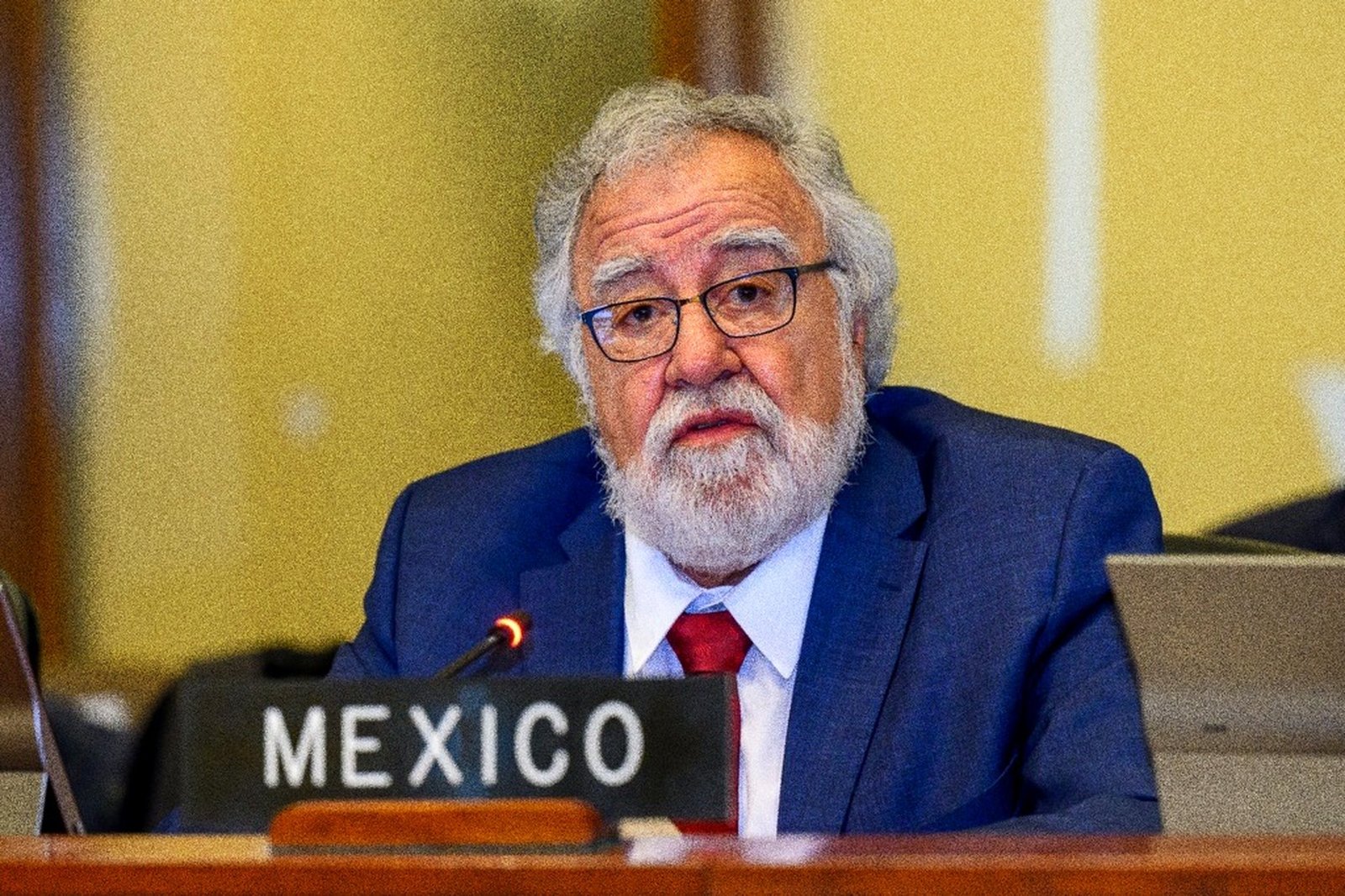
Mexico City. The Mexican government warned this Wednesday that labeling Nicaragua’s political crisis as a threat to regional security “does not necessarily contribute to resolving it” and may, on the contrary, “deepen the isolation” of the Central American country, said Mexico’s representative to the Organization of American States (OAS), Alejandro Encinas.
In setting out Mexico’s position before the OAS Permanent Council—which voted this morning and approved a resolution promoted by the United States to convene a meeting of foreign ministers to discuss actions in response to the plan by the government of Daniel Ortega and Rosario Murillo to abolish elections in Nicaragua—Encinas affirmed that the Mexican government is willing to “participate constructively” in efforts to address the political and human rights crisis in the Central American nation.
However, it declined to support the US proposal, considering that it lacks clarity about the actions it would seek to undertake. For that reason, Mexico voted to abstain.
“Nicaragua’s internal situation does not constitute a threat to hemispheric peace or security.”
Alejandro Encinas, Mexico’s representative to the OAS
Encinas explained that Mexico “has followed the evolution of the political and human rights situation in Nicaragua” and reiterated the Mexican government’s “permanent commitment” “to the promotion, protection, and respect of human rights and fundamental freedoms.”
The diplomat recalled that the Constitution establishes the principles that govern the country’s foreign policy: the self-determination of peoples, non-intervention, the peaceful resolution of disputes, and unrestricted respect for human rights.
On the basis of that framework, he said, Mexico considered that Nicaragua’s internal situation “does not constitute a threat to hemispheric peace or security.”
Encinas warned that characterizing the Nicaraguan crisis as a risk to regional security “could open the door to proposing actions that exceed the powers” of the OAS, since these are internal affairs of a state that is no longer part of the organization.
He added that such an approach could prove incompatible with the principles of sovereignty, self-determination, non-intervention, and the peaceful resolution of disputes contained in the OAS Charter, the United Nations Charter, and the American Convention on Human Rights.
Encinas stressed that Mexico does not agree with convening a consultation meeting of foreign ministers on Nicaragua “without having clarity about what the appropriate actions might be,” nor without a prior process of consultation and analysis.
That path, he maintained, could steer the process away from the search for peaceful and diplomatic solutions and orient it toward a security-focused approach to a situation he described as “essentially political and about human rights.”
The representative recalled the validity of the international instruments to which Nicaragua is a party, in particular the American Convention on Human Rights, which enshrines the right of every person to take part in “genuine, periodic elections by universal, free, and secret suffrage.”
Encinas also cited President Claudia Sheinbaum, who, he said, has been clear in noting that the Mexican government “always” agrees with democracy.
The diplomat reiterated Mexico’s willingness to collaborate in any process that facilitates dialogue, promotes international cooperation for development, and strengthens the protection of human rights in Nicaragua, “on the premise that peace and democracy are consolidated through respect for the popular will, sovereignty, and understanding among nations.”
-
People’s Mañanera October 21
President Sheinbaum’s daily press conference, with comments on Pemex, fuel theft, Jalisco’s water crisis, missing persons, and the lie detector.
-
Jáuregui’s Arrest Does Not Close the CIA Case in Chihuahua; Morena Demands Broader Investigations
Morena leader Ariadna Montiel holds Governor Maru Campos politically responsible and says ex-prosecutor Guillermo Zuany must also face justice.
-
Morena Accuses Violation of the Secular State Over Award Ceremony for Evangelicals in the Chamber of Deputies
A representative of Israel’s embassy attended the PRI-hosted event, and the group’s founder was arrested in the U.S. for drug trafficking in 2007, Morena deputies said.