Mexico Discovers Ceremonial Plaza and Stela of Unknown Culture in Coatepec, Veracruz
This article by Ana Mónica Rodríguez originally appeared in the August 22, 2026 edition of La Jornada, Mexico’s premier left-wing daily newspaper.
In Coatepec, Veracruz, archaeologists from the National Institute of Anthropology and History (INAH) discovered a civic-ceremonial structure and a monolithic sculpture with “characteristics atypical of the region,” near the pre-Hispanic zone of Campo Viejo, which is more than 2,000 years old.
What has drawn the specialists’ attention is that it is a platform whose flanks display circular-shaped stones, and a monolith showing one of two figures with possible Mayoid features.
In an interview, archaeologists Lino Espinoza García and Alberto Vázquez Domínguez revealed that, based on the materials found, the settlement of this civilization “gives us a relative chronology of some 1,500 years before the Christian era, which is when the settlement of Campo Viejo begins, and from there on there is a constant population until the colonial period; meanwhile, the findings of the platform and the stela could have a relative chronology dating to the Protoclassic period, which ranges between 200 BC and 200 AD.”
They added that “we are just a few days away from carrying out carbon-14 studies, which could give us an absolute date.”
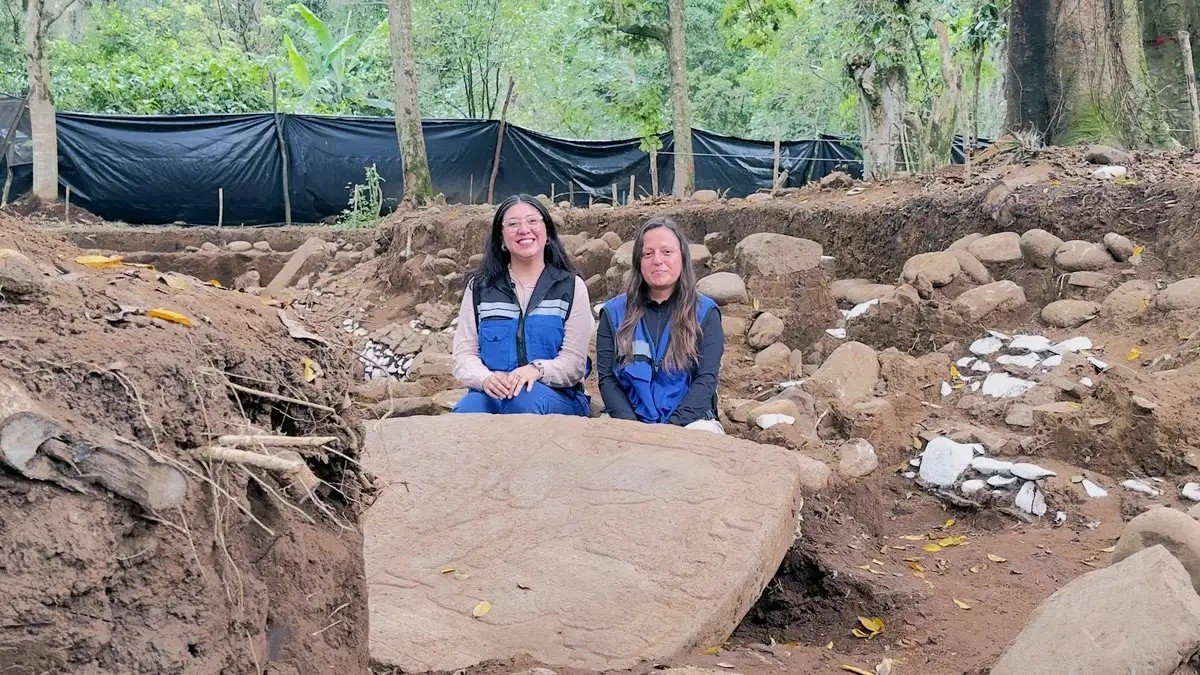
The discovery took place on a private property in the San Lucas subdivision, where “a platform (30 meters long by 12 meters wide) built with flagstones and dressed white limestone with a plaster-like texture emerged, a characteristic achieved by induced means to decorate the walls, possibly through a type of firing.”
The ornamentation, they explained, consists of lines or figures resembling squares, and circular-shaped stones on two of its flanks, attributes that are not characteristic of the region and had not been recorded previously.
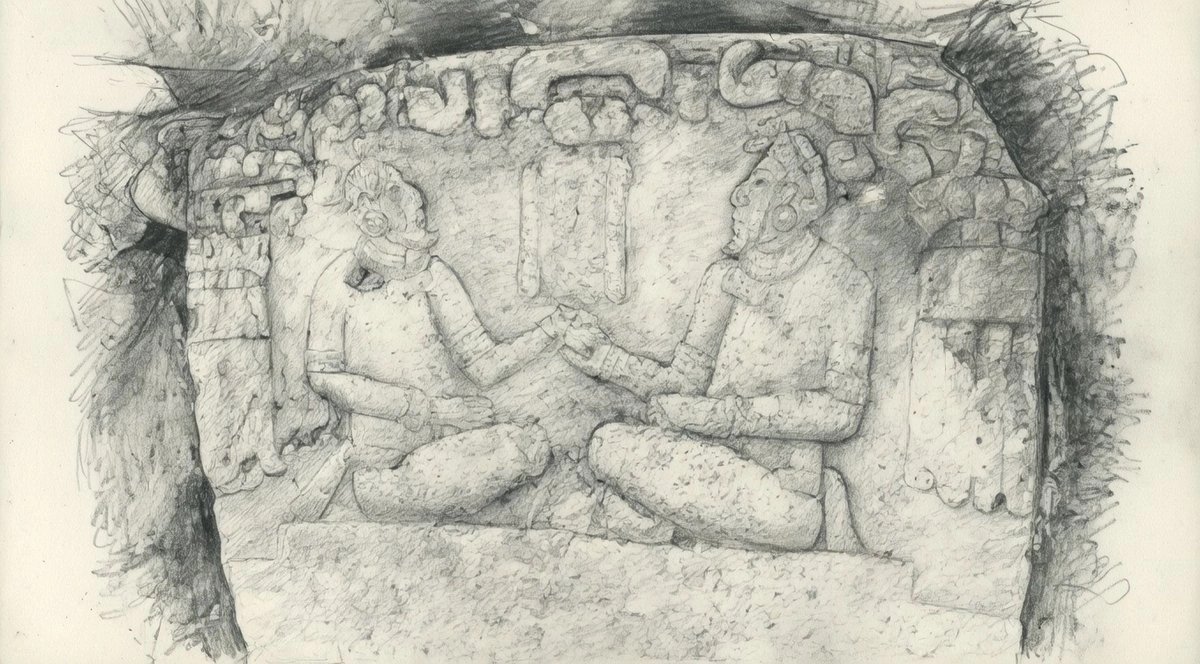
A monolithic sculpture was also found, “1.88 meters tall by 1.47 meters wide at its broadest part, and 68 centimeters at its narrowest. Its thickness ranges between 22 and 25 centimeters, and it bears engravings alluding to an event of a symbolic nature in which two elite figures, in a seated position and with elaborate garments, receive in a vessel a fluid from a divine entity that is on a higher plane.”
Espinoza García added: “In the stela, two figures are represented in a seated position, with two vessels in their hands and probably performing a ritual of petition or initiation; one of them appears to be of advanced age and the other younger; both wear the same attire (such as headdresses, wristbands, pectorals, and necklaces), and in the upper part iconographic elements can be seen alluding to a descending bird, but we are still trying to understand” each element.
Lino Espinoza noted: “The entire stela, in andesite stone, alludes to matters of fertility and the cultivation of the land.”
The entire stela, in andesite stone, alludes to matters of fertility and the cultivation of the land.
Lino Espinoza García, INAH archaeologist
Both the structure and the sculpture, which is reminiscent of those of the Maya culture, were found in a good state of preservation.
During the salvage work, archaeological soundings have been carried out that have made it possible to recover and identify other pre-Hispanic materials associated with the structure, “such as remains of charred corn, found in the form of offerings, vessels, and a green-stone bead fragmented into four parts, in addition to cinnabar pigments,” which will be sent to the laboratory for study.
A Local Civilization
Regarding the culture to which the materials might belong, although the term Totonac is common for the populations that developed between the Cazones and Papaloapan rivers, there is a lack of indicators of that civilization at the site, so the specialists propose that it is a local culture with attributes of Gulf Coast groups, they indicated.
The field excavations conclude this month, and the specialists will continue with the laboratory analyses, which will extend into early 2027.
This project, which began at the end of 2025 and was authorized by INAH’s Archaeology Council, arose from a request for a change in land use for the development of private urban infrastructure, since the area where the archaeological work is being carried out, roughly 12 hectares, is intended for residential use.
The salvage work is also part of the research that the INAH Veracruz Center has carried out on the periphery of the Campo Viejo archaeological site (where the San Lucas subdivision is located) since the year 2000, aimed at the research, protection, and preservation of the archaeological heritage.
Notably, the financial, technological, and specialized-use resources, professional equipment and tools, as well as support personnel, have been provided by the property’s owners, who have taken an interest in the discoveries and their dissemination.
-
Mexican Governor Maru Hands Out Gifts and Rivers of Public Money to Media and Famous Journalists From Mexico City
Ties from Pineda Covalín, 5,000 tamales and 1.5 million pesos for Adela Micha: Chihuahua’s PAN governments have spent billions polishing their image.
-
Jáuregui, Maru Campos’s Former Prosecutor, Is Ordered to Stand Trial for Treason Against Mexico
After 80 years without a similar case, a judge ordered the trial on more than 150 pieces of evidence presented by the Attorney General’s Office.
-
Mexico Meets Minimum Annual Water Delivery to the US Despite Extreme Drought
Washington’s Agriculture Secretary confirmed the 350,000 acre-feet, but pressed Mexico to keep delivering and repay the “water debt owed to Texas farmers”.