Mexico Announces 12,750 Primary Care Clinics for 2027
This article by Fernanda Monroy originally appeared in the August 25, 2026 edition of Contralínea, a Mexican investigative journalism magazine.
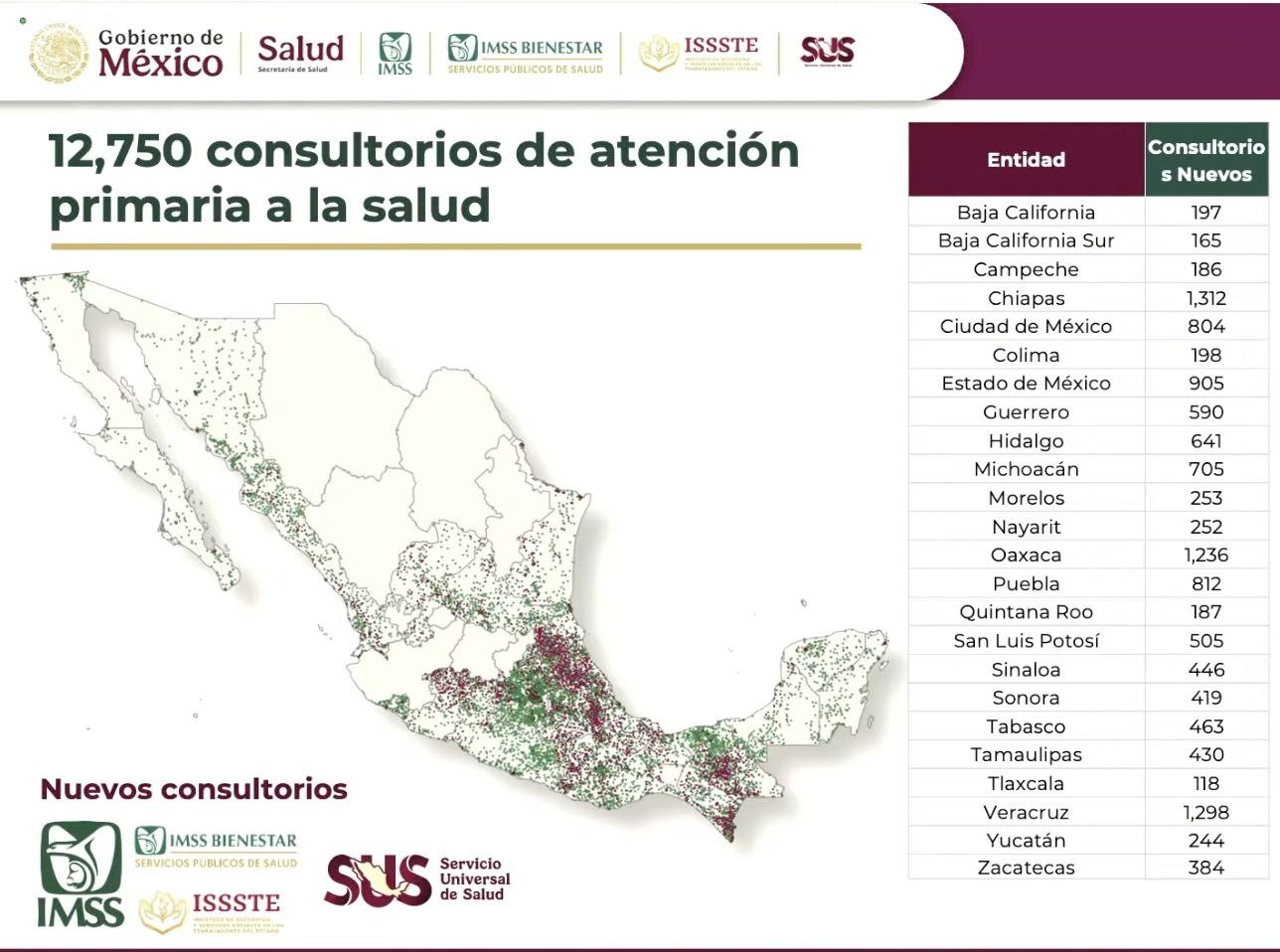
The federal government will expand its primary health care network with 12,750 new clinics in the 24 states where IMSS-Bienestar operates. The new infrastructure will begin operating in January 2027 and, according to the Ministry of Health, will add 40 million consultations for the population.
The Undersecretary for Sectoral Integration and Coordination of Medical Care Services, Eduardo Clark, explained during the morning press conference that the clinics aim to bring medical services closer to people and treat low-complexity conditions, as well as follow up on chronic degenerative diseases such as diabetes and hypertension.
The new spaces will be installed in both urban and rural areas, based on identifying places where medical care points are currently lacking or where existing capacity needs to be expanded. For this, Health Houses, clinics, workplaces, and IMSS Family Medicine Units, among other spaces, are being considered.
The official noted that the clinics will have a standardized care model across the 24 states. They will also have medical staff able to prescribe medications, as well as basic equipment and technological tools, including computers, internet, and an Electronic Medical Record.
He detailed that these spaces will treat acute conditions requiring immediate care, such as a cold, diarrhea, or mild pain, but will also serve for the prevention and control of chronic diseases.
In addition, each clinic will have 90 types of free medications, selected by specialists from the Ministry of Health, the IMSS, the ISSSTE, and IMSS-Bienestar to treat the main primary-care conditions. The planned hours will be 8:00 a.m. to 8:00 p.m. on weekdays, while on weekends they will operate from 8:00 a.m. to 2:00 p.m.
For his part, the Minister of Health, David Kershenobich, explained that primary care seeks to keep patients from having to go directly to hospitals for conditions that can be resolved at a first level of care.
“Primary health care is the closest point where the population can receive care; it is the gateway to the Health System.”
David KerShenObich
According to the official, this model will also improve follow-up of people with diabetes and hypertension, carry out prevention and vaccination actions, and follow up on pregnant women and children.
If medical staff detect a serious condition, the patient may be referred to higher-level care units, including IMSS-Bienestar, IMSS, or ISSSTE hospitals.
The expansion of the clinics will be linked to the Universal Health Service, through an app that will allow users to manage appointments, check their medical history, review prescriptions, and have an electronic medical record.
Undersecretary Clark also reported that a National Teleconsultation Center is planned, with 1,000 doctors available to provide remote care from users’ homes or workplaces.
The official noted that access to the new clinics will be universal within the 24 states where IMSS-Bienestar operates. That is, a person will be able to go to a clinic regardless of whether their coverage corresponds to IMSS, ISSSTE, or IMSS-Bienestar.
The launch of the clinics will be accompanied by a community process. Starting September 14, the Health for Well-being Committees will begin to be formed; they will receive resources and verify the necessary adaptations to the spaces.
Also, from September 14 to October 31, a call will be open to hire the staff who will work at these clinics. It will be aimed at doctors, nurses, and technical and auxiliary health personnel.
He added that retired doctors and nurses may also participate, joining the program without suspending their pension payments. The federal government expects the network to begin operating in January 2027 and to be ready between January and February of that year.
-
Mexican Governor Maru Hands Out Gifts and Rivers of Public Money to Media and Famous Journalists From Mexico City
Ties from Pineda Covalín, 5,000 tamales and 1.5 million pesos for Adela Micha: Chihuahua’s PAN governments have spent billions polishing their image.
-
Jáuregui, Maru Campos’s Former Prosecutor, Is Ordered to Stand Trial for Treason Against Mexico
After 80 years without a similar case, a judge ordered the trial on more than 150 pieces of evidence presented by the Attorney General’s Office.
-
Mexico Meets Minimum Annual Water Delivery to the US Despite Extreme Drought
Washington’s Agriculture Secretary confirmed the 350,000 acre-feet, but pressed Mexico to keep delivering and repay the “water debt owed to Texas farmers”.