
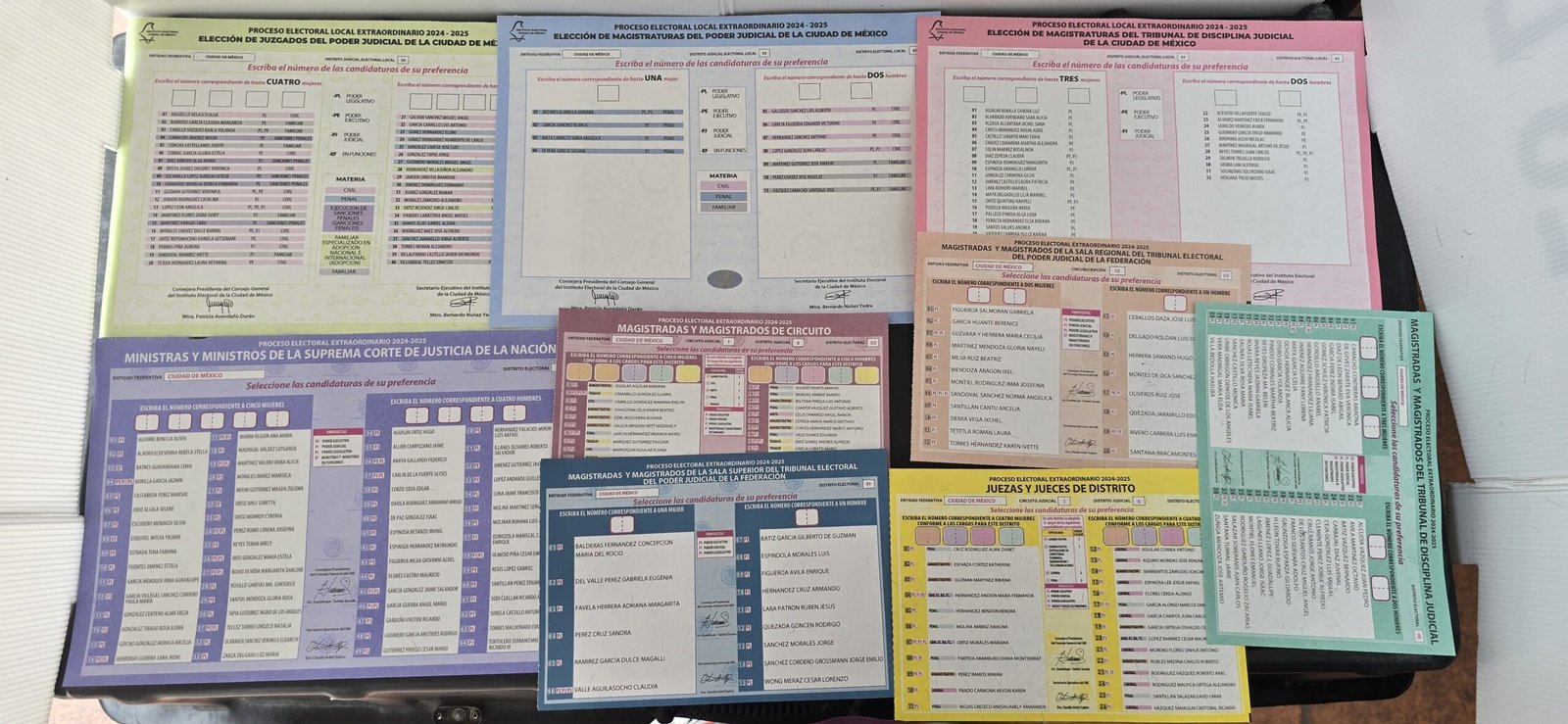
On June 2, 2024, Claudia Sheinbaum was elected President of Mexico. Sheinbaum, the former Head of Government of Mexico City and a member of the Movimiento Regeneración Nacional (National Regeneration Movement, or Morena) party, ran on a promise to continue many of the policies of the outgoing president and Morena founder Andrés Manuel López Obrador, including a proposed constitutional reform1The term “constitutional reform” is used in Mexico instead of “constitutional amendment.” to elect every local, state, and federal judge and minister in the country by popular vote.2“Cargos a elegir,” Instituto Nacional Electoral, accessed February 27, 2026, https://ine.mx/cargos-pj-2025. Three months later, the lower house of Mexico’s legislative branch, the Chamber of Deputies, approved the reform.3The reform is long and multifaceted, and not every detail is discussed in this paper. Among other provisions, it decreased the number of SCJN ministers from eleven to nine, shortened terms from fifteen to twelve years, capped ministers’ salaries so as not to exceed that of the President of the Republic, established a Judicial Discipline Tribunal to sanction or remove ministers, and reorganized the process of obtaining and moving between judicial careers. The reform will be carried out in two rounds. A second round of elections for all state-level judges and remaining federal judges and members of the Tribunal of Judicial Discipline is scheduled for 2027. It passed the Senate a week later, was quickly approved by a simple majority of state legislatures, and became constitutional law on September 15, 2024. Finally, on June 1, 2025, Mexicans went to the polls and cast votes for nearly nine hundred judicial positions, including district judges, circuit magistrates, electoral court magistrates, and ministers of the Suprema Corte de Justicia de la Nación (Supreme Court of Justice of the Nation, or SCJN).4When talking about members of the Supreme Court, the term “ministers” is used in Mexico instead of “justices.” Mexico had made history, becoming the second country after Bolivia to elect a supreme court and the first to elect every judicial position directly.5Ricardo Miranda, interviewed by Luke Pickrell, “Ricardo Miranda on Mexico's Constitution and the Programa Universitario de Estudios sobre Democracia, Justicia y Sociedad,” The Democratic Constitution Blog, March 21, 2025, https://democraticconstitutionblog.substack.com/p/the-democratic-constitution-podcast-534. “The people are a force to be reckoned with and have achieved something historic,” announced Regeneracíon, a Morena newspaper, “the process of regenerating the judiciary begins.”6Instituto Nacional de Formación Política, “La Reforma al Poder Judicial ¡Va!,” Regeneracíon, November 10, 2024, https://www.infpmorena.com.mx/regeneracion.
This paper examines two factors that supported the 2024 judicial reform in becoming constitutional law and maintaining its popularity leading up to the elections: the success of Morena—a political juggernaut that has dominated the competition in consecutive presidential elections—and the failure of Mexico’s two largest opposition parties, the Partido Revolucionario Institucional (Institutional Revolutionary Party, or PRI) and the Partido Acción Nacional (National Action Party, or PAN), to gain mass support. Morena’s success is attributed to two factors: its ability to realize campaign promises leading up to the proposed judicial reform, and its success in advertising to and interacting with the public before and after the reform became law. Special attention is given to Morena’s education and propaganda wing, the Instituto Nacional de Formación Política (National Institute of Political Formation, or INFP).7All translations of Spanish text in this article, including material from the INFP, are the author's. Morena delivered on enough of its prior promises to gain the respect and trust of its base. When López Obrador formally announced the judicial reform in September 2023 and then sent it to Congress in February 2024 as part of a larger package of reforms, millions of people trusted Morena to deliver results—even if they did not always understand the specifics of the judicial reform.8MND Staff, “Polls on Morena's judicial reform show the majority of Mexican's support it,” Mexico Daily News, June 18, 2024, https://mexiconewsdaily.com/politics/judicial-reform-polls-show-majority-in-favor. After the reform became law, Morena mobilized the public through visual media and community meetings. This outreach helped the reform maintain popular support in the lead-up to election day.9Jordan Lippert and Sofia Hernandez Ramones, “Ahead of Mexico's First-Ever Judicial Elections, Most Mexicans Approve of the Law That Implemented Them,” Pew Research Center, May 22, 2025, https://www.pewresearch.org/short-reads/2025/05/22/ahead-of-mexicos-first-ever-judicial-elections-most-mexicans-approve-of-the-law-that-implemented-them. Meanwhile, the PRI and PAN are strongly associated with neoliberal economic policies, an ongoing war on drugs that has left hundreds of thousands dead and disappeared, and brutal repression against dissent. Both parties previously attempted to reform the judiciary—the PRI in 1994 and the PAN in 2011—but with few measurable long-term successes.
01Literature Review
Before exploring the two factors behind the success of the 2024 judicial reform, it is necessary to review the evolution of Mexico’s judicial system—particularly the SCJN—since the current Constitution was written in 1917. This discussion is followed by a review of what has been said about the most recent judicial reform.
Mexico’s Judicial System
The Mexican Constitution has been amended hundreds of times.10Andrea Castagnola and Saúl López Noriega, “The Transformation of the Role of the Mexican Supreme Court,” in Judicial Politics in Mexico: The Supreme Court and the Transition to Democracy, ed. Andrea Castagnola and Saúl López Noriega (Routledge, 2018). The size of the SCJN, the length and terms of service, and the purview of the federal and state judiciary have all evolved.11José María Serna de la Garza, The Constitution of Mexico (Hart Publishing, 2013), 104-5. From 1929 to 2000, state power was held by the Partido Revolucionario Nacional (National Revolutionary Party, or PRN), which became the PRI in 1946. For decades, the PRI successfully controlled most political, labor, and social organizations through a mixture of clientelism, patronage, and coercion.12Emily Edmonds-Poli and David A. Shirk, Contemporary Mexican Politics, 4th ed. (Rowman & Littlefield, 2020), 56-9. The judicial system was also subordinate to the PRI. Ministers and judges became chameleon-like actors who, if not PRI members themselves, followed the “ideas of the highest members of the ruling group at the moment, especially those of the president of the republic, be they revolutionary, conservative, or whatever else is in fashion.”13Pilar Domingo, “Judicial Independence: The Politics of the Supreme Court in Mexico,” Journal of Latin American Studies 32, no. 3 (2000): 719, https://doi.org/10.1017/S0022216X00005885. Whenever a minister or judge left his position, he had a comfy position waiting somewhere else within the party’s orbit. (Most judicial positions were held by men: the first female Supreme Court minister was elected in 2023.) All replacements would be nominated by a PRI president and confirmed by a PRI-dominated Senate. But if Mexican history proves anything, it is that the powerful inevitably fall. In 1988, the PRI was forced to resort to remarkably ham-fisted measures in assuring its candidate won the presidency.14Mexicans were told that the electronic voting-counting system crashed. When the system finally turned back on, Gortari had surged ahead in the count. In 1991, the PRI and PAN agreed to burn the saved electoral ballots. Investigations after the PRI left power confirmed the fraud. Twelve years later, it lost a presidential election for the first time in party history.15The PRI had lost other presidential elections, most famously in 1988. This was the first time the party lost a presidential election despite any efforts to cheat.
The period between President Salinas de Gortari in 1988 and President Vicente Fox in 2000 is often referred to as a time of national democratization, with Fox’s victory serving as an exclamation point.16See Edmonds-Poli and Shirk, Contemporary Mexican Politics, 71; Larry Diamond, “What the Democratization of Mexico Means for All the World,” Hoover Digest, October 30, 2000, https://www.hoover.org/research/what-democratization-mexico-means-all-world; Clare Ribando Seelke, “Mexico: Background and U.S. Relations,” Congressional Research Service, May 17, 2023, https://www.congress.gov/crs-product/R42917; Roderic Ai Camp, “Democratizing Mexican Politics: 1982–2012,” Oxford Research Encyclopedia of Latin American History, April 2, 2015, https://doi.org/10.1093/acrefore/9780199366439.013.12; and Tom Ginsburg, “Introduction,” in Judicial Politics in Mexico: The Supreme Court and the Transition to Democracy, ed. Andrea Castagnola and Saúl López Noriega (Routledge, 2018). An important marker along the road to democratization was a SCJN reform initiated by President Ernesto Zedillo in 1994. Under the reform, the twenty-six-member SCJN was dismissed and replaced with a hand-picked list of eleven ministers (the PRI had to negotiate the list with the PAN, which had gained significant ground in Congress).17Jodi S. Finkel, “Judicial Reform as Insurance Policy: Mexico in the 1990s,” Latin American Politics and Society 47, no. 1 (2005): 107, https://doi.org/10.1111/j.1548-2456.2005.tb00302.x. The reform also lowered term lengths from life to fifteen years, raised qualification standards, and created the Federal Judicial Council (CFJ) to serve as a hiring and disciplinary body guarding against corruption and ensuring a high standard of performance.18Domingo, “Judicial Independence,” 715. Perhaps most significantly, it greatly expanded the SCJN’s role, giving it powers of legislative review closer to—but not yet reaching—those of the Supreme Court of the United States.19Pedro Salazar Ugarte, “The Law As Power,” in Judicial Politics in Mexico: The Supreme Court and the Transition to Democracy, ed. Andrea Castagnola and Saúl López Noriega (Routledge, 2018), chap. 2. For many, this marked the beginning of judicial independence, which most regard as a key tenet of a democratic state.20Domingo, “Judicial Independence,” 705. Explanations for why the PRI (in consultation with the PAN) chose to weaken its hold on the judicial branch include increasing social complexity,21Héctor Fix-Fierro, “Judicial Reform in Mexico: What Next?” in Beyond Common Knowledge: Empirical Approaches to the Rule of Law, ed. Erik G. Jensen and Thomas C. Heller (Stanford University Press, 2005), 248. political calculation,22Fix-Fierro, “Judicial Reform,” 271. and personal gain.23“Ernesto Zedillo, the former president who inaugurated the ‘golden pension’ for ministers, reappears to question the reform of the judiciary,” Pie de Pagina, September 16, 2024, https://piedepagina.mx/ernesto-zedillo-el-expresidente-que-inauguro-la-pension-dorada-de-ministros-reaparece-para-cuestionar-la-reforma-del-poder-judicial. The judicial system began taking on a more independent role following the 1994 reform, and, eventually, decided its first case of unconstitutionality against the PRI in 1998.24Serna de la Garza, The Constitution, 127. Since 2000, the judicial system has struggled with many of the same issues as other government institutions, including a lack of capacity and resources, internal corruption, and low levels of public confidence.25Edmonds-Poli and Shirk, Contemporary Mexican Politics, 89. Morena looked to address many of these concerns through the direct election of judges and magistrates.
Arguments For and Against Direct Elections
Opponents of the 2024 reform argued that it was a “clearly retributive agenda”26Jaime Olaiz-González, “Interesting Times in Mexico: Constitutional Demise was Not on the Ballot,” ICL Journal 18, no. 3 (2024): 387, https://doi.org/10.1515/icl-2024-0030. that amounted to “democratic backsliding,”27Azul A. Aguiar Aguilar, “Courts and the Judicial Erosion of Democracy in Latin America,” Politics and Policy 51, no. 1 (January 2023): 8, https://doi.org/10.1111/polp.12516. a “hollowing-out” of the judiciary,28Amanda Driscoll, Michael J. Nelson, and Julio Ríos-Figueroa, “Mexico's Judicial Elections and the Politics of Reform,” Judicature International, accessed March 6, 2026, https://judicature.duke.edu/articles/mexicos-judicial-elections-and-the-politics-of-reform. an undermining of protections against government abuse,29Gustavo López Nachón, “Losing Sight of Judicial Independence: The Case of Mexico's Judicial Reform,” Yale Journal of International Law Forum, July 9, 2025, https://yjil.yale.edu/posts/2025-07-09-losing-sight-of-judicial-independence-the-case-of-mexicos-judicial-reform. a destabilizing of “liberal institutions that are essential pillars of democracy,”30Mónica Castillejos-Aragón, “Populism and Challenges to Judicial Independence in Mexico,” Berkeley Review of Latin American Studies, accessed March 17, 2026, https://clacs.berkeley.edu/brlas2023/law-populism-and-challenges-judicial-independence-mexico. and a further step toward some version of authoritarianism. Some believe that Mexico is already an authoritarian society after the previous six years of López Obrador.31Azul A. Aguiar Aguilar, Rodrigo Castro Cornejo, and Alejandro Monsiváis-Carrillo, “Is Mexico at the Gates of Authoritarianism?,” Journal of Democracy 36, no. 1 (January 2025): 51, https://doi.org/10.1353/jod.2025.a947883. Even the United States felt obliged to weigh in against the reform.32“Mexico lashes out at US ambassador's comments on proposed judicial reform,” Al Jazeera, August 23, 2024, https://www.aljazeera.com/news/2024/8/23/mexico-lashes-out-at-us-ambassadors-comments-on-proposed-judicial-reform. Former president Fox opposed the change, labeling it “treason against the homeland” and calling on Mexicans to “defend democracy.”33Mayte Baena, “Vicente Fox explota tras aprobación de la reforma al Poder Judicial: ‘Traición a la patria,’” Infobae, September 11, 2024, https://www.infobae.com/mexico/2024/09/11/vicente-fox-reacciona-a-la-aprobacion-de-la-reforma-al-poder-judicial-tilda-accion-de-traicion-a-la-patria. Speaking at a Georgetown University event on “The State of Democracy in America,” former president Calderón said that the United States should have taken the dangers of the reform more seriously.34Andrés García, “Calderón responsabiliza a Ken Salazar por falta de reacción ante la reforma judicial mexicana,” Infobae, September 10, 2025, https://www.infobae.com/mexico/2025/09/10/calderon-responsabiliza-a-ken-salazar-por-falta-de-reaccion-ante-la-reforma-judicial-mexicana. Mexico’s judicial sector has been an especially vocal opponent of the reform. Many SCJN ministers spoke out against the change as it moved through Congress, calling it “very dangerous” to “[make] judges or justices [beholden] to political opinions and to popular opinions.”35Rebecca Bayer, “Departing Mexican Supreme Court justice weighs in on judicial reforms in his country,” Harvard Law Today, November 21, 2024, https://hls.harvard.edu/today/departing-mexican-supreme-court-justice-weighs-in-on-judicial-reforms-in-his-country. Eight of the then eleven justices resigned once the reform became law rather than stand for election. On September 10, 2024, protestors—among them judicial employees and law students—entered the Senate chambers to physically obstruct a vote on the reform.36Megan Janetsky, “With protestors at the door, Mexico's Senate says judges must stand for elections,” The Christian Science Monitor, September 11, 2024, https://www.csmonitor.com/World/Americas/2024/0911/mexico-senate-controversial-judge-elections.
The idea of direct elections for SCJN ministers was first voiced publicly by Morena in the Chamber of Deputies in May 2023. The party argued that by invalidating Morena’s “Plan B,” a bundle of laws which included changes to the INE, the SCJN had crossed a line by overriding the “democratic will” of Congress.37Georgina Zerega, “Morena busca llevar el destino de los miembros de la Suprema Corte a una consulta popular,” El País, May 13, 2023, https://elpais.com/mexico/2023-05-15/morena-busca-llevar-el-destino-de-los-miembros-de-la-suprema-corte-a-una-consulta-popular.html. After announcing his intention to send a reform to Congress in September 2023, López Obrador argued that “those who administer justice must serve the people—their causes and mandates—and not, as is currently the case, operate under the directives benefiting specific groups or political and economic factions, or even under the directive of criminal interests.”38Zedryk Raziel and Carmen Morán Breña, “López Obrador arremete contra el Poder Judicial en su quinto informe de Gobierno: ‘Tienen convivencias inconfesables,’” El País, September 1, 2023, https://elpais.com/mexico/2023-09-01/lopez-obrador-arremete-contra-el-poder-judicial-en-su-quinto-informe-de-gobierno-tienen-convivencias-inconfesables.html.
Supporters of the reform have pointed to low levels of public trust in the judicial system due to nepotism, corruption, and the power of “monied interests.”39Alejandra Spitalier, “Justice Denied: The Case for Judicial Reform in Mexico,” Wilson Center, September 5, 2024, https://www.wilsoncenter.org/article/justice-denied-case-judicial-reform-mexico. They argued that the SCJN routinely served the interests of a wealthy minority of the population and only used the language of “constitutionality” and “judicial independence” to hide its class bias.40Mariano Guevara, interviewed by Luke Pickrell, “Mariano Guevara Recaps Mexico's Judicial Elections,” The Democratic Constitution Blog, June 25, 2025, https://democraticconstitutionblog.substack.com/p/mariano-guevara-recaps-mexicos-judicial. Other proponents asserted that the reform would stop the judicial sector from blocking progressive and majority-supported social policies like better healthcare and expanded retirement benefits for women.41“Plan C en las calles: gobernar con el pueblo,” Conciencias, September 8, 2024, https://revistaconciencias.mx/gobernar-con-el-pueblo. It would also provide a degree of protection from the long reach of the interventionist-prone United States,42Leonardo Lugo Maonroy, “La reforma judicial, ¿por qué le interesa tanto a la derecha?,” Conciencias, November 6, 2024, https://revistaconciencias.mx/la-reforma-judicial-por-que-le-interesa-tanto-a-la-derecha. serve as a bulwark against “lawfare” (the weaponizing of the judicial system by right-wing actors against progressive politicians),43Guevara, “Mariano Guevara Recaps Mexico's Judicial Elections.” allow for a greater diversity of opinions to be expressed through the judicial process, and generally bring the law closer to the average citizen.44Miranda, “Ricardo Miranda on Mexico's Constitution.” The reform was considered “overdue,” “revitalizing,” and a “new moment” unlike anything else in the long history of constitutional change.45Miranda, “Ricardo Miranda on Mexico's Constitution.” Rather than an example of López Obrador’s alleged “contempt for democratic institutions,”46Castillejos-Aragón, “Populism and Challenges to Judicial Independence in Mexico,” 42. the direct elections of judges and ministers were seen as a step forward for the country’s democracy.47Guevara, “Mariano Guevara Recaps Mexico's Judicial Elections.”
02The Success of Morena
To understand why such a sweeping constitutional reform became possible, one must first understand the rise of Morena and the political trajectory of López Obrador. Morena is the product of López Obrador’s political initiative and achievements.48Martí Batres Guadarrama, Morena y su Identidad Política (Panorama, 2017), 9. Those achievements, in turn, were built through and amplified by constant discourse and connection with the people of Mexico. A leader in the now-defunct Partido de la Revolución Democrática (Democratic Revolution Party, or PRD) in the southern state of Tabasco, López Obrador entered the national spotlight in 1992 after heading the Exodus for Democracy to Mexico City, where he addressed thousands of supporters.49A movement organized by López Obrador to protest the PRI's allegedly fraudulent victory in the 1991 Tabasco gubernatorial election. His star rose after the infamous desafuero campaign in which President Fox attempted to strip him of his political immunity as Head of Government of Mexico City over a minor legal battle. López Obrador’s popularity reached new heights after he led another protest over the outcome of the 2006 presidential election, when he lost to Felipe Calderón. Claiming fraud and refusing to recognize the results, López Obrador declared himself the legitimate president, held a rally in Mexico City’s historic main square, and toured all thirty-two states to rally support.50Edmonds-Poli and Shirk, Contemporary Mexican Politics, 91-2.
Fulfilling Promises and Building Trust
Politicians always make promises. But follow-through is all too rare. Morena, however, has delivered—at least in some areas, and at least enough to build a degree of trust. In 2019, López Obrador introduced the Banco del Bienestar, a nationwide system that has increased access to welfare and banking services, including pensions and savings accounts.51“Banco del Bienestar: 6 años de entregas de los Programas para el Bienestar a quienes más los necesitan,” Programas para el bienestar, July 21, 2025, https://programasparaelbienestar.gob.mx/banco-del-bienestar-6-anos-de-entregas-de-los-programas-para-el-bienestar-a-quienes-mas-los-necesitan. Since 2018, access to educational scholarships has been expanded,52“El Programa Nacional de Becas para el Bienestar Benito Juárez cumplió la meta de apoyar a 10 millones de estudiantes,” Gobierno de México, accessed March 3, 2026, https://www.gob.mx/becasbenitojuarez/articulos/el-programa-nacional-de-becas-para-el-bienestar-benito-juarez-cumplio-la-meta-de-apoyar-a-10-millones-de-estudiantes-215728. the federal minimum wage has increased,53“Incremento a los Salarios Mínimos para 2026,” Gobierno de México, December 3, 2025, https://www.gob.mx/conasami/articulos/incremento-a-los-salarios-minimos-para-2026?idiom=es. and some 13.4 million people have been lifted out of poverty as measured by the state’s official index.54Oscar Lopez, “‘Historic’: how Mexico's welfare policies helped 13.4 million people out of poverty,” The Guardian, August 18, 2025, https://www.theguardian.com/world/2025/aug/18/mexico-welfare-policies-amlo. The government’s Housing for Well-Being Program aims to build over one million affordable homes by 2030.55MND Staff, “Mexico announces plan to build 1.1M new homes by the end of Sheinbaum's term,” Mexico Daily News, April 14, 2025, https://mexiconewsdaily.com/news/mexico-affordable-housing-plan-build-new-homes-sheinbaum. Clara Brugada, the Head of Government of Mexico City and a Morena member, has been internationally recognized for her promotion of accessible urban social services and cultural activities.56“Reciben Utopías de la Ciudad de México Reconocimiento Internacional del OIDP por Mejores Prácticas de Participación Ciudadana,” Ciudad de México, October 28, 2024, https://cultura.cdmx.gob.mx/comunicacion/nota/374-24.
This is not to say that Morena’s record is perfect. There are many areas for improvement, including addressing questions of internal corruption and freedom of expression.57This is not the space for a conversation about internal party democracy, the extent to which minority voices are often formally or informally silenced within organisations of all types, and whether or not recognizing factions or currents would solve anything. Yet, given Morena's size and ideological diversity, one feels a little uneasy reading Guadarrama's (2017) claim that “diversity of opinion expresses itself naturally [in Morena]” without the need to formally recognize minority views (41). Granted, Guadarrama's statement is from 2017, when the party was much smaller. However, it is not clear that party policy has changed its policy toward internal factions since then. But by the time López Obrador announced the judicial reform, Morena had built up enough support and trust that most people were willing to give support to whatever lay ahead. Not everyone understood what the reform would do, but confidence in the party was high. When the reform was announced, López Obrador’s approval rating stood at 69 percent.58Carin Zissis, “Approval Tracker: Mexico's President AMLO,” AS/COA, September 13, 2024, https://www.as-coa.org/articles/approval-tracker-mexicos-president-amlo. From that point on, it never dipped below 68 percent, and even reached a high of 77 percent when he stepped down in October of 2024.59Luis Pablo Beauregard and Patricia San Juan Flores, “Claudia Sheinbaum has higher approval ratings than López Obrador after first year in office,” El País, October 1, 2025, https://english.elpais.com/international/2025-10-01/claudia-sheinbaum-has-higher-approval-rating-than-lopez-obrador-after-first-year-in-office.html. Morena’s policies were popular enough that when the SCJN obstructed some of his legislative victories—as it did on multiple occasions during López Obrador’s six-year term60Atzayacatl Cabrera, “¿Cuál es el origen del Plan C de AMLO?,” El Sol de México, June 5, 2024, https://oem.com.mx/elsoldemexico/mexico/cual-es-el-origen-del-plan-c-de-amlo-13123024.—the party’s support increased. López Obrador was elected with nearly 54 percent of the vote in 2018, but Morena and its allies fell short of a congressional majority. However, in the May 2024 elections, Morena and its coalition partners—the Partido Verde Ecologista de México (Ecologist Green Party of Mexico, or PVE) and the Partido del Trabajo (Labor Party, or PT)—won a majority of state legislatures, a two-thirds majority in the Chamber of Deputies, and a near two-thirds majority in the Senate.61“Mexico's 2024 Elections,” United States Congress, March 4, 2026, https://www.congress.gov/crs-product/IN12356. Sheinbaum won a record 60 percent of the vote in her election to the presidency, and her approval ratings never dropped below 76 percent during her first year in office, which included the period during which the judicial reform was moved through Congress and became constitutional law.62Luis Pablo Beauregard and San Juan Flores, “Claudia Sheinbaum has higher approval ratings than López Obrador after first year in office,” El País, October 1, 2025, https://english.elpais.com/international/2025-10-01/claudia-sheinbaum-has-higher-approval-rating-than-lopez-obrador-after-first-year-in-office.html.
Morena grew out of the grassroots networks formed during López Obrador’s nationwide rallies in the aftermath of the 2006 presidential elections.63Héctor Alejandro Quintanar Pérez, Las raíces del Movimiento Regeneración Nacional: antecedentes, consolidación partidaria y definición ideológica de Morena (Editorial Itaca, 2017), 176. The party’s formation was helped by the transmission of arguments and ideas using print media, including Regeneración, which made its way into homes across the country.64Pérez, Las raíces, 256. As president, López Obrador began his famous mañaneras (daily morning press conferences broadcast on television and YouTube that Sheinbaum has continued) and held a two-day conference with independent journalists from across the Americas.65“Convocatoria al Primer Encuentro Continental de Comunicador@s Independientes: ‘Informar es liberar,’” Gobierno de México, July 29, 2024, https://www.gob.mx/amlo/prensa/convocatoria-al-primer-encuentro-continental-de-comunicador-s-independientes-informar-es-liberar-372259?idiom=es. Morena consistently presents itself as a partido-movimiento (party-movement)—a new type of political organization that participates in both elections and social movements and measures its strength both at the ballot box and in the streets.66Guadarrama, Morena y su Identidad Política, 26. Many militantes (supporters and organizers) argue that to forget the popular struggles would be to abandon the party’s foundation and change into “just another component of the corrupt political class.”67Guadarrama, Morena y su Identidad Política, 27.
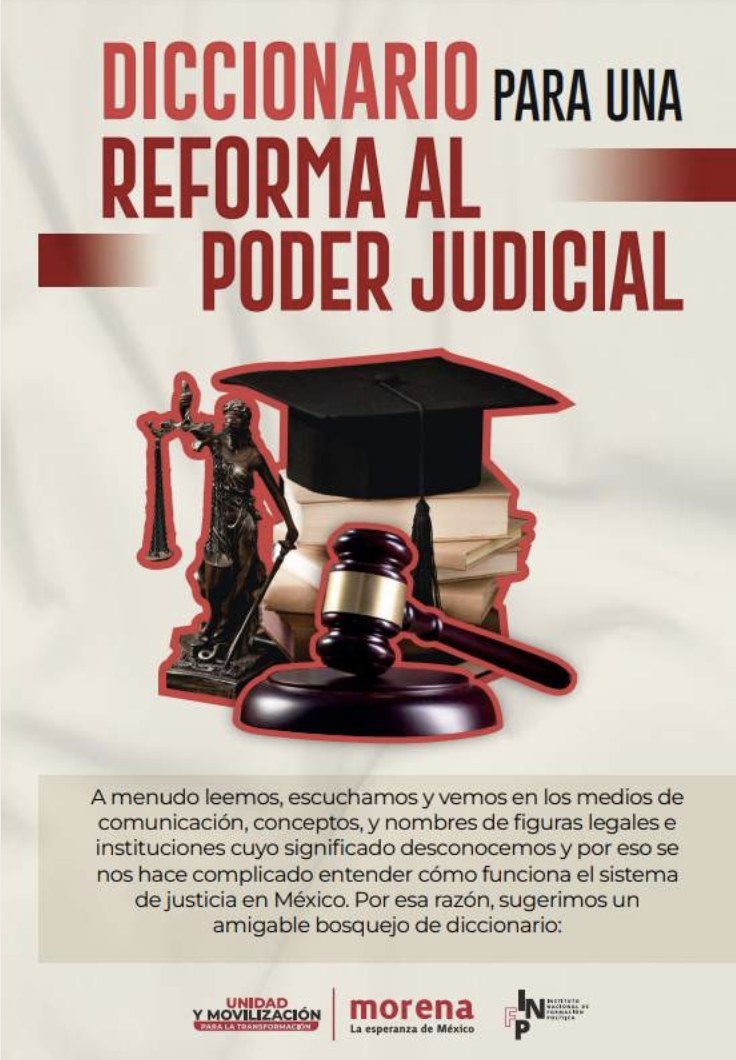
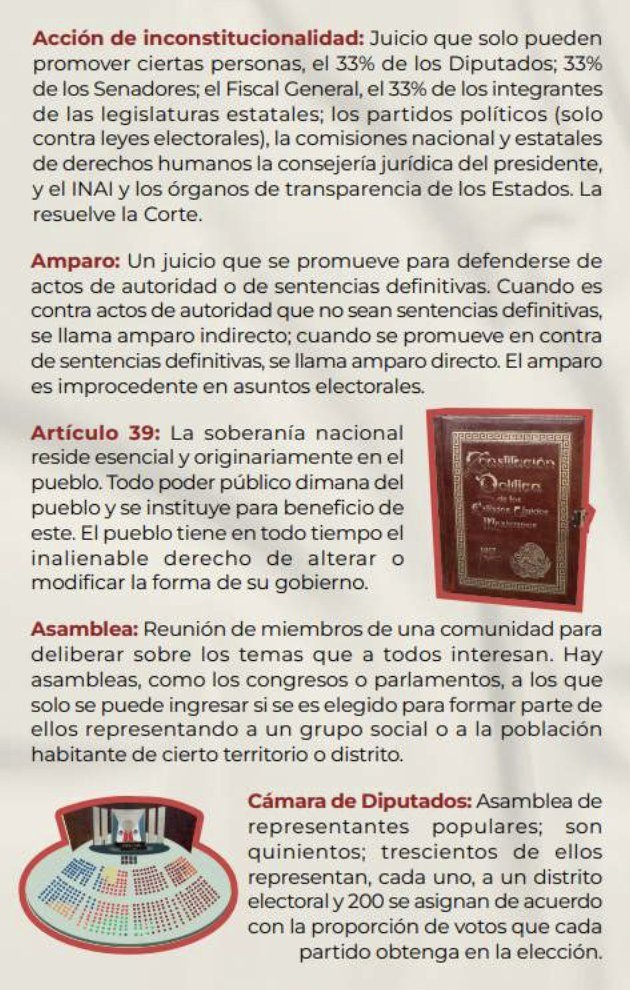
Morena promotes its ongoing campaigns, announces its legislative success, and presents its proposals for the future through a variety of outlets. Its central outlet is the INFP, which has its roots in study circles formed during the election protests of 2006, and was officially founded during López Obrador’s first year in office.68Instituto Nacional de Formación Política de Morena, “Rafael Barajas ‘El Instituto Nacional de Formación Política de Morena,’” YouTube video, 43:33, June 23, 2025, https://www.youtube.com/watch?v=mefPt36AuIM. The INFP is “against the dominant norms of the neoliberal era that championed individualism,” and strives for “debate and the socialization of thought.”69“El Instituto,” Instituto Nacional de Formación Política, accessed March 16, 2026, https://www.infpmorena.com.mx/el-instituto. It publishes newspapers, magazines, and books, maintains a robust social media presence, and hosts online and in-person study groups, educational courses, and panel discussions. Through the INFP, citizens can learn about many aspects of Morena’s identity, including its ideological and ethical principles, its fight against transnational organized crime, and its six-year legislative plan.70“Proyecto de Nación,” Instituto Nacional de Formación Política, accessed March 16, 2026, https://share.articulate.com/bJX49rpN3kxbVwGJWoNDa#. The INFP also promoted the party’s position on national control over the energy sector, its reform to the mining sector that increased environmental protection and nationalized most lithium deposits, and its public health approaches to drug use and addiction.71“Micrositios,” Instituto Nacional de Formación Política, accessed March 16, 2026, https://www.infpmorena.com.mx/micrositios. To promote the judicial reforms, the INFP created an online module detailing the components of Morena’s Plan C (which included the 2024 judicial reform) and distributed a dictionary of important laws and legal terms.72See images one and two below.
Communication and Mobilization
Morena and its supporters succeeded in sustaining support for the judicial reform from the moment it was announced to the time Mexicans went to the polls. This was done in a variety of ways, including community meetings, INFP publications, online educational courses, and individual citizen initiatives. The PRI and PAN took the opposite approach, opting for a boycott of the elections and an unofficial pact of silence. This strategy was strengthened by the opposition's influence within the national media sphere. Ricardo Salinas Pliego, for example, is a Mexican billionaire with his own telecommunications empire and millions of pesos in unpaid taxes.73Sin Embargo, “Salinas Pliego no pagó al SAT; estaría aún negociando, de acuerdo con fuentes,” Sin Embargo, January 1, 2026, https://www.sinembargo.mx/4756184/salinas-pliego-no-pago-al-sat-estaria-aun-negociando-de-acuerdo-con-fuentes. He was also a firm opponent of the reform.74Alfredo Maza, “Amparo de Salinas Pliego, Reformas del ‘Viernes Negro,’ y Le de Amnistía: Los Asuntos para la Nueva Corte,” Animal Político, August 4, 2025, https://grupoanimal.mx/politica/pendientes-nueva-corte-ministros-eleccion-judicial. The Instituto Nacional Electoral (National Electoral Institute, or INE)—an independent federal institution created in the aftermath of the fraudulent 1988 presidential contest—was officially tasked with carrying out the judicial elections. Responsibilities included educating the public about the voting process, creating an online searchable database of candidates, designing and disseminating the new ballots, counting the votes, and releasing the results.75“Informative Document of the Mexican Electoral Regime 2025,” Instituto Nacional Electoral, accessed March 4, 2026, https://ine.mx/foreign-visitors-2025. Unlike in legislative and presidential elections, no party affiliations were attached to candidates, and political parties were barred from promoting any participant.76“Informative Document of the Mexican Electoral Regime 2025,” Instituto Nacional Electoral. Also unique to this election, individuals in pretrial detention77People held in jail before their criminal trial and before they have been convicted. and nationals living outside of the country could not vote, with the government arguing that there was not sufficient time or resources to provide the usual accommodations.78“Aprueba INE procedimiento para asignar candidaturas a cargos en cada Distrito Judicial Electoral para el PEEPJF 2024-2025,” Instituto Nacional Electoral, accessed March 16, 2026, https://centralelectoral.ine.mx/2025/02/10/aprueba-ine-procedimiento-para-asignar-candidaturas-a-cargos-en-cada-distrito-judicial-electoral-para-el-peepjf-2024-2025. The government clashed with the INE—whose supposedly apolitical and impartial nature was often questioned by López Obrador—over whether the institute was adequately promoting the elections, particularly after the INE decision prohibited public servants and government institutions from helping publicize them.79Mathieu Tourliere, “Tómbolas, acordeones, conflictos de interés...Éstas son las polémicas de la elección judicial,” Proceso, May 31, 2025, https://www.proceso.com.mx/nacional/2025/5/31/tombolas-acordeones-conflictos-de-interes-estas-son-las-polemicas-de-la-eleccion-judicial-352127.html. That ban on state-sponsored promotion was later overturned, allowing the government to promote the elections alongside the INE.80Omar Tinoco, “TEPJF revierte prohibición del INE; gobierno y funcionarios sí podrán hablar de elección judicial,” Infobae, April 9, 2025, https://www.infobae.com/mexico/2025/04/09/tepjf-revierte-prohibicion-del-ine-gobierno-y-funcionarios-si-podran-hablar-de-eleccion-judicial.
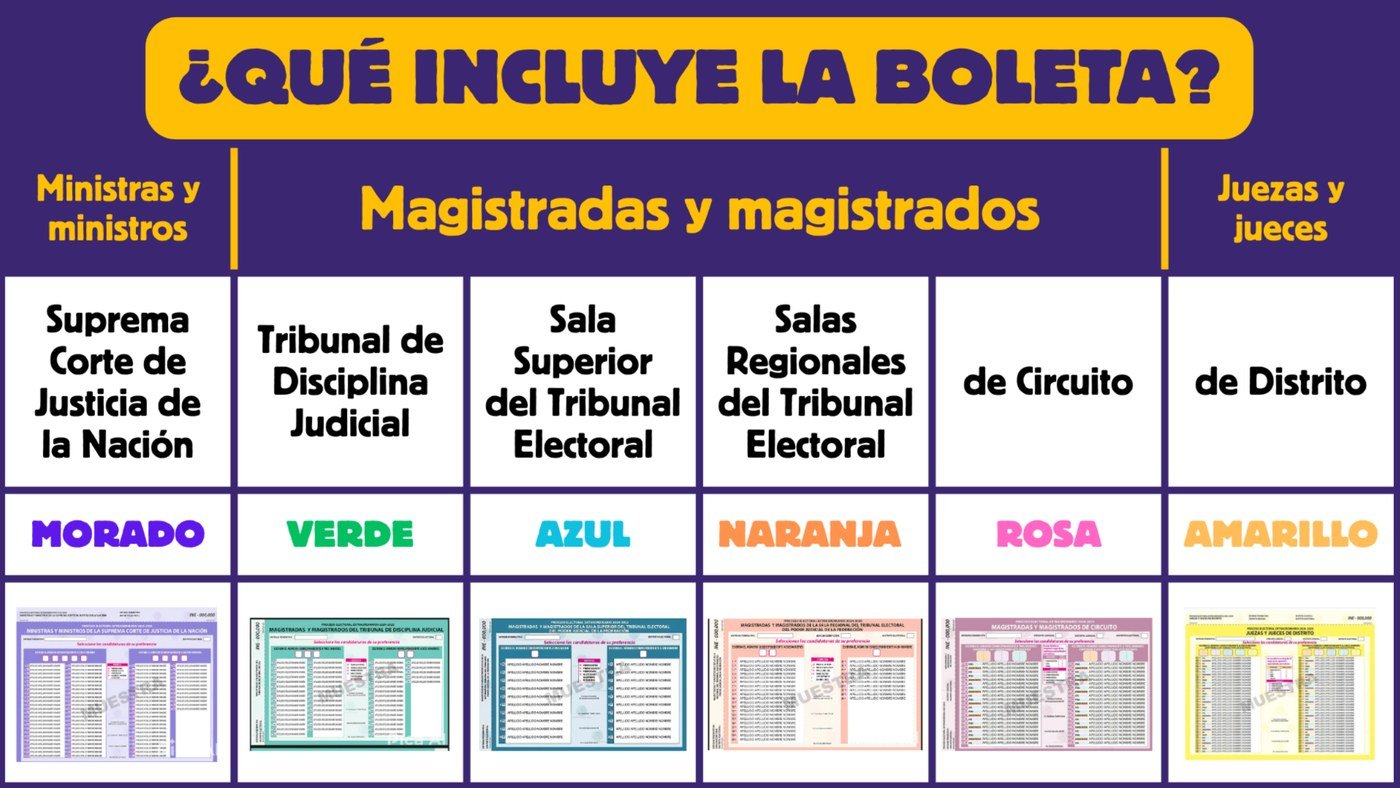
Information about the elections and the new voting process was made available in different ways. The INE created a webpage through which voters could search for candidates, learn how to navigate the colors and codes on the six new ballots, and see the final results.81“Elección del Poder Judicial 2025,” Instituto Nacional Electoral, accessed March 2, 2026, https://www.ine.mx/eleccion-del-poder-judicial-de-la-federacion-2025. Informational videos were played in metro stations, and posters were displayed in public places. Candidates were allowed to promote themselves through forums organized by the INE, private or social organizations, or the public, but not through radio or television. Candidates could also use social media to boost their campaigns, provided that no money was used to amplify their reach.82“Informative Document of the Mexican Electoral Regime 2025,” Instituto Nacional Electoral. Unlike in legislative or presidential elections, the INE did not provide public funds. Candidates had to fund their own campaigns within certain limits, including a spending ceiling and a ban on paid consultants.83Organization of American States, 2025 Federal Judiciary Elections in Mexico: Preliminary Report (Washington, D.C., 2025), 22, https://www.oas.org/fpdb/press/2025_MEXICO_EOM_Judiciary_Elections_Preliminary_Report_ENG.pdf.
Many informational events were organized in private residences and small family stores, providing an additional space for the public to learn about the election and meet the candidates. At least some of these events were organized by Morena-affiliated youth groups and advertised through WhatsApp chats created by party supporters. Presenters at these meetings spoke highly of the reforms and discussed the problems with the current judiciary. Participants were encouraged to share personal experiences about the judicial system and consider how they could be more involved in the justice system.84The author observed two community meetings during the campaign period, which lasted from late April through May, 2025. The first meeting was a panel event with four judicial candidates vying for different positions, and took place at a middle-class residence in Mexico City. The second was a general information meeting held in a small fruit and vegetable store in an industrial section of Mexico City. Slideshows were created to more easily convey information, especially about the election’s color-coded and numbered ballots.85See image three below. For voters accustomed to marking their preference by crossing out a party logo, the new ballots were often seen as complicated and burdensome.86Difficulties with the new ballots were expressed to the author. Even longtime voters who considered themselves politically informed found the system of numbers and colors, plus the total number of ballots, difficult to manage. The formal and informal activities described above were rooted in Morena’s origins in mass protests like the Exodus for Democracy and interstate support networks that formed after the 2006 presidential elections, as well as in the party’s ideological and strategic commitment to its base—seen in its ongoing door-to-door recruitment strategy87Guadarrama, Morena y su Identidad Política, 74–75. and its overall insistence on being a partido-movimiento.
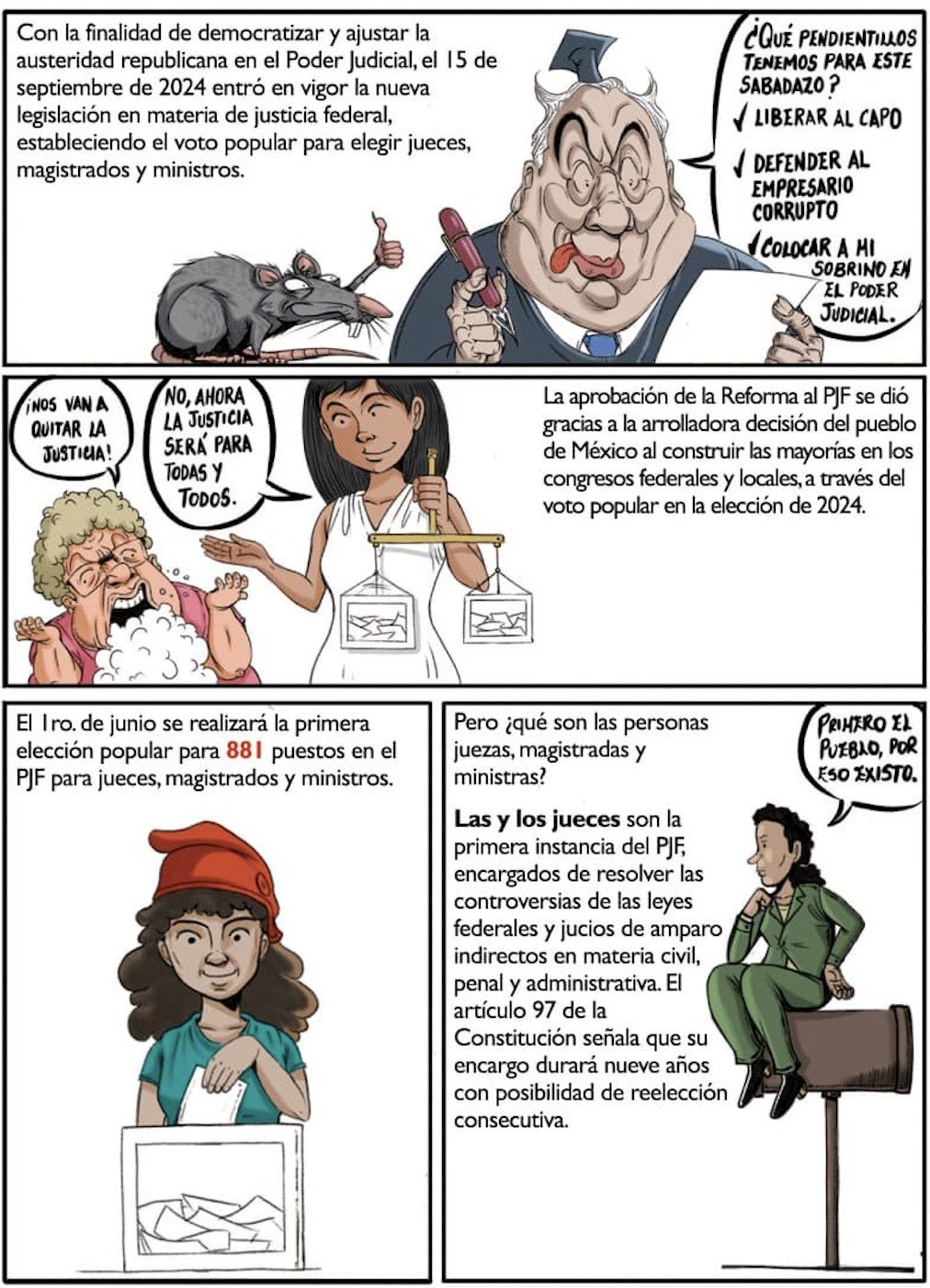
Individual Mexicans also took initiative in creating their own infographics, including lists of what candidates could and could not do during the campaign period.88Defensores del Pueblo (@defensores_delpueblo), “¿Sabes qué NO pueden hacer los candidatos y candidatas en esta elección? Infórmate y evita irregularidades. Comparte para que más personas estén al tanto,” Instagram photo, April 2, 2025, https://www.instagram.com/p/DH9SG9RpOwE. Comics were also circulated on social media, many of them criticizing the judicial system as nepotistic, self-serving, and corrupt. These comics also confronted common arguments against reform, such as the idea that elections would harm the judicial system. In one strip, a judge reviews his list of Saturday activities, while a woman cries that the reform will “take away our justice.” Lady Justice disagrees, explaining that “now justice will be for everyone,” while a woman wearing a red liberty cap reminds readers when to vote.89See image four below.
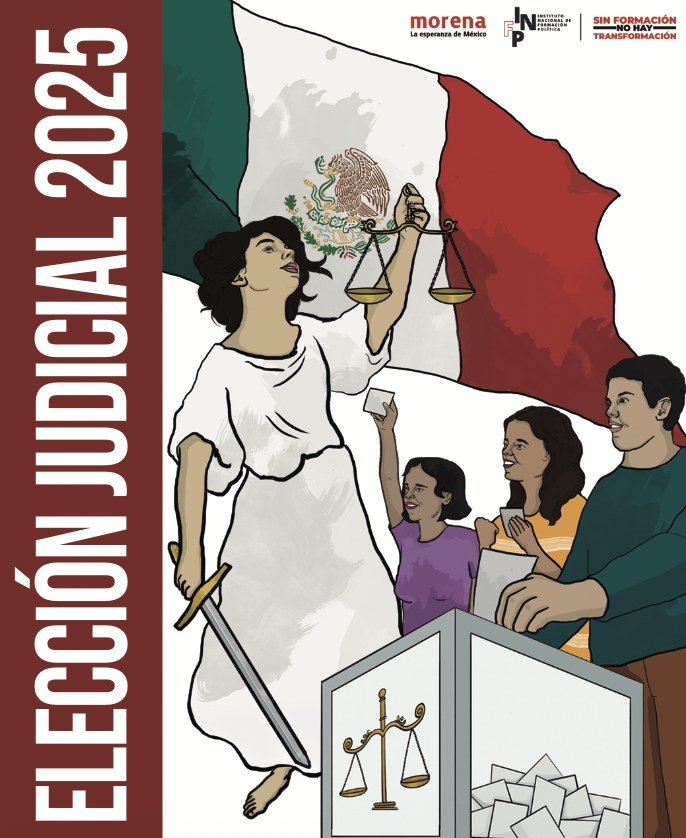
Morena also distributed some 100,000 information pamphlets90“Morena distribuirá 100 mil folletos sobre la elección judicial de 2025,” Tribuna Abierta, March 13, 2025, https://tribunaabierta.com.mx/2025/03/13/morena-distribuira-100-mil-folletos-sobre-la-eleccion-judicial-de-2025. in coordination with the INFP, which featured an image of Lady Justice lifting her scales beside the Mexican flag.91See image five below. Morena’s logo, the INFP’s logo, and one of Morena’s trademark phrases—sin formación no hay transformación (translated literally as “without formation there is no transformation,” but closer in sentiment to “without political education and ideological development there is no transformation”)—are all visible in the top right corner. The pamphlets included sections on candidate qualifications, which positions were being filled, how to navigate the ballots, and a list of important dates. “With this reform,” reads the packet’s introduction, “our country finds itself at the forefront of international democratization.” The judicial reform is described as a “profound renewal of the state institutions by guaranteeing greater participation in crucial matters of public life.” Regeneración dedicated an issue to judicial reform, declaring a victory for “democracy, the people of Mexico, and the Fourth Transformation.”92Instituto Nacional de Formación Política, “La Reforma al Poder Judicial ¡Va!” It also included a timetable of the reform’s progress and important future dates, including the election date. The website of Morena’s flagship magazine, Conciencias, featured several articles promoting the reform, including criticism of the INE’s attempt to limit the government’s ability to provide information about the elections.93Jaime Miguel Castañeda Salas, “Contra las elecciones: cómo salvar la democracia en la elección judicial,” Conciencias, April 4, 2025, https://revistaconciencias.mx/contra-las-elecciones-como-salvar-la-democracia-en-la-eleccion-judicial.
03Failure of the Opposition
For any political party to rise, at least one other must fall. In Mexico’s case, two parties have hit bottom. Presidential candidate Xóchitl Gálvez—supported by the PRI, PAN, and the PRD—was easily defeated by Claudia Sheinbaum. Once called the “perfect dictatorship,”94Fernando García Ramírez, “Sobre la dictadura perfecta,” Letras Libres, April 16, 2025, https://letraslibres.com/ideas/garcia-ramirez-dictadura-perfecta-mario-vargas-llosa-octavio-paz. PRI members began leaving the party after the 2024 elections, with more than a few deciding to join the winning team in Morena.95Jared Olson, “The fall of Mexico's PRI party, a once-dominant political force,” Al Jazeera, May 31, 2024, https://www.aljazeera.com/news/2024/5/31/the-fall-of-mexicos-pri-party-a-once-dominant-political-force. (Morena’s decision to allow members of the opposition to switch sides has caused consternation in some circles.) For the PRI and PAN, it has proven difficult to shake the interconnected legacies of neoliberal economic policies, failed judicial reform, and the violent repression of political dissent.
Neoliberal Economic Policies
Mexico has experimented with varying levels of state involvement in the economy. Beginning in the 1940s, the PRI focused on internal market development through import substitution industrialization (ISI).96Edmonds-Poli and Shirk, Contemporary Mexican Politics, 204. This strategy seemed to pay off, as the economy grew steadily from the 1940s through the 1970s, and the middle class expanded.97Edmonds-Poli and Shirk, Contemporary Mexican Politics, 207. But ISI was a double-edged sword. Profits were not distributed evenly, and despite efforts to expand the welfare state, the gap between rich and poor grew.98Edmonds-Poli and Shirk, Contemporary Mexican Politics, 210. The economy took a downward turn in the 1970s, as the state expanded public spending, wages, and state-led development in an attempt to sustain growth. A severe economic crisis in 1982 forced the state to borrow from the International Monetary Fund, which, coupled with corruption and mismanagement, led to a high level of foreign debt.99Edmonds-Poli and Shirk, Contemporary Mexican Politics, 212. Subsequent presidents—many of them U.S.-trained technocrats—were committed to neoliberal policies as a means to attract foreign investment and restore growth. Most Mexicans suffered during this period, but not all. When Salinas de Gortari left office, Mexico’s new billionaires had “made their money scooping up the nation’s banks, mines, toll roads, sugar plantations, TV stations, and telephone services” that were being sold off.100Greg Grandin, America, América (Penguin Random House, 2025), 603. Zedillo then pushed through the privatization of freight rail and the reduction of workers’ pensions. He also bailed out the banks by turning their private debt into public debt—a burden that Mexicans are still paying off. Not for nothing does Morena present itself as an explicitly antineoliberal alternative to the status quo ante.101Guadarrama, Morena y su Identidad Política, 55–60.
Failed Reforms
The PRI and the PAN also failed to meaningfully reform the judiciary. Zedillo said that his 1994 reform was what Mexicans deserved. He promised an effective justice system with equality under the law. But between 1994 and 2018, the average level of “some or much trust in the judiciary” was only 26 percent.102Driscoll, Nelson, and Ríos-Figueroa, “Mexico's Judicial Elections and the Politics of Reform.” In 2017, 71 percent of respondents in a national survey said that corruption was “very frequent” in the judiciary.103Driscoll, Nelson, and Ríos-Figueroa, “Mexico's Judicial Elections and the Politics of Reform.” A 2018 report found widespread nepotism within the judicial branch, demonstrating that the Judicial Council created by Zedillo ultimately amounted to a “half-broken promise.”104Julio Ríos-Figueroa, “Family Ties and Nepotism in the Mexican Federal Judiciary,” in The Limits of Judicialization: From Progress to Backlash in Latin America, ed. Sandra Botero, Daniel M. Brinks, and Ezequiel A. Gonzalez-Ocantos (Cambridge University Press, 2022), 197. The entire system, including the SCJN, had “managed to reproduce patterns of behavior… similar to those of the patronage networks created under the authoritarian regime.”105Ríos-Figueroa, “Family Ties,” 213. The reform also failed to ensure equal justice. By the time Morena came to power, less than 1 percent of Mexicans held 43 percent of all national wealth.106Pablo Mijangos y González, Historia Mínima de la Suprema Corte de Justicia de México (The College of Mexico, 2019), 221. At least some of this wealth concentration could be explained by frequent tax evasion and fraud—a practice that critics say is promoted by a complicated legal framework upheld by the SCJN, which has deferred several rulings amounting to billions of uncollected pesos.107Iván Evair Saldaña, “SCJN, a prueba: deberá resolver en dos meses 69 litigios fiscales,” La Jornada, December 19, 2025, https://www.jornada.com.mx/noticia/2025/12/19/politica/scjn-a-prueba-debera-resolver-en-dos-meses-69-litigios-fiscales. While not directly connected to the SCJN, observers have also argued that the current amparo law—originally designed to protect individuals against human rights violations—actually increases the opportunities for well-resourced litigants to game the system, including to delay or contest tax obligations.108MND Staff, “Congress approves major reform to the Amparo Law, Mexico's main legal rights protection,” Mexico Daily News, October 16, 2025, https://mexiconewsdaily.com/news/amparo-law-reform-approved.
By 2011, Mexicans were also suffering from years of Calderón’s militarized war on drugs, which he waged in tandem with the United States.109Nathaniel Parish Flannery, “Calderón's War,” Colombia Journal of International Affairs, April 17, 2023, https://jia.sipa.columbia.edu/news/calderons-war. In this context, Calderón pushed through a series of reforms allowing the SCJN to ground its ruling in international treaties and decisions made by the Inter-American Court of Human Rights, a change designed to protect the rights of victims as well as the accused.110Victor Manuel Collí Ek, “Improving Human Rights in Mexico: Constitutional Reforms, International Standards, and New Requirements for Judges,” Human Rights Brief 20, no. 1 (2012): 10, https://digitalcommons.wcl.american.edu/cgi/viewcontent.cgi?article=1850&context=hrbrief. The reform also expanded the scope of amparo suits, a longstanding system through which citizens can launch complaints against state abuses. Most commentators were hopeful about the new approach, and in 2013, the SCJN won a human rights prize from the United Nations for its work.111Oscar Lopez, “Mexican Supreme Court Receives Human Rights Prize from United Nations,” The Latin Times, December 10, 2013, https://www.latintimes.com/mexican-supreme-court-receives-human-rights-prize-united-nations-136775. But despite the reform, Mexico continued to struggle with drug-related violence and human rights violations. This should not be entirely surprising. Short of a massive state, federal, and international intervention that addresses the root causes of the drug trade—including unemployment and low wages at home and consumer demand and lax gun laws in the United States—the resulting violence and general social disruption in Mexico cannot be dramatically reduced. Faced with the consequences of policies enacted by his own party (with the support of the PRI), there was relatively little one president could have done.
By the time a fed-up electorate returned Enrique Peña Nieto and the PRI to power in 2012, some one hundred thousand people had been killed or disappeared during Calderon’s six years in office, many of them “mowed down by masked gunmen at parties and funerals… shot while sitting in their cars or going on errands,” or “snatched from homes or offices and never heard from again.”112Daniel Hernandez, “Calderon's War on Drug Cartels: A Legacy of Blood and Tragedy,” Los Angeles Times, December 1, 2012, https://www.latimes.com/world/la-xpm-2012-dec-01-la-fg-wn-mexico-calderon-cartels-20121130-story.html. Calderon posed as a man of law and order, but that image has suffered from the recent sentencing of his former Secretary of Public Security, Genaro García Luna, to decades in prison for helping the infamous Sinaloa Cartel.113“Ex-Mexican Secretary of Public Security Genaro Garcia Luna Sentenced to Over 38 Years in Prison,” U.S. Immigration and Customs Enforcement, October 17, 2024, https://www.ice.gov/news/releases/ex-mexican-secretary-public-security-genaro-garcia-luna-sentenced-over-38-years. It is a dark but entirely unsurprising irony that Calderon’s administration was complicit in the very drug trade and human rights abuses it was supposedly trying to combat.
State Violence
Drug cartels were not the only dangerous organizations roaming Mexico’s streets. On September 26, 2014, forty-three students from the Ayotzinapa Rural Teachers' College were disappeared (since presumed murdered) en route to an event marking the anniversary of the infamous massacre of hundreds of students by the Mexican military on the night of October 2, 1968, in Mexico City’s Plaza de las Tres Culturas.114The massacre was part of a much longer wave of state repression and violence from the 1960s into the 1980s that historians now call Mexico's Dirty War. Peña Nieto promised a full investigation, but it all came to nothing. Worse, the more independent investigators dug, the clearer it became that, as in 1968, the state was implicated.115Stepanie Brewer, “Ayotzinapa Case: Key Points to Understand the Mexican Government's New Actions,” Washington Office on Latin America, accessed October 20, 2025, https://www.wola.org/analysis/ayotzinapa-key-points-understand-mexican-governments-new-actions. As in 1968, the Ayotzinapa killings did immense damage to the PRI’s reputation. The killings also further damaged the reputation of the state in general in the eyes of a new generation of Mexicans. López Obrador opened many state archives to public investigation. But to this day, no one has been convicted of a crime. Sheinbaum—a self-described “child of 1968”116Patrick J. McDonnell, “Sheinbaum, a ‘child of 1968,’ apologizes for historic ‘atrocity’ in Tlatelolco, Mexico City,” Los Angeles Times, October 2, 2024, https://www.latimes.com/world-nation/story/2024-10-02/child-of-1968-sheinbaum-apologizes-for-1968-atrocity-in-tlatelolco-mexico-city.—issued the most explicit public apology for the massacre to date, asking forgiveness from the victims’ families and recognizing the event as a crime against humanity.117McDonnell, “Sheinbaum, a ‘child of 1968,’ apologizes for historic ‘atrocity’ in Tlatelolco, Mexico City.” As Head of Government of Mexico City under López Obrador’s administration, she also disbanded the infamous granaderos—riot police known for brutal tactics against protestors, including against students in 1968.118Gretel Morales, “Claudia Sheinbaum dissolves riot police,” El Universal, June 12, 2018, https://www.eluniversal.com.mx/english/sheinbaum-dissolves-riot. Yet there is still no final determination of what happened or who is responsible in the Ayotzinapa case.
04Conclusion
On June 1, 2025, about 13 million people—some 13 percent of the total electorate—cast valid ballots in the highly anticipated judicial elections. Organizers had hoped for at least 20 million participants.119Villalpando and Laaksonen, “Alfredo and Sami on Mexico's Judicial Elections.” About 60 million people—60 percent of the electorate—had participated in the 2024 presidential and legislative elections. Opponents of the reform seized on the low turnout to brand the process as illegitimate. Mexicans, they said, had rejected Morena’s alleged attempt to eliminate constitutional checks and balances and move the country even closer to authoritarianism. But considering that polls showed majority support for the reform leading up to election day, this explanation is hard to sustain. The INE predicted between 8 and 15 million participants (or 8 to 15 percent of the electorate), and emphasized that low turnout is common every time something is done for the first time.120Ibeth Cardona, “INE estima entre el 8 y 15% de participación para la elección judicial; hasta 10 minutos para emitir un voto,” El Universal, January 16, 2025, https://www.eluniversal.com.mx/nacion/ine-estima-entre-el-8-y-15-de-participacion-para-la-eleccion-judicial-hasta-10-minutos-para-emitir-un-voto. Sheinbaum called the process a “complete success,” but there are obvious areas for improvement in the lead-up to next year’s second round of elections for the remaining appeal judges and district court judges.121Thomas Graham, “Mexican president hails ‘complete success’ after just 13% vote in judicial elections,” The Guardian, June 2, 2025, https://www.theguardian.com/world/2025/jun/02/mexico-judicial-election-claudia-sheinbaum. The application process was not entirely standardized, and the eligibility requirements were not always clear.122Organization of American States, 2025 Federal Judiciary, 21. When it came to propaganda, some observers noted “excessive restrictions” on communication and the challenges many candidates faced in presenting themselves to the public.123Organization of American States, 2025 Federal Judiciary, 22. Many people also found the ballots confusing—a reality brought home to the author through conversations with participants, including many with a college education and a self-described high degree of political knowledge. Even supporters of Morena recognise the need for improvements.
One thing is clear. When Mexicans went to the polls on June 1 to elect a new judiciary, the old system was immensely unpopular and in need of significant reform—a reality that even some of Morena’s detractors admitted.124Driscoll, Nelson, and Ríos-Figueroa, “Mexico's Judicial Elections and the Politics of Reform.” For most of its history, the judicial system has been widely seen as “inefficient, ineffectual, or even corrupt.”125Stephen Zamora, José Ramón Cossío, Leonel Pereznieto, José Roldán-Xopa, David Lopez, “Judicial System,” in Mexican Law, ed. Stephen Zamora (Oxford University Press, 2012), 187. The two previous parties, the PRI and PAN, had failed to reform the judiciary and were widely discredited due to neoliberal economic policies and the violent repression of dissent. Morena’s consistent popularity and its control over the executive and legislative branches are the price the PRI and PAN are now paying. Some critics say that the judicial reform was López Obrador's personal retribution against the judiciary.126Jaime Olaiz-González, “Interesting Times in Mexico: Constitutional Demise was Not on the Ballot.” Mariano Guevara, a law student and Morena activist, sees the situation differently. If subjecting the judiciary to direct elections is a form of revenge, then it is the revenge not of one man, but of tens of millions of Mexicans harmed by the old system.127Guevara, “Mariano Guevara Recaps Mexico's Judicial Elections.” Mexico made history in 2024 when it reformed its constitution to elect every member of the judiciary. Many people hope that the change will reduce corruption and nepotism and increase transparency, efficiency, and confidence in a widely-panned judicial system. For now, it is too soon to assess the medium and long-term results.
Bibliography
- Aguiar Aguilar, Azul A. “Courts and the Judicial Erosion of Democracy in Latin America.” Politics and Policy 51, no. 1 (January 2023): 7-25. https://doi.org/10.1111/polp.12516.
- Aguiar Aguilar, Azul A., Rodrigo Castro Cornejo, and Alejandro Monsiváis-Carrillo. “Is Mexico at the Gates of Authoritarianism?” Journal of Democracy 36, no. 1 (January 2025): 50-64. https://doi.org/10.1353/jod.2025.a947883.
- Al Jazeera. “Mexico Lashes Out at US Ambassador's Comments on Proposed Judicial Reform.” Al Jazeera, August 23, 2024. https://www.aljazeera.com/news/2024/8/23/mexico-lashes-out-at-us-ambassadors-comments-on-proposed-judicial-reform.
- Baena, Mayte. “Vicente Fox Explota Tras Aprobación de la Reforma al Poder Judicial: ‘Traición a la patria.’” Infobae, September 11, 2024. https://www.infobae.com/mexico/2024/09/11/vicente-fox-reacciona-a-la-aprobacion-de-la-reforma-al-poder-judicial-tilda-accion-de-traicion-a-la-patria.
- Bayer, Rebecca. “Departing Mexican Supreme Court Justice Weighs in on Judicial Reforms in His Country.” Harvard Law Today, November 21, 2024. https://hls.harvard.edu/today/departing-mexican-supreme-court-justice-weighs-in-on-judicial-reforms-in-his-country.
- Beauregard, Luis Pablo, and Patricia San Juan Flores. “Claudia Sheinbaum Has Higher Approval Ratings than López Obrador after First Year in Office.” El País, October 1, 2025. https://english.elpais.com/international/2025-10-01/claudia-sheinbaum-has-higher-approval-rating-than-lopez-obrador-after-first-year-in-office.html.
- Brewer, Stephanie. “Ayotzinapa Case: Key Points to Understand the Mexican Government's New Actions.” Washington Office on Latin America. Accessed October 20, 2025. https://www.wola.org/analysis/ayotzinapa-key-points-understand-mexican-governments-new-actions.
- Cabrera, Atzayacatl. “¿Cuál es el origen del Plan C de AMLO?” El Sol de México, June 5, 2024. https://oem.com.mx/elsoldemexico/mexico/cual-es-el-origen-del-plan-c-de-amlo-13123024.
- Camp, Roderic Ai. “Democratizing Mexican Politics: 1982–2012.” Oxford Research Encyclopedia of Latin American History, April 2, 2015. https://doi.org/10.1093/acrefore/9780199366439.013.12.
- Cardona, Ibeth. “INE Estima entre el 8 y 15% de Participación para la Elección Judicial; Hasta 10 Minutos para Emitir un Voto.” El Universal, January 16, 2025. https://www.eluniversal.com.mx/nacion/ine-estima-entre-el-8-y-15-de-participacion-para-la-eleccion-judicial-hasta-10-minutos-para-emitir-un-voto.
- Castañeda Salas, Jaime Miguel. “Contra las elecciones: cómo salvar la democracia en la elección judicial.” Conciencias, April 4, 2025. https://revistaconciencias.mx/contra-las-elecciones-como-salvar-la-democracia-en-la-eleccion-judicial.
- Castillejos-Aragón, Mónica. “Populism and Challenges to Judicial Independence in Mexico.” Berkeley Review of Latin American Studies. Accessed March 17, 2026. https://clacs.berkeley.edu/brlas2023/law-populism-and-challenges-judicial-independence-mexico.
- Collí Ek, Víctor Manuel. “Improving Human Rights in Mexico: Constitutional Reforms, International Standards, and New Requirements for Judges.” Human Rights Brief 20, no. 1 (2012): 7-14. https://digitalcommons.wcl.american.edu/cgi/viewcontent.cgi?article=1850&context=hrbrief.
- Congressional Research Service. “Mexico: Background and U.S. Relations.” Congressional Research Service, May 17, 2023. https://www.congress.gov/crs-product/R42917.
- Defensores del Pueblo (@defensores_delpueblo). “¿Sabes qué NO pueden hacer los candidatos y candidatas en esta elección? Infórmate y evita irregularidades. Comparte para que más personas estén al tanto.” Instagram photo, April 2, 2025. https://www.instagram.com/p/DH9SG9RpOwE.
- Diamond, Larry. “What the Democratization of Mexico Means for All the World.” Hoover Digest, October 30, 2000. https://www.hoover.org/research/what-democratization-mexico-means-all-world.
- Domingo, Pilar. “Judicial Independence: The Politics of the Supreme Court in Mexico.” Journal of Latin American Studies 32, no. 3 (2000): 719. https://doi.org/10.1017/S0022216X00005885.
- Driscoll, Amanda, Michael J. Nelson, and Julio Ríos-Figueroa. “Mexico's Judicial Elections and the Politics of Reform.” Judicature International. Accessed March 6, 2026. https://judicature.duke.edu/articles/mexicos-judicial-elections-and-the-politics-of-reform.
- Edmonds-Poli, Emily, and David A. Shirk. Contemporary Mexican Politics. 4th ed. Rowman & Littlefield, 2020.
- El País. “López Obrador Arremete Contra el Poder Judicial en su Quinto Informe de Gobierno: ‘Tienen convivencias inconfesables.’” El País, September 1, 2023. https://elpais.com/mexico/2023-09-01/lopez-obrador-arremete-contra-el-poder-judicial-en-su-quinto-informe-de-gobierno-tienen-convivencias-inconfesables.html.
- El País. “Morena Busca Llevar el Destino de los Miembros de la Suprema Corte a una Consulta Popular.” El País, May 13, 2023. https://elpais.com/mexico/2023-05-15/morena-busca-llevar-el-destino-de-los-miembros-de-la-suprema-corte-a-una-consulta-popular.html.
- El Universal. “Claudia Sheinbaum Dissolves Riot Police.” El Universal, June 12, 2018. https://www.eluniversal.com.mx/english/sheinbaum-dissolves-riot.
- Fix-Fierro, Héctor. “Judicial Reform in Mexico: What Next?” In Beyond Common Knowledge: Empirical Approaches to the Rule of Law, edited by Erik G. Jensen and Thomas C. Heller. Stanford University Press, 2005.
- Flannery, Nathaniel Parish. “Calderón's War.” Colombia Journal of International Affairs, April 17, 2023. https://jia.sipa.columbia.edu/news/calderons-war.
- García, Andrés. “Calderón Responsabiliza a Ken Salazar por Falta de Reacción Ante la Reforma Judicial Mexicana.” Infobae, September 10, 2025. https://www.infobae.com/mexico/2025/09/10/calderon-responsabiliza-a-ken-salazar-por-falta-de-reaccion-ante-la-reforma-judicial-mexicana.
- García Ramírez, Fernando. “Sobre la dictadura perfecta.” Letras Libres, April 16, 2025. https://letraslibres.com/ideas/garcia-ramirez-dictadura-perfecta-mario-vargas-llosa-octavio-paz.
- Ginsburg, Tom. “Introduction.” In Judicial Politics in Mexico: The Supreme Court and the Transition to Democracy, edited by Andrea Castagnola and Saúl López Noriega. Routledge, 2018.
- Gobierno de México. “Banco del Bienestar: 6 años de entregas de los Programas para el Bienestar a quienes más los necesitan.” Programas para el Bienestar, July 21, 2025. https://programasparaelbienestar.gob.mx/banco-del-bienestar-6-anos-de-entregas-de-los-programas-para-el-bienestar-a-quienes-mas-los-necesitan.
- Gobierno de México. “Convocatoria al Primer Encuentro Continental de Comunicador@s Independientes: ‘Informar es liberar.’” Gobierno de México, July 29, 2024. https://www.gob.mx/amlo/prensa/convocatoria-al-primer-encuentro-continental-de-comunicador-s-independientes-informar-es-liberar-372259?idiom=es.
- Gobierno de México. “El Programa Nacional de Becas para el Bienestar Benito Juárez Cumplió la Meta de Apoyar a 10 Millones de Estudiantes.” Gobierno de México. Accessed March 3, 2026. https://www.gob.mx/becasbenitojuarez/articulos/el-programa-nacional-de-becas-para-el-bienestar-benito-juarez-cumplio-la-meta-de-apoyar-a-10-millones-de-estudiantes-215728.
- Gobierno de México. “Incremento a los Salarios Mínimos para 2026.” Gobierno de México, December 3, 2025. https://www.gob.mx/conasami/articulos/incremento-a-los-salarios-minimos-para-2026?idiom=es.
- Gobierno de México. “Reciben Utopías de la Ciudad de México Reconocimiento Internacional del OIDP por Mejores Prácticas de Participación Ciudadana.” Ciudad de México, October 28, 2024. https://cultura.cdmx.gob.mx/comunicacion/nota/374-24.
- Grandin, Greg. America, América. Penguin Random House, 2025.
- Guadarrama, Martí Batres. Morena y Su Identidad Política. Panorama, 2017.
- Guevara, Mariano. “Mariano Guevara Recaps Mexico's Judicial Elections.” Interviewed by Luke Pickrell. The Democratic Constitution Blog, June 25, 2025. https://democraticconstitutionblog.substack.com/p/mariano-guevara-recaps-mexicos-judicial.
- Hernandez, Daniel. “Calderon's War on Drug Cartels: A Legacy of Blood and Tragedy.” Los Angeles Times, December 1, 2012. https://www.latimes.com/world/la-xpm-2012-dec-01-la-fg-wn-mexico-calderon-cartels-20121130-story.html.
- Instituto Nacional de Formación Política. “El Instituto.” Instituto Nacional de Formación Política. Accessed March 16, 2026. https://www.infpmorena.com.mx/el-instituto.
- Instituto Nacional de Formación Política. “La Reforma al Poder Judicial ¡Va!” Regeneración, November 10, 2024. https://www.infpmorena.com.mx/regeneracion.
- Instituto Nacional de Formación Política. “Micrositios.” Instituto Nacional de Formación Política. Accessed March 16, 2026. https://www.infpmorena.com.mx/micrositios.
- Instituto Nacional de Formación Política. “Proyecto de Nación.” Instituto Nacional de Formación Política. Accessed March 16, 2026. https://share.articulate.com/bJX49rpN3kxbVwGJWoNDa#.
- Instituto Nacional de Formación Política de Morena. “Rafael Barajas ‘El Instituto Nacional de Formación Política de Morena.’” YouTube video, 43:33. June 23, 2025. https://www.youtube.com/watch?v=mefPt36AuIM.
- Instituto Nacional Electoral. “Aprueba INE Procedimiento para Asignar Candidaturas a Cargos en Cada Distrito Judicial Electoral para el PEEPJF 2024-2025.” Instituto Nacional Electoral. Accessed March 16, 2026. https://centralelectoral.ine.mx/2025/02/10/aprueba-ine-procedimiento-para-asignar-candidaturas-a-cargos-en-cada-distrito-judicial-electoral-para-el-peepjf-2024-2025.
- Instituto Nacional Electoral. “Cargos a elegir.” Instituto Nacional Electoral. Accessed February 27, 2026. https://ine.mx/cargos-pj-2025.
- Instituto Nacional Electoral. “Elección del Poder Judicial 2025.” Instituto Nacional Electoral. Accessed March 2, 2026. https://www.ine.mx/eleccion-del-poder-judicial-de-la-federacion-2025.
- Instituto Nacional Electoral. “Informative Document of the Mexican Electoral Regime 2025.” Instituto Nacional Electoral. Accessed March 4, 2026. https://ine.mx/foreign-visitors-2025.
- Janetsky, Megan. “With Protestors at the Door, Mexico's Senate Says Judges Must Stand for Elections.” The Christian Science Monitor, September 11, 2024. https://www.csmonitor.com/World/Americas/2024/0911/mexico-senate-controversial-judge-elections.
- López Nachón, Gustavo. “Losing Sight of Judicial Independence: The Case of Mexico's Judicial Reform.” Yale Journal of International Law Forum, July 9, 2025. https://yjil.yale.edu/posts/2025-07-09-losing-sight-of-judicial-independence-the-case-of-mexicos-judicial-reform.
- Lugo Maonroy, Leonardo. “La reforma judicial, ¿por qué le interesa tanto a la derecha?” Conciencias, November 6, 2024. https://revistaconciencias.mx/la-reforma-judicial-por-que-le-interesa-tanto-a-la-derecha.
- Maza, Alfredo. “Amparo de Salinas Pliego, Reformas del ‘Viernes Negro,’ y Le de Amnistía: Los Asuntos para la Nueva Corte.” Animal Político, August 4, 2025. https://grupoanimal.mx/politica/pendientes-nueva-corte-ministros-eleccion-judicial.
- McDonnell, Patrick J. “Sheinbaum, a ‘Child of 1968,’ Apologizes for Historic ‘Atrocity’ in Tlatelolco, Mexico City.” Los Angeles Times, October 2, 2024. https://www.latimes.com/world-nation/story/2024-10-02/child-of-1968-sheinbaum-apologizes-for-1968-atrocity-in-tlatelolco-mexico-city.
- Mijangos y González, Pablo. Historia Mínima de la Suprema Corte de Justicia de México. The College of Mexico, 2019.
- Miranda, Ricardo. “Ricardo Miranda on Mexico's Constitution and the Programa Universitario de Estudios sobre Democracia, Justicia y Sociedad.” Interviewed by Luke Pickrell. The Democratic Constitution Blog, March 21, 2025. https://democraticconstitutionblog.substack.com/p/the-democratic-constitution-podcast-534.
- MND Staff. “Congress Approves Major Reform to the Amparo Law, Mexico's Main Legal Rights Protection.” Mexico Daily News, October 16, 2025. https://mexiconewsdaily.com/news/amparo-law-reform-approved.
- MND Staff. “Mexico Announces Plan to Build 1.1M New Homes by the End of Sheinbaum's Term.” Mexico Daily News, April 14, 2025. https://mexiconewsdaily.com/news/mexico-affordable-housing-plan-build-new-homes-sheinbaum.
- MND Staff. “Polls on Morena's Judicial Reform Show the Majority of Mexicans Support It.” Mexico Daily News, June 18, 2024. https://mexiconewsdaily.com/politics/judicial-reform-polls-show-majority-in-favor.
- Morales, Gretel. “Claudia Sheinbaum Dissolves Riot Police.” El Universal, June 12, 2018. https://www.eluniversal.com.mx/english/sheinbaum-dissolves-riot.
- Morena. “Morena distribuirá 100 mil folletos sobre la elección judicial de 2025.” Tribuna Abierta, March 13, 2025. https://tribunaabierta.com.mx/2025/03/13/morena-distribuira-100-mil-folletos-sobre-la-eleccion-judicial-de-2025.
- Olaiz-González, Jaime. “Interesting Times in Mexico: Constitutional Demise Was Not on the Ballot.” ICL Journal 18, no. 3 (2024): 385–392. https://doi.org/10.1515/icl-2024-0030.
- Olson, Jared. “The Fall of Mexico's PRI Party, a Once-Dominant Political Force.” Al Jazeera, May 31, 2024. https://www.aljazeera.com/news/2024/5/31/the-fall-of-mexicos-pri-party-a-once-dominant-political-force.
- Organization of American States. 2025 Federal Judiciary Elections in Mexico: Preliminary Report. Washington, D.C., June 6, 2025. https://www.oas.org/fpdb/press/2025_MEXICO_EOM_Judiciary_Elections_Preliminary_Report_ENG.pdf.
- Pew Research Center. “Ahead of Mexico's First-Ever Judicial Elections, Most Mexicans Approve of the Law That Implemented Them.” Pew Research Center, May 22, 2025. https://www.pewresearch.org/short-reads/2025/05/22/ahead-of-mexicos-first-ever-judicial-elections-most-mexicans-approve-of-the-law-that-implemented-them.
- Pie de Página. “Ernesto Zedillo, the Former President Who Inaugurated the ‘Golden Pension’ for Ministers, Reappears to Question the Reform of the Judiciary.” Pie de Página, September 16, 2024. https://piedepagina.mx/ernesto-zedillo-el-expresidente-que-inauguro-la-pension-dorada-de-ministros-reaparece-para-cuestionar-la-reforma-del-poder-judicial.
- Ribando Seelke, Clare. “Mexico: Background and U.S. Relations.” Congress.gov, May 17, 2023. https://www.congress.gov/crs-product/R42917.
- Ríos-Figueroa, Julio. “Family Ties and Nepotism in the Mexican Federal Judiciary.” In The Limits of Judicialization: From Progress to Backlash in Latin America, edited by Sandra Botero, Daniel M. Brinks, and Ezequiel A. Gonzalez-Ocantos. Cambridge: Cambridge University Press, 2022.
- Salazar Ugarte, Pedro. “The Law as Power.” In Judicial Politics in Mexico: The Supreme Court and the Transition to Democracy, edited by Andrea Castagnola and Saúl López Noriega. Routledge, 2018.
- Saldaña, Iván Evair. “SCJN, a Prueba: Deberá Resolver en Dos Meses 69 Litigios Fiscales.” La Jornada, December 19, 2025. https://www.jornada.com.mx/noticia/2025/12/19/politica/scjn-a-prueba-debera-resolver-en-dos-meses-69-litigios-fiscales.
- Serna de la Garza, José María. The Constitution of Mexico. Hart Publishing, 2013.
- Sin Embargo. “Salinas Pliego no pagó al SAT; estaría aún negociando, de acuerdo con fuentes.” Sin Embargo, January 1, 2026. https://www.sinembargo.mx/4756184/salinas-pliego-no-pago-al-sat-estaria-aun-negociando-de-acuerdo-con-fuentes.
- Spitalier, Alejandra. “Justice Denied: The Case for Judicial Reform in Mexico.” Wilson Center, September 5, 2024. https://www.wilsoncenter.org/article/justice-denied-case-judicial-reform-mexico.
- The Guardian. “‘Historic’: How Mexico's Welfare Policies Helped 13.4 Million People out of Poverty.” The Guardian, August 18, 2025. https://www.theguardian.com/world/2025/aug/18/mexico-welfare-policies-amlo.
- Tinoco, Omar. “TEPJF Revierte Prohibición del INE; Gobierno y Funcionarios Sí Podrán Hablar de Elección Judicial.” Infobae, April 9, 2025. https://www.infobae.com/mexico/2025/04/09/tepjf-revierte-prohibicion-del-ine-gobierno-y-funcionarios-si-podran-hablar-de-eleccion-judicial.
- Tourliere, Mathieu. “Tómbolas, acordeones, conflictos de interés... Éstas son las polémicas de la elección judicial.” Proceso, May 31, 2025. https://www.proceso.com.mx/nacional/2025/5/31/tombolas-acordeones-conflictos-de-interes-estas-son-las-polemicas-de-la-eleccion-judicial-352127.html.
- U.S. Congress. “Mexico's 2024 Elections.” Congress.gov, March 4, 2026. https://www.congress.gov/crs-product/IN12356.
- U.S. Immigration and Customs Enforcement. “Ex-Mexican Secretary of Public Security Genaro Garcia Luna Sentenced to Over 38 Years in Prison.” U.S. Immigration and Customs Enforcement, October 17, 2024. https://www.ice.gov/news/releases/ex-mexican-secretary-public-security-genaro-garcia-luna-sentenced-over-38-years.
- Zamora, Stephen, José Ramón Cossío, Leonel Pereznieto, José Roldán-Xopa, and David Lopez. “Judicial System.” In Mexican Law, edited by Stephen Zamora. Oxford University Press, 2012.
- Zerega, Georgina. “Morena Busca Llevar el Destino de los Miembros de la Suprema Corte a una Consulta Popular.” El País, May 13, 2023. https://elpais.com/mexico/2023-05-15/morena-busca-llevar-el-destino-de-los-miembros-de-la-suprema-corte-a-una-consulta-popular.html.
- Zissis, Carin. “Approval Tracker: Mexico's President AMLO.” AS/COA, September 13, 2024. https://www.as-coa.org/articles/approval-tracker-mexicos-president-amlo.