China Backs Mexico Against Foreign Interference and Calls to Strengthen Cooperation During Roberto Velasco’s Visit
This article by Ángeles Cruz Martínez originally appeared in the September 7, 2026 edition of La Jornada, Mexico’s premier left-wing daily newspaper.
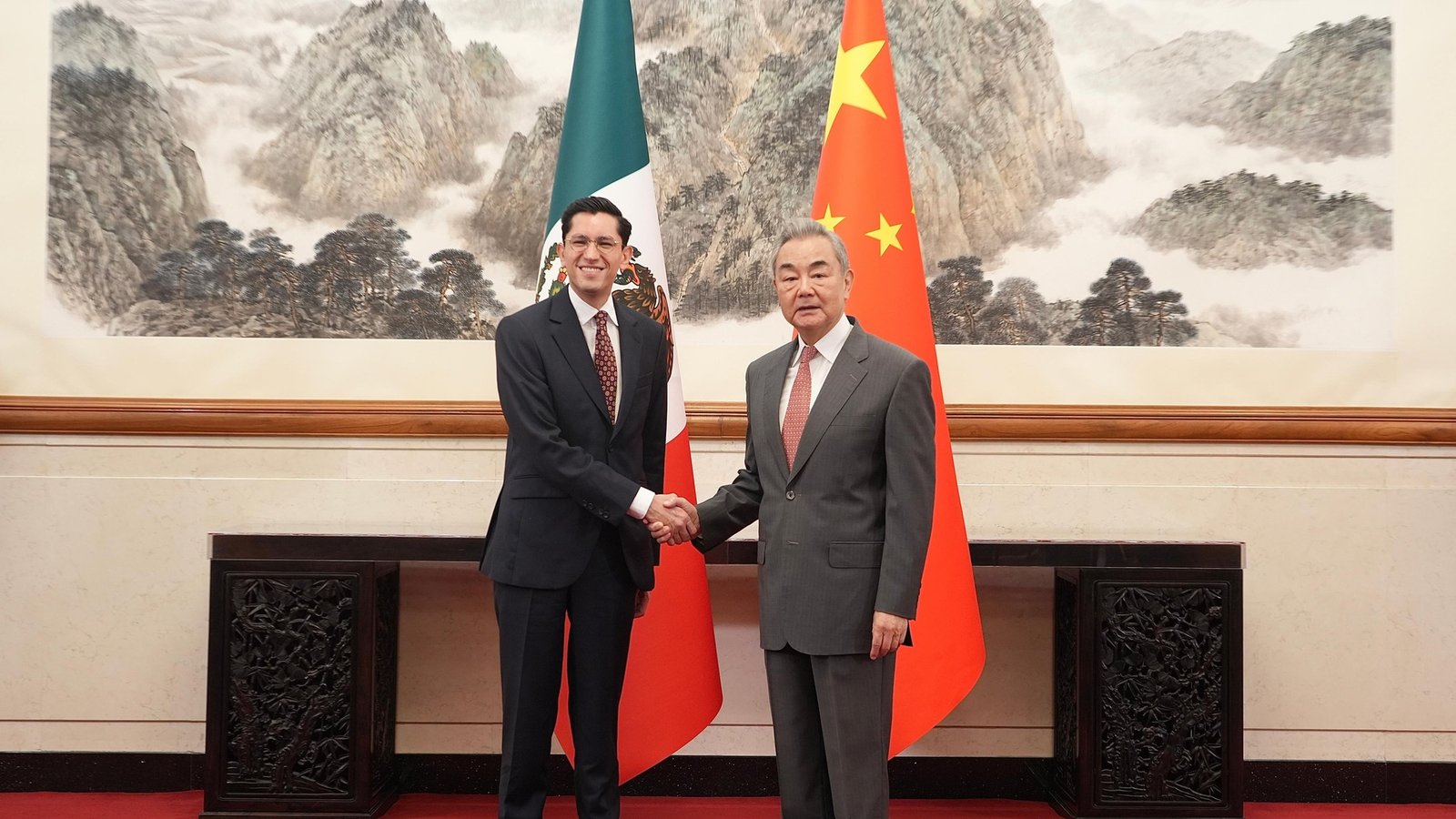
Beijing. The governments of China and Mexico have common interests and are committed to accelerating the development and revitalization of both nations, as well as to being an active force for international peace, equity, and justice, said the Asian nation’s Foreign Minister, Wang Yi, during the reception he held for his Mexican counterpart, Roberto Velasco Alvarez. He also reaffirmed “support for Mexico in its independence and autonomy, safeguarding its sovereignty and security,” as well as in its opposition to foreign interference.
The relationship between China and Mexico is not directed at third parties and must not be affected by third parties.
Wang Yi, China’s Foreign Minister
Velasco Alvarez made a visit to this country on Monday, where the meeting of the Asia-Pacific Economic Cooperation forum (APEC) will take place this coming November in the province of Chengdu, and which President Claudia Sheinbaum is expected to attend.
The foreign minister also recalled that Mexico will host this international mechanism in 2028.
He also mentioned that next year will mark 55 years since the establishment of diplomatic relations, which are grounded in the shared principles of respect for sovereignty, equality among states, and non-intervention.
Mexico has historically maintained this position, which is shared by the Five Principles of Peaceful Coexistence later promoted by China, he noted.
During the meeting, Velasco reported on the opening of Mexico’s career consulate in Chongqing, which reaffirms “the national commitment to strengthening the ties between our peoples.”
Regarding the APEC meeting, Wang Yi commented that its theme is “Building an Asia-Pacific Community and Promoting Common Prosperity.” During the days of the conclave, China will seek to work with the participating states on revitalizing the countries that make up that region and to activate the process for achieving a free-trade area, he indicated.
After conveying the Mexican president’s greetings to Chinese President Xi Jinping, as well as reiterating the federal government’s condolences for the damage suffered in the Tibet region due to the landslide that occurred nearly two weeks ago, Velasco Alvarez reaffirmed the position the country has held since 1971 at the United Nations General Assembly, in favor of the one-China principle.
He recalled that in 2027, both nations will celebrate the 55th anniversary of the establishment of diplomatic relations, which are grounded in the shared principles of respect for sovereignty, equality among states, and non-intervention.
For his part, Yi highlighted that Mexico and China are large developing countries and also share the goal of building a fairer and more rational system of global governance.
China has always viewed and promoted the relationship between the two nations from the strategic standpoint of the unity and cooperation of the countries of the Global South.
Therefore, there is a willingness to strengthen, in a coordinated manner, strategic cooperation on the international and multilateral stage, to protect the legitimate interests of both countries, and to make joint efforts so that the countries of the South strengthen one another, he maintained.
-
César Jáuregui, Maru Campos’s Former Prosecutor, Arrested in Relation to the CIA Case in Chihuahua
The CIA operated illegally on Mexican soil without the federal government’s consent; now the Chihuahua officials who allowed it are facing charges.
-
US Lifts Restrictions on Mexican Airlines
Washington revoked Order 213-2, imposed in 2025 over cargo flights moved to AIFA, reopening new US routes from both Mexico City airports.
-
“Ingeniero,” CJNG Member Who Designed and Built Narco-Tunnels, Falls in Zapopan
The Defense Secretariat says Luis Manuel “N” built drug tunnels into the US from Tijuana and took orders directly from CJNG leader Juan Carlos Valencia González.