A Very Strong El Niño Phenomenon Is Forecast for 2026-2027 in Mexico
This article by Fernanda Monroy originally appeared in the July 9, 2026 edition of Contralínea, an independent Mexican investigative magazine.
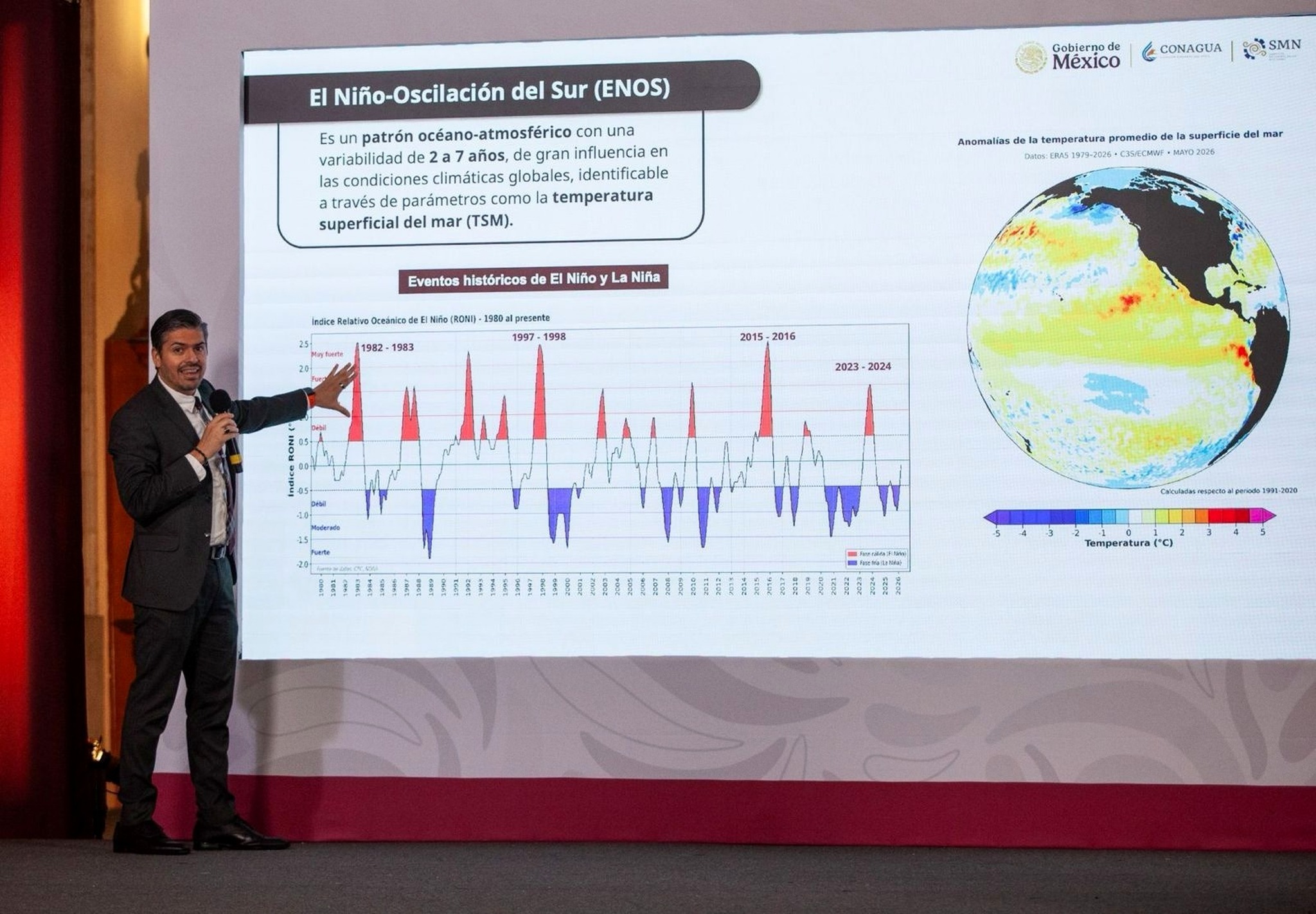
Mexico could face one of the most intense El Niño episodes of the last decades during the 2026-2027 period, warned the general coordinator of the National Meteorological Service (SMN), Fabián Vázquez Romaña, reporting that there is a probability of between 97 and 100 percent that the phenomenon will set in over the coming months, and of 63 percent that it will reach the very strong category.
During the morning press conference, the official explained that, if this scenario materializes, cyclone activity in the Pacific Ocean would increase, the pattern of rainfall would change, and higher temperatures would be recorded heading into the spring of 2027.
The specialist explained that forecast models place the period of greatest intensity between November 2026 and January 2027, with behavior comparable to the events recorded in 1982-1983, 1997-1998, and 2015-2016, considered among the most severe on record.
The SMN coordinator recalled that El Niño is a natural climate phenomenon that arises from the interaction between the atmosphere and the equatorial Pacific Ocean, and that occurs cyclically every two to seven years. However, he noted that the rise in global temperature is changing the way these events develop and their effects.
As evidence of the strengthening of the phenomenon, he indicated that the sea surface temperature in the region known as Niño 3.4 reached 29.2 degrees Celsius, just 0.2 degrees below the maximum recorded in November 2015. “The trend is consistent with a Niño event that is forming very strong.”
Among the anticipated impacts, he highlighted an increase in the formation of tropical cyclones in the Pacific, where between 18 and 21 cyclones are forecast this year, of which four have developed so far. In the Atlantic, by contrast, between 11 and 15 cyclones are expected, of which only one has formed.
The official clarified that a greater number of cyclones does not necessarily imply an increase in direct impacts on Mexican territory, but rather greater activity in the formation of these systems.
Regarding rainfall, he explained that during July and August a precipitation deficit is forecast in the central, northeastern, southern, and southeastern regions of the country, although he specified that this does not mean an absence of rain. For September and October, conditions would tend to normalize as cyclone activity increases.
In winter, from November to April, the outlook would change mainly for the north of the country, where above-average rainfall could be recorded, as well as a greater presence of cold fronts, winter storms, and atmospheric rivers.
He added that the effects of El Niño could extend until the spring of 2027, with higher temperatures, more frequent heat waves, an increased risk of forest fires, and a deterioration in air quality.
In light of this outlook, the national coordinator of Civil Protection, Laura Velázquez Alzúa, reported that the government of Mexico maintains a permanent scheme of coordination with federal, state, and municipal authorities to address the possible effects of the rainy and cyclone season.
She explained that the agency works permanently with the National Meteorological Service to update forecasts and risk maps, monitor dams, rivers, and areas prone to flooding or landslides, in addition to overseeing the conditions of temporary shelters.
She also reported that the installation of Command Posts continues in the 17 coastal states, of which 11 are already in operation, with the participation of state and municipal authorities, as well as the Defense Ministry, the Navy, the National Guard, Conagua, the Federal Electricity Commission, Pemex, and agencies from the Health and Education sectors.
Coordinator Velázquez Alzúa noted that 2026 has been a year of persistent rainfall, and highlighted that just the previous day precipitation was recorded in 31 of the country’s 32 states, with the exception of Baja California.
Finally, she announced that the federal government is strengthening the cell-phone alert system to issue specific warnings for hurricanes, and assured that the DN-III-E Plan, the Marina Plan, and the protocols of the National Civil Protection Coordination remain active to respond immediately to any emergency stemming from rains, cyclones, or the effects associated with El Niño.
-
People’s Mañanera October 21
President Sheinbaum’s daily press conference, with comments on Pemex, fuel theft, Jalisco’s water crisis, missing persons, and the lie detector.
-
Jáuregui’s Arrest Does Not Close the CIA Case in Chihuahua; Morena Demands Broader Investigations
Morena leader Ariadna Montiel holds Governor Maru Campos politically responsible and says ex-prosecutor Guillermo Zuany must also face justice.
-
Morena Accuses Violation of the Secular State Over Award Ceremony for Evangelicals in the Chamber of Deputies
A representative of Israel’s embassy attended the PRI-hosted event, and the group’s founder was arrested in the U.S. for drug trafficking in 2007, Morena deputies said.