Colossal Archaeological Exhibition of Mesoamerica Amazes in China
This article by Emir Olivares Alonso originally appeared in the July 20, 2026 edition of La Jornada, Mexico’s premier left wing daily newspaper.
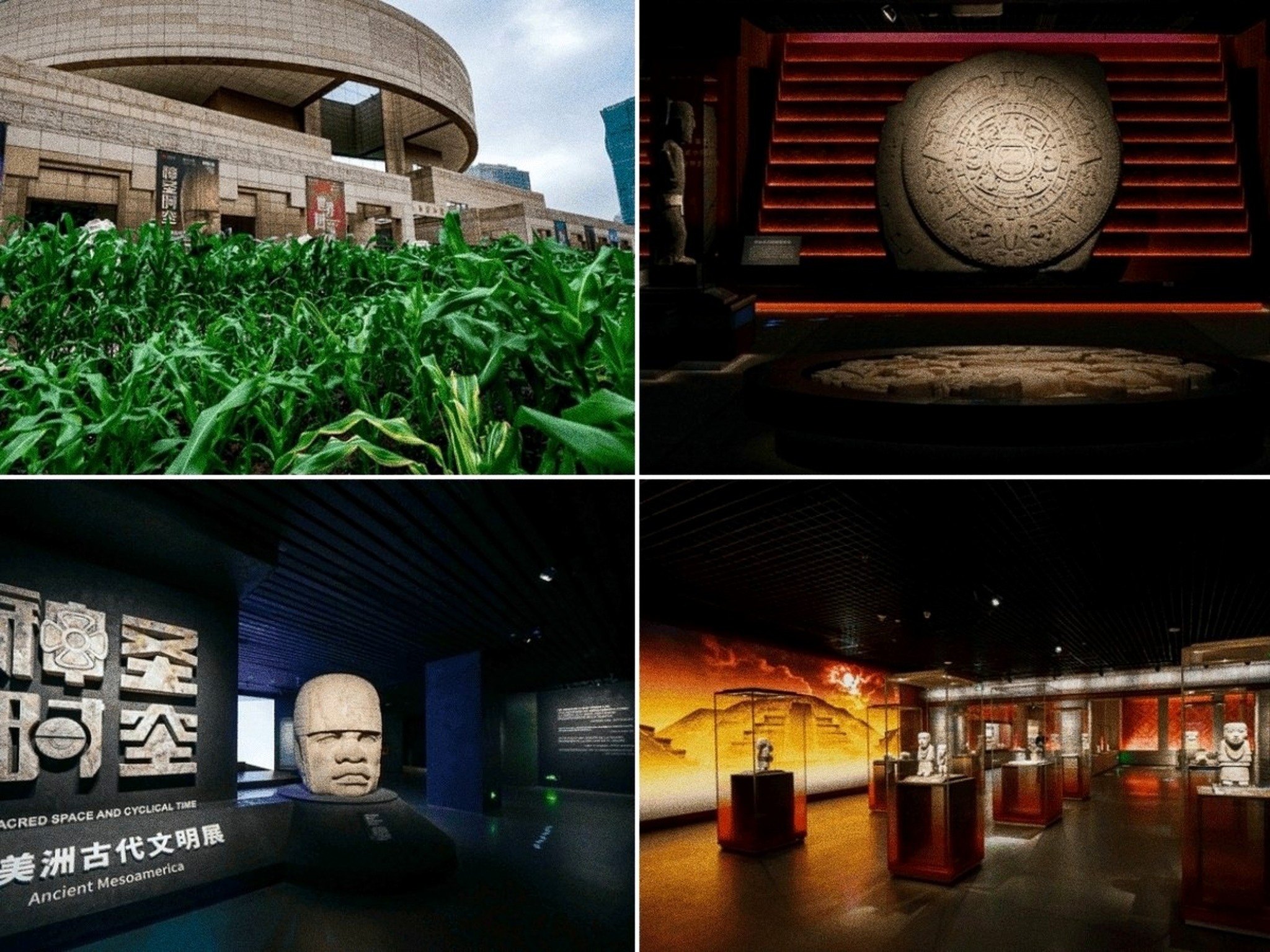
Shanghai. It was five lustrums of waiting for China to be able to host once again a colossal collection of archaeological pieces from the ancient cultures of Mesoamerica. The Shanghai Museum is the venue for the exhibition The Summit of the World’s Trees: Ancient Civilizations of America, whose thematic line centers on a dichotomy: that even though they arose thousands of kilometers apart and despite their marked differences, the worldview of the American peoples finds some parallels with one of the oldest civilizations on the planet: the Chinese.
Motivated by the interest in having their people understand other cultures –which flourished when the first Chinese dynasties were consolidating the empire–, authorities of the Asian nation worked for months with their counterparts in Mexico and Peru to bring to this megalopolis nearly 3,000 archaeological relics from the Olmec, Maya, Teotihuacan, Mexica, and Andean cultures, of which 804 come from our country.
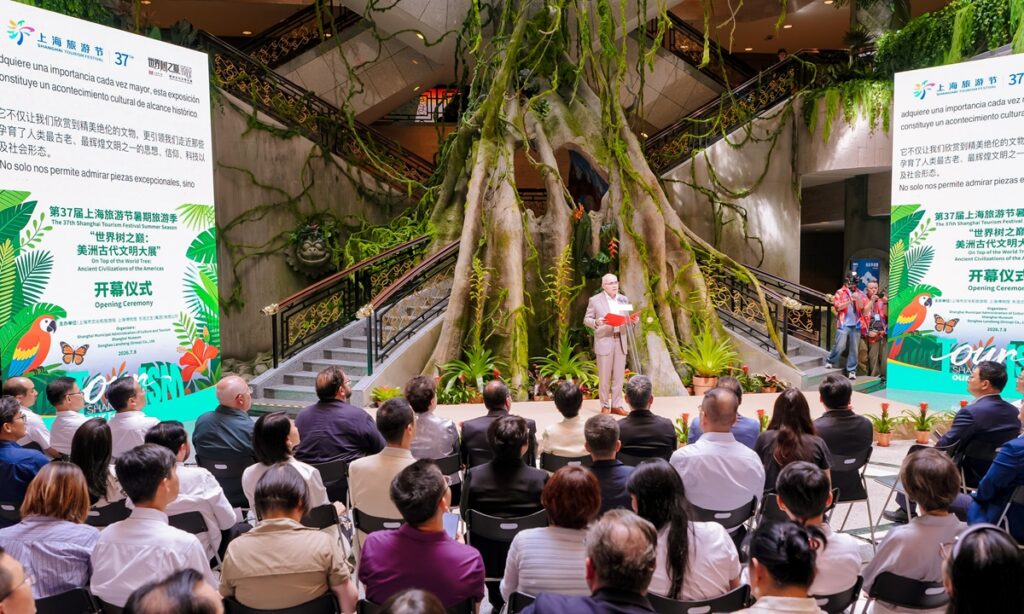
It is one of the largest and most complete exhibitions dedicated to the ancient cultures of the American continent that have been organized not only in China, but in all of Asia. The exhibition opened this past day 8 and will remain open until November 14, 2027. Official reports indicate that so far it has an average of 10,000 visitors a day.
Thus, from one of the most emblematic cities of Chinese hypermodernity, space has been given to understand some of the ancient civilizations of the planet.
Six skulls carved in stone stop the steps of a little girl of about seven years old in one of the halls of the museum complex, one of the most important of the Asian giant. Her attitude denotes fear at seeing those objects alluding to death, but her curiosity dominates her and, little by little, she approaches. She glances sideways at the Maya pieces for a few seconds and ends up taking refuge in her mother’s lap, clinging to her arm.
The woman tries to explain to her what she is looking at: in the worldview of the ancient Mesoamerican cultures, death did not represent the end of existence, but a transformation, the passage to another stage.
The scene is repeated in different halls of the complex: expressions of surprise, constant questions, and attendees who discover other visions of the world. What for many Chinese visitors may seem a disturbing image, for the original peoples of Mexico was part of a profound vision about the balance of the universe and the cycle of life.
According to the Shanghai Museum, the exhibition constitutes “the largest exhibition of its kind” organized since 2001, when the venue presented the exhibition Maya Treasures from Mexico; in addition to being the most extensive and complete presentation dedicated to the ancient civilizations of the American continent carried out to date.
From the beginning of the tour, the exhibition poses a central idea: the ancient civilizations of China and America, although separated by an immense ocean, posed similar questions about the origin of the universe, the passage of time, the relationship with nature, and the role of the human being within the cosmos.
The Exhibition Represents a Dialogue Between Ancient Cultures
For the director of the Shanghai Museum, Chu Xiaobo, the exhibition represents a dialogue between ancient cultures. “Chinese civilization and the Latin American ones have many points in common in their worldview,” he told the Xinhua agency on the day of the inauguration, highlighting that the cultures of America and China developed calendars, astronomical knowledge, complex agricultural systems, and a profound symbolic relationship with elements of nature.
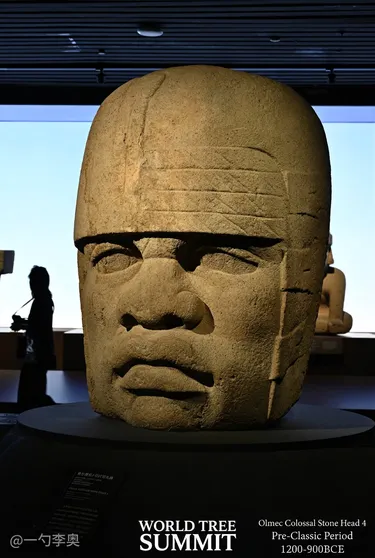
One of the greatest symbols of the exhibition is the Colossal Head 4 of San Lorenzo, of Olmec origin, the so-called mother culture. This civilization arose, according to historical reports, between 1600 and 1500, when the Shang dynasty was beginning in China.
The piece, of approximately 4.5 tons and almost 3,000 years old, traveled more than 13,000 kilometers from Mexico to Shanghai. Its transfer represented a complex international operation of conservation, packing, security, and transport that translated into working sessions of Mexican and Chinese archaeologists, restorers, heritage specialists, and technical teams.
The consul of cultural affairs and cooperation of the consulate of Mexico in Shanghai, Rodrigo Topete Maza, notes in conversation with this newspaper that exhibitions like this one –which takes place within the framework of the 55th anniversary of the establishment of relations between our country and the People’s Republic of China, next year– strengthen mutual knowledge, promote respect for heritage, and generate new opportunities for cooperation between museums, universities, researchers, and cultural institutions.
“It is a reminder that the bilateral relationship is not only built through political dialogue or economic cooperation, but also through cultural exchange and the recognition of the deep historical roots of both peoples. The exhibition reflects the growing interest that exists in China in learning about the cultural heritage of Mexico.”
In another hall, visitors discover one of the most surprising spaces of Teotihuacan: the representation of the tunnel found beneath the temple of Quetzalcóatl. The feathered serpent, one of the most important figures of Mesoamerica, appears as a symbol of union between the earth and the sky: the force of nature and divine power.
For many Chinese attendees, the image turns out to be familiar in a symbolic sense, since they associate it with the dragon. The presence of mythological beings associated with the sky, the sacred animals, and the connection between rulers and supernatural forces recall some ideas also present in the tradition of this country.
The Mexica culture occupies a prominent place in the exhibition. Its temples, deities, and ritual objects show a society organized around agriculture, war, and the need to maintain the cosmic balance. A replica of the Sun Stone is presented, onto which a light show is projected that allows visitors to understand how the Mexica conceived of time as a cycle. The universe had to be kept in motion, and human sacrifice was interpreted as a form of renewal and continuity.
This is one of the parts that most provokes surprise on this side of the world. Miss Li, a young Chinese woman of 22 years, acknowledges that the sacrifice rituals were one of the aspects that most caught her attention. “Now it may seem something difficult to understand. Although it is something not so nice, in that era it had an indispensable meaning within that society,” she comments.
The Maya presence is another of the great attractions of the exhibition. Calendars, sculptures, and objects related to rulers make it possible to learn about a civilization that achieved extraordinary advances in astronomy, writing, mathematics, and architecture. The replica of the tomb of Pakal, ruler of Palenque –discovered in 1952–, allows visitors to get close to the reliefs associated with his journey to the beyond. Some even touch with amazement the carved representations, trying to understand a history that occurred more than a thousand years ago.
The second part of the exhibition takes the visitor toward the Andes. There, gold appears not as a symbol of economic wealth, but as a sacred material related to the gods, power, and the connection with the ancestors. The Andean cultures used gold, silver, copper, stone, textiles, and ceramics to represent their beliefs, their social hierarchies, and their interpretation of the universe.
The magnitude of the exhibition was possible thanks to the collaboration between Mexican, Peruvian, and Chinese institutions, in a project that required more than 18 months of preparation.
Guo Cunhai, director of the Office of Social and Cultural Research of the Latin American Institute of the Chinese Academy of Social Sciences, affirms that the encounter between both regions makes it possible to build a more diverse world narrative, in which no civilization represents a single path of development. “Civilizations do not develop in a single line,” and mutual learning is important, he emphasized.
Among gods, calendars, sacred trees, and memories in stone, the cultures of America make evident a history that could not be eradicated by the long and violent stage of colonization and survived the passage of time, and in the coming months it will dialogue with China from the heart of Shanghai.
-
Defense of Sovereignty “Is Not Rhetoric, It’s Principles,” Sheinbaum Says
Sheinbaum recalled foreign pressure on Mexico in the 19th and 20th centuries and blamed the neoliberal governments and Calderón for opening the door to U.S. influence.
-
Sheinbaum Presents Draft Decree to Force Digital Platforms to Take Down Content That Incites Violence and Hate
No fines for now: the government will talk with tech companies before publishing the decree next week, a promise made after the Coahuila school attack.
-
People’s Mañanera October 9
President Sheinbaum’s daily press conference, with comments on digital safety, IMSS-Bienestar, sovereignty, and the opposition.