
Mexico’s Supreme Court Will Incorporate Legal Knowledge of Indigenous & Afro-Mexican Peoples
This article by Ivan Evair Saldaña originally appeared in the January 29, 2026 edition of La Jornada, Mexico’s premier left wing daily newspaper.
Mexico City. The Supreme Court of Justice of the Nation (SCJN) created the Community Research System (SIC), a mechanism that seeks to incorporate the legal knowledge of indigenous and Afro-Mexican peoples—derived from their history, practices and defense of human rights—into the drafting of resolutions by judges, magistrates and ministers of the country.
The SIC, which is part of the Center for Constitutional Studies and Legal Knowledge (CECSJ) of the high court, expands the traditional vision of law, makes legal pluralism a reality and allows this knowledge to become part of its national history, said Supreme Court President Hugo Aguilar Ortiz during the presentation ceremony of the system.
“I am convinced that justice must abandon formality. I say it won’t be abandoned entirely, but it must get closer to reality, and to get closer to reality we need method, we need knowledge, we need systematization, we need the people who demand justice, who cry out for justice, who mobilize out there, to systematize their arguments and bring them to us. And for that, research is required, applied research,” criticized the representative of the Federal Judiciary (PJF).

He also emphasized that the goal is to transform the justice system through applied research that directly impacts sentences and conflict resolution, overcoming views that have historically minimized community knowledge.
“You could say that outside, in the Western world, art is produced, but if we see something in rural communities, it’s called crafts, it has less value. If it’s a rule established by the State, it’s law; but if the community produces it, it’s custom and tradition. If we see a priest performing his ritual, well, he’s a priest, but if we see our village elder perform a cleansing, a ritual, well, he’s a witch doctor. If someone tells a story, well, it’s not documented, it’s part of oral tradition, it’s a myth, but if a scholar tells it, it’s history. Anything that Indigenous people produce, anything that our very being produces; you can stand up and say, well, he’s Indigenous, he doesn’t know, he doesn’t have the capacity,” he emphasized.
Orlando Aragón Andrade, director general of the CECSJ, pointed out that, given the plurality of justice and legal systems, it is necessary to build bridges of dialogue to move toward a more democratic society and a more inclusive court. In turn, Iván Ramos Méndez, representing the head of the INPI, Adelfo Regino Montes, stated that following the 2024 constitutional reform, there are more than 16,000 normative systems in force in Mexico.
Also participating in the presentation were Catalina Ramírez Hernández, from the Judicial Administration Body; Palmira Flores García, an indigenous community researcher from San Luis Potosí; and Sael Silva Cisneros, an Afro-Mexican community researcher from Guerrero.
-
Defense of Sovereignty “Is Not Rhetoric, It’s Principles,” Sheinbaum Says
Sheinbaum recalled foreign pressure on Mexico in the 19th and 20th centuries and blamed the neoliberal governments and Calderón for opening the door to U.S. influence.
-
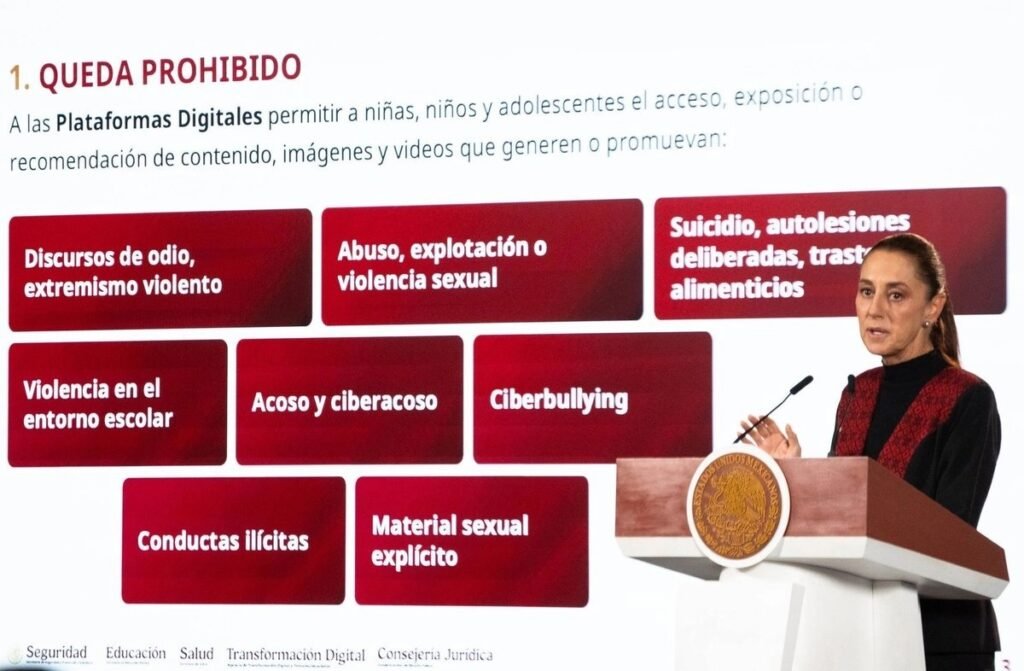
Sheinbaum Presents Draft Decree to Force Digital Platforms to Take Down Content That Incites Violence and Hate
No fines for now: the government will talk with tech companies before publishing the decree next week, a promise made after the Coahuila school attack.
-
People’s Mañanera October 9
President Sheinbaum’s daily press conference, with comments on digital safety, IMSS-Bienestar, sovereignty, and the opposition.