Only 1 in 10 App Workers Able to Access Social Security
This article originally appeared in the September 9, 2025 edition of La Jornada, Mexico’s premier left wing daily newspaper.
Editor’s note: Only last month, Mexico’s National Union of App-Based Workers (UNTA) warned of the risk of “massive exclusion” of app workers from social security after the government initially registered nearly a million app workers into IMSS (Social Security), something that the Mexico’s Deputy Labor Minister Quiahuitl Chávez Domínguez celebrated as “a true paradigm shift,” ensuring that “Technological innovation is no longer at odds with labor rights,” while the Mexican government used the numbers to tout job creation numbers of 1.35 million. But with only 11.5% of the total jobs added being permanent positions and only 13.6% of app workers remaining eligible for IMSS, the numbers look a lot less rosy.
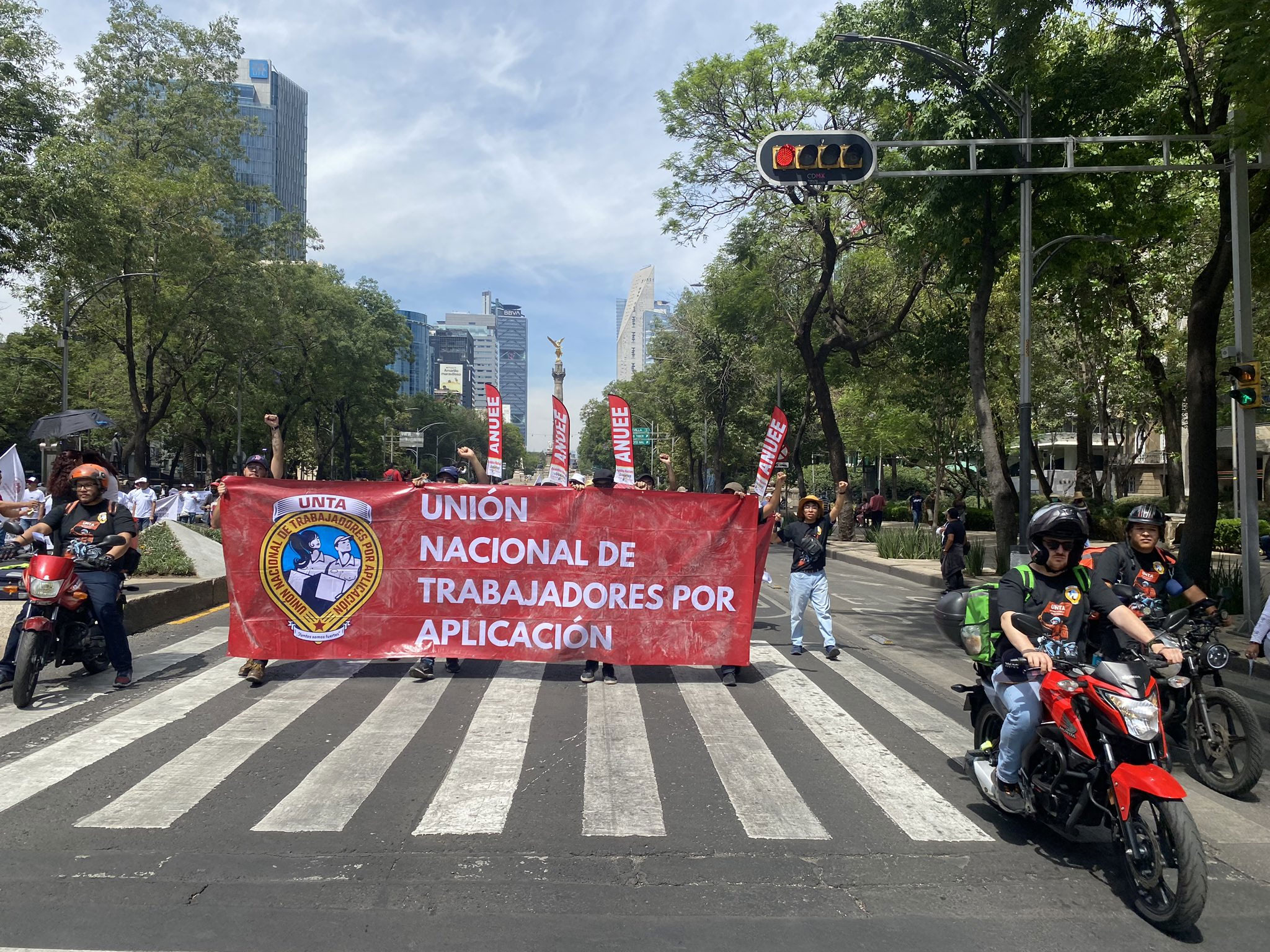
Mexico City. The National Union of App-Based Workers (UNTA) expressed concern about the results of the second month of the pilot test for people who work on digital platforms, as only one in 10 accessed universal social security, according to official data.
The Mexican Social Security Institute (IMSS) reported yesterday that 980,471 people registered as beneficiaries of the reform; however, only 133,178 (13.6 percent of the total) exceeded the monthly net income (MIN) threshold above the minimum wage on 14 registered digital platforms, allowing them access to the full social security system.
“This means that nine out of 10 workers still lack full access to the five IMSS insurance plans, despite having registered on the platform,” UNTA emphasized.
Thus, although more than 980,000 workers were registered with occupational risk coverage through the application, “the majority remain excluded from key rights” such as general medical care, childcare, retirement savings, or disability pensions, he emphasized.
The INM is calculated based on the worker’s total income, less the exclusion percentage, the latter representing the cost of work tools.
The organization led by Sergio Guerrero noted that the so-called exclusion percentages—which reduce recognized wages by up to 60 percent—“are creating a structural barrier to the recognition of rights.”
Therefore, he reiterated his call to the Ministry of Labor and Social Welfare and the Mexican Social Security Institute (IMSS) to eliminate this criterion, as well as the “lack of transparency and clarity in the information,” since it is necessary, he indicated, to have disaggregated data by type of activity (delivery workers or drivers), by platform, and by federal entity to understand the true scope of the process.
In accordance with the general provisions, three categories of workers and exclusion percentages were defined. These will be deducted from their gross monthly income to determine their INM, and these will vary in two phases.
During the first three months after the pilot plan comes into effect (July to September), increased exclusion percentages will be applied as part of a gradual phase-in: car drivers, 60 percent; motorcycles, 50 percent; and non-motorized drivers, 15 percent.
From October to December, the exclusion rate will be 36 percent, 30 percent, and 12 percent, respectively.
-
People’s Mañanera October 21
President Sheinbaum’s daily press conference, with comments on Pemex, fuel theft, Jalisco’s water crisis, missing persons, and the lie detector.
-
Jáuregui’s Arrest Does Not Close the CIA Case in Chihuahua; Morena Demands Broader Investigations
Morena leader Ariadna Montiel holds Governor Maru Campos politically responsible and says ex-prosecutor Guillermo Zuany must also face justice.
-
Morena Accuses Violation of the Secular State Over Award Ceremony for Evangelicals in the Chamber of Deputies
A representative of Israel’s embassy attended the PRI-hosted event, and the group’s founder was arrested in the U.S. for drug trafficking in 2007, Morena deputies said.