
Mexico’s Pemex Cuts Debt by More Than US$20 Billion and Raises Refining 81% Compared to 2018, Carpio Says
This article by Fernanda Monroy originally appeared in the October 21, 2026 edition of Contralínea, a Mexican investigative journalism magazine.
Petróleos Mexicanos (Pemex) reduced its debt by more than US$20 billion in less than two years and reached its lowest level since 2014, reported its director general, Juan Carlos Carpio Fragoso. He also reported an 81 percent increase in oil refining compared to 2018 and production of 1.76 million barrels per day.
During the morning press conference this Wednesday, October 21, the official highlighted that the public company’s strategy focuses on maintaining hydrocarbon production, increasing the transformation of oil into fuels, strengthening petrochemicals and fertilizers, and allocating greater resources to productive projects.
He indicated that natural gas production increased 7.5 percent compared to 2024, to exceed 4.9 billion cubic feet per day. Regarding crude processing, he said Pemex went from around 612,000 barrels per day in 2018 to more than 1.1 million barrels currently. He attributed this growth to the operation of the refineries, the addition of the Olmeca refinery, and operational improvements at strategic facilities in Tula.
This progress was also reflected in fuel manufacturing, as the production of gasoline, diesel, and jet fuel increased 186 percent compared to 2018, going from 350,000 barrels per day to one million.
Carpio Fragoso explained that, of the fuels marketed by the oil company, the proportion coming from its own facilities went from 24 of every 100 liters sold in 2018 to 87 of every 100 liters today. According to the executive, this change makes it possible to generate greater value within the national production chain and reduce dependence on external purchases.
In the petrochemical sector, the production of ethylene derivatives grew 27 percent compared to 2025, which represents greater availability of domestic raw materials for industry.
Meanwhile, fertilizer production increased 16 percent, with a 36 percent increase in urea production, in addition to advances in phosphate and nitrogen inputs for the agricultural sector.
The head of Pemex also reported that gasoline and diesel sales grew 17.9 percent between January and September 2026, compared to the same period of the previous year.
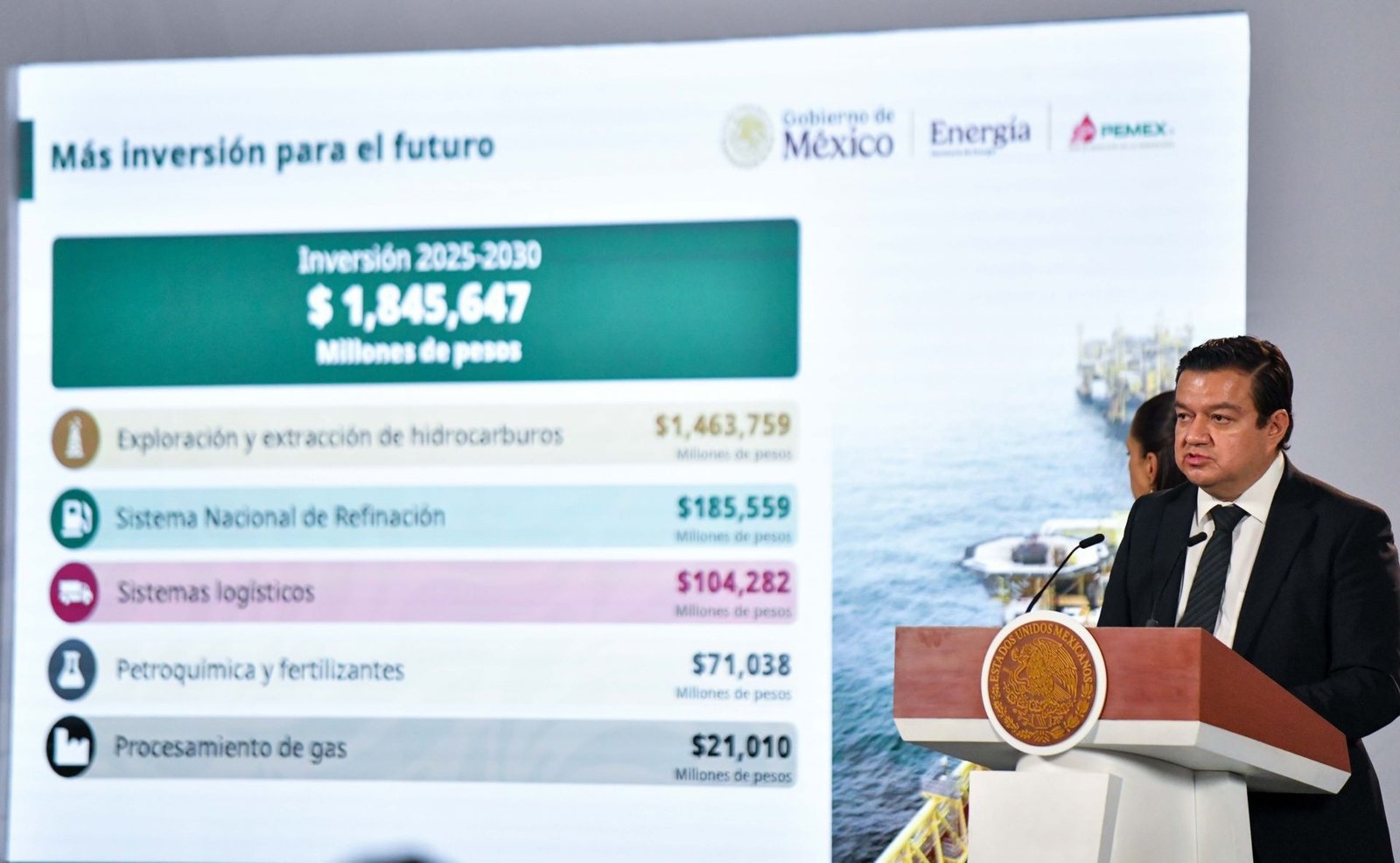
On the financial front, he maintained that the debt reduction will make it possible to lower interest payments and free up resources to invest in extraction, refining, and petrochemicals. As part of its growth plans, the company plans to allocate more than 1.8 trillion pesos between 2025 and 2030, coming exclusively from its own resources, to strengthen its value chain.
In the social sphere, the official detailed that, between 2025 and September 2026, Pemex allocated almost 6.6 billion pesos to support communities and strategic regions where it has operations. These funds were channeled to roads, infrastructure, health and education works, productive projects, and community programs.
Finally, he stated that the results are part of a strategy to strengthen Pemex as a public company fundamental to national development, through greater energy generation and continued investment in the different stages of the hydrocarbon chain.
-
Sheinbaum Rejects Collusion With Crime; Fires Back That There Was an Alliance Between the PAN and Criminals
She cited the more than 50% drop in homicides as proof and recalled Genaro García Luna, the PAN-era security secretary tied to criminal organizations.
-
People’s Mañanera October 22
President Sheinbaum’s daily press conference, with comments on Plan México, housing in Guerrero, foreign agents in Chihuahua, and IMSS wages.
-
Mexico Owns the Water. Who Can Use It?
From the poisoned Santiago River to the 1992 law that turned water into a commodity, Luis Eugenio Parés explains what it will take to make water a right again in an exclusive interview from our latest bulletin.