Sheinbaum Drives the First Mexican Electric Vehicle: Olinia 1 to Sell for 150,000 Pesos
This article by Iván Evair Saldaña originally appeared in the June 7, 2026 edition of La Jornada, Mexico’s premier left wing daily newspaper.
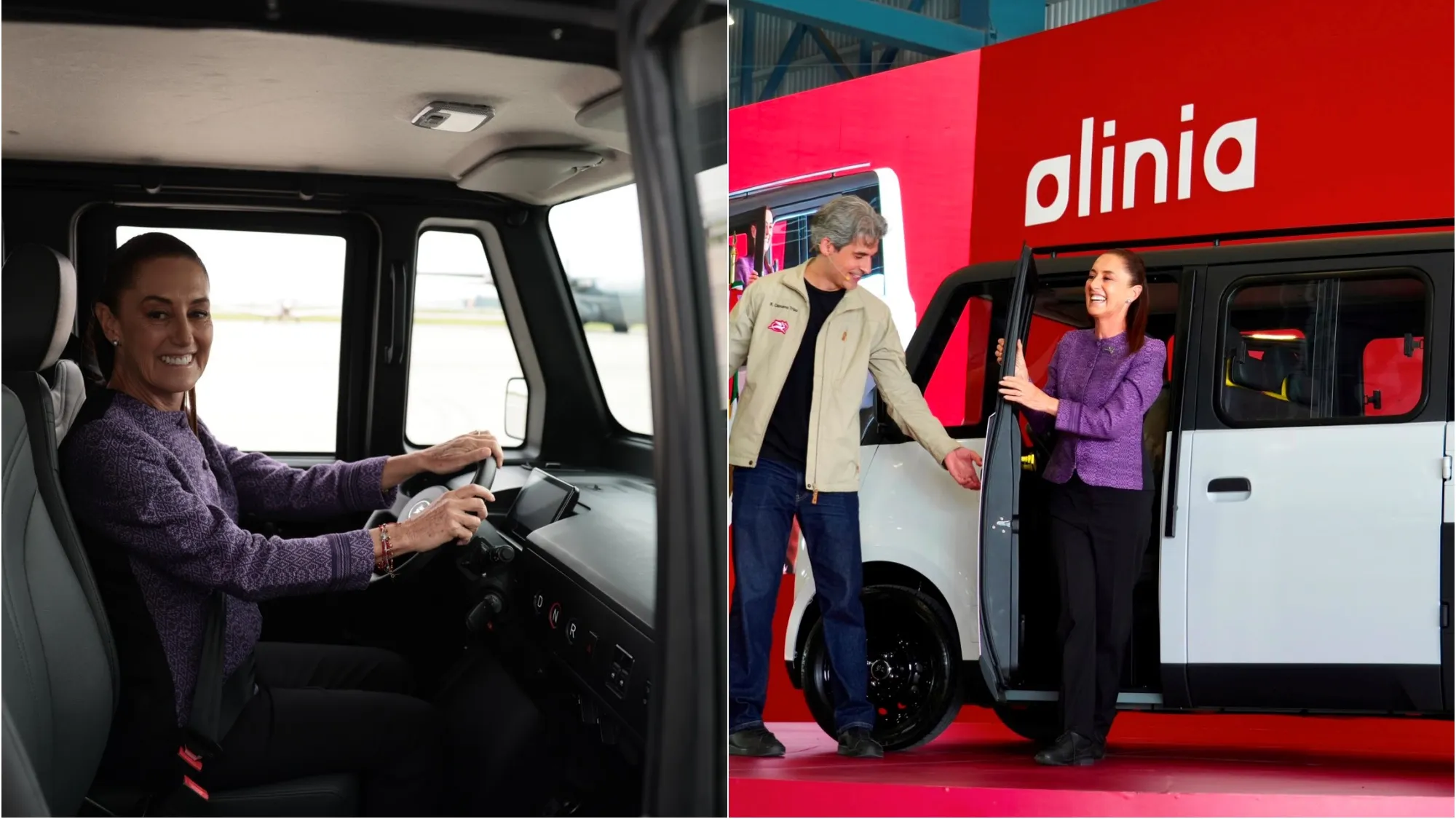
Zumpango, State of Mexico. — Amid applause, President Claudia Sheinbaum Pardo entered one of the hangars at the Santa Lucía Military Air Base driving the first Mexican electric vehicle, Olinia 1, during its official unveiling. The car will go on sale starting at 150,000 pesos per unit and will be on the road beginning next summer.
“Mission accomplished… Olinia means movement — to move, in Náhuatl: movement of ideas, of creativity, moving with innovation, with hope, moving toward new horizons,” the federal president said minutes later.
Olinia 1 was presented by the project director, Roberto Capuano Tripp, as “the vehicle that millions of people in Mexico need” and as the first product of an industry that, he said, “we are watching being born before our eyes,” before cabinet secretaries, the governor of the State of Mexico Delfina Gómez, diplomats and business leaders.
It is also the result of 18 months of collective work in which institutions, research centers and public universities — such as the Instituto Politécnico Nacional (IPN) — participated, in addition to specialists and companies from China, the United States, India and Germany, as well as Mexican companies that collaborated on the design, integration and manufacture of the unit and all of its parts from scratch.
“Building a national industry does not mean isolating ourselves; it means learning, integrating capabilities, and developing our knowledge step by step. But our goal is very clear: by 2030 we expect to reach 75 percent national integration, building capacities in the areas where we need them. And to achieve this, Olinia is being built as a Mexican company, with mixed participation,” Capuano announced.
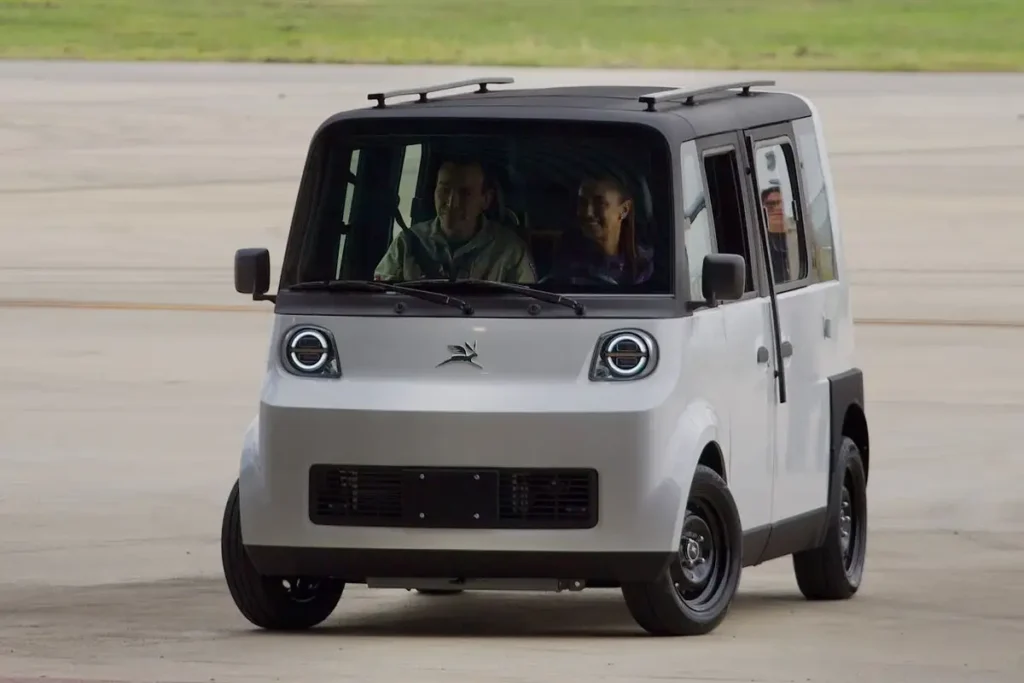
It is a compact plug-in electric vehicle designed to maximize interior and exterior space, with capacity for up to six people and equipped to transport people in wheelchairs. It has a 14.7 kWh battery with a range of 125 km.
Capuano Tripp announced that they are working on a plan to deploy charging infrastructure for electric vehicles, with the goal of installing tens of thousands of charging points across the country by 2030. As a first stage, he said, there is already a project to set up 2,000 chargers in the State of Mexico, Mexico City and Puebla, in coordination with the Secretariat of Energy and the Federal Electricity Commission.
“In addition, this effort is paving the way to achieve a massive replacement of taxis in those three states. The vehicle is designed for a low operating cost of 49 cents per kilometer, five times less than a gasoline car. That means savings of up to 50,000 pesos a year in gasoline.”
“Let’s talk operating costs. A gasoline vehicle has an approximate cost of 2 pesos and 40 cents per kilometer. A motorcycle, one peso per kilometer. With more than 125 kilometers of range per charge, Olinia 1 achieves an operating cost of 49 cents per kilometer… To give an idea of what this means in practice, a driver who covers 75 kilometers a day in an Olinia versus a gasoline car can save more than 50,000 pesos a year just in fuel. This vehicle will end up paying for itself with the savings it generates,” said Imelda Vega, a researcher at the Instituto Tecnológico de Puebla.
Rosaura Ruiz Gutiérrez, head of the Secretariat of Science, Humanities, Technology and Innovation (Secihti), said that Mexico’s scientific community responded to the challenge President Sheinbaum Pardo set for them. “This is not just about an electric vehicle; what we are seeking is to spur the creation of an industrial sector with enormous growth potential. Of course, launching a national electromobility industry does not mean we have to travel that road alone,” she said.
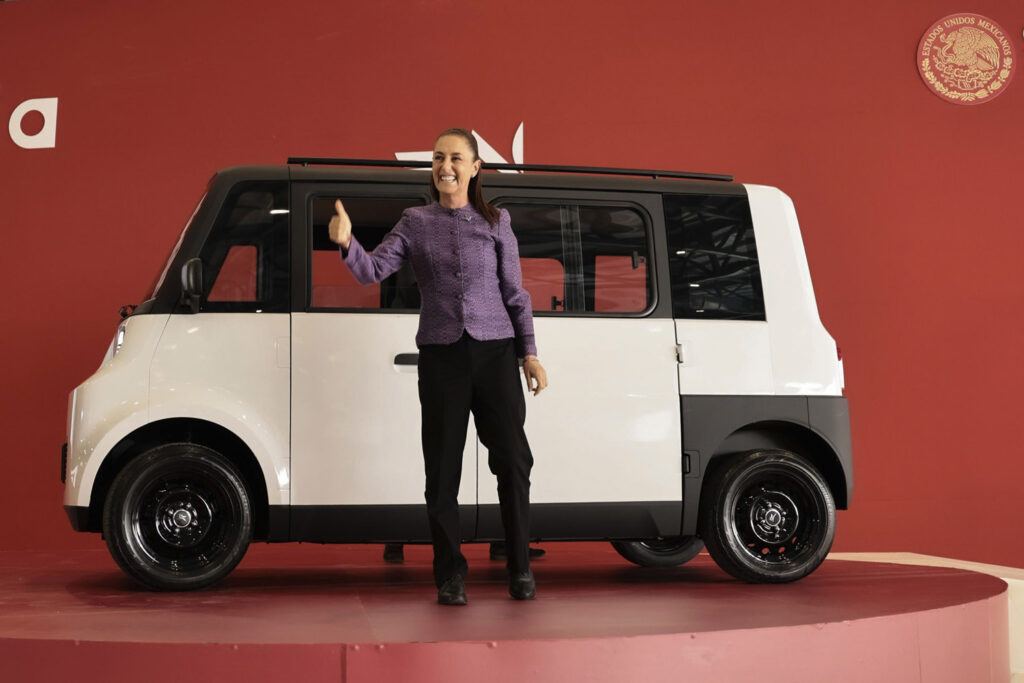
Olinia, a Car Built with Mexican Talent
During the event, the President of the Republic highlighted that Olinia 1 demonstrates that the creativity, knowledge and innovation of Mexicans — which has ancestral origins in their indigenous peoples — can be transformed into technological development and well-being.
“That creativity and that innovation is in each and every Mexican. And there are also dozens of examples of scientists, technologists, philosophers, artists, Mexican men and women who have transformed the world. From color television to the birth control pill, advances and new research in astronomy, biotechnology, the interpretation of history, literature, philosophy — Mexican men and women who, day after day, generate knowledge,” she noted.
She also said that Olinia breaks with the idea that the country can only assemble vehicles or adapt innovations from abroad.
“This is not just about manufacturing an electric car; it is about demonstrating that we are capable of imagining it, designing it, developing it, and making it a reality. For a long time Mexico was spoken of as a country destined solely to produce what others imagined. We were told that we could not, that we should not. We were told that innovation was reserved for other places, that Mexico was made only for the maquila, that our role was to receive technology, not develop it, to receive ideas, not create them — but that is false,” she emphasized.
She also stressed that the project will spur new careers, specialties and lines of research in Mexico in areas such as batteries, software, artificial intelligence, advanced electronics, new materials and clean energy.
“The Seed” of Mexico’s New Electric Car Industry
For Sheinbaum Pardo, Olinia “is the seed” of a new national industry and of an innovation ecosystem based on collaboration among universities, research centers, the State and private initiative, as part of a new stage of technological development for the country.
Finally, she presided over the symbolic signing of the Olinia 1 prototype, an automotive industry tradition that recognizes those who took part in the creation of a new model.
“That is why Olinia represents much more than an electric car: it represents a seed — the seed of a new ecosystem of innovation built from Mexico, the seed of a national industry that can grow from the bottom up, driven by the knowledge, creativity and work of thousands of Mexican women and men; the seed of a mixed economy in which universities, research centers, the State and the creative initiative of society collaborate to develop new technologies, new solutions and new national capacities,” she emphasized.
The president closed her speech by noting that “Olinia is transformation, and Mexico is in transformation,” where “what seemed impossible is being made possible.”
The event concluded with President Claudia Sheinbaum Pardo signing a piece of the Olinia 1, an automotive tradition that honors those who took part in its development.
-
People’s Mañanera October 8
President Sheinbaum’s daily press conference, with comments on public companies, railways, Morena’s 15 years, and US security cooperation.
-
Confidence in Mexico Secures US Investment, Sheinbaum Says After Meeting With Business Leaders and Ambassador Johnson
The executives, who came with Ambassador Ronald Johnson, pressed for a quick USMCA deal, while new pharma, energy and farm investments are on the way.
-
Mexicana Expects to Reach Profitability Starting in 2030
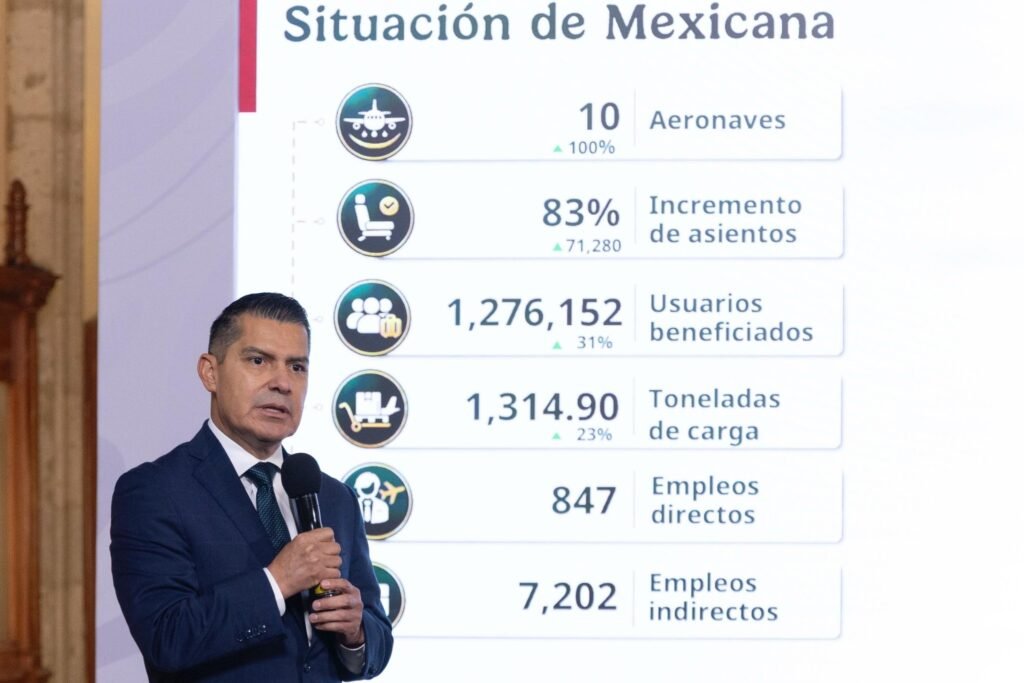
Mexico’s state airline plans to double its fleet to 20 planes by 2027, after boosting seat capacity 83 percent this year and carrying over 1.27 million passengers.