
Government Promotes Discussion to Regulate Social Media for Minors
This article by Fernanda Monroy originally appeared in the July 27, 2026 edition of Contralínea, a Mexican investigative journalism magazine.
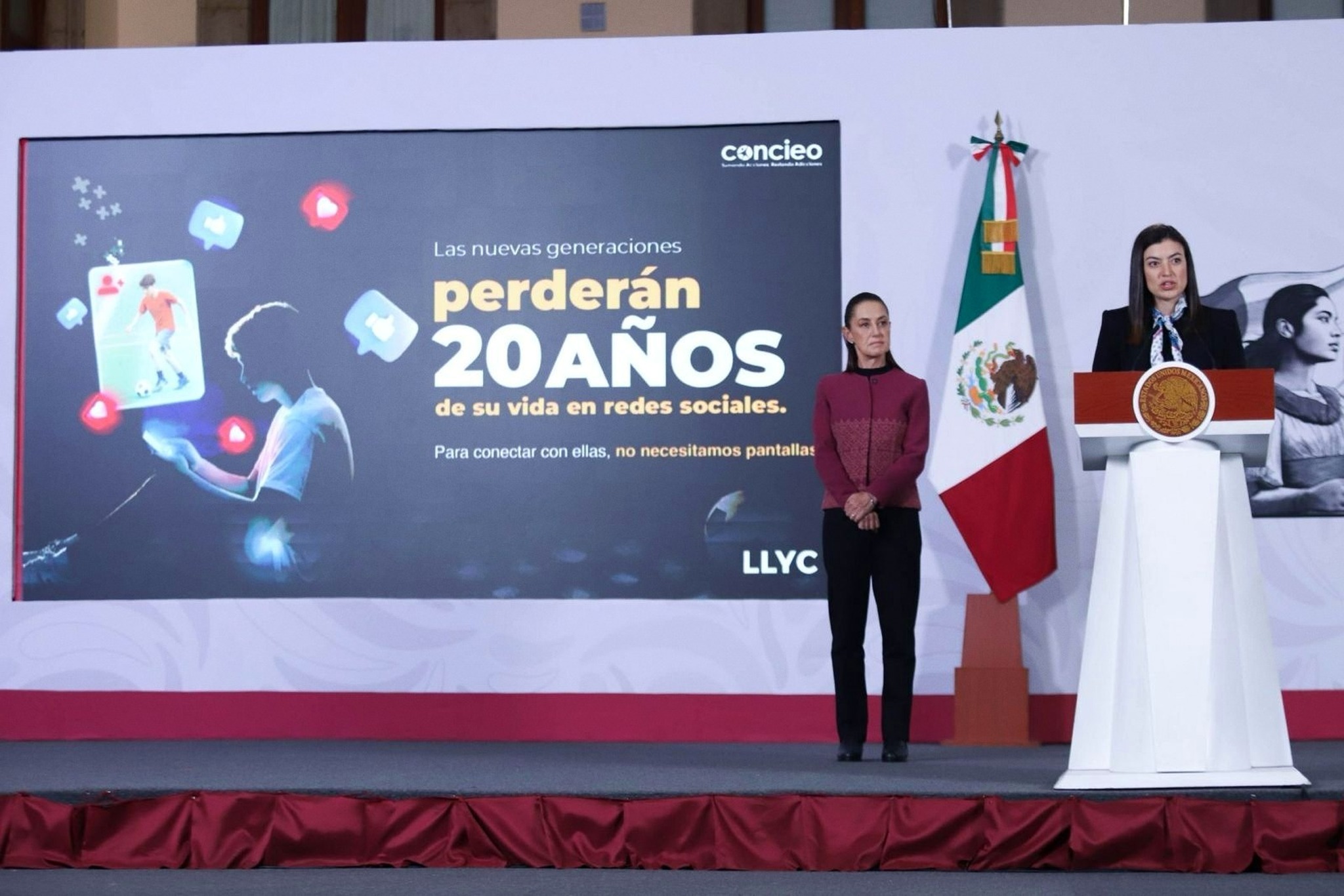
The federal government will promote a discussion to regulate access to social media by girls, boys, and adolescents, after specialists warned that excessive use of these platforms can affect brain development, attention, sleep, and mental health during key stages of growth.
During the morning press conference, the Secretary of Public Education, Mario Delgado Carrillo, explained that the initiative seeks to open a public debate grounded in scientific evidence so that mothers, fathers, teachers, and authorities know the risks associated with excessive use of devices and digital platforms by minors.
The SEP head noted that “the most important thing is that we are all taking on this challenge together. The objective is for us to accompany this generation and give them tools for a full and happy life.”
As part of that discussion, specialists in neurodevelopment and addiction prevention presented research on the way social media and other digital platforms interact with the brain during childhood and adolescence.
The general director of Concieo AC (an association to prevent addictions in girls, boys, and young people), Tania Jiménez García, explained that problematic technology use provokes an elevated release of dopamine, a neurotransmitter related to the sensation of reward. Faced with that overstimulation, she said, the brain reduces its production of this substance and modifies its receptors as a protection mechanism, which can cause everyday activities to stop generating satisfaction and favor the constant search for digital stimuli.
The specialist added that this type of use can also affect functions such as attention, concentration, impulse control, and emotional regulation. However, she clarified that the brain retains the capacity to recover through neuroplasticity, as long as there is timely intervention and healthy habits.
For her part, the director of the Center for Digital Youth at the University of Washington, Lucía Magis Weinberg, explained that adolescence, between the ages of 10 and 25, is a stage of intense brain reorganization. She indicated that the regions related to emotions and reward-seeking mature before those in charge of self-control and decision-making, which makes adolescents more vulnerable to developing unhealthy habits.
The researcher noted that various studies show that constant use of digital platforms can erode attention capacity. As an example, she indicated that two decades ago a person could maintain concentration for around two and a half minutes in front of a screen before getting distracted, while currently that time has been reduced to approximately 47 seconds. She also warned that increasingly early access to cell phones is associated with impacts on cognitive development.
The specialist added that excessive screen use can also displace activities essential for development, such as sleep, physical activity, in-person socializing, and the construction of identity during adolescence, so she recommended setting limits, promoting disconnection spaces, and strengthening education for healthy technology use.
For her part, President Claudia Sheinbaum Pardo affirmed that the federal government is preparing informational materials directed at mothers and fathers to spread awareness of the risks of excessive social media use, and to foster decisions oriented toward protecting girls, boys, and adolescents.
She also warned that, if this phenomenon is not addressed, the consequences could impact not only the individual development of the new generations, but also that of the country, so she stressed the importance of the discussion.
-
César Jáuregui, Maru Campos’s Former Prosecutor, Arrested in Relation to the CIA Case in Chihuahua
The CIA operated illegally on Mexican soil without the federal government’s consent; now the Chihuahua officials who allowed it are facing charges.
-
US Lifts Restrictions on Mexican Airlines
Washington revoked Order 213-2, imposed in 2025 over cargo flights moved to AIFA, reopening new US routes from both Mexico City airports.
-
“Ingeniero,” CJNG Member Who Designed and Built Narco-Tunnels, Falls in Zapopan
The Defense Secretariat says Luis Manuel “N” built drug tunnels into the US from Tijuana and took orders directly from CJNG leader Juan Carlos Valencia González.