
Cambiémosla Ya: US-Mexico Critical Minerals Action Plan Puts Mexican Sovereignty At Risk
This statement was released by La Colectiva Cambiémosla Ya on February 4th, 2026.
Editor’s note: Mexico and the US signed a Critical Minerals Action Plan on February 4th, the same day that the US signed an agreement with the Argentinian government of Javier Milei. This agreement directly ties Mexico to the goals outlined in US National Security Strategy, released at the end of November 2025, and previous SouthCOM statements which declared “Latin America and the Caribbean “are on the front lines of a decisive and urgent contest to define the future of our world.” A document released by the US Trade Representative yesterday pertaining to this US-Mexico Critical Minerals Action Plan agreement contains an extremely worrying item on its wishlist, (“necesssary to ensure supply chain resilience”) considering that access to Mexican minerals can now be considered a matter of US national security: a provision for “Coordinated rapid responses to prevent disruptions and crises in critical minerals supply chains.” The already significant body-count amassed by Canadian mining corporations over their decades of operation in Mexico testifies to the dangers inherent in private mining operations, and it’s not hard to imagine how “disruptions and crises” like obstinate Indigenous and rural communities and striking miners would be treated when regarded as national security threats to the US.
The move towards Mexican minerals as a key element of US nationals ecurity did not originate in yesterday’s announcement, nor the November release of the US National Security Strategy document, but rather has direct origins in President Sheinbaum’s invitation to participate in the 51st G7 Summit held in Alberta, Canada in June 2025, which was regarded in the domestic press as resulting from her ability to handle Trump and international standing, but, for the attendees, more likely a move to get Mexico on board with the G7’s own Critical Minerals Action Plan.
In December of last year, Economy Minister Marcelo Ebrard addressed the XXXVI International Mining Convention in Acapulco, emphasizing the importance the Mexican government now placed on “accelerating permits” and “facilitating investment” in mining to guarantee “supply chain security,” mimicking language used in the G7 Critical Minerals Action Plan.
The Critical Minerals Action Plan signed between the United States and Mexico puts Mexico’s sovereignty over resources at risk.
The signing of the Critical Minerals Action Plan is a betrayal of campaign promises that proclaimed the expansion of rights for the peoples and communities of Mexico.
The Agreement will intensify mining extractivism, destruction, and the dispossession of community territories. The Ministry of Economy is determined to work for the mining industry and deregulate strategic sectors.
The signing of the Critical Minerals Action Plan between the United States and Mexico compromises sovereignty over the country’s mineral resources and will deepen the socio-environmental impacts caused by mining in the territories. It is a step back to neoliberalism, which avoided regulating one of the most polluting and rights-violating industries.
The objective of the Plan signed this February 4th between Marcelo Ebrard, Mexico’s Secretary of Economy, and Jamieson Greer, United States Trade Representative, is to secure the supply of so-called critical minerals for the United States and guarantee its preference as a buyer at the agreed-upon prices.
This agreement, which will take effect in 60 days, contemplates incorporating regulatory standards to facilitate the exploitation, processing, and marketing of critical minerals. This means they will attempt to weaken the progress made in regulating mining exploration and exploitation and reopen the door to dispossession, displacement, and the destruction of communities, ecosystems, and territories.
The Secretary of Economy should fulfill his mandate and publish the regulations for the Mining Law that allow for the implementation of the protection of community rights and the environment achieved in 2023, rather than trying to return privileges to the industry, as Salinas did during the neoliberal period.
The Plan clearly establishes priorities: it requires knowing what critical minerals exist, where they are located, and in what quantity; establishing trade measures to facilitate the supply of critical minerals between the parties; technical and regulatory intervention; investing in research and development of technology to process critical minerals; and identifying specific minerals, mining projects, and processing projects of interest to the United States, Mexico, or other countries recognized for their responsible business conduct standards (whatever that means).
The Critical Minerals Action Plan avoids mentioning the collective rights of communities and indigenous peoples, nor does it allude to the protection of health, human, biodiversity, and environmental rights. This agreement disregards human rights and makes no consideration for sacrifice zones or the climate crisis.
The Cambiémosla Ya! Collective urges the guarantee of community rights, the protection of the environment, and progress in regulating mining. In 2018, people voted to end the practice of prioritizing private, national, and foreign interests, as well as those of multinational corporations. In 2024, they voted to maintain as a priority the towns and communities that neoliberalism sought to eliminate.
The signing of this Action Plan on Critical Minerals is a betrayal of the campaign promises that proclaimed the expansion of rights for the towns and communities of Mexico. The communities, organizations, and individuals that make up the Cambiémosla Ya! Collective see this Plan as a threat to Mexico, its towns, and its common resources.
The Cambiémosla Ya Collective brings together communities, civil organizations, academics, and land defenders. Its members include communities and towns affected by mining projects in Baja California Sur, Coahuila, Morelos, Oaxaca, Puebla, Sonora, and Zacatecas; organizations such as CartoCrítica, CEMDA, the Berta Cáceres Environmental Justice Legal Clinic, the South Baja California Academics Collective, the Sonora River Basin Committees, CCMSS, the Maseual Altepetajpianij Council, EDUCA, Engenera, the Heinrich Böll Foundation, Fundar, the Atzin No to Mining Movement, the Morelos Movement Against Toxic Mining, PODER, TerraVida, the Union of Communities of the Sierra de Juárez, and academics from UIA, UAM, and UNAM.
More Information:
Gerardo Suárez
+52 55 3079 8674
colectivacambiemoslaya@gmail.com
-
“Washington Stole the Election from Me. It Happened in Honduras and It Can Happen in Mexico”
In an interview with Sin Embargo, the Honduran ex-candidate says Trump’s attacks and the Juan Orlando Hernández pardon were a planned operation, and urges the left to organize.
-
Defense of Sovereignty “Is Not Rhetoric, It’s Principles,” Sheinbaum Says
Sheinbaum recalled foreign pressure on Mexico in the 19th and 20th centuries and blamed the neoliberal governments and Calderón for opening the door to U.S. influence.
-
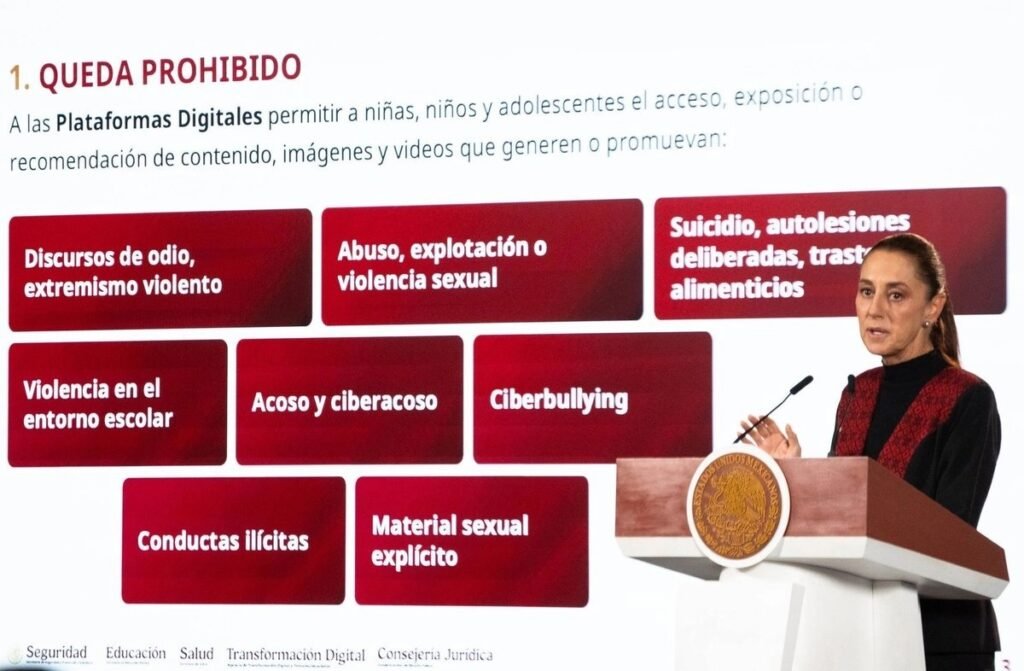
Sheinbaum Presents Draft Decree to Force Digital Platforms to Take Down Content That Incites Violence and Hate
No fines for now: the government will talk with tech companies before publishing the decree next week, a promise made after the Coahuila school attack.