From Below, Punching Up: The People’s Tribunal for Justice in Palestine and the Demilitarization of Mexico Reaches Its Verdict
When states fail to hold themselves and each other accountable for the injustices they commit, they forfeit their moral authority to judge. Under such circumstances, it becomes not just the job but the obligation of the people—el pueblo—to bring their governments to justice.
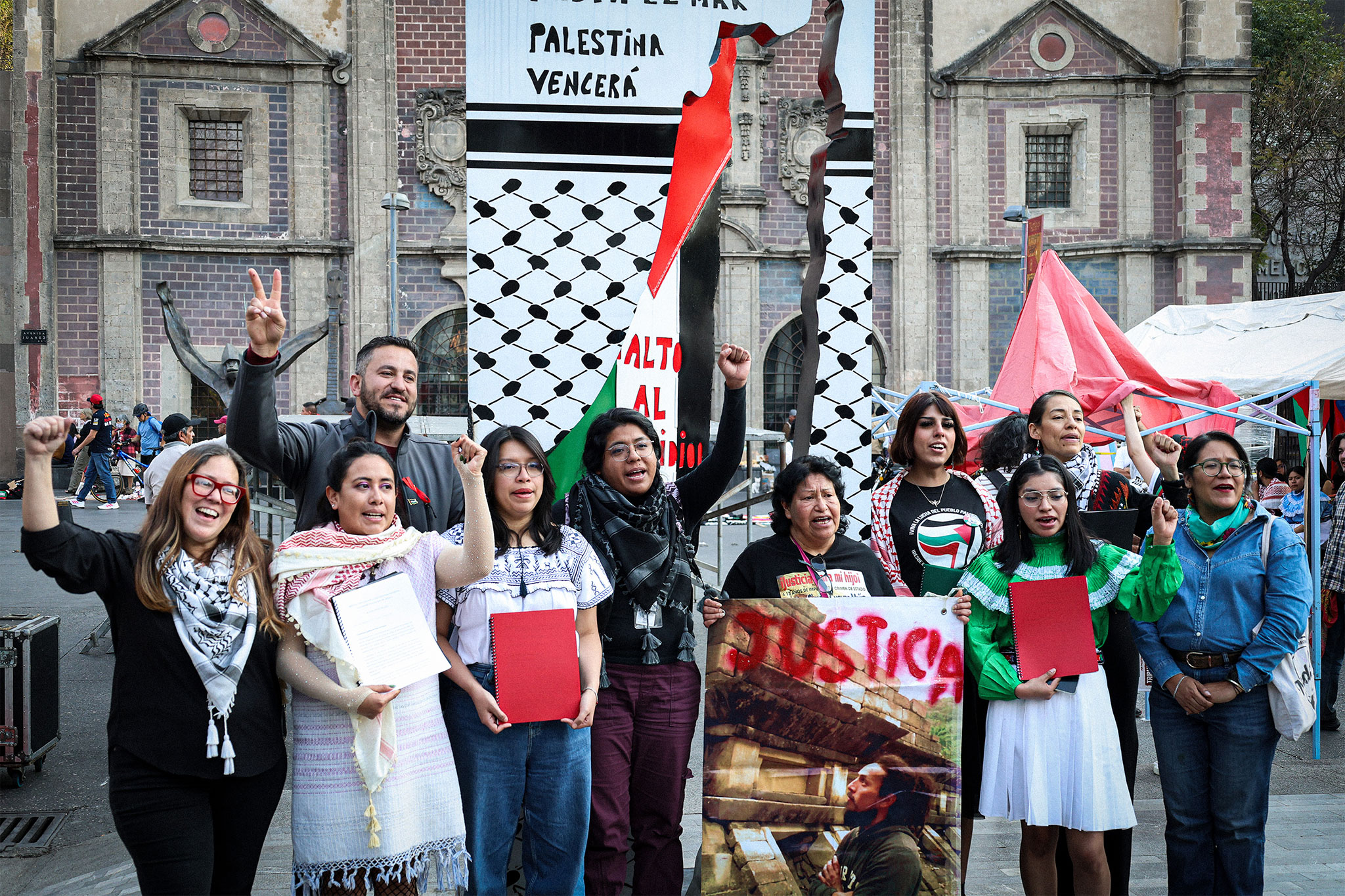
This is the core belief that inspired the People’s Tribunal for Justice in Palestine and the Demilitarization of Mexico. This herculean effort, organized by the Inter-University and Popular Assembly for Palestine (AIPP), was convened on February 8 in the Plaza Palestina in Mexico City and brought to a close this Saturday, February 22, in the Casa de Los Pueblos y Samir Flores.
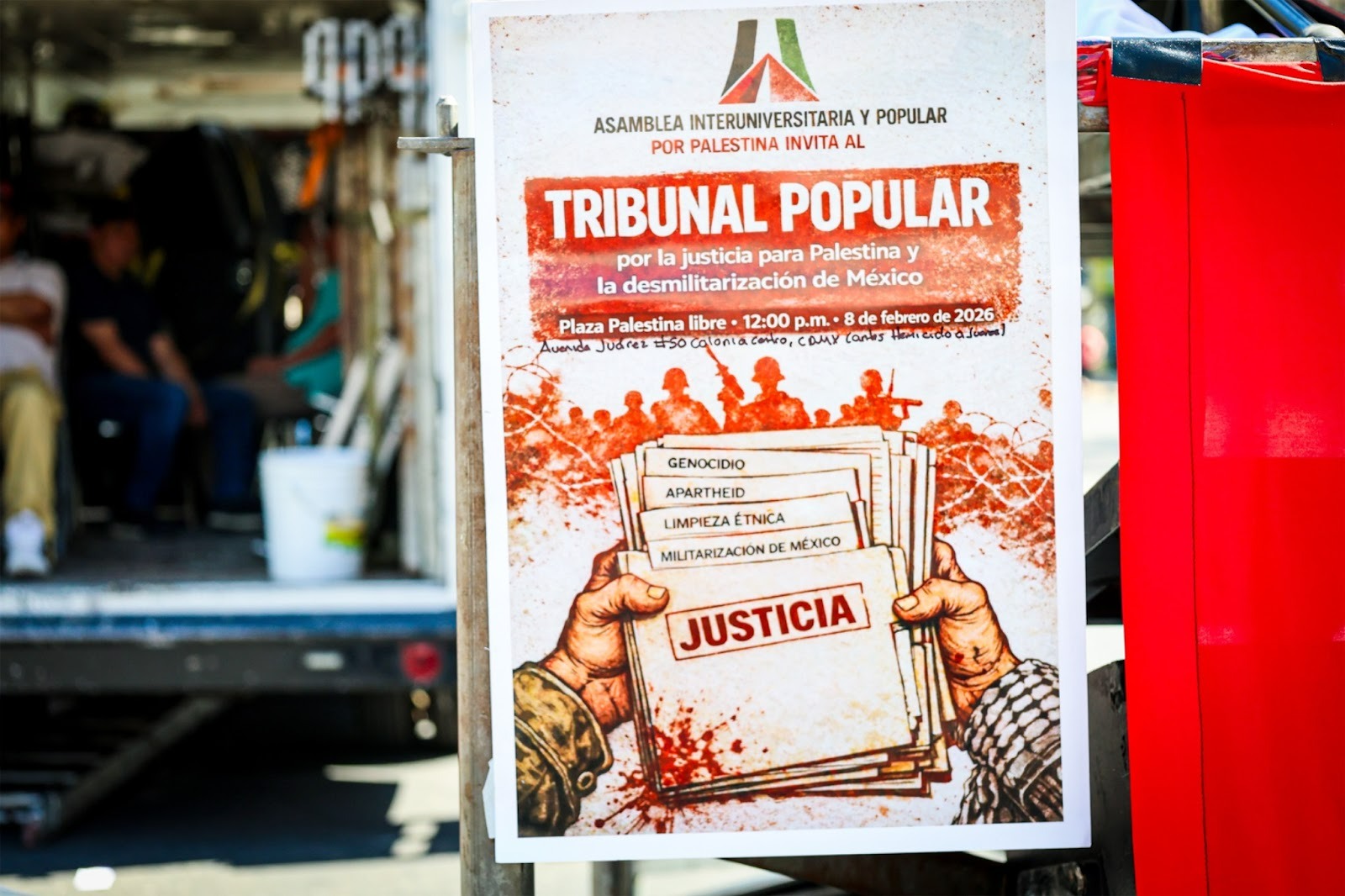
By the end, the tribunal did not deliver any binding form of justice to Palestine—no stolen land was restored, no right of return was enforced—nor were its organizers able to wave a magic wand to disarm Mexico or cut its ties with Israel. This was not unexpected, as the AIPP is not an official state body and does not have that kind of pull. Nonetheless, the tribunal made good on its guiding principle of taking up the mantle of judgment long neglected by official institutions. It did this not by, as the bromide goes, “speaking truth to power,” for the culpable world leaders and their lackeys were invariably absent.
Rather, it spoke truth to those still in the process of claiming and asserting their own power before and against the perpetrators of injustice. For it is they, and we, who will ultimately have to act upon the tribunal’s verdict in ways that will bring about those material ends. And it is actions like this tribunal that serve to justify and reinforce our commitment to that future reality.
Rather, it spoke truth to those still in the process of claiming and asserting their own power before and against the perpetrators of injustice. For it is they, and we, who will ultimately have to act upon the tribunal’s verdict in ways that will bring about those material ends. And it is actions like this tribunal that serve to justify and reinforce our commitment to that future reality.
An Invaluable Process, a Predictable Outcome
That, and to call spades spades (or in Spanish, “al pan, pan, y al vino, vino”). So, who were the culpable, derelict governments in the dock? Israel, the United States, the European Union, and, last but not least, Mexico. The charges were a litany of war crimes and crimes against humanity, including: (1) the direct and indirect perpetration and facilitation of the genocide of the Palestinian people in Gaza; (2) the perpetuation of an “economy of genocide”—to use Francesca Albanese’s term—through financialization, arms shipments and contracts, and the maintaining of business ties with the Zionist entity; (3) the targeted killing of Palestinian journalists by Israel; (4) the militarization of Mexico, a project in which Israel is heavily involved; and (5) Israel’s unlawful interception of the Sumud Flotilla, and the subsequent sequestration, abuse, and torture of its crew, specifically the Mexican contingent.
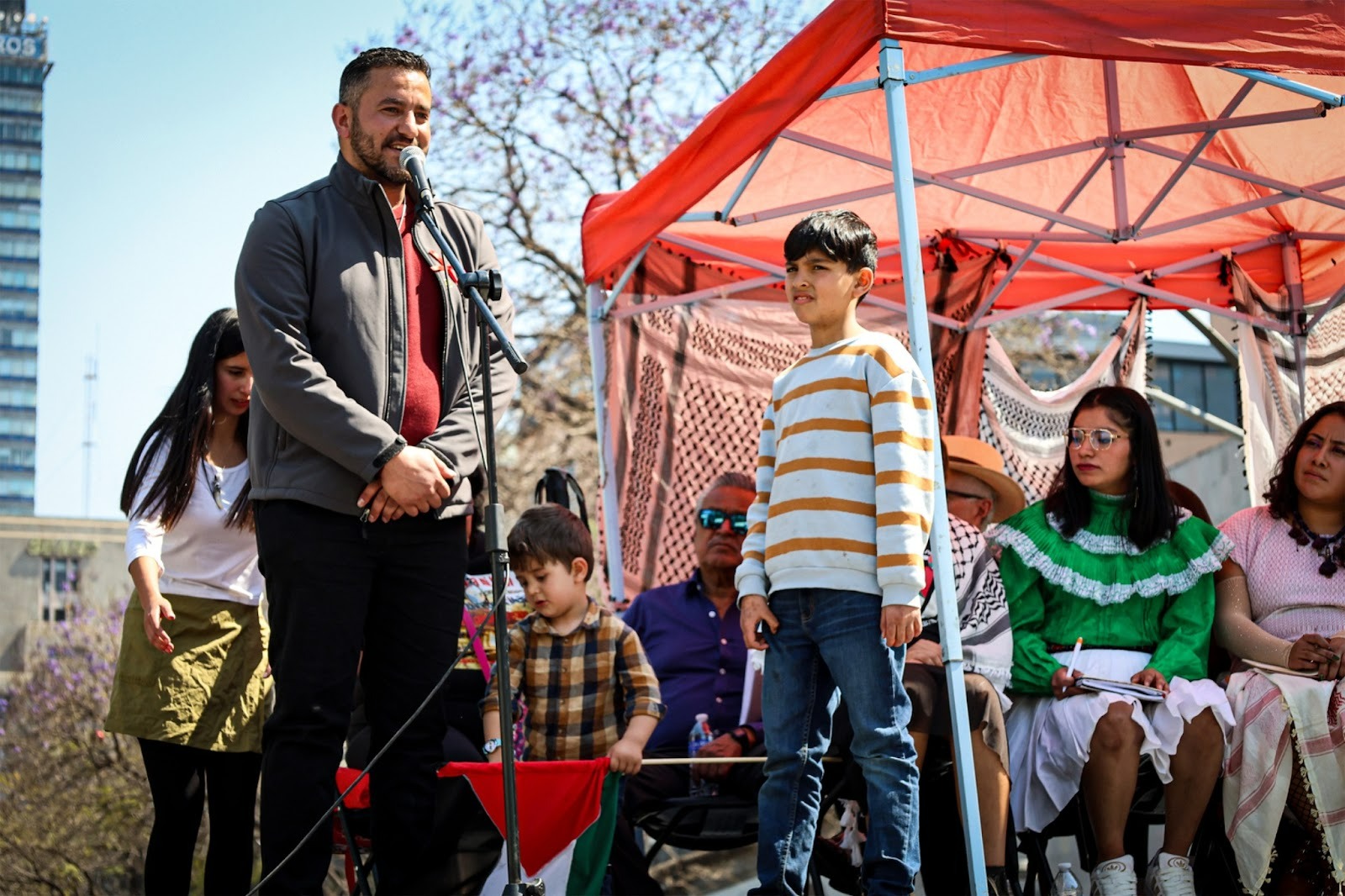
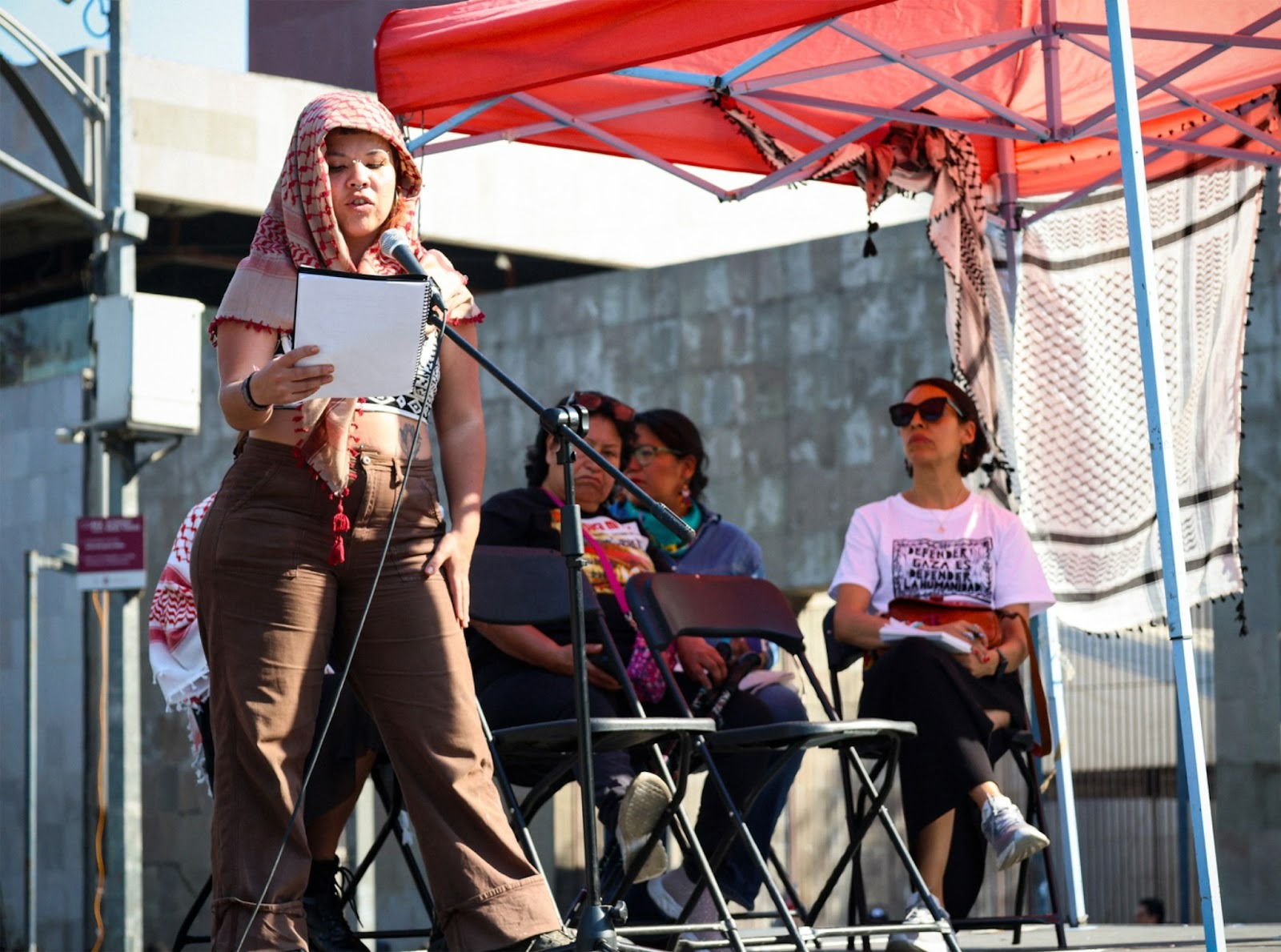
During the initial hearings, which drew a crowd of nearly 100 attendees, a diverse plenary of over two dozen community organizers, human rights lawyers and defenders, trade unionists, artist-activists, educators, students, trans rights activists, journalists, and Indigenous group leaders accepted the grave responsibility of judgment. For it was in this cross-section of “oppressed peoples, the working class, indigenous peoples, rebellious youth, and disobedient dissidents” that the “legitimacy of the tribunal” lay, as tribunal organizer Titze Malambé put it. These judges presided over the reading of hundreds of pages of charges and evidence—thoroughly researched, meticulously cited, painstakingly communicated, and sickening to take in in one sitting. They also heard the moving testimonies of several witnesses, including Palestinian refugee Shadi Abed, who managed to secure refugee status for his 18 family members in Mexico, and Sumud Flotilla crew member Sol González Eguía, who, along with the others, was subjected to inhumane treatment and abuse at the hands of Israeli soldiers.
To dispatch any doubt, permit me to indulge in a not-so-spoiling spoiler: The judges ruled unanimously and unsparingly to condemn the defendants on all counts. This was no surprise, as nary a partisan for Israel or the Zionist project could be found among the judges or the audience—and good riddance.
Given the abundantly patent and well-documented nature of the injustices, the predictability of the judges’ ruling, the political and moral persuasion of the audience, and, realistically, the organizers’ inability to mete out punishment commensurate with the crimes, one might question the utility of the tribunal at all. Indeed, this was the sentiment alluded to by judge and artist Argelia Guerrero when she said, “I find it grave to have to issue such an obvious statement as affirming that starving a people to death is a crime.”
It is obvious, even somewhat absurd, and for that reason I won’t rehash the evidence (which is vast, public, and easily accessible). At the same time, stating the obvious in no uncertain terms is indispensable, as was arriving at a guilty verdict. However, that was not the most empowering aspect of the tribunal.
Rather, its real strength lies in the very act of its organization and execution, which, as judge and human rights defender Karen Castillo notes, “is a small step towards building other forms… of justice, memory, and solidarity, but from the communities, from the activists, from the students.” In other words, the tribunal is an exercise in justice, as organizer Isabel Vega says—but not a purely performative one. It is the kind of exercise that keeps el pueblo in shape—intellectually, politically, spiritually—for more confrontational forms of struggle, much in the same way that James C. Scott’s “anarchist calisthenics” keep the practitioner prepared to disobey authority when called upon by conscience.
“The purpose of a [tribunal] is what it does”
It’s a tradition with a long history that spans the 20th and 21st centuries. This was certainly not the first people’s tribunal to judge the crimes committed by Israel, the United States, and other world actors against the Palestinian people. Numerous others have taken place around the world, including the Russell Tribunal on Palestine (modeled after Bertrand Russell’s Vietnam War tribunal), the Permanent People’s Tribunal (which has been especially active in Latin America), and truth commissions that have taken corrupt government figures and war criminals to task. Nor was it the first of its kind in Mexico, its predecessors having been hosted by the Boycott, Divestment and Sanctions (BDS) movement for decades.
On the contrary—and not to its discredit—the AIPP tribunal, as Malambé stated in their opening remarks, “is inscribed in the long genealogy of people’s tribunals that for decades have been erected throughout Abya Yala to confront the policies of death and injustices that the capitalist, colonial, imperialist system has perpetrated against our peoples.” It has served, and continues to serve, as one of the many forms of resistance to the repressive, exogenous institutions imposed by Western, colonial, and capitalist invaders over the last 500 years. It does so, as human rights attorney and former president of the National Lawyers Guild Azadeh Shahshahani affirms, by “keeping the lived human experience at the forefront of any conversation on violations of human rights, particularly when state actors try to dispute the seriousness of the allegations.”
For the organizers of this tribunal, the intention was also born from a long-standing and deep-seated distrust and disenchantment with the country’s bankrupt and corrupt bourgeois institutions. Vega traces the conception of the tribunal to a suggestion planted by another AIPP member at a bi-weekly meeting as a way to bypass feckless courts and government bodies and appeal directly to the working class. After many months of deliberation and planning, the result was “another tool to propose to the organized sectors… of the independent left” in Mexico to pressure the government, and in particular President Claudia Sheinbaum, to cut all ties with the Zionist entity—something that the most heinous of atrocities and the kidnapping of their own citizens at sea have yet to persuade them to do.
In other words, the tribunal is an exercise in justice, as organizer Isabel Vega says—but not a purely performative one. It is the kind of exercise that keeps el pueblo in shape—intellectually, politically, spiritually—for more confrontational forms of struggle, much in the same way that James C. Scott’s “anarchist calisthenics” keep the practitioner prepared to disobey authority when called upon by conscience.
Inevitably, the action resonated not just within the Mexican community but with the country’s Palestinian diaspora, whose voices take pride of place in judging all acts of solidarity with Palestine. Several of the roughly 13,000-strong diaspora living in Mexico were in attendance, and they expressed their support for the tribunal and gratitude to its organizers.
“Any activity anywhere in the world that is done in support of Palestine supports the cause and helps to highlight the genocide and the plight of Palestinians that has been happening for years throughout Palestine and today in Gaza and the West Bank,” says Khalil, a Palestinian refugee from Lebanon who has been living in Mexico for six years. He expressed hope that “in Mexico and around the world these activities and marches continue, that people don’t stop talking about Palestine so that everyone knows the full history of the genocide that Israel is waging against Palestinians.”
Abed echoed these remarks between bites of his family’s delicious falafel (which they were selling at the tribunal), sharing that, “I feel very proud that there are so many people talking about Palestine, because we want to raise awareness. We want the whole world to hear about the Palestinian case.”
One cannot extrapolate from these two votes of confidence to rubber-stamp the tribunal with the approval of the entire Palestinian community. But what can be said is that, even after two-and-a-half years since the most recent phase of genocide, and almost 80 since the incorporation of the Zionist entity, el pueblo Mexicano has not, and will not, go quiet on the issue.
Drawing Comparisons, Connecting Dots
If anything, events from the last decade or so in the country underscore just how close to home the genocide in Palestine hits in Mexico. Evoking the technocratic dystopia currently being touted by the Gaza Board of Peace and its death merchants, judge and representative from the Nahua people of Milpa Alta Alejandra Retana drew attention to her community’s similar “struggle against the imposition of the Cablebús project, L6, which [the government] seeks to approve without respecting the agrarian and indigenous rights of the community.” The wages of their resistance have been in the form of racist vilification, on- and off-line, and even being singled out by la Presidenta for allegedly “opposing any progress of the [fourth transformation].”
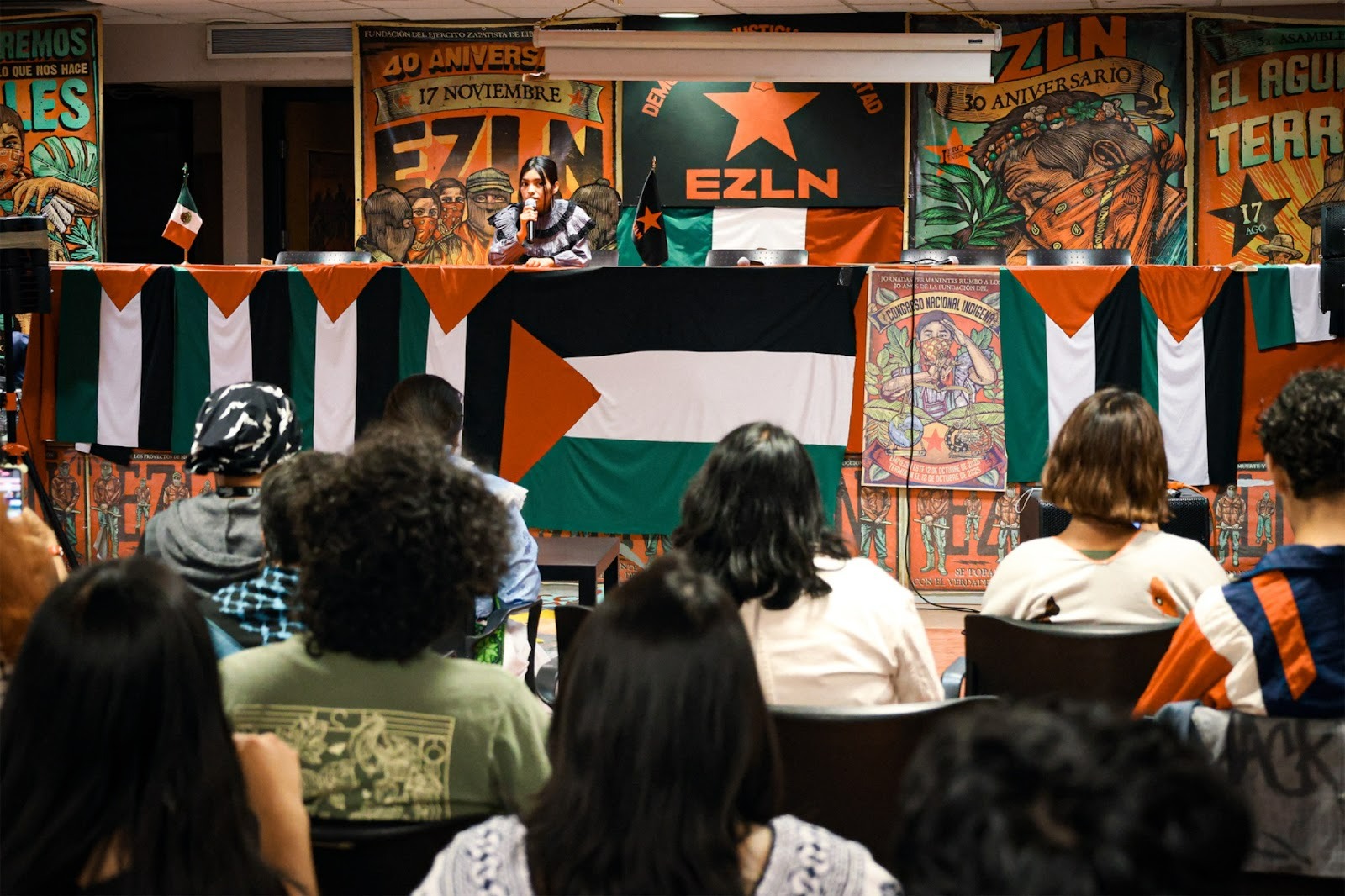
Retana proceeded to condemn Mexico for continuing to fund Israel’s death machine by purchasing from them weapons and technologies that end up being used against resistors on its very own soil. Lest we were to forget, Ansel Margarito, judge and member of the Otomi community—which has been waging a 30-year battle against state repression and displacement—reminded us that it was Israeli spyware Pegasus that was used in the disappearance of the 43 normalistas from Ayotzinapa, and which, as Margarito affirms, is today used to persecute the Zapatistas.
Between the all-too-frequent assassinations of journalists, the social cleansing of “trans women, street vendors, resistors, and homeless people” as judge and trans activist Victoria Reyes noted, and the imposition and prioritization of megaprojects (like the Tren Maya and AIFA airport) that run roughshod over Indigenous people, their land, and their rights, it requires no great powers of perception to see that many of the horrors already visited upon the Palestinian people are here in Mexico, and in spades.
It was to the tribunal’s great credit to make explicit these connections to more local social failures, not to draw attention away from the genocide in Palestine, but to heighten a collective sense of solidarity between the peoples—essential for the current fight and those to come. For, as Margarito so poignantly put it, “only through organized resistance will we achieve justice, because the government system is designed to repress us.”
Transcending the Symbolic
On the topic of organized resistance and what the future of the collective struggle might look like, the tribunal, and its judges, were comparatively more reticent. Some were sure to announce the plans for the imminent embarkation of the next flotilla installment this spring, and call attention to other protests scheduled for the short-term in the city.
Castillo urged the public to resist complacency with rhetorical gestures, emphasizing, “it will be a collective responsibility for this tribunal to transcend beyond a symbolic exercise.” How best to fulfill this responsibility? Castillo admits it will require self- and organizational-reflection: “both from those of us who participated, those who organized it, but also from society and social movements in general, by attending, disseminating, documenting, and also asking ourselves… ‘what is justice and what justice we want?'”
Perhaps to facilitate that kind of introspection, but also to motivate others to take concrete action, the AIPP plans to compile the cases and evidence in a single document and send it to participating and sympathetic organizations and individuals “who want to sign it and subscribe to it, thereby supporting the citizens’ initiative to break relations with Israel,” says Malambé.
It was to the tribunal’s great credit to make explicit these connections to more local social failures, not to draw attention away from the genocide in Palestine, but to heighten a collective sense of solidarity between the peoples—essential for the current fight and those to come
Vega seeks to cast the net a bit wider, and “produce a book, a free, digital reference book, with all the material we compiled in the investigation for the accusations, and with the judges’ verdicts, and other material that we’ve been discussing, so that it can serve as a record of this process.” Such records have been used by more official bodies in the past to carry out their own truth and reconciliation campaigns. We can only hope that, when it is published, it falls into hands that can also form iron fists.
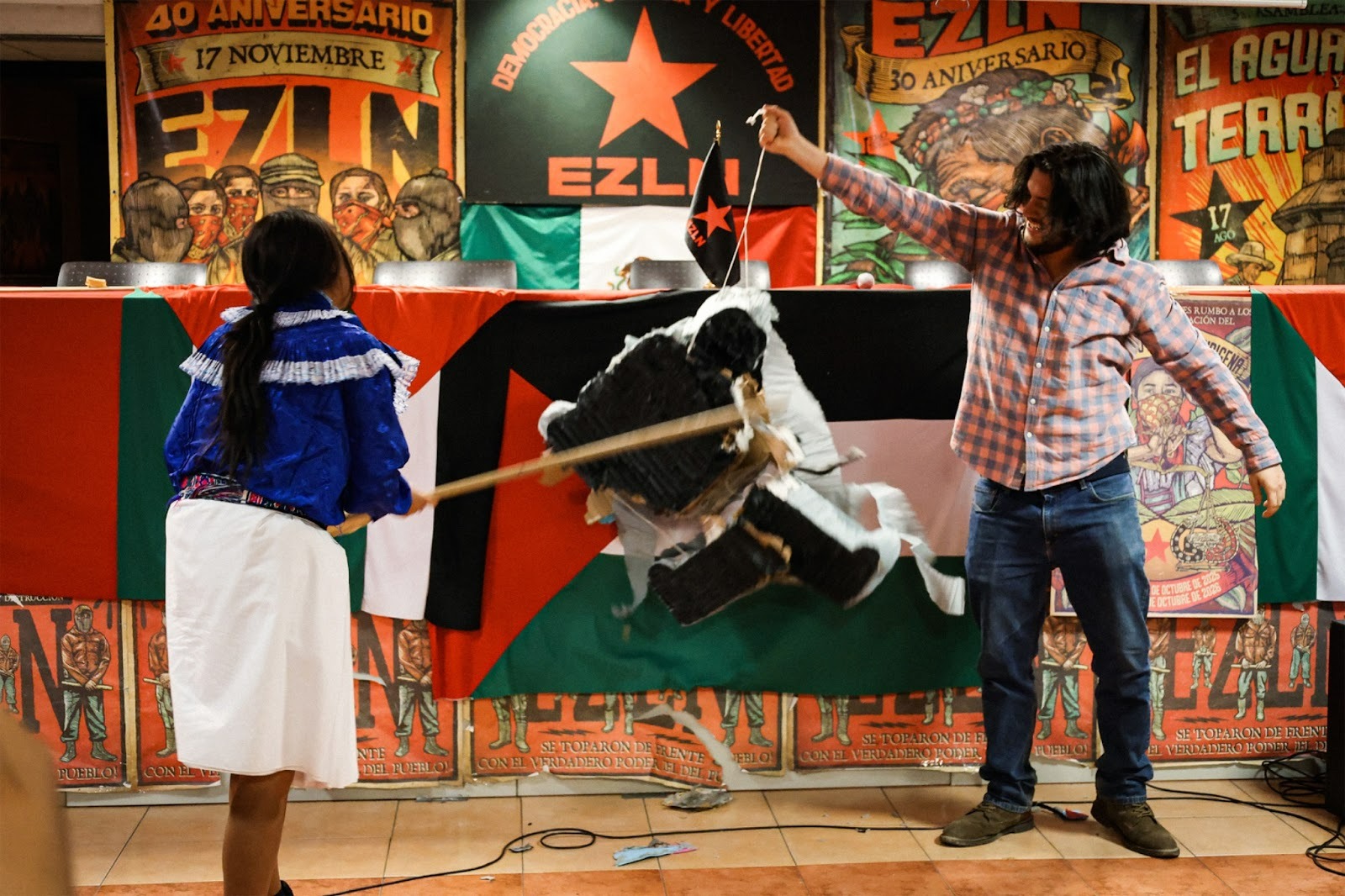
After all the verdicts had been read and pending announcements made, the tribunal’s organizers closed out the sobering afternoon with some much-earned levity—by beating the ever-loving s**t out of a piñata of Benjamin Netanyahu. With little hesitation, Khalil took the first swing, only he opted to deliver the blow with a more intimate kick to the groin.
The ritual took on a kind of ecstatic metonymy for the Tribunal as a whole—what it represented, and what it promises: the joining together of two distant cultures and peoples by the bonds of solidarity and the shared experience of suffering but also struggle. And the physical attacks against the most prominent embodiment of Zionist terror and colonialist warmongering’s effigy? Time will tell if they will remain mere shadowplay or take a more physical form.

Seth Garben is a writer, poet, musician, filmmaker, playwright, and activist/organizer based in the US and Mexico City. He is a member of the Democratic Socialists of America and a core team lead with immigrant rights group Danbury Unites for Immigrants. He composes and performs music in Mexico City and internationally as Goldy Head.
-
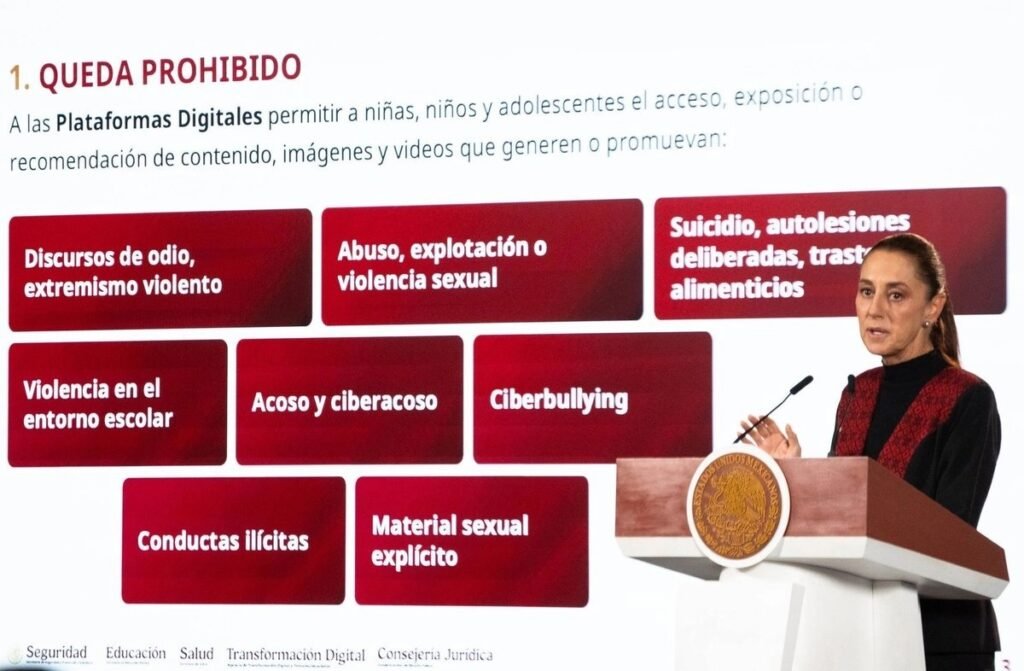
Sheinbaum Presents Draft Decree to Force Digital Platforms to Take Down Content That Incites Violence and Hate
No fines for now: the government will talk with tech companies before publishing the decree next week, a promise made after the Coahuila school attack.
-
People’s Mañanera October 9
President Sheinbaum’s daily press conference, with comments on digital safety, IMSS-Bienestar, sovereignty, and the opposition.
-
Mexico’s Gas Reserves Would Last Only 3 Days
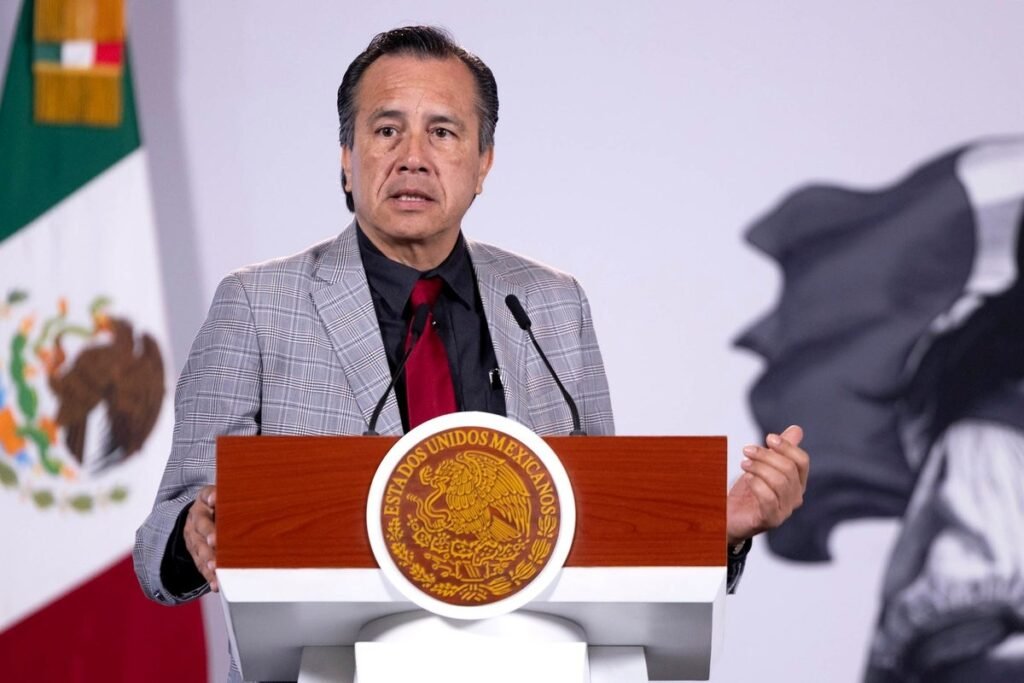
Cenagas director Cuitláhuac García revealed Mexico has no gas storage and imports 75% of what it consumes, after a US supply cut exposed the risk.