

Mexico’s Right Wing Seeks Return to CIDE
This article by Aníbal García Fernández originally appeared in the February 21, 2026 edition of Revista Contralínea. Mexico Solidarity Media has translated and republished countless articles written for La Jornada by José Romero, the now former Director of CIDE who was appointed by former President AMLO, covering issues of political economy, Mexican sovereignty and dependency and national development.

The Center for Economic Research and Teaching (CIDE) has historically had deep ties to right-wing political groups; even individuals close to former president Carlos Salinas de Gortari—the architect of neoliberalism in Mexico—have been associated with this public educational institution. This largely reflects the various political and ideological disputes currently taking place in the country.
Its tendency towards links with the right wing in the last 40 years was also reflected in its harboring defenders of repressors – as happened in the case of the Acteal massacre, where “investigators” from that institution defended the perpetrators.
Adding to this history, the recent dismissal of its now former director, José Antonio Romero Tellaeche, has been well received by circles opposed to the current administration and those on the right. From 2021 to 2026, CIDE began a process of greater heterogeneity in terms of academic profiles and attempted to address national problems from a theoretical-critical perspective. One need only read the various columns the former official contributed to La Jornada.
On June 5, 2025, Romero Tellaeche wrote a critique of the Ministry of Economy for establishing a letter of intent with the Institute for Innovation and Public Purpose (IIPP) at University College London. This document outlines partnerships in public policy design based on the approach of academic Mariana Mazzucato, who has met with the heads of various ministries. “What can this British institute contribute that institutions like the Center for Economic Research and Teaching (CIDE), El Colegio de México, the National Autonomous University of Mexico (UNAM), or the 26 Public Research Centers cannot offer?” Romero Tellaeche questioned.
This wasn’t his only criticism; he also criticized Plan Mexico. In May 2025, he questioned the fact that strategic sectors—such as semiconductors, electromobility, pharmaceuticals, agribusiness, and petrochemicals—were conceived in the Plan Mexico as free trade zones, and that it also included the participation of institutions like the United States Agency for International Development (USAID) and the Wilson Center.
The latter is a US think tank that paved the way for the loss of Mexico’s energy sovereignty, with supposed expert voices recommending public policies contrary to the strengthening of Petróleos Mexicanos (Pemex), to give just one example.
Lab-Co & USAID

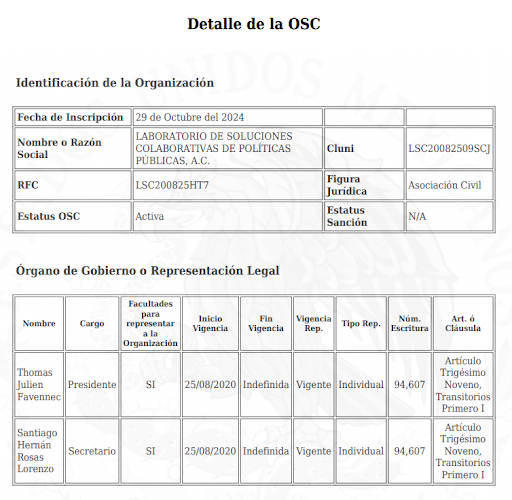
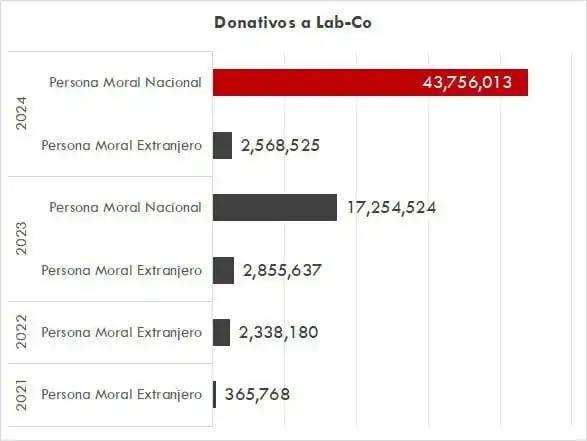
Thomas Julien Favonnec and Santiago Hernán Rosas Lorenzo are listed as president and secretary, respectively, of the Collaborative Public Policy Solutions Laboratory (Lab-Co). This NGO received 69,138,647 pesos in donations from abroad and within Mexico between 2021 and 2024. It received additional funding in 2024.
In 2021, Lab-Co received 2,482,733.5 pesos in unrelated income for Police Academy Evaluation, without specifying which academy it was for. However, in Mexico City, Lab-Co organized the evaluation of the tourist police.
And indeed, it had several programs with USAID. For example, in 2022, the project “Strengthening the Analytical and Information Use Capacities of Prosecutor’s Offices and Courts” was carried out, which was part of the Strengthening Criminal Justice Institutions (ConJusticia) program.
It was implemented in Zacatecas and Coahuila with the purpose of providing prosecutor’s offices and courts with “better information to serve victims and defendants, improve their internal management, be accountable, and be more transparent.”
Consolidation of the Standardized Civic Justice Model in municipalities across Mexico was another project included in 2022, within the framework of USAID’s Prevention and Reduction of Violence in Mexico (Previ) program . Under this scheme, Lab-Co provided technical assistance for the implementation and consolidation of the Standardized Civic Justice Model (MHJC) in 11 municipalities across five states : La Paz, Benito Juárez, Solidaridad, Guadalajara, Zapopan, Tlaquepaque, Tonalá, Tlajomulco, Puerto Vallarta, Querétaro, and San Luis Potosí.
Other activities include the Training Module on the Hotspot Policing Approach for Municipal Police Officers, also within the framework of the Previ program; and the Train-the-Trainer Course for the implementation of the National Police and Civic Justice Model. Regarding the latter, LAB-CO mentions in its 2022 activity report that it designed and delivered the course to the Chihuahua Municipal Police.
In 2023, LAB-CO received funds classified as “related income” totaling 5,674,952.17 pesos. That same year, LAB-CO allocated 23,292,288.15 pesos to nine projects, and it has been one of the key figures in implementing the new Mexican judicial system, which, as detailed in other investigations, received substantial funding from the United States under the Mérida Initiative.
Among the programs that USAID funded for Lab-Co in 2023 were: Technical Assistance for the Standardized Civic Justice Model in 12 municipalities, Strengthening Monitoring and Accountability Capacities of the Criminal Justice System, and Training and Support for Analysts to Improve Citizen Security in Mexico. The latter received over 11 million pesos.
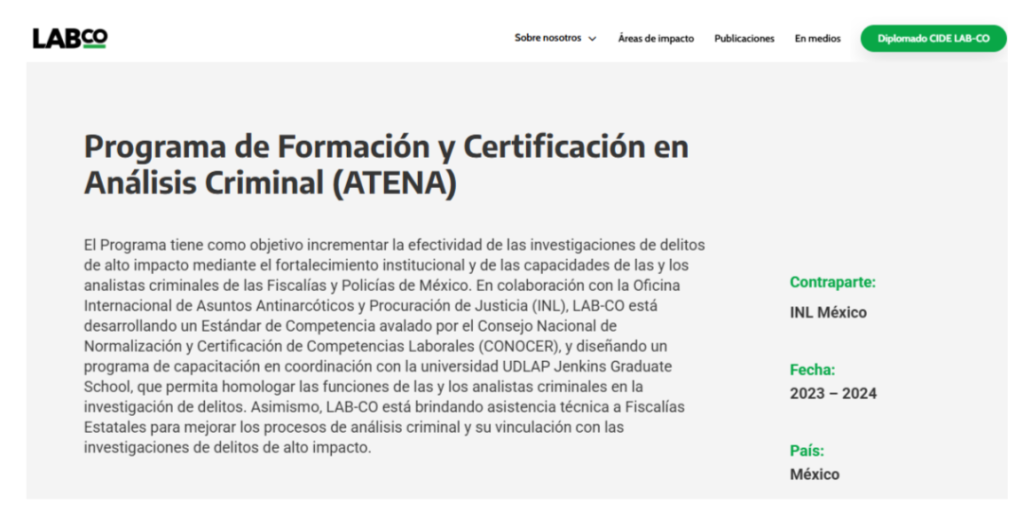
Furthermore, one of Lab-Co’s initiatives is the Criminal Analysis Training and Certification Program (ATENA), which aims to increase the effectiveness of high-impact crime investigations by strengthening the institutional capacity of criminal analysts within Mexican prosecutors’ offices and police forces. This is done in collaboration with the Bureau of International Narcotics and Law Enforcement Affairs (INL). This indicates that Lab-Co has also worked with offices belonging to the State Department, now headed by Marco Rubio.
In 2023, the project “Differentiated Attention to Violence Against Women in the Chiapas Prosecutor’s Office” (2023-2024) was supported by the Inter-American Development Bank (IDB). They continued with the USAID projects that had been underway since 2023 and added another project funded by the Pan American Development Foundation (PADF), focused on police training in the Dominican Republic, Jamaica, Guyana, and Trinidad and Tobago.
In 2024, Lab-Co continued with the projects of the Homologated Model of Civic Justice under USAID funding in 12 municipalities and 3 states of Mexico, such as Querétaro, Baja California, Baja California Sur, San Luis Potosí and Quintana Roo.
That same year, a program was added that will run until 2027, aiming to build “alliances to find and identify missing and disappeared persons,” in collaboration with the European Union and the Mexican Institute for Human Rights and Democracy (IMDHD), which in turn received funding from USAID. It also receives funding from German cooperation, the European Union, and other sources. This same NGO has also funded media outlets in Mexico.
Link with Government Institutions
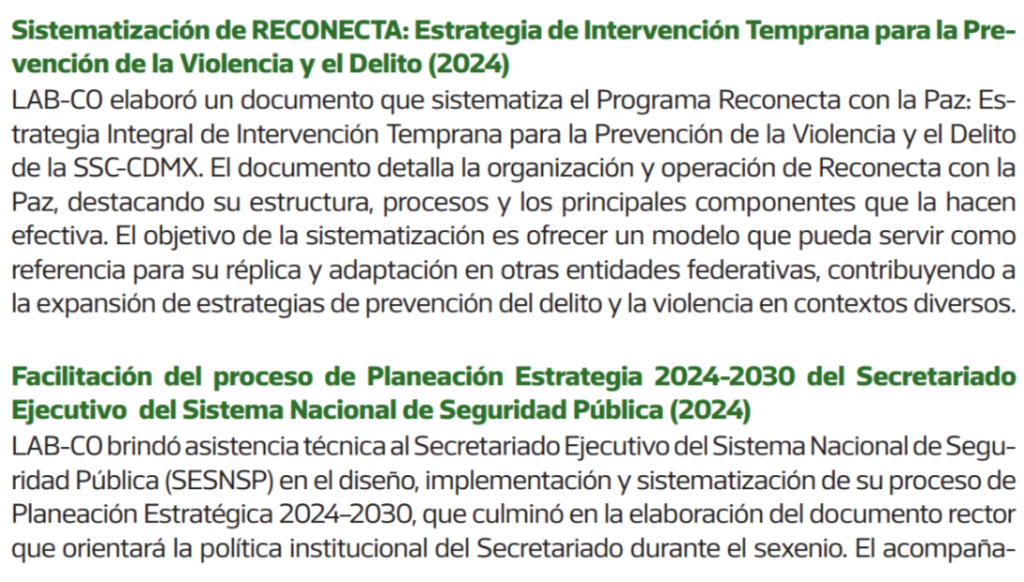
In 2024, two Lab-Co projects with public institutions stand out. The first is the Facilitation of the 2024-2030 Strategic Planning Process of the Executive Secretariat of the National Public Security System (2024). The objective is to provide “technical assistance to the Executive Secretariat of the National Public Security System (SESNSP) in the design, implementation, and systematization of its 2024-2030 Strategic Planning process, which culminated in the development of the guiding document that will direct the Secretariat’s institutional policy during the six-year term.”
The laboratory also mentions that it delivered a document that “constitutes the basis for the management, monitoring and evaluation of the performance of the SESNSP in the coming years”.
The other program is the Systematization of RECONECTA: Early Intervention Strategy for the Prevention of Violence and Crime (2024). This program, developed in collaboration with the Secretariat of Citizen Security of Mexico City, aimed to offer a model that could serve as a reference for replication and adaptation in other states, contributing to the expansion of crime and violence prevention strategies in diverse contexts.
By 2024, according to its own activity report, the company was already working with prosecutors’ offices in the states of Mexico, Sonora, Zacatecas, California, Chiapas, Chihuahua, Coahuila, Michoacán, Nayarit, Oaxaca, San Luis Potosí, Sinaloa, Tabasco, and Yucatán, in addition to the Attorney General’s Office (FGR). This also includes the governments of Guadalajara and Zapopan, as well as the Secretariats of Citizen Security of Mexico City, Baja California Sur, Chiapas, Chihuahua, Guanajuato, Jalisco, Michoacán, Nayarit, Nuevo León, Puebla, and Sonora. In other words, they cover at least a third of the prosecutors’ offices and security secretariats in the country.
It doesn’t end there, because Lab-Co has links with the Venezuelan opposition, which –at least ten of its members– ended up advising Nayib Bukele, an authoritarian security model that is also liked by the United States and Mexican conservatives.
Connection with the Bukele model
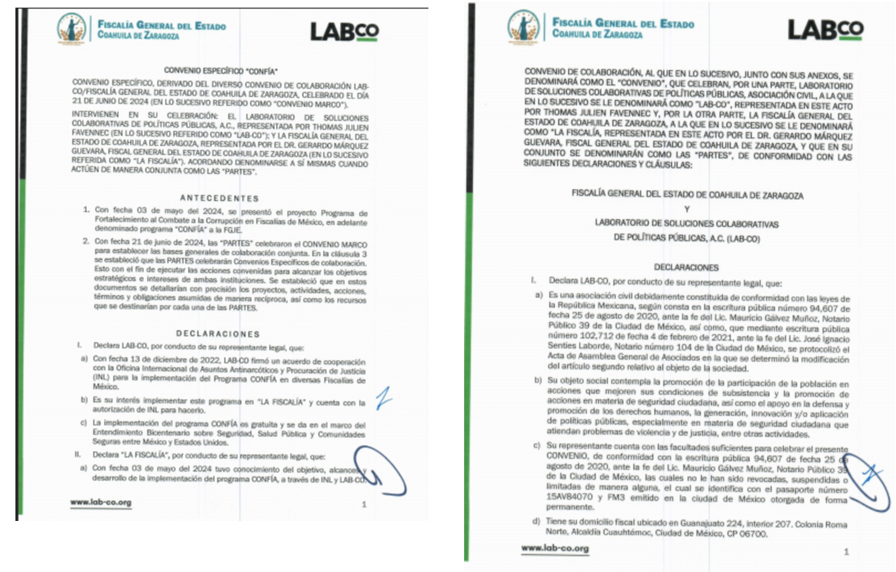
Lab-Co established a presence in El Salvador in 2020, during Nayib Bukele’s presidency. Thomas Julien Favonnec and Santiago Hernán Rosas Lorenzo built Lab-Co’s subsidiary in San Salvador.
Santiago Rosas, Spanish by birth but linked to the Venezuelan opposition, was listed as president of the association; Mercedes de Lourdes Vegas Rodríguez Azpúrua as secretary; and Thomas Julien Favennec as treasurer. This is nothing new; several media outlets have already reported on Bukele’s connection to Venezuelan opposition members. Even outlets like El Faro, which has been attacked by Bukele, extensively detailed this link.
Santiago Rosas, a member of Lab-Co, was none other than the one who was linked to the development of the Territorial Control Plan, a security model of the Salvadoran government that had an investment of 575.2 million dollars, as recognized by the authorities of that country.
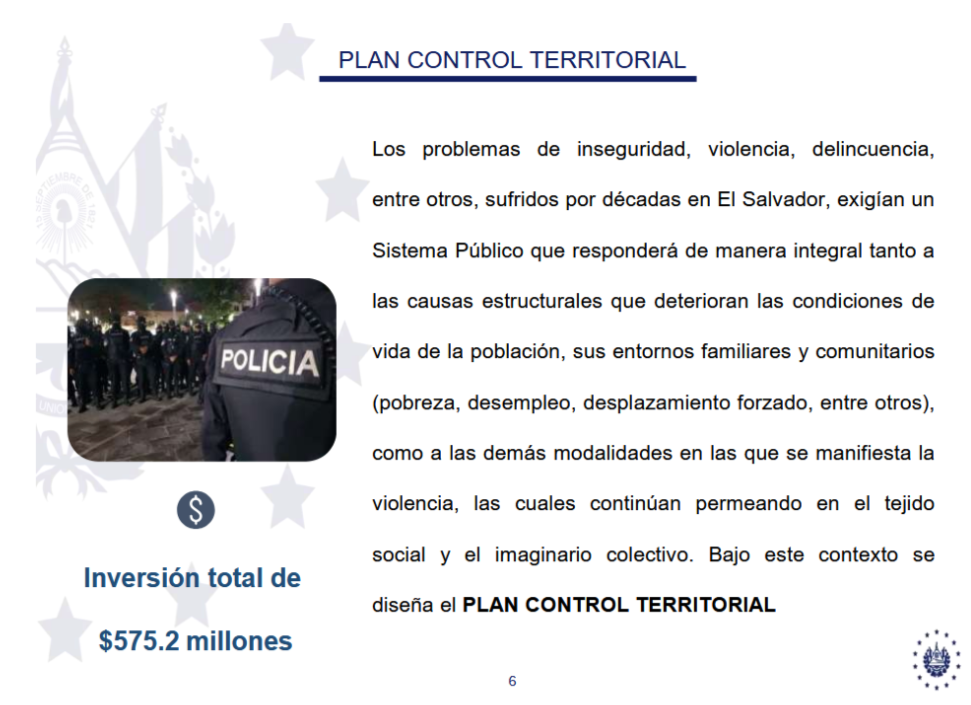
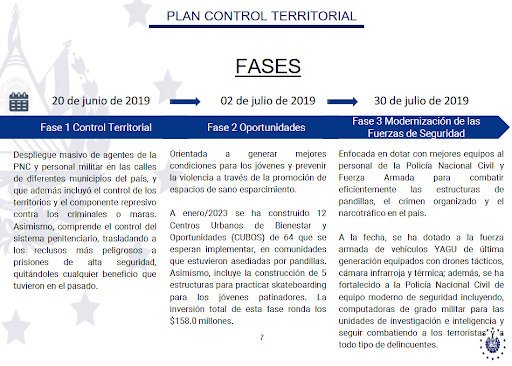
As an example, there is documentation from the Salvadoran government dated November 2023, issued by its Ministry of Finance. The Territorial Control Plan consists of six phases: Territorial Control, Opportunities, Modernization of Security Forces, Incursion, Extraction, and Integration.
Lab-Co’s Alliance with CIDE
On January 28, 2026, following Romero Tellaeche’s departure, Mayor Claudia Sheinbaum stated in her morning press conference: “The truth is that CIDE, for a long time, was oriented toward an economic policy that corresponded to the previous period, which was neoliberal. And the idea was to also orient CIDE toward a much broader approach. That was a debate during President López Obrador’s administration.” She also rejected the idea of returning to a neoliberal CIDE.
However, Lab-Co, in partnership with CIDE, will offer the second edition of the Diploma Program in Design and Implementation of Public Security and Justice Policies. The program costs 25,000 pesos, with payment plans available, and payment is made to CIDE’s account at HSBC bank.
According to the laboratory’s own information, the diploma program will have 10 members of CIDE among its faculty, including Carlos Pérez Ricart, who also joined Lab-Co’s advisory board in 2026. It will also include six members of the NGO, among them its director.
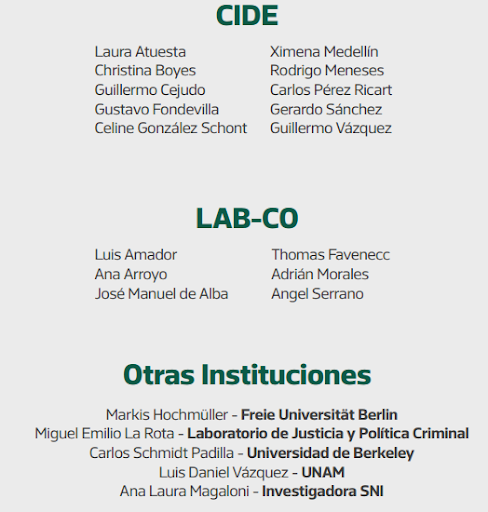
The event will also feature participants from other institutions and researchers, such as Ana Laura Magaloni, who participated in a discussion hosted by Letras Libres on September 26, 2024, where she criticized the judicial reform, one of the most significant initiatives of the two administrations of the Fourth Transformation. Magaloni ran for a position as a magistrate on the Supreme Court of Justice of the Nation in 2019 but was not elected.
Marcela Figueroa, who is the head of the Executive Secretariat of the National Public Security System, will also participate in the Diploma program.
Just as Claudio X González, one of the main opponents of the Fourth Transformation and creator of Mexicans Against Corruption and Impunity (MCCI), once positioned himself at CIDE for his journalism course, now Lab-Co, with former advisors to Bukele and with funding from USAID and the State Department of Marco Rubio —the same one who is suffocating Cuba and kidnapping a sitting president—, is again positioning itself at CIDE for courses on security and justice.
President Claudia Sheinbaum’s words were clear: “They must stop being elitist institutions. They must be much more integrated into the nation’s problems and the people. There has been a great deal of elitism in many academic institutions, as if they were above everyone else. No one is above anyone else; no matter how many years of experience you have, or how many publications you have, no matter how intelligent someone considers themselves to be, you are never above anyone. You are not above a farmer, a laborer, a homemaker, a domestic worker, never. And this vision of academic elitism is not good.”
-
A Hundred Years After ‘La Cristiada’
“The Cristero War stands as an example of the high cost that political struggles among the elites of power can have for society when they act irresponsibly,” concludes Meyer.
-
The Normalization of the Abnormal
Palestine’s ambassador to Mexico, Nadya Rasheed, denounces the normalization of genocide in Gaza: more than 73,000 Palestinians killed, homes, schools and hospitals destroyed, water poisoned — and a world that looks away.
-
Peña Nieto Filmed Next to Controversial Israeli Contractor
Former Mexican president Peña Nieto was filmed wearing a kippah at a Jewish wedding in Italy, seated beside Avishai Neriah, the Israeli businessman an outlet accused of channeling $25M to him for Mexican government contracts, including Pegasus.