
High Oil & Fertilizer Prices are Impacting Mexican Agriculture
This article by Bertha Becerra originally appeared in the April 3, 2026 edition of El Sol de México.
The war generated a global conflict: the United States went the military route and the Arabs [Editor’s note: Iran is not an Arab country], by closing the Strait of Hormuz and not allowing the transit of oil and fertilizers, impacted food production in the country, stated research professor Gerardo Noriega, from the Autonomous University of Chapingo.
The cost of armed and trade wars hits agricultural producers hard with rising fertilizer prices due to increased oil and, consequently, diesel prices, which are essential for food production.
Added to this is the drop in prices on the international market for white corn by six percent and for yellow corn by eight percent , and the lack of credit and government support, warned José Amadeo Hernández Barajas, president of the CEN of the Independent Peasant Central (CCI).
Professor-researcher Noriega from UACh echoed the peasant leader’s statement and provided a breakdown of the effects of these high prices and how they impact food production in the Mexican countryside:
With the average price of 28.60 pesos per liter of diesel as a base, but which continues to rise, he broke down the activities and costs for planting grains:
- For subsoil work on a plot, that is, breaking up the soil so that water infiltrates well for planting, the machinery requires 19 liters, which totals 545 pesos.
- Fallowing and planting require five operations, each using nine liters of diesel. The total cost is 1,290 pesos.
“In total, 1,835 pesos are needed just to pay for diesel on one hectare,” said Professor Noriega. “And this doesn’t even take into account that the price of fertilizers has skyrocketed, with increases averaging 33.6 percent and still rising.”
“We must add the cost of pest and disease management, whose inputs increased by 12.35 percent, plus other miscellaneous expenses due to our technological dependence.”
“Today, it is necessary to invest just over 44,000 pesos per hectare for the purchase of seeds , fertilizers, and pesticides,” he added.
“Meanwhile, corn prices in international markets are falling and the producer is losing capital,” the UACh academic told El Sol de México.
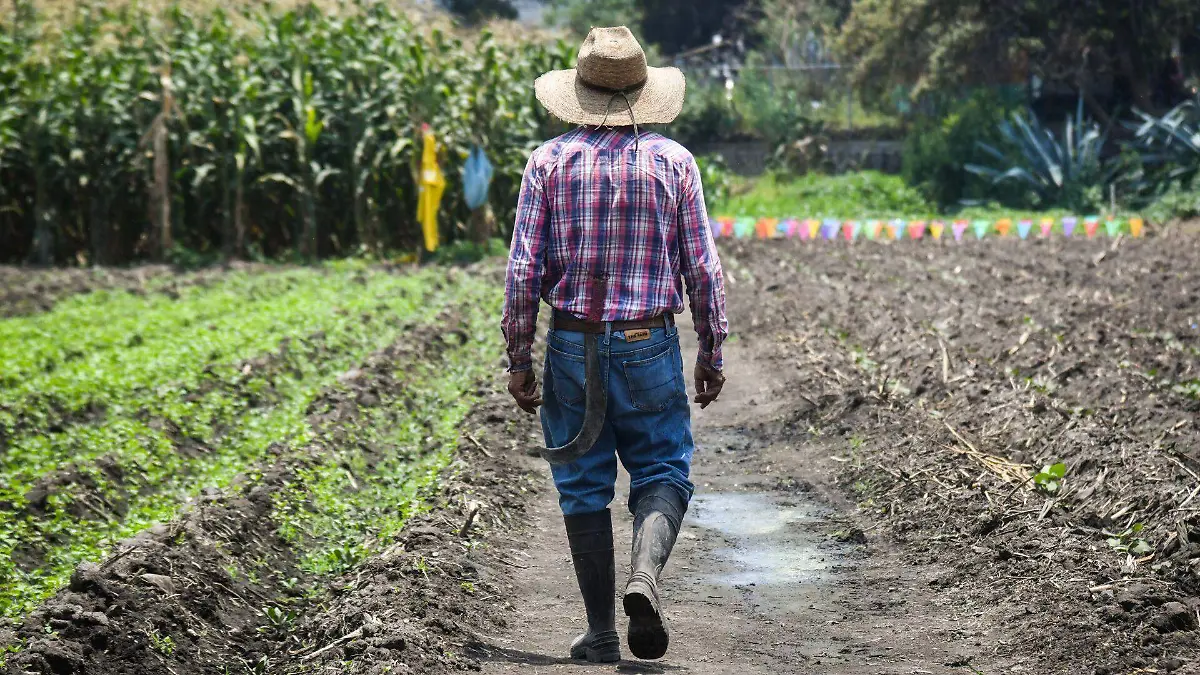
He emphasized that seeds, fertilizers, and pest control supplies account for 65 percent of the resources needed to plant one hectare of production.
“Producers are losing capital because production costs are very high and grain prices, as regulated by the Chicago Board of Trade, are very low,” he stated. “And it is both military and trade wars that are ruining the agricultural sector and affecting food sovereignty and security.”
“The impact of producing less food will be that we will depend even more on imports. This war, both military and trade-related, is leading us to plant less because there is no fertilizer available,” the expert opined.
“The risk of smaller harvests is inevitable because if there isn’t enough fertilizer, how are we going to fertilize the farmland?” he questioned.
And the low international price of corn discourages farmers, Professor Noriega said. Therefore, the peripheral impact of this whole situation is that we are moving toward greater grain imports. “We are moving further away from food sovereignty and security.”
“We are going to eat what they want to sell us, not what we want,” warned Professor Noriega.
What is the alternative?
Researcher Gerardo Noriega added that we need to move towards biotechnology, because fertilizers can be replaced by microorganisms. Instead of nitrogen, bacteria.
“But this then requires an agreement between public entities, academic institutions, and producers, and we will move towards biotechnology and the use of our natural resources ,” the Chapingo researcher said optimistically.
He stated that “government institutions must be approached. And these institutions must approach universities and higher education centers: UNAM , with the Center for Research and Advanced Studies of the National Polytechnic Institute (IPN), the Autonomous University of Chapingo (UACh) and the Postgraduate College (COLPOS).”
He recounted: “We in Chapingo, together with researchers from the Center for Research and Advanced Studies of the National Polytechnic Institute (CINVESTAV), Doctors Jaime García Mena and Jahir Cruz Narváez, and Doctor José Javier Castro Arellano, from the School of Chemical Engineering and Extractive Industries (ESIQIE) of the IPN, and we in Chapingo, work together to develop innovations to promote biotechnology in basic grains,” he said.
“With science and agro-biotechnological knowledge reaching the furrow, we will help improve food production.”
-
Sheinbaum Meets Privately with Maru Campos on Her Arrival in Ciudad Juárez
If any law was broken in the drug operation involving CIA agents in Chihuahua, those responsible, including state officials, must be prosecuted, the two agreed.
-
Beatriz Mojica: From Criticizing AMLO to Coordinating Morena in Guerrero
The senator on leave is Morena’s pick for governor of Guerrero in 2027, after a career that includes the PRD and her 2018 support for Ricardo Anaya.
-
Morena’s Elections Commission Chief: Differences Are Natural to a Living Party
Amid criticism over the 10 chosen profiles, Citlalli Hernández, president of Morena’s National Elections Commission, defended the differences as natural to a living party.