Exhibition on Maya Culture Amazes in China
This article by Emir Olivares Alonso originally appeared in the June 28, 2026 edition of La Jornada, Mexico’s premier left wing daily newspaper.
Beijing. The descent of the feathered serpent at the temple of Kukulcán, at Chichen Itzá –during the spring and autumn equinoxes– is one of the images that most astonishes people on this side of the world. The impact is due not only to the astronomical precision of the ancient Maya, but to its resemblance to another mythical being revered thousands of kilometers away: the millennia-old Chinese dragon.
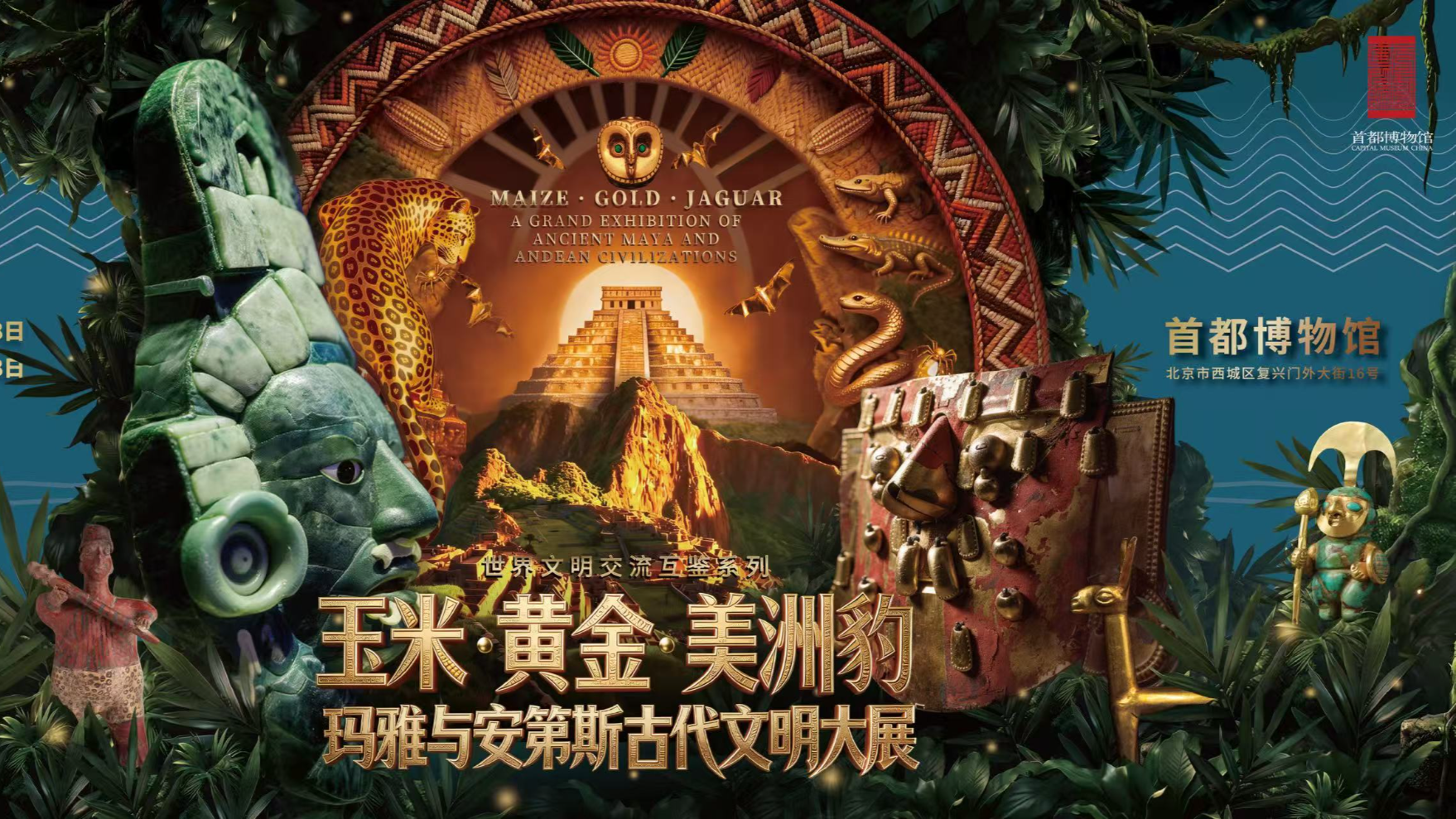
That parallel is on display in Corn-Gold-Jaguar: Grand Exhibition of the Ancient Maya and Andean Civilizations, which, after two years of negotiations between cultural authorities of China, Mexico, and Peru, is on view at the Capital Museum, the second most important in this city. The exhibition, organized by the Beijing Municipal Cultural Heritage Administration, is made up of more than 800 pieces, 384 of them Mexican.
It has been open to the public since this past May 18 and will remain until October 18. The organizers assert that it is the “most ambitious and largest-scale” international exhibition in the museum’s nearly 10-year history. So far it has received close to 80,000 visitors.
At two extremes of the ancient world, three great civilizations flourished side by side: Chinese, Maya, and Inca. Even though there is no academic consensus on a historical relationship between them, several experts have found some coincidences in their worldviews.
Throughout the museum tour, visitors can discover the advances of the two pre-Columbian cultures, their form of organization, their scientific and agricultural contributions, and also the parallels with the Chinese past.
Analogous Traits
Zhou Sirui, a professor in the double-major English-Spanish program at the Beijing Language and Culture University, notes that even though Chinese civilization settled thousands of kilometers from the ancient American cultures, these “share numerous analogous traits in multiple aspects.”
She explains that cultural elements of ancient China such as the dragon (long) and the phoenix (feng) –still present in modern China– bear greater similarities to the view that pre-Hispanic civilizations held of Quetzalcóatl (Kukulkán) and the quetzal, which differs from the meaning that the Western world, particularly Europe, gave to those mythological beings.
Information provided by the organizers states that as early as the 1960s, the anthropologist Kwang-chih Chang formulated the hypothesis of the Sino-Maya “civilizational continuum,” which points to the parallels between the two worldviews.
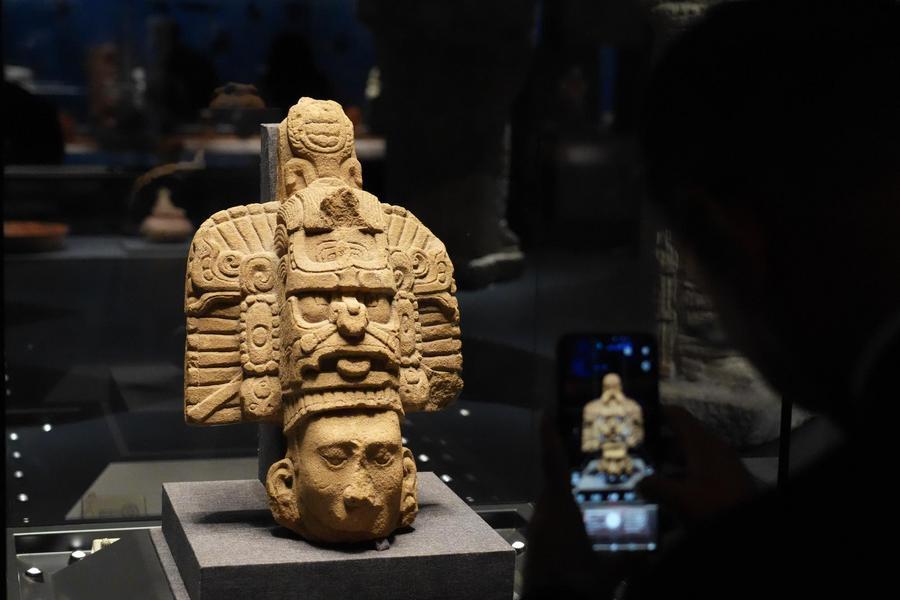
The exhibition is divided into three phases: the first, dedicated to the Maya, with 224 pieces from the National Institute of Anthropology and History from the Classic period of that civilization (300-800 BCE), alluding to its historical, artistic, and cosmogonic legacy.
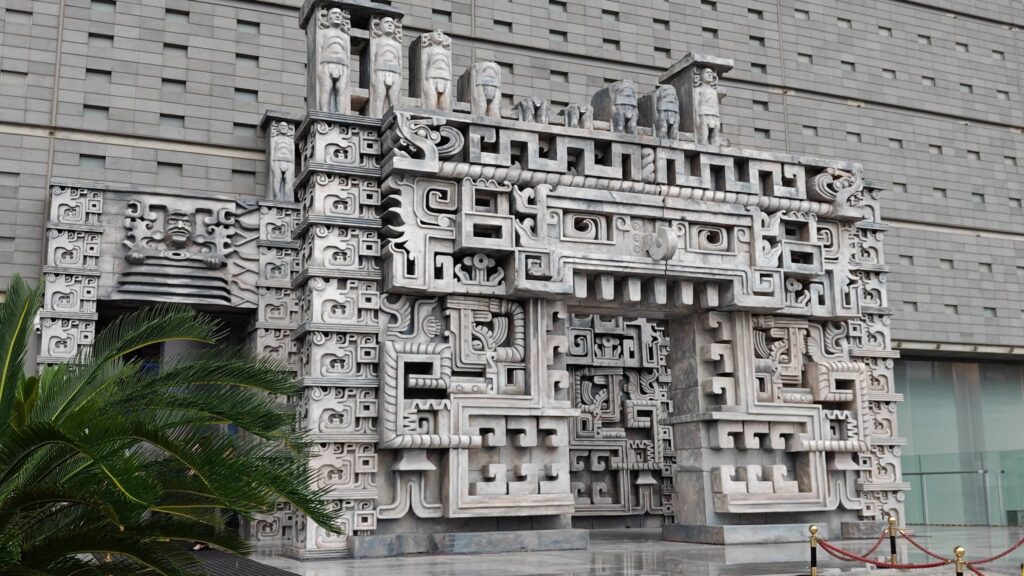
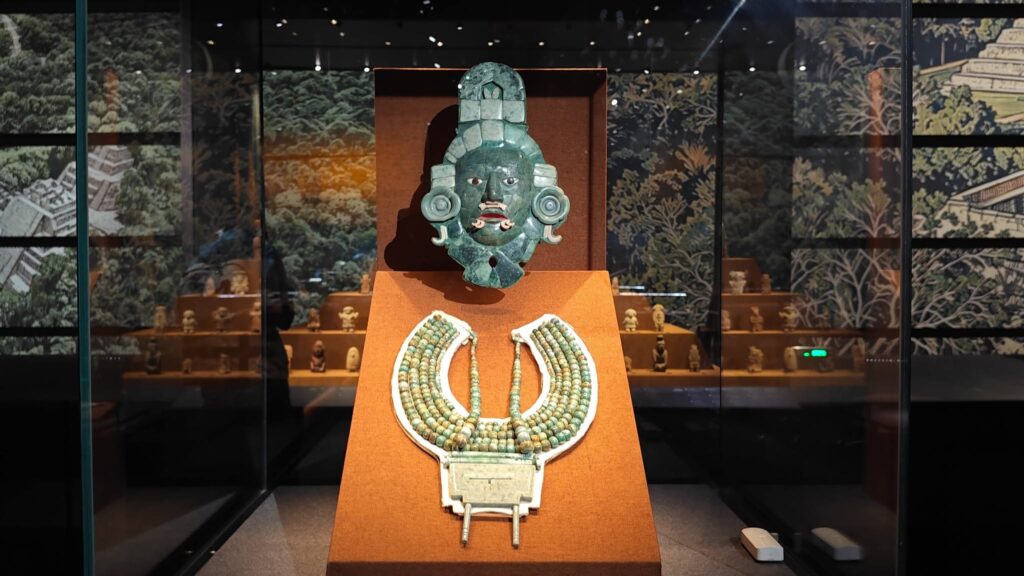
In the center of the hall, several neon lights form the outline of a three-dimensional scale replica of the temple of Kukulcán. Inside it, one of the most sought-after pieces is on display: the jade mask of Calakmul. There are also incense burners, adorned vessels, engravings, and large sculptures, such as The Holder of the Sky, “authentic relics from the other side of the planet.”
The curators placed special emphasis on the sacred tree: the ceiba (yaaxché), center of the Maya worldview, which spans and connects three planes: the upper one (the spiritual world), the middle one (the earthly), and the underworld or Xibalbá, which merge with each descent of Kukulcán.
The astronomical, mathematical, and architectural legacy of that ancient culture is a central part of the exhibition. The mastery of milpa cultivation, the precision of their calendars, and the legacy that the creation of the number zero represents are also elements that visitors learn about with astonishment.
“Corn was one of the fundamental crops of the Maya civilization. In their creation myths, human beings were molded from corn dough, which is why the Maya called themselves ‘children of corn,'” explains Shao Xinxin, curator of the exhibition and researcher at the Capital Museum.
He recalls that the Classic period of the Maya civilization roughly coincides with the end of the Han dynasty through the Sui and Tang dynasties in China.
Azucena Cardoso, in charge of Cultural Affairs and Tourism Promotion at the Mexican embassy in China, says separately that there is much interest among that country’s citizens in Mexican culture, in this case, in the Maya.
“Our goal is to bring more and to exhibit not only about that civilization, but to show that there were many more, such as the Olmec, the Zapotec, the Mexica,” she says, revealing that in the coming weeks another exhibition on Mexican indigenous cultures will open in Shanghai.
The pieces left the country in compliance with the Monuments Law and, after a tour through several points of the planet, Beijing being the last, they will return to national territory.
The second hall is dedicated to the legacy of the Inca culture. A central element in the Andean exhibition is gold, a sacred mineral for that worldview. The curator was the expert Zhao Yazhuo.
The most emblematic piece brought from Peru is a gold diadem of the Mochica culture, which “constitutes a masterwork of Andean metallurgy.” At its center is a face with feline features and eyes inlaid with chrysocolla stones and gold sheets; its mouth has fangs made from turban shells, and around the face are eight tentacles whose ends take the form of mythological creatures resembling the catfish.
According to the experts, the ornaments, ceremonial and funerary pieces of the Mochica nobility –which include headdresses, masks, nose ornaments, ear pendants, pectorals, rattles, and scepters– symbolized their secular status and theocratic hierarchy.
UNAM’s Contribution
On the third level, 160 pieces and elements contributed by the National Autonomous University of Mexico are on display, leaving the country for the first time. It is dedicated to the relationship between Mesoamerican cultures and animals such as the jaguar, the quetzal, the dog, reptiles, and the turkey.
“The jaguar, a feline exclusive to the American continent, is a sacred totem and symbol of power revered by both the Maya and the Andean peoples. In the Maya worldview, it is the incarnation of the sun: during the day, that star illuminates the world of the living, but when night falls, it transforms into a spotted jaguar that descends to the underworld. By moving through the three planes of the universe, the jaguar symbolizes both death and chaos and the hope of rebirth,” the exhibition explains.
This part of the exhibition targets a younger audience, digital natives, which is why it incorporates artificial intelligence, digital tools, and virtual reality experiences.
The deputy director of the Capital Museum, Tan Xiaoling, states that Chinese civilization engages in a close dialogue with the Maya and Andean civilizations in the museum’s exhibition spaces, in order to generate a spiritual resonance in visitors.
The organizers highlight the reception the public has given the exhibition and are confident that during the summer vacation period –mid-July to early September– attendance will triple.
Consulted by La Jornada, Professor Zhou insists: “In China, the dragon is a supreme symbol of celestial power. It refers to climatic prosperity, to timely rain, and to the fertility of the earth. The phoenix is the male counterpart of the dragon; it symbolizes social peace, renewal, and rebirth. The pair of dragon and phoenix represent the harmony between yin and yang, total prosperity, and supreme happiness.”
For the Maya worldview –and that of other indigenous civilizations of Mexico– on the other hand, the feathered serpent is the mythological being that connects the sky with the earth. They also believed in the existence of opposite, complementary, and inseparable pairs that constitute the essence of everything: life and death, masculine and feminine, light and darkness.
The legacy of these cultures is evident today. Their respective structures are part of the so-called Seven Wonders of the Modern World: the Great Wall (China), Machu Picchu (Inca), and Chichen Itzá (Maya).
-
A Hundred Years After ‘La Cristiada’
“The Cristero War stands as an example of the high cost that political struggles among the elites of power can have for society when they act irresponsibly,” concludes Meyer.
-
The Normalization of the Abnormal
Palestine’s ambassador to Mexico, Nadya Rasheed, denounces the normalization of genocide in Gaza: more than 73,000 Palestinians killed, homes, schools and hospitals destroyed, water poisoned — and a world that looks away.
-
Peña Nieto Filmed Next to Controversial Israeli Contractor
Former Mexican president Peña Nieto was filmed wearing a kippah at a Jewish wedding in Italy, seated beside Avishai Neriah, the Israeli businessman an outlet accused of channeling $25M to him for Mexican government contracts, including Pegasus.