
The Specter of the Far Right in Latin America
This article by Óscar David Rojas Silva originally appeared in the July 3, 2026 edition of Contralínea, a Mexican investigative journalism magazine.
The hegemonic decline of the United States vis-à-vis China has provoked an imperialist retrenchment over Latin America and the Caribbean. This leads us to reflect on the duality between an interventionist force that appears renewed by its stridency and cynicism, but which at the same time forces us to gauge the significance of having lost the ability to impose its conditions on a global scale.
The central element to consider is that, after the financial maelstrom beginning in the 1970s, our northern neighbor underwent a process of deindustrialization due to the offshoring of industrial production toward the Eastern Hemisphere. As a result, the US trade balance is chronically negative, and its economy’s indebtedness reaches stratospheric levels. But this is not only a matter of export and import levels that can be corrected in the next quarter; rather, financial globalization caused the US to stop developing structural productive capacity—that which has to do with logistics and the State’s ability to organize collective productivity.
Instead, the North American State became an entity controlled by corporate business power, which has been accustomed to acting under the principles of short-term profits. In contrast, the Chinese State works in the opposite way: corporations are subject to public planning under long-term strategies. The difference between the Western and Eastern hemispheres is based not only on political signs, but on economic temporality and the dominance of differentiated forms of property. The concrete fact is that the decadence of North American imperialism means that its own logic has led it to the impossibility of understanding other ways of establishing relations with the hemisphere south of the Río Bravo. That is why the vision of the Trump corollary of the new edition of the Monroe Doctrine is already untenable for the challenge we all face as a global economy.
It is in this context that the rise of the far right emerges, anachronistically, as a systematic phenomenon in recent times. The process reveals what was previously hidden beneath the theatricality of democracy: the real electorate is the oligarchies anchored to imperialist logic. Paradoxically, they have used the very shamelessness of cynicism to activate a political proposal based on anti-politics, the outsider project that breaks with the normality of repeated discourses that are impotent in the face of the chronic problems of the underdevelopment imposed by the very powers behind these new options.
What actually happens is that the traditional democratic veneer no longer serves the purposes of preserving political power. The “ultra” in the right—that being “beyond” the conventional democratic form—means the reckless operation of presenting the honesty of the authoritarian threat as a desirable asset in contrast to traditional posturing. Figures such as Abelardo de la Espriella, Javier Milei, or Daniel Noboa are virtual representations of the US’s direct control over those territories, insofar as their deregulatory policies reproduce the conditions of financial extraction that such control requires. In this way, the advance of the far right is the dismantling of the theatricality built under the postwar neoliberal order. The problem is that the people cease to connect their actual material condition with a concrete assessment of the government’s actions under this scheme. Social networks and mass media construct a political simulacrum that reduces the future electoral decision to an affinity of likes in order to belong, even if only virtually, to an illusory community.
This, of course, has an expiration date, because the far right not only has no real answers to social problems, but rather signifies their deepening and regression. The problem is that as long as the left lacks a creative stance to reconnect the spirit of belonging with concrete results, there will be no effective strategy to contest the imaginary of the future. As Plato pointed out in The Republic, the soul of a community is divided into three elements: a) logos, which refers to reason, the logical and thinking part; b) thumos, referring to the mobilizing spirit, the emotional side, courage, the bravery in the face of injustices; and c) epithymia, which represents bodily needs, the immediate satisfaction of pleasures. The different political forms would be a specific combination of each of these three instances.
In the far right, the collusion between thumos and epithymia dominates: thumos is subordinated to epithymia, and it appeals to national emotion while exploiting the promise of obtaining immediate needs by force, whether demands for security or lack of employment (or the repeated frustration with an aging left, as in Argentina). Logos is relegated as anachronistic or as a permanent fallacy. In the case of the US “Make America Great Again,” for example, the image of recovering the greatness of the North American power was combined with the frustration of a people whose generation is already poorer than their parents. Logos was deactivated because, despite continuing to observe the accumulation of profits among the elites, they find no explanatory alternative of another possible strategy to solve their problems.
Logos must be restored by the left, but under a creative renewal: subordinating thumos to logos by appealing to an imaginary of the future that activates the collective spirit under an epic horizon of liberation, while at the same time seeking the immediate satisfaction of needs that generate new social experiences of individual enrichment. The traditional left, which throughout the twentieth century appealed to the collective, stopped paying attention to the individual itself. It is not enough to be right; one must generate an enchantment to mobilize wills around the materialization of a new social condition. We cannot sit with our arms crossed waiting for the far-right wave to pass; its existence is, from this point of view, feasible only under the absence of a renewed interconnection of reason, collective spirit, and individual fulfillment. A left that does not understand the structural determinations of this imperialist retrenchment will not be able to build that epic horizon of liberation in the face of the decline of US hegemony.
Óscar David Rojas Silva is an economist (UdeG) with a master’s degree and a doctorate (UNAM) in the critique of political economy. He is an academic at FES Acatlán, director of the Center for the Study of Contemporary Capitalism, and a communicator specializing in critical thought on Radio del Azufre and Academia del Azufre.
-
Sheinbaum: US Decision to Name Cartels ‘Terrorists’ ‘Must Not Be a Pretext for an Invasion’
In opposition-run Aguascalientes, Sheinbaum called welfare spending ‘investment, not expense,’ pointing to the trillion pesos now behind programs recast as constitutional rights.
-
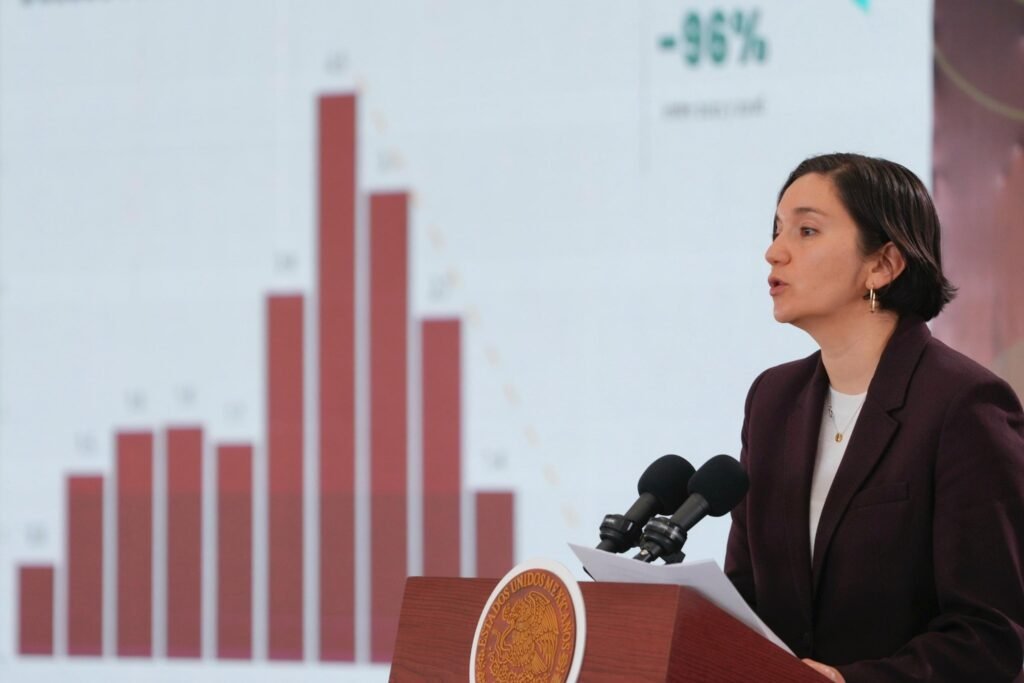
Intentional Homicides in Zacatecas Fall 96% Since 2021, SESNSP Reports
Zacatecas’ daily homicide average fell from 4.5 killings a day at its 2021 peak to 0.2, the lowest on record, as residents’ sense of insecurity also eased.
-
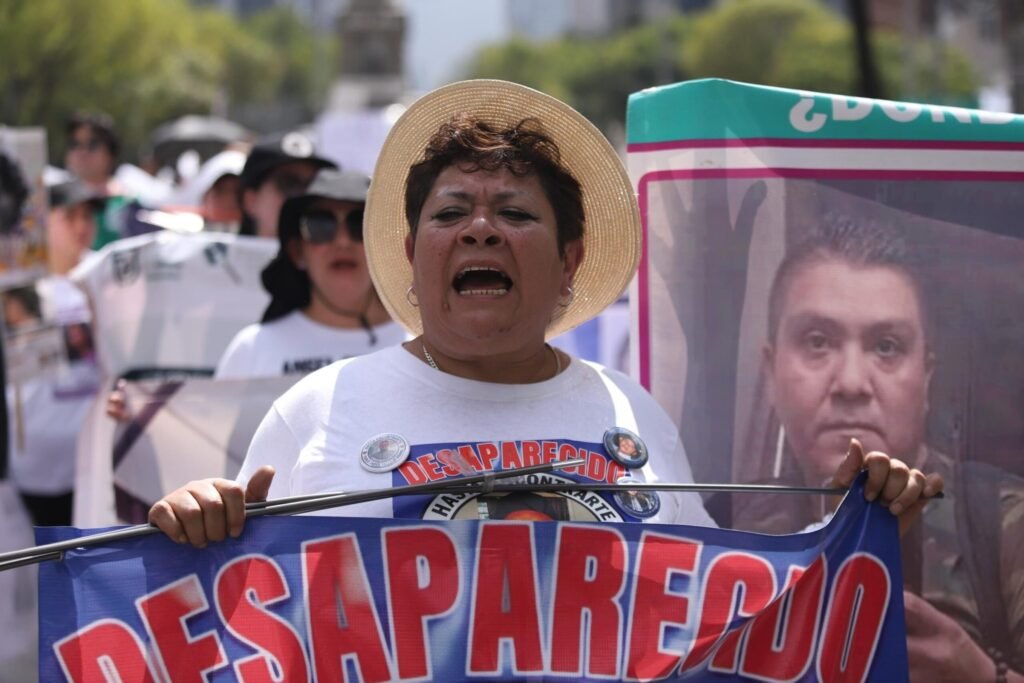
Mexico Reinforces Search Strategy with 10 Actions; Reports 13,625 People Located
Mexico reinforced its National Search Strategy with 10 new actions; of 31,946 people located, 13,625 were found since July 2025 through the strategy’s mechanisms.