“We Won’t Leave Mexico’s Mountains of Guerrero,” Governance Secretary Says
This article by Anahí Del Ángel originally appeared in the August 17, 2026 edition of Contralínea, an independent Mexican investigative journalism magazine.
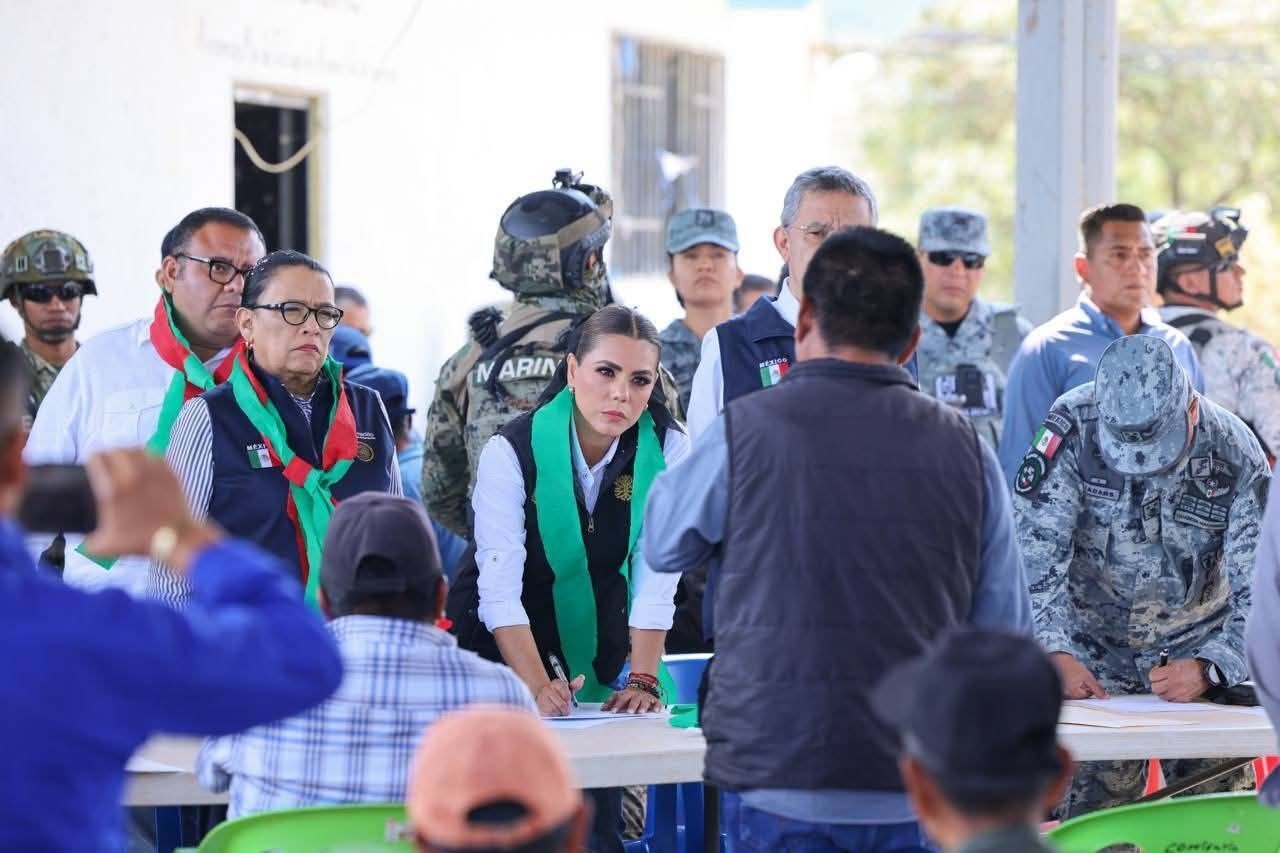
The federal government will maintain a permanent presence in the Upper and Lower Mountains (Montaña Alta and Baja) of Guerrero, a poor, largely Indigenous highland region where fighting among organized-crime groups has forced families to flee their homes, with elements of the National Guard and the Secretariat of National Defense, as well as teams from various federal and state agencies to serve the communities affected by the displacement of families, affirmed the Secretary of Governance, Rosa Icela Rodríguez: “we are not going to leave the region.”
Presenting the progress of the Master Plan for the Upper and Lower Mountains, the official noted that, since May 13, 19 federal institutions and dozens of agencies of the Guerrero government have worked in a coordinated manner in 19 communities of four municipalities: Atlixtac, Chilapa de Álvarez, Olinalá, and Zapotitlán de Tablas.
She explained that the intervention was ordered by President Claudia Sheinbaum after the displacement of families in the region became known. The order, she said, was to serve the population “in a close, humane, and permanent manner,” with people as the priority and through a strategy coordinated among the federal, state, and municipal governments.
She detailed that the strategy was defined based on the meeting of federal officials with the victims of the displacement; they, she said, toured the communities and met with families, municipal and community authorities, women, young people, senior citizens, and farmers.
From those tours, the conditions of vulnerability and insecurity were identified and 19 priority communities were established where government intervention is currently concentrated.
The Master Plan, as Rodríguez detailed, contemplates 13 lines of action: peacebuilding, security, justice, agriculture, environment, health, culture, welfare, education, infrastructure, connectivity, food, and housing. The priority, she indicated, are girls, boys, and young people, with the goal that they can study, train, and develop a life project in their own communities.
Likewise, she highlighted that since the start of the intervention, those affected have been accompanied and security conditions have been strengthened to allow their return; as a result, families from Tula and Xicotlán, communities of Chilapa, have already returned to their homes.
She also reported that economic support was given to people whose homes were severely affected or completely destroyed, and stressed that the return requires guaranteeing security conditions, but also services and opportunities to prevent new displacements and allow families to remain in their communities.
“We know that in order for them to be able to stay in their communities they need security, health, education, housing, roads, food, employment opportunities, and conditions for their daughters and sons to build their future here,” the official affirmed during the presentation of the Plan’s progress.
She maintained that the pacification strategy is not limited to the presence of security forces, but includes actions to address the causes that generate violence. In that framework, she noted that the Tianguis del Bienestar was brought to the region, through which new essential goods were delivered free of charge.
In the effort to pacify the area, other bodies also participated, such as the Secretariat of Education, in charge of delivering scholarships and actions to improve school infrastructure, while the Secretariat of Labor incorporated young people from the region into the Youth Building the Future program and the Secretariat of Welfare integrated people who do not yet receive any social program.
Actions aimed at women were also reinforced to prevent and address the violence they face, as well as to expand their autonomy and access to protection mechanisms. In terms of health, medical services and medicines were brought to communities that have historically had difficulties accessing these services.
For the rural sector, the federal government launched training and technical assistance actions, in addition to the delivery of corn and programs aimed at improving the productivity and marketing of products, for which the Secretariat of Agriculture is expected to join in a few days.
Rosa Icela Rodríguez noted that this visit will aim to tour the communities and fulfill the commitment made to the population to deliver corn and beans for food. In addition, she affirmed that actions to strengthen productive activities and improve the economic conditions of families will continue.
In terms of security, the Secretary of State reported that a permanent command post was established in Chilapa, with daily participation of the Secretariat of Governance, the Secretariat of National Defense, the National Guard, the Secretariat of Security and Citizen Protection, and the Guerrero government.
She assured that the Mexican government will not withdraw its presence from the region. “To tell the families of the Mountains that we are not going to leave the region, that the teams will be there permanently, as well as the elements of the National Guard and the Secretariat of National Defense, hand in hand with the State Police.”
She added that the institutional presence will be maintained “for as long as necessary” and that the progress of the Master Plan will be reported periodically to the communities.
The federal official stated that building peace in Guerrero requires combining security with attention to the causes of violence.
We, the good ones, are more than those who resort to violence; together we can build peace in any territory.
Rosa Icela Rodríguez
Finally, she announced that this year artisanal roads will be completed and access to the communities will be improved. She assured that social, productive, and security programs will continue in order to recover the conditions of well-being, security, and tranquility of the families of the Mountains of Guerrero.
-
César Jáuregui, Maru Campos’s Former Prosecutor, Arrested in Relation to the CIA Case in Chihuahua
The CIA operated illegally on Mexican soil without the federal government’s consent; now the Chihuahua officials who allowed it are facing charges.
-
US Lifts Restrictions on Mexican Airlines
Washington revoked Order 213-2, imposed in 2025 over cargo flights moved to AIFA, reopening new US routes from both Mexico City airports.
-
“Ingeniero,” CJNG Member Who Designed and Built Narco-Tunnels, Falls in Zapopan
The Defense Secretariat says Luis Manuel “N” built drug tunnels into the US from Tijuana and took orders directly from CJNG leader Juan Carlos Valencia González.