The Three Sovereignties: The Civilizational Crisis of the West
This article by Oscar David Rojas Silva originally appeared in the August 27, 2026 edition of Contralínea, one of Mexico’s leading investigative journalism magazines.
There are three levels at which one can measure a country’s advance or retreat in its hard-fought battle for emancipation. Since the fifteenth century, colonialism —as the Dantean origin of violence in its maximum expression— broke not only the economy of the various countries it touched, but also their political systems, their collective imaginary, and their personal relationships. Hence a country must begin primarily with the recovery of its political sovereignty, that is, with the capacity to recognize the national community in the State and not the invading colonial entity. This is a necessary premise, without which nothing else can be conceived. Deceitful liberal democracy has been the straitjacket that has always disguised bourgeois interests behind any supposed alternative. For that reason, the battle to overcome electoral fraud and the interventionism of de facto powers stands as the main task at this level.
Once this first degree is reached, it is necessary to aim at the second level: economic sovereignty, whose materiality depends on the State’s capacity to establish certain general conditions of production that allow it to conserve economic energy (value) to the greatest possible degree within the metabolism of social being; that is, so that economic activity and its fruits cease to be produced in the abstract, for incessant accumulation, and become anchored to the concrete needs of social reproduction. Thus, the economic body makes it possible to sustain sovereign policies through four areas: energy, food, technology, and credit.
It should be emphasized that these possibilities are not abstract decisions or statements, but concrete realities that require continuity in their construction; for that reason, the logic of alternation in liberal democracy has always constituted a trap that impedes the consolidation of a harmoniously developed form. In the case of Mexico, the struggle against fraud and the political consolidation of the second story of the transformation speak of a model of popular democracy that has decided, forcefully, to reaffirm the continuity of the development plan under way. Political sovereignty expresses its advance if we recapitulate how the executive, the legislative, and the judicial branches have progressively undergone transformations in their internal logics. For that reason, the current discussion about corporate media and the right of audiences is a symbol that the process now continues with what is called the fourth power. This also explains why reducing violence is a core matter: the integrity of the territory and its pacification are, without a doubt, a premise for consolidating this level.
Now then, political sovereignty opens the route toward economic sovereignty. It is no minor detail that one of the great changes experienced since 2018 was having a National Development Plan (PND) anchored in the country’s own conditions, and not in a series of abstract policies dictated from the International Monetary Fund and its associated agencies. From the PND to the Plan México, we have observed the need to preserve energy and to drive import substitution in favor of a new internal market. This battle already lies within the second level of analysis that we propose here. The process unfolds under the unprecedented sign that our economy is anchored to the twilight of the hegemonic economy, so that it simultaneously presents an interventionist stridency and a chronic weakness, which means a real opportunity to reorganize one’s own economy and, with that, to contribute to economic sovereignty.
At this level it is worth bearing in mind that industrial development is not an end in itself; it is not about sacrificing the collective worker or nature, but about creating, with the new capacities, a new political-philosophical cycle that endows the result of the process with a new social content. Economic sovereignty enables a real praxis that affects the economy as a whole: one does not only compete in the markets, one also cooperates; but for that it is necessary to have the capacity to transform the inertial paradigm of interventionism toward the projection of a different vision of humanity. Thus one arrives at the third level: civilizational sovereignty.
China offers an example of this route: it began its battle for political sovereignty in the revolution of 1949, and in 1978, with the opening, moved on to a new moment in which it built the economic sovereignty it enjoys today in the four areas noted. This process has allowed it to begin to contest a worldview different from the Western one. Xi Jinping has already deployed four agendas aimed at a restructuring of the planetary economy: the Global Development Initiative (2021), the Global Security Initiative (2022), the Global Civilization Initiative (2023), and, most recently, the Global Governance Initiative (2025), presented by Xi at the summit of the Shanghai Cooperation Organisation in Tianjin on the occasion of the 80th anniversary of the founding of the UN.
Meanwhile, this rise of the East irrupts materially with the New Silk Road —which since its launch in 2013 has already brought together more than 150 countries and an accumulated commitment of over 1.3 trillion dollars in investment and construction contracts— and enjoys a new spirit among the various countries that, when they turn toward the West, see only a series of abuses and sanctions, not to mention the constant diplomatic mistreatment. We must insist that the East does not reproduce the Western paradigm of a single dominant pole, but the opposite: the path to realizing civilizational sovereignty which, this time, cannot remain confined to national territory, but whose field of action is already planetary, so that the push for the economic sovereignties of the countries of the Global South is not a kind of “philanthropic aid,” but the premise for projecting the third level, which is now multipolar. As a consequence, the new economic models that emerge in this new epoch must have an industrial policy, but also a civilizational policy, anchored to the development of the social contents proper to a new historical moment.
In contrast, when we turn to analyze the current conditions of the United States, we observe a generalized crisis. In reverse order: a) the US is going through a civilizational crisis, since the American dream has ceased to be the canon, while its immediate area of influence, represented in the G7 (United States, Canada, United Kingdom, France, Germany, Italy, and Japan), has lost the leadership to sustain itself and falls back on constant aggression. At this level, the loss of its military capacity to impose conditions also stands out: it has begun its withdrawal from West Asia, marked by its defeat against Iran, while the wound of what was supposed to be its great victory over the Soviet bloc remains open today. (b) Economic sovereignty is also compromised, owing to weak growth marked by chronic and stratospheric debt —which in August 2026 already surpassed 39.8 trillion dollars, equivalent to about 123 percent of GDP—, while the country has become a deficit nation; a consumer, but not a producer. Having benefited from the advantages of holding the key currency, the dollar, is now taking its toll. c) In the sphere of political sovereignty, the system finds itself in crisis due to the moral bankruptcy of the Epstein files and an abuse of the mechanisms of subjective warfare, which use permanent distortion to dispute the right to steer the same ship amid the mentioned polycrisis. The US has been left with no choice but to seek refuge, once again, in the asymmetry of the territories it has historically controlled, as is the case of Latin America and the Caribbean (LAC). We observe the stridency and chronic lack of respect the US elite exhibits as the symbol of a force that, in fact, has already lost.
In sum, if we think of LAC as a bloc, we need to drive the rebirth of a shared worldview with a view to beginning the process of recovering political sovereignty. Let us not forget that the reactivated Monroe Doctrine —originally proclaimed in 1823 and revived by Washington at the end of 2025 in the form of the so-called “Trump corollary”— shares its temporal origin with the Amphictyonic Congress of Panama, convened by Simón Bolívar in 1826 as the first attempt at continental unity against that same hegemonic pretension. The recent shift to the right in LAC has been a symbol of the civilizational crisis of the United States; the case of Argentina with Milei already warns us that algorithmic deception can be powerful, but its effects are not lasting. It seems to me that LAC will turn again in search of real social options, but for that it is necessary to build on the foundations of a new vision. That is, to set out from the recovery of the historical civilizational processes already experienced in order to project a new attempt to storm the future. This time it will not be declarative but grounded in a real economic base.
Oscar David Rojas Silva
Economist (UdeG); master's and doctorate (UNAM) in the critique of political economy. Academic at FES Acatlán. Director of the Center for the Study of Contemporary Capitalism, and a communicator specialized in critical thought at Radio del Azufre and Academia del Azufre.
-
Mexico’s Financial Sector Is a Shackle on Development
Drawing on Mariana Mazzucato’s critique, Mario Campa argues that Mexico’s concentrated commercial banking and starved development banking hold back the country’s development.
-
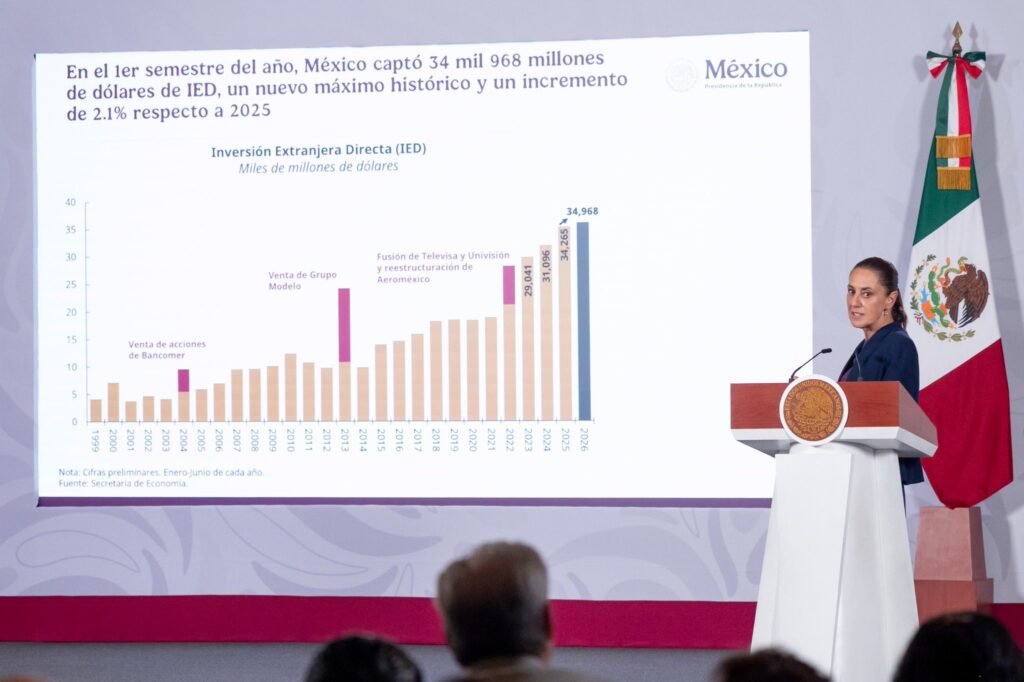
Foreign Direct Investment in Mexico Reaches Record of $34.968 Billion in First Half of 2026
Sheinbaum framed the record as proof the economy is holding firm despite forecasts of weaker growth, alongside a peso at 16.97 to the dollar.
-
People’s Mañanera August 27
President Sheinbaum’s daily press conference, with comments on national sovereignty, Cabeza de Vaca, migrant protection, Somos México, La Derecha Diario, and audience rights.