A Circus at Mexico’s Education Secretariat
This article by Luis Hernández Navarro originally appeared in the February 17, 2026 edition of La Jornada, Mexico’s premier left wing daily newspaper.
Simultaneously farce and tragedy, the feud between Marx Arriaga and Mario Delgado reveals the consequences of using public education as a fiefdom to repay political favors. Despite their attempts to cloak themselves in the defense of the New Mexican School (NEM) and free textbooks, what’s at stake in this farcical spectacle is a matter of self-interest.
Both the Secretary of Public Education (SEP) and the head of the institution’s General Directorate of Educational Materials are disgraceful. Even if they cloak themselves in the noble mission of educating children, Delgado’s offer of the Costa Rican ambassadorship to Arriaga (an updated version of Álvaro Obregón’s infamous 50,000-peso bribes to his detractors) in exchange for his job at the SEP demonstrates the pedagogical depth of this clash.
The current Secretary of Education has consistently betrayed the teaching profession. As a senator for the PRD party in late 2012 and early 2013, he placed himself at the beck and call of Claudio X. González to approve Peña Nieto’s education reform. According to the businessman, on December 12, 2012, the Senator called him jubilantly to tell him that the new legislation had been approved with his vote in favor.
On September 13, 2018, already a Morena party deputy, Delgado announced: “The education reform will be overturned, not a single comma will remain.” A lie. The approved education legislation not only preserved the commas, but entire paragraphs of the old text and, above all, its neoliberal core.

And now, working from Vasconcelos’s office, he has dedicated himself to forging close alliances with business groups like Lego and Femsa, opening the door to private interests in terms of approaches and content. He wants to implement STEM education within the New Mexican Education Model (NEM), a flawed and unoriginal pedagogical fad used to attract funding and to promote initiatives and educational materials worthy of the Pleistocene era. Incidentally, he promotes a teacher training program that is utterly devoid of critical thinking.
Engaged in this approach, Delgado promoted the development of “supplementary” workbooks by the SEP (Ministry of Public Education) in collaboration with international organizations. Furthermore, he spearheaded the creation of a coalition called Alianza México (Mexico Alliance), which, as Mauro Jarquín has explained, is essentially a classic model of philanthrocapitalism in education, and has a presence in several states. In addition, local authorities, particularly in northern states, tend not to distribute books or collections published by Marx’s office.
Marx Arriaga suffers from severe personality disorders. He is a civil servant who fancies himself a teachers’ union leader; a state employee with preacher aspirations; a philologist who dreams of refounding an ethereal and ambiguous liberating pedagogy; a colonel without troops, but with a salary, who fantasizes about taking heaven by storm; a street fighter whom stylists knock out; an unelected apostle of Obradorism; a missionary who proclaims the new world in a strident and vociferous manner.
His time in the education sector has been fraught with controversy. Since his appearance at a morning press conference on April 26, 2023, announcing a new educational model, the scandals surrounding him have been relentless. The combination of his penchant for championing fervent causes with the kind of rhetoric worthy of a lay evangelist, and his inability to ground his pedagogical pronouncements in simple examples, has earned him widespread criticism from academics, teachers, and journalists.
His curriculum reform is a hodgepodge of good intentions and few concrete steps. He’s had indigestion from decolonial theory. He’s indulging in empty rhetoric that has fueled the right wing’s fear of communism. His verbosity ultimately drives away any possibility of sympathizing with what he claims to defend.
Until his latest scandal, he was a powerful figure. He held that position during President López Obrador’s six-year term, when all his erratic behavior was tolerated. He also held it throughout the first year of Claudia Sheinbaum’s administration. He traveled the country as if he were accountable to no one. He said whatever he wanted, whenever he wanted, without any repercussions.
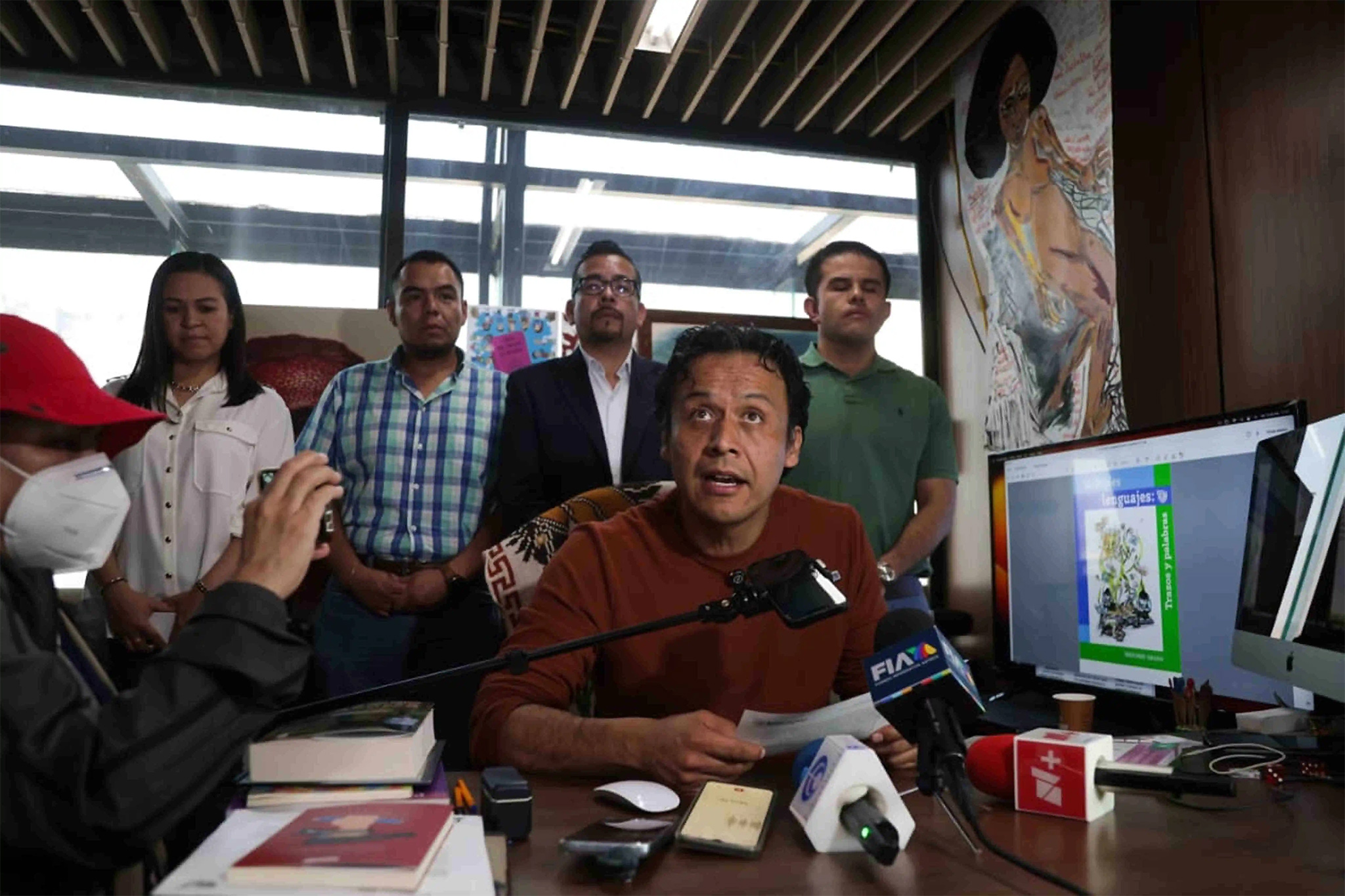
Things started to heat up when, at the end of December last year, he called for the formation of “Committees for the Defense of the New Mexican School and its Free Textbooks.”
Beyond his role as a civil servant, Marx has his own political capital comprised of teachers, some of whom are followers of critical pedagogy. They are concentrated in Chihuahua, Baja California, Michoacán, Querétaro, Guerrero, the State of Mexico, Guanajuato, Puebla, Coahuila, and Mexico City.
The Freirean Bonfires he organized and the Insurgent Bonfires he convened (a kind of study circle) would become the embryos of his committees. He held 300 Freirean Bonfires in which just over 3,000 teachers participated. At the beginning of this year, some 1,500 teachers were registered for the Insurgent Bonfires project, which was scheduled to hold 200 bonfires. The number of attendees could reach approximately 3,000 education workers.
The poet Nadia López García was appointed as Arriaga’s replacement. In 2018, President Enrique Peña Nieto presented her with the National Youth Award. The wounds of Ayotzinapa were still raw. In her acceptance speech, the current head of educational materials told the president: “Rest assured that today you have planted, in this generation, the seed for all our dreams to grow in Mexico.”
Unfortunately, the dispute at the SEP is not a fight between good and bad for the defense of public education, but a brawl between rival power groups for control and the collection of political rents from a pedagogical project that has not yet been born.
-
People’s Mañanera March 30
President Sheinbaum’s daily press conference, with comments on investments in Fine Arts & Anthropology & History institutions, Cuba, lawsuit by Mexicans who died in ICE custody, and fuel price controls.
-
Mexico’s Mobile Consulates in the US
Such consulates perform an extremely important task, especially when the policies of the US administration under Donald Trump are becoming increasingly aggressive.
-
A Law to Protect the Dignity & Life of Women
Mexico’s General Law to Prevent, Investigate, Sanction and Repair the Damage for the Crime of Femicide seeks to strengthen the capacity of the State to protect, act promptly, investigate, as well as guarantee truth, justice and reparation for victims.