Cuba Does Not Stand Alone
This article by Laura Carlsen originally appeared in the April 26, 2026 edition of Counterpunch and appears here courtesy of the author. The views expressed in this article are the authors’ own and do not necessarily reflect those of Mexico Solidarity Media or the Mexico Solidarity Project.
As Trump’s approval plummets, besieged by the fiasco in Iran and his bizarre attempts to deify himself, instead of reassuring the nation, he’s threatening to throw away more taxpayer money on another senseless war.
Speaking at a meeting of the extreme right Christian nationalist organization, Turning Point USA, in Phoenix on April 17, Trump spewed false claims about the thwarted war launched by Israel and the U.S. on Iran, then stated, “And very soon, this great strength will also bring about a day 70 years in waiting. It’s called A New Dawn for Cuba.” He added ominously, “Now watch what happens”.
After the speech, when the press cited reports that the Pentagon is preparing for miitary action in Cuba and asked: “Are those reports true, is Cuba next?” Trump repeated several times “It depends on what your definition of military action is”. Then he told the female reporter she probably couldn’t understand, before changing the subject.
The latest threat isn’t surprising, given the escalation of pressure on the Cuban government and Trump’s desperate need to divert attention from the Epstein files and public opposition to his terrible decision to attack Iran. A military attack on Cuba, however, would further chip away at Trump’s core support and alienate the widening group of U.S. independents who want to see improvements in their own lives. It would initiate a prolonged and costly conflict, further isolate the U.S. from allies and international rule of law, and dash hopes for negotiating economic reforms—something that the Cuban government has been open to.
Most important in Trump calculations, it would also be political suicide for the Republican Party just months before the mid-term elections.
With so much at stake, how is it that this administration has dragged us to the precipice of yet another illegal war with enormous human and economic costs, this time just 90 miles from the U.S. mainland?
Strangling Cuba—Another Trump war crime
The U.S. embargo and economic sanctions have brought about a humanitarian crisis in Cuba for decades. Mark Weisbrot at the Center for Economic and Policy Research recently wrote that U.S. sanctions on Cuba qualify as collective punishment of civilians and as such, a violation of the Fourth Geneva Convention and a war crime. As the U.S. and Israel continue to bomb hospitals and schools in Iran, Lebanon and Gaza during ceasefires, babies in intensive care are dying in Cuban hospitals deprived of electricity and medicines. The Cuban community health system that dramatically reduced infant mortality and achieved Human Development indices that put far wealthier countries to shame has been forced to suspend surgeries and other vital care. As with the wars in the Middle East, it is women, children and the elderly who suffer the brunt of sanctions
In January, Marco Rubio’s obsession with regime change in Cuba won out over cooler heads and Trump intensified Cuba’s suffering. On January 29, 2026, he issued an executive order that announced tariffs on U.S. imports from any country that “directly or indirectly sells or provides oil to Cuba”. Resorting again to the 1977 International Emergency Economic Powers Act, the order proclaims Cuba a threat to U.S. national security, listing a series of Cold War shibboleths and invented claims to posit that a small, impoverished island that has not once attacked the United States poses a major security risk.
Foreign leaders, including Mexico’s Claudia Sheinbaum, immediately condemned the measure against Cuba and the extraterritorial overreach. United Nations human rights experts demanded the U.S. blockade be lifted in a strongly worded statement: “The U.S. executive order imposing a fuel blockade on Cuba is a serious violation of international law and a grave threat to a democratic and equitable international order… There is no right under international law to impose economic penalties on third States for engaging in lawful trade with another sovereign country.”
No act of aggression or threatening move from Cuba triggered the order. Trump’s threat of tariffs weaponizes the U.S. economy–built and sustained by millions of workers and consumers—for the his administration´s broligarchy agenda and the far-right strategy of global hegemony. The Feb. 20, 2026 Supreme Court decision to strike down the use of the 1977 International Emergency Economic Powers Act to leverage tariffs for political purposes without Congressional approval failed to ease the pressure. The Trump administration dusted off another bogus justification, the 1974 Trade Act, to continue tariff threats. Mexico, a key provider of fuel to Cuba, has so far been unwilling to risk a trade or military confrontation with the U.S. to resume sending oil purchases to the starved island. Trump backed off locking horns with Russia though, and a Russian tanker delivered 780,000 barrels of crude to the island in March. The Russian government announced recently that another tanker is on its way.
The Regime Change Faction Vs…
Bravado aside, there are differences within the Trump government on how to handle Cuba. The regime-change agenda is driven by three forces: to appease Marco Rubio’s personal vendetta and the Florida anti-Castro faction by ousting the current government, to remove regional leftwing leadership that openly opposes Trump’s renewed Monroe Doctrine of hegemony in the Americas, and to advance in the extreme right’s plan to create a capitalist resource reserve out of Latin America by imposing lackey governments that do its bidding.
Rubio’s views are well known—regime change or bust. This camp hoped to convince Trump that economic strangulation would prepare the ground for an easy military win and Trump would go down in history as the president who ended the longest resistance to U.S. imperialism in history. Some regime-change advocates, most of whom have spent decades publicly inflating the strength of the Cuban opposistion, posited that forcing intense suffering on the Cuban people would trigger insurrection–the same false assumption made in Iran. Anyone who knows anything about Cuba and Cubans outside the Miami bubble, knows that’s not how it would go down.
But as mixed messages come out of the White House through different lines of communication, it’s not clear that Rubio is calling the shots. While Rubio and the South Florida lobby want the complete elimination of the communist government, another group prefers economic reforms that allow U.S. investment.
In a recent interview a reporter asked the Secretary of State directly, “Do you still want regime change or would you be ok with an economic deal?” and he flew off the handle. “What do you mean an economic deal?”, he snapped. “No, Cuba’s economy needs to change and their economy can’t change unless the system of government changes… Who’s gonna invest millions of dollars in a Communist country?”
U.S. foreign direct investment in China in 2024 was $122.9 billion dollars. Just saying.
At least in the long term, the extreme right also prefers regime change in Cuba as part of its vision of wiping the left off the map, starting with Latin America. Cuba is a blight on this vision. With Argentina, Chile, Paraguay, Bolivia, Ecuador, Panama, Honduras, Costa Rica and El Salvador already in their pockets, the international rightwing is focusing its money and effort on the holdouts in the region, particularly the weaker ones. (In that vein, expect intense intervention in the Peruvian elections where the leftist Roberto Sánchez leads the far right to pass to a second-round voting).
Ernesto Dominguez of the Center for Studies of Hemispheric Affairs and the United States of the University of Havana, stresses that the regional context is especially important now with the attempt to reconstruct U.S. hegemony in the Western Hemisphere as home base for building global hegemony.
“Cuba has been the example of opposition, to refuse U.S. control and survive in spite of all the pressures from the U.S., with all that implies as an example, but also in terms of collaboration with other forces on the left in the region,” he notes. Dominguez also points out that calling Cuba a national security threat serves the dual Trump goal of increasing pressure on Cuba and acquiring new tariff powers to pressure other nations, especially Mexico.
In a recent discussion on Hecho en America, Iramis Rosique, also from the University of Havana, added the importance of Cuba in the rightwing culture wars.
“Among the international extreme right, there’s huge interest in destroying the Cuban project. Why? Because it’s a symbolic, historical, ideological, communications stronghold, a point of reference in the region and the world… We’re the last remaining soldiers of the Cold War.”
The capitalist pragmatist faction
Fortunately for the U.S. and Cuban populations, the regime-change faction seems to be losing ground in Washington. Self-enrichment is almost always Trump’s primary interest. Investment groups and global funds are pressuring for a negotiated path to a market-based economy in Cuba. According to one investor fund, Cuba has unexploited nickel reserves and underused tourist potential that attracts international investors and the best way to increase access is through negotiations.
“We see the pragmatic tone and approach as consistent with what we know about Trump’s preferences and instincts, and we believe any agreements are likely to be positive for investors like us,” they stated in a letter to investors, listing as factors talks with the existing Venezuelan government, successful US-Cuba anti-narcotics cooperation, Sec. of Energy Chris Wright’s statement in Jan. 12 that the US seeks “a transition away from communism rather than a complete collapse”, and the desire to avoid an Iraqi or Afghan quagmire.
There may, in fact, be grounds for negotiations. Trump himself has reportedly said he does not want a complete collapse that would drive up immigration and create instability so close to the U.S. One thing his administration definitely doesn’t need is a new Bay of Pigs. A humiliating defeat would not only bruise Trump’s fragile “I-always-win-even-when-I-lose” ego, but would heighten animosity toward the United States in the region and increase respect for Cuba’s defense of sovereignty. The Cuban government and people, like the Iranians, will not roll over and play dead if threatened with a U.S. takeover. Regime change in Cuba, apart from being a blatant violation of international law and human rights, would require direct military action that costs lives, followed by sustained occupation.
In a sign that the capitalist pragmatists may be winning out over the Cold War ideologues, last week a State Department delegation sat down with representatives of the Cuban government to negotiate demands, according to Axios, although there has been no official statement from the State Department. The Mexican government confirmed the meeting, stating, “The elimination of the energy blockade against the country was the priority issue for our delegation. This act of economic coercion is an unjustified punishment on the whole Cuban population. It’s also blackmail on a global scale against sovereign states, that have every right to export fuel to Cuba based on the norms of free trade.”
U.S. demands reportedly include releasing alleged political prisoners (the Cuban government pardoned 2,010 prisoners April 2, many of whom have already been released), an almost forgotten demand to compensate U.S. companies for assets seized following the 1959 revolution, further opening to U.S. investment, and the takeover of the Cuban communications market by Elon Musk’s Starlink satellite network as part of the broligarchy cut on the deal.
The U.S. has also demanded that foreign bases of operations on the island be closed down, but the only one in existence is Guantanamo, which, of course, is run by the United States.
Although Cubans and millions of people worldwide for whom Cuba has been an inspiration do not want to see a mini-Miami on the island, some sort of agreement is far preferable to a war of annihilation or the end of self-determination.
Popular defense and solidarity
There’s a critical consideration that neither the regime change ideologues nor the capitalist pragmatists will ever understand—the power of popular mobilization in defense of a homeland and of international solidarity.
These factors defy dictums of maximum profit or even self-preservation, and they are the reasons that Donald Trump and the rest of the macho maniacs like Hegseth and General Dan “Razin” Caine continue to make the same mistake over and over again. They think that military might and bluster will instantly break a people’s will to defend their homeland. But even after genocide in Gaza and the mass bombing of Iran and Lebanon the people haven’t caved, and Cuba will be no exception. It’s not a question of putting one’s body on the line for a certain leader or even a certain government. It’s the right to a national identity and history and to live and make decisions about your life in your own land.
Within these parameters, the Cuban government has expressed willingness to negotiate even as it braces for a possible invasion. President Miguel Diaz Canel stated again on April 16, “The moment is extremely challenging and it calls on us to be ready to confront serious threats, among them military aggression. It’s not what we want, but it’s our duty to prepare ourselves to avoid it and if it is inevitable, to defeat it.” The government is mobilizing forces and staging extensive maneuvers. Days earlier Diaz Canel told NBC News, “If we have to die, we’ll die”.
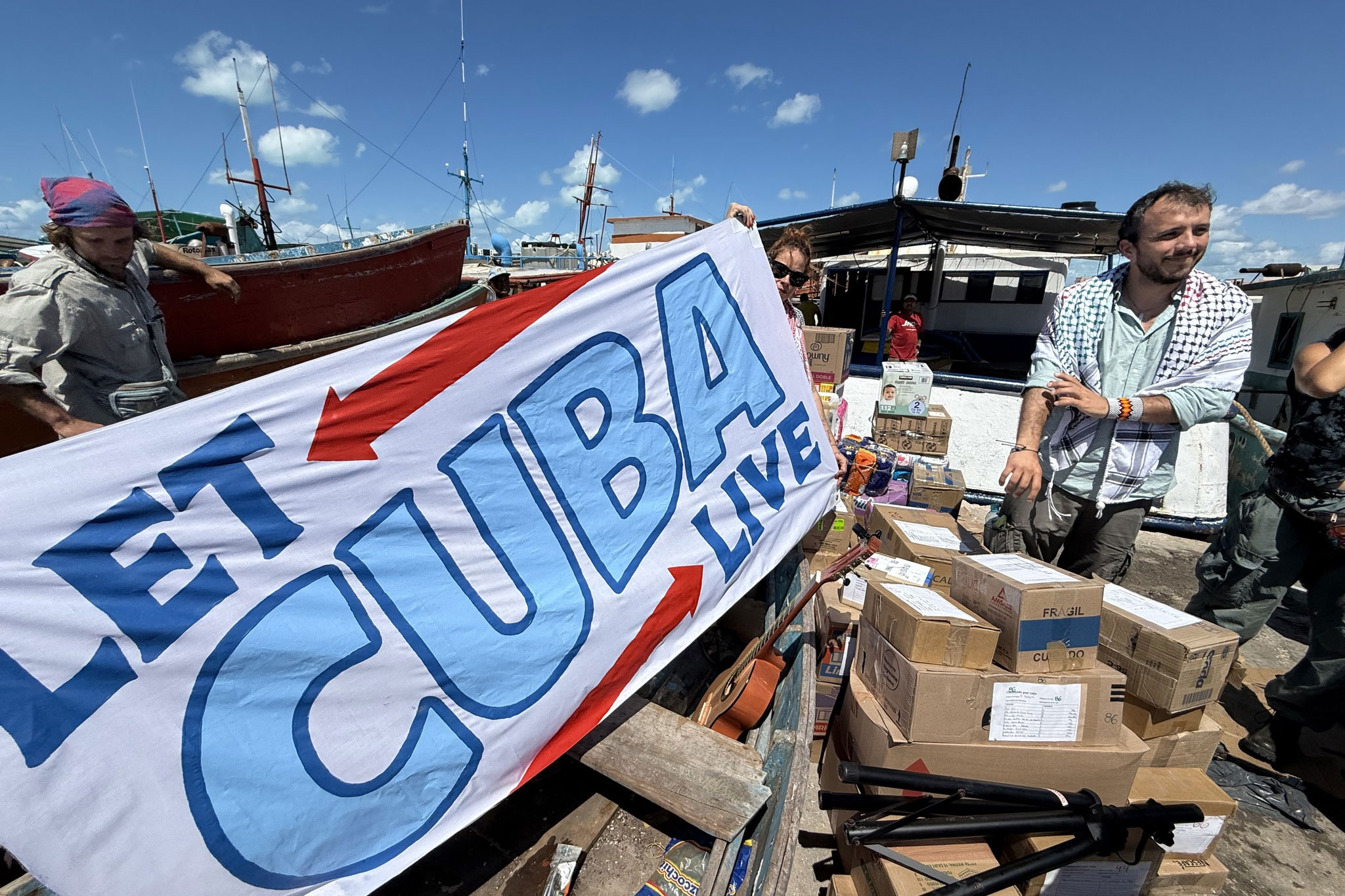
Throughout the world, but especially in Latin America, populations have responded with demonstrations for Cuba’s right to self-determination, humanitarian aid drives, petitions and delegations to the island. Tamara Barra of the Mexican Movement in Solidarity with Cuba explained that her organization issued a call to action, to go out into the streets. She praised the position of the Mexican government, while describing efforts to call on it to take an even firmer stance. President Claudia Sheinbaum recently reaffirmed Mexico´s solidarity and denounced the blockade in a joint statement with Brazil and Spain at the “Defense of Democracy” forum of progressive governments in Barcelona last weekend.
The communique reads in part: “We express our huge concern for the grave humanitarian crisis affecting the Cuban people and we urge adoption of measures necessary to relieve this situation and avoid actions that worsen the living conditions of the population or violate international law. We commit to working together to increase our humanitarian response aimed at relieving the suffering of the Cuban people.”
In the United States, democrats introduced legislation in both the House and Senate titled “A joint resolution to direct the removal of United States Armed Forces from hostilities within or against the Republic of Cuba that have not been authorized by Congress”. The bill defines hostilities as the oil blockade, among other acts. Codepink and other organizations have been holding forums, collecting humanitarian aid and talking to Congress about stopping any plans for a military attack.
An illegal and ill-advised military action against Cuba will not be the Caribbean “excursion” regime- change zealots are trying to sell the president and the public. Cuba will defend itself, and it has powerful allies. These include not just U.S. geopolitical adversaries like China and Russia, but allies like Germany that just warned there is no basis for U.S. intervention in Cuba, Latin American countries that see in Cuba a reflection of their own defense of national sovereignty historically and today faced with current US intervention and arm-twisting, and of millions of people who view Cuba as proof that if even a small island nation can withstand decades of U.S. persecution, there’s hope for the rest of the world.
Laura Carlsen is the Mexico City-based Director of the international relations think tank, Mira: Feminisms and Democracies.
-
People’s Mañanera October 22
President Sheinbaum’s daily press conference, with comments on Plan México, housing in Guerrero, foreign agents in Chihuahua, and IMSS wages.
-
Mexico Owns the Water. Who Can Use It?
From the poisoned Santiago River to the 1992 law that turned water into a commodity, Luis Eugenio Parés explains what it will take to make water a right again in an exclusive interview from our latest bulletin.
-
Heads Will Roll – Soberanía 129
Chihuahua’s ex-attorney general arrested for treason over the CIA raid, Morena’s commanding lead ahead of 2027, the Mexican-American swing in Texas, and the FBI’s El Mayo FOIA dodge.