
Detentions of Americans by Mexican Army & National Guard are on the Rise
This article by Arturo Rojas was originally published in the January 8, 2026 edition of El Economista.
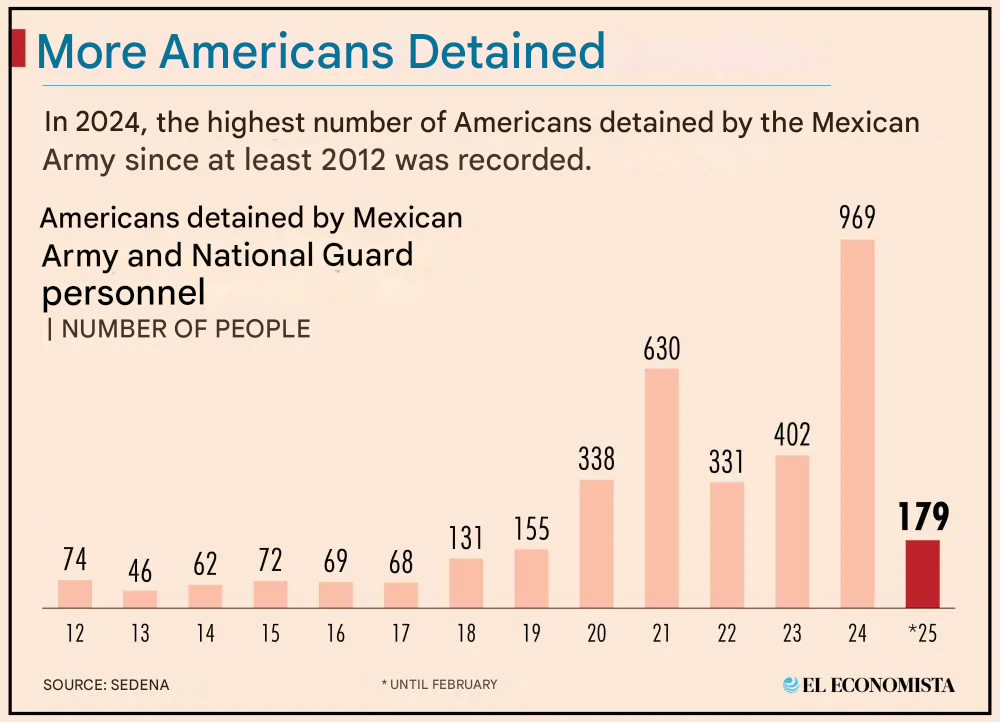
The number of U.S. citizens detained by Mexican Army and National Guard personnel has steadily increased in recent years. Official records, spanning more than 13 years (from 2012 to February 2025), show that 3,526 Americans have been apprehended; more than 80% of these cases have occurred since 2018.
Figures released by the Ministry of National Defense (SEDENA) through the transparency platform indicate that cases have occurred in 24 states; border states lead the numbers.
In Baja California, 946 US citizens have been detained since 2012; followed by Tamaulipas (645) and Sonora (621); these three entities account for 63% of the total.
The other entities where cases were reported were Quintana Roo (461); Baja California Sur (424); Chihuahua (220); Coahuila (110); Nuevo León (25); Jalisco (13); Michoacán (11); Sinaloa (12); Guanajuato (5); Morelos (5); Chiapas (5); Mexico City (4); Colima (4); Guerrero (4); Zacatecas (4); Aguascalientes (2); Durango (1); Oaxaca (1); San Luis Potosí (1); Veracruz (1) and Yucatán (1).
The year 2024—the year of Donald Trump’s election victory and Claudia Sheinbaum’s inauguration—had the highest number of cases with 969 arrests, an average of at least two arrests per day. Compared to the previous year (402), this represents a 141 percent increase.
The arrests carried out by the Mexican Army and the National Guard, as reported, are conducted under the principle that military personnel act in cases of flagrant crime, mainly in application of the Federal Law on Firearms and Explosives, as well as in operations aimed at reducing the rates of violence in the country.
As explained, the detainees and the seized items are immediately turned over to the appropriate ministerial authority, in accordance with Article 16 of the Constitution and Article 230 of the National Code of Criminal Procedure. It is this ministerial authority that, based on its investigations and powers, determines the type of crime or crimes committed by the individuals placed at its disposal.
While there is no official data detailing what happened to each detainee, it can be observed that, as of June 2025, the number of Americans being processed in the Mexican prison system was lower than the number of those apprehended.
Data from the Decentralized Administrative Body for Prevention and Social Reintegration, as of June 30 of last year —the most up-to-date publicly available—, indicate that there are a total of 1,132 US citizens in prisons in Mexico.
The records also show the cases by Federal Social Rehabilitation Centers (Ceferesos); here, Cefereso No. 18 CPS Coahuila stands out, with 35 people, and Cefereso No. 11 CPS Sonora, with 26, as well as Cefereso No. 17 CPS Michoacán, with 17 inmates.
Black Market Weapons
The increase in the detention of U.S. citizens in Mexico, particularly for federal firearms-related crimes, reflects broader dynamics of transnational organized crime and illegal arms trafficking, experts said.
Victor Hernandez, director of the Latin American Institute for Strategic Studies, pointed out that U.S. citizens are a priority target for cartels because of the ease with which they can acquire weapons in their country without raising suspicion.
“With a driver’s license, they can buy weapons at any store and cross the border without raising any red flags,” he explained, while dismissing the narrative that people with dual nationality represent a greater risk, as there is no statistical support for it.
Regarding the role they may play within Mexican drug trafficking, the expert indicated that, while it is not impossible for them to occupy leadership positions, they generally perform specialized roles, such as financial operators, logistics links or hitmen with specific skills.
Jorelvy Calixto, a security specialist and external consultant for Global Thought, pointed out that one of the worrying elements is not only the incorporation of foreigners into illicit activities, but also the transfer of technical and tactical knowledge to Mexican criminal organizations.
“They not only work on illegal matters, they also contribute know-how on new forms of attack, explosives manufacturing and the use of technology,” he explained.
This exchange of knowledge, he said, has contributed to the cartels increasing the lethality and sophistication of their attacks, with direct effects on the civilian population.
The consulting firm identified dual nationality, which facilitates border crossings, as well as the ease of acquiring weapons in the United States and the constant flow of information about their use and clandestine manufacture, as key factors for the recruitment of US citizens.
“What we used to see in terrorist groups we are now seeing more and more in cartels,” he warned.
Both specialists agreed that, in terms of intelligence, it would be essential to have lists of criminal records and risk profiles of US citizens entering Mexico, in order to prevent crimes and guarantee due process in accordance with national and international jurisdiction.
Legislation
According to current legislation in Mexico, carrying and possessing firearms without a license is a severely punished crime for any person within Mexican territory, including foreigners.
The Federal Law on Firearms and Explosives punishes the illegal importation of firearms into the country with prison sentences of three to ten years. The law allows foreigners to carry firearms only under very limited circumstances, such as in the case of permanent residents or those who obtain temporary licenses for sporting purposes.
-
Mexico Requires a Deterrence Strategy
Mexico should continue to work at maintaining a positive relationship with our closest neighbor and number one trading partner. But acting like Trump isn’t capable of unilateral military action against us is foolish.
-
People’s Mañanera April 1
President Sheinbaum’s daily press conference, with comments on energy sovereignty, Tamaulipas housing, World Cup 2026, and the Gulf of Mexico oil spill.
-
The Hidden Connections Between the Ukrainian Military & Drug Cartels
It is difficult to believe that European intelligence services, which rigorously monitor arms trafficking, would ignore the flow of weapons & drones into the Americas.