
Economic Package Will Seek to Combat Evasion and Avoidance by Shell-Invoice Firms
This article originally appeared in the September 8, 2026 edition of Contralínea, an independent Mexican investigative magazine.
In 2027, tax revenue is expected to reach a record high of 15.9 percent of GDP, without creating new taxes, said Treasury Secretary Edgar Amador as he delivered the Economic Package proposal to the Congress of the Union. He explained that this result will rely on greater collection efficiency, as well as on the fight against evasion, avoidance, and companies that invoice simulated transactions, known as factureras.
Before the legislators, the official indicated that this will give the State greater resources to finance well-being, infrastructure, and productive development. He also anticipated that the growth forecast for the Mexican economy next year is at least 2 percent.
That result, he said, will be achieved through an environment of greater commercial certainty and more favorable financial conditions, as well as the dynamism of consumption, the strengthening of public and private investment, and a greater contribution from the external sector.
Amador Zamora asserted that the 2027 Economic Package is based on the principles of Mexican humanism, shared prosperity, and responsibility in spending. For this reason, he said, the economic policy strategy will translate into higher incomes for families, more investment opportunities, and less poverty and inequality.
With that objective, investment in education will increase by 10.7 percent; in science, 13 percent; health, 11.3 percent; and security, 11.5 percent. In addition, all the Programs for Well-being will be guaranteed an increase above inflation.
The Treasury Secretary stated that public and mixed investment between 2026 and 2030 will amount to 5.7 trillion pesos, which will drive Mexico’s economic development. He also detailed that Plan México will be one of the main engines of this strategy, with incentives and supplier development to mobilize private investment, increase the national content of production, strengthen supply chains, and generate higher value-added jobs.
He added that in 2027 the process of gradually reducing the deficit will continue, and that the Public Sector Borrowing Requirements will stand at 3.9 percent of GDP, representing a cumulative reduction of 1.8 percentage points compared to 2024. The fiscal strategy will make it possible to preserve macroeconomic stability and maintain a sustainable trajectory for public debt.
-
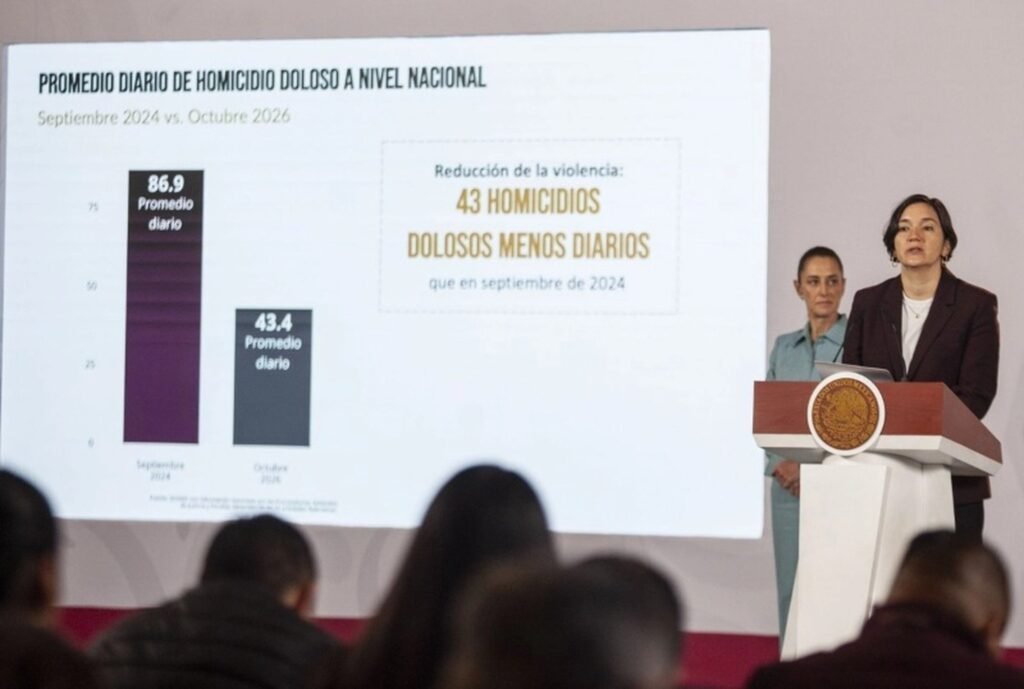
Intentional Homicides Fell 50 Percent Between September 2024 and October 2026, Sheinbaum Says
All 32 states cut their daily homicide rate, led by San Luis Potosí with a 77 percent drop, while perception of insecurity fell to its lowest since 2013.
-
López Beltrán Calls Salinas Pliego a “Vulture” and Questions Him About His Ties to Epstein, García Luna and Marcial Maciel
In a 34-minute video, AMLO’s son answered the businessman point by point and fired back questions on taxes, Fobaproa and TV Azteca.
-
Sheinbaum Says She Will Present Her Electoral Reform Proposal Again After the 2027 Elections
Sheinbaum says parties, including Morena’s own allies, sank her two reform bids to protect their proportional representation seats.