
Government Will Provide 36,000 San Quintín Families With 40,000 Pesos to Improve Their Housing
This article by Fernanda Monroy originally appeared in the June 22, 2026 edition of Contralínea, a Mexican investigative journalism magazine.
The federal government will provide support of 40,000 pesos to 36,000 families in San Quintín, Baja California, to improve their housing as part of a strategy that also includes the regularization of land tenure, electrification works, and actions to expand access to potable water, President Claudia Sheinbaum Pardo reported.
During her morning press conference, the head of state explained that many families live in homes built on ejido land whose sale was carried out irregularly, a situation that has prevented them from obtaining legal certainty over their properties and accessing better housing conditions.
“Now the 36,000 families are going to be given 40,000 pesos each so that they can improve the conditions of their housing, in addition to the regularization process that allows them, with their own income, to continue improving them.”
The head of the federal Executive added that the program also includes the expansion of electrification and actions to address the lag in the supply of potable water, noting that San Quintín is a municipality with a large territorial extension. “It is a very large area, but we are going to attend to everyone.”
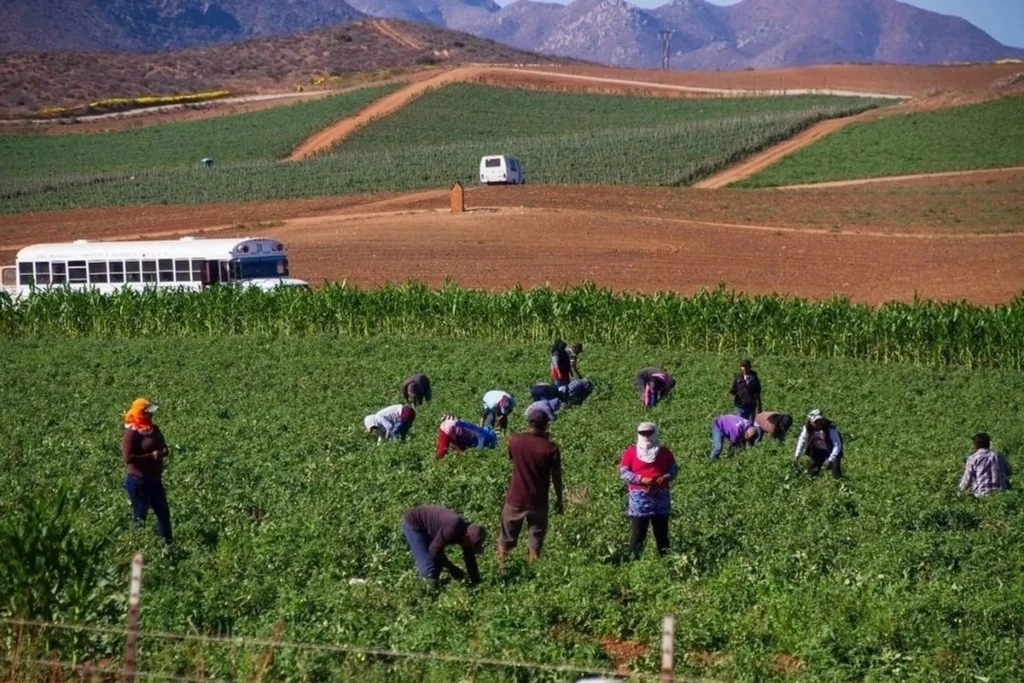
On labor matters and with the aim of attending to the region’s day laborers, the president reported that a Service Center for Day Laborers is already operating, where workers will be able to directly file complaints related to their working conditions.
She also announced that the Ministry of Labor and Social Welfare and the Mexican Social Security Institute (IMSS) will carry out joint inspections of agricultural companies in San Quintín, as well as in areas of Ensenada and northern Baja California Sur, to verify that their workers are registered with the IMSS and have social security.
She recalled that the companies have a period of six months to comply with the labor certificate required to export their products. Starting in August or September, she said, they will have to prove that their workers are affiliated with the IMSS in order to maintain that requirement.
Sheinbaum acknowledged that the majority of day laborers work under a “piecework” payment scheme, meaning they receive their pay according to the quantity of products they harvest and not for a fixed workday, which in some cases results in workdays longer than eight hours.
She emphasized that this payment system does not exempt employers from complying with their social security obligations or from respecting the workday established by law. “We are better off than when we started, but there is still much to do.”
The head of state announced that she will return to San Quintín within six months to evaluate the progress in the actions undertaken in labor matters as well as in housing and infrastructure.
-
Sheinbaum Presents Draft Decree to Force Digital Platforms to Take Down Content That Incites Violence and Hate
No fines for now: the government will talk with tech companies before publishing the decree next week, a promise made after the Coahuila school attack.
-
People’s Mañanera October 9
President Sheinbaum’s daily press conference, with comments on digital safety, IMSS-Bienestar, sovereignty, and the opposition.
-
Mexico’s Gas Reserves Would Last Only 3 Days
Cenagas director Cuitláhuac García revealed Mexico has no gas storage and imports 75% of what it consumes, after a US supply cut exposed the risk.