Hyundai Supplier Union Wins Recognition
This article by Bertha Becerra originally appeared in the February 9, 2026 edition of El Sol de México.
Four years after filing its complaint with the USMCA’s Rapid Response Labor Mechanism, the Independent Union of Supply Chain Transporters (SITRABICS) achieved recognition as a union at a Hyundai supplier in Baja California.
“Although it was a real ordeal to find justice, we finally achieved it. And any worker who is determined to raise their voice to improve their labour rights has to be willing to fight against anything. And we are the example,” said Jesús Iturbero Salinas, general secretary of SITABRICS, in an interview with El Sol de México.
“In our case, it was four and a half years, from October 2021 when I was fired until February 3, 2026, when we finalized everything. This perseverance in defending our rights proved us right,” he added.
The union leader announced that the USMCA’s Rapid Response Labor Mechanism recognized that there were real violations of workers’ rights by the then company Liber Gennesys Group, now Transportista Kamu, S. de R. L, which is an integral part of the Hyundai Motor Group supply chain in Baja California.
“There were real violations of the rights of the workers who were fired for organizing to form our independent union within the company,” he accused.
The outcome of the MLRR was that both governments agreed to implement a remediation plan that includes various actions and stages that the Kamu company has to fulfill to compensate for the damage.
Iturbero Salinas recounted that after complicated negotiations they achieved the recognition of STRABISC as an independent union organization and representative of its 300 members within the company, the reinstatement of two union leaders with payment of back wages and compensation for the general secretary, as well as the signing of a Protocol of Coexistence and Exercise of Union Freedom between the company and the union.”
On February 3, the protocol between SITRABICS and the company Kamu was signed at the Federal Center for Conciliation and Labor Registration in Tijuana.
“The union representatives of SITABRICS will carry out union activities at the workplace to address the needs of our affiliated colleagues,” assured the leader of SITABRICS.
On Wednesday, February 4, two union leaders were reinstated and returned to the activities they performed before being dismissed, with respect for their legal guarantees and union leave.
He commented that this is the first case handled by the USMCA’s Rapid Response Labor Mechanism (RRLM) regarding transportation in Baja California. “While the investigations by both the Mexican and US governments took a very long time, in the end, the facts speak for themselves. We thank God and celebrate. We have a lot of work ahead of us.”
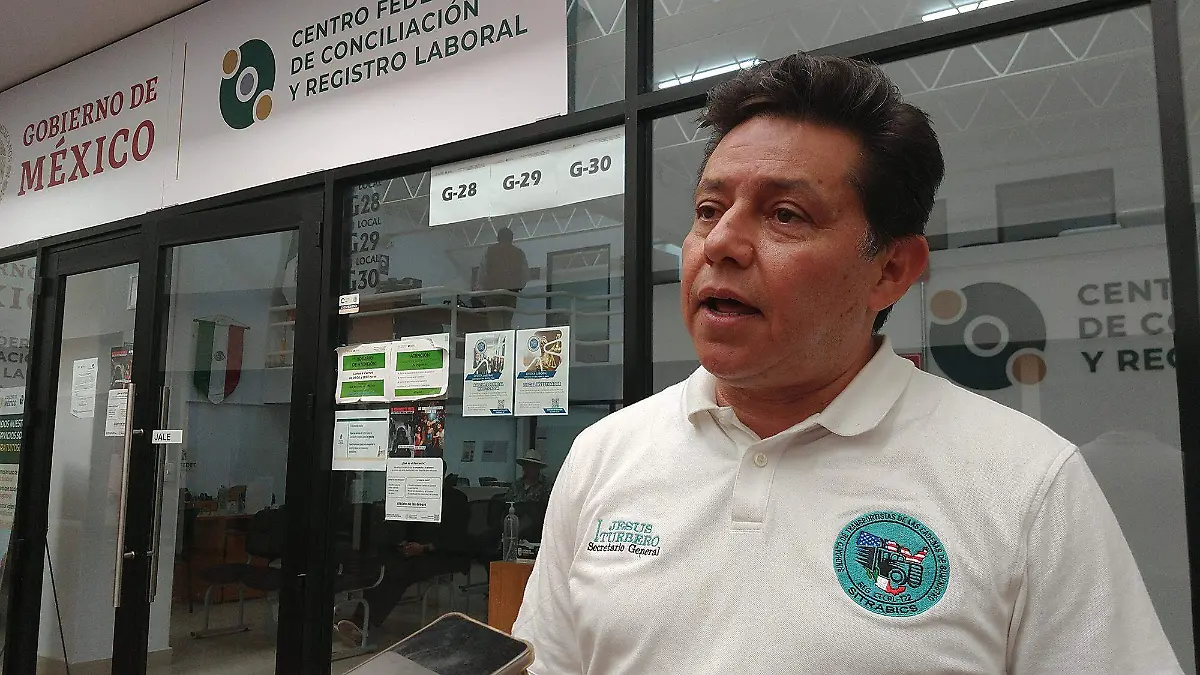
The SITABRICS Case is the First Resolved Under USMCA in Transport Sector
When you speak of Calvary, what do you mean?
The complaint regarding our problems was filed in June 2025. In fact, we learned of the resolution in November 2025, but we were not allowed to make it public because negotiations with the Kamu company had not yet concluded. Therefore, the Mexican and U.S. governments could not take the Remediation Plan for granted.
How many people were laid off?
Ten workers were laid off. However, only three of us were reinstated. Apparently, neither government found sufficient evidence to reinstate the other two. The reinstatement was carried out with all the guarantees stipulated by the Federal Labor Law (LFT).
How did it end up, in your case?
I accepted the severance package. There was an offer of reinstatement for the three colleagues; however, in my case, due to the organization’s needs, I had to accept the severance package because I will be dedicated to the union. I remain as secretary of SITRABICS. I have access to the Protocol for Coexistence and the Exercise of Union Freedom between our union and the company, no longer as an employee but as the union’s general secretary.
How would you rate this MLRR resolution?
I would describe it more as a success than a triumph, because the Remediation Plan that was achieved opens the door to give hope to workers in the sector that justice can indeed be done in labour matters.
Jesús Iturbero recalled that the Kamu company wanted to prevent independent unionization. “They put every obstacle and complication in our way. What made everything more difficult was the way they were covert, disguised. Even the United States government had a very hard time investigating and getting to the bottom of how they operated.”
“Even we weren’t clear on who the boss was. There were many things that kept falling apart. Also, since it was a transport company, there was no experience with the MLRR. It was the first union to file a complaint regarding transport, which is not a fixed company, but a mobile job.”
“All of this complicated and slowed down the investigation by both the Mexican and U.S. governments to understand this case. The Legal Department, which supported us, had to piece together a whole puzzle. There were many interviews with the workers.”
-
El Taller: Central America: Ground Zero for Empire with Hilary Goodfriend
Breaking down Central America’s political trajectory—from US intervention to today’s far-right surge, electoral sabotage, and Mexico’s strategic role.
-
People’s Mañanera March 25
President Sheinbaum’s daily press conference, with comments on Plan B electoral reform, Housing for Wellbeing and housing as a social right, polls, and consular protection for Mexican migrants in the US.
-
Ecocidal Militarism
If citizens in Western democracies were asked whether their militaries should build public infrastructure instead of waging war, they would almost certainly choose the latter. Abby Martin’s newest film “The Greatest Enemy of the Earth,” documents the environmental cost of the American empire.