
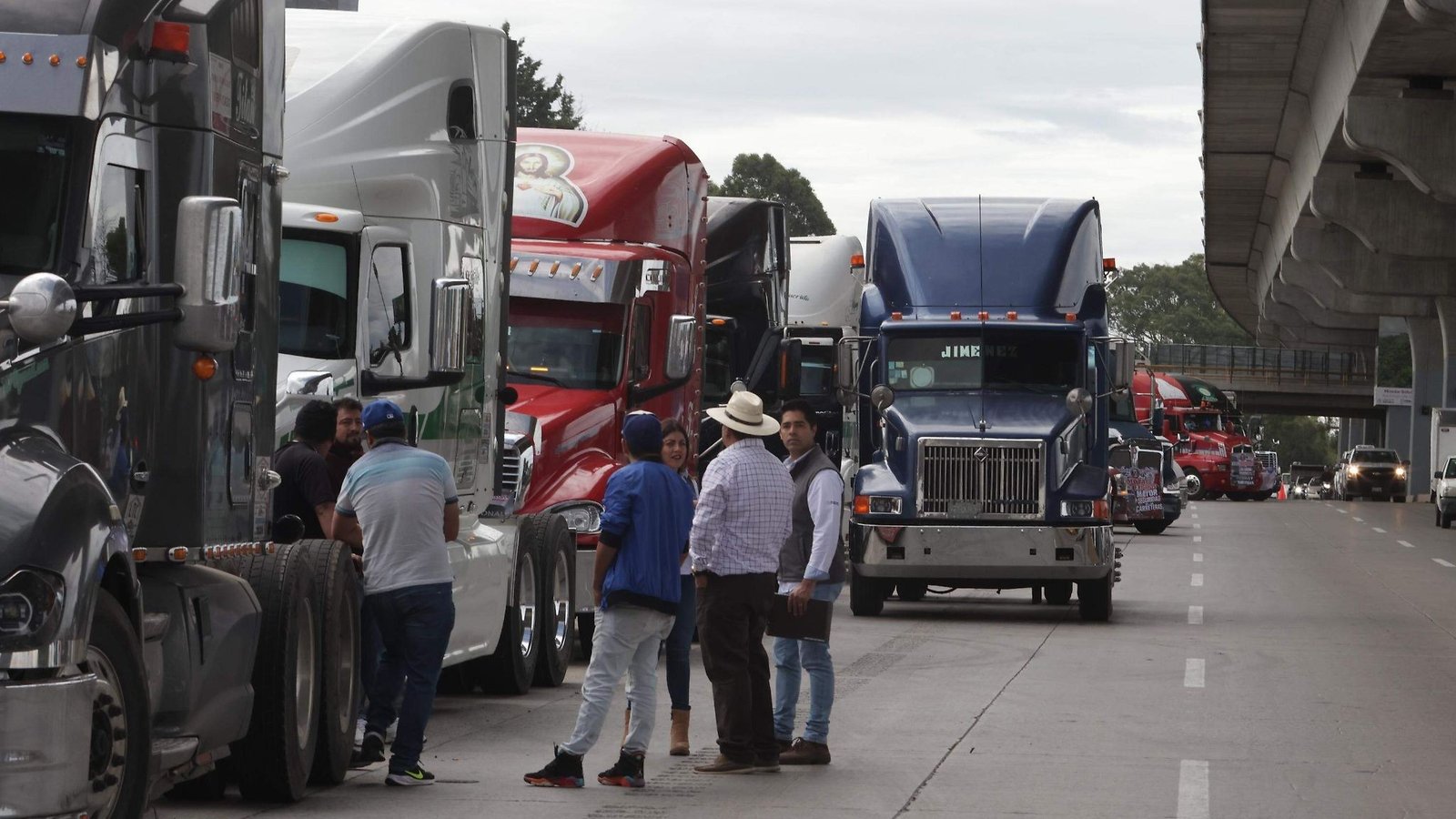
Hyundai Accused of Leaving Transport Operators Without Routes and Putting More Than 300 Jobs at Risk
This article by Bertha Becerra originally appeared in the September 13, 2026 edition of El Sol de México.
The Korean automaker Hyundai de México intends to dismantle its main logistics provider of more than a decade, Transportista Kamu, S. de R.L., and leave more than 300 transport workers without jobs, in order to fake a bankruptcy. And all to evade compliance with the Remediation Plan of the T-MEC Rapid Response Labor Mechanism (RRLM), for violating freedom-of-association rights.
So denounced today Jesús Iturbero, general secretary of the Supply Chain Transport Workers Union (SITRABICS), who said that since January of this year, the commitments Hyundai made have not been honored.
“This process is moving forward with serious difficulties, due to the persistent denial of this right and to reprisals by the company against workers who join or express sympathy for SITRABICS,” he told El Sol de México.
He revealed that “this situation is aggravated by the company’s obstinate conduct of failing to comply with national labor, social-security, and tax laws, and pressuring its transport operators to engage in illegal unfair-competition practices in the United States, by demanding that its workers perform cabotage under threat of reprisal and with the high risk that ICE will take away their work visas.”
Faced with this grave situation, the general secretary of SITRABICS demands that the Secretariat of Labor and Social Welfare (STPS), the IMSS, and the SAT establish a Tripartite Negotiating Table. And that it include Hyundai executives to halt the dismantling of the operation of Transportación Kamu, S. de R.L. de C.V. and protect employment in Mexico.
As well as taking measures to reactivate the work of the transport operators and guarantee the comprehensive remediation ordered by the T-MEC RRLM since January, of the collective rights of the SITRABICS workforce.
Unfair Competition Practices
He explained that drivers of the Kamu company, which depends on Hyundai, are made to sign for cargo destined for Mexico, when in reality it is going to Texas or other states of the American Union. At customs, when the paperwork and shipments are reviewed and do not match, they take away their visa, sue them, deport them, and they can no longer work.
“That’s how the pressure works. And many accept the risk,” said the general secretary of SITRABICS.
In our union, at least 5 members no longer have their visa to work as transport operators in the United States.
And those who do not accept these types of cabotage trips are left in the United States without pay for up to a week.
He highlighted that on Thursday, September 3, the transport drivers and owners of the cargo trucks shut down the border crossing in Mexicali to demand the return of their visas.
They Demand a Response From the Secretariat of Governance
He demanded a response from the Secretariat of Governance on this serious problem. “I sent a document with all the information to Secretary Rosa Icela Rodríguez. It is a very serious problem all along the border strip. The Foreign Relations Secretariat and the Secretariat of Labor must also intervene,” he specified.
In the course of the interview, Mr. Jesús Iturbero stated that in this complex context, the company Hyundai Glovis America, based in Irvine, California, the main client of Transportista Kamu S. de R.L. de C.V., at the beginning of August behaved as follows:
It left dozens of transport operators without route assignments in the U.S., and without income, in a maneuver of operational asphyxiation.
“That is, without assigning them export routes for delivering supplies from Mexico to the vehicle production plant in Montgomery, Alabama, United States.”
And it turns out that Transportista Kamu, which belongs to Hyundai, accuses SITRABICS of being to blame for the lack of supply transport to Hyundai. But this paralysis occurred in parallel to the complaint process before the T-MEC RRLM, which the SITRABICS union filed with the binational labor authorities, Mexico and the United States, he pointed out.
“It was in the framework of demanding compliance with the Remediation Plan that obliges the company to act in accordance with the law and respect freedom of association,” the union leader Iturbero emphasized.
He explained that both Kamu, the transport company, and Hyundai, the automaker, use the “swallow company” (empresa golondrina) strategy. Thus, while Kamu keeps its workers in the yards without collecting full wages, Hyundai began to progressively transfer export routes, apparently to other transport companies.
And with that, to gradually reduce the fleet of trucks, to simulate asset shortfalls at its contractor of more than eleven years, to fake a bankruptcy and evade the payments to workers stipulated by the Federal Labor Law.
“This is grave harm to the workers. And at the Federal Labor Center of Tijuana (CFLT), there is no support because Kamu’s administrators greet the federal Labor officials ‘with hugs and kisses,’ and with that they intimidate the transport operators. They buy off any authority.”
The workers are pressured to give in. They have told him:
I had to sign, I had no other choice!
He also commented that “I have already informed Dr. Gabriel Tamariz, of the Secretariat of Labor and Social Welfare, about these situations and about the grave risk of simulation by a company like Hyundai, with which SITRABICS has more than a decade of work.”
He affirmed: “We consider it urgent that actions be taken against the multinational company Hyundai, including its subsidiary Hyundai México, S.A. de C.V., so that it assumes the legal responsibilities of its supply chain, after benefiting directly for more than a decade from the services of this labor fleet.”
Six decades as a reporter and counting. Reading is my vice.
I cover news from the world of labor and agriculture.
-
Mexico Meets Minimum Annual Water Delivery to the US Despite Extreme Drought
Washington’s Agriculture Secretary confirmed the 350,000 acre-feet, but pressed Mexico to keep delivering and repay the “water debt owed to Texas farmers”.
-
Reading AMLO
“That is hegemony: being able to offer a direction for society as a whole, governed from a social class that has conquered political power,” writes Mejía Madrid.
-
Maru Campos Betrays Everyone, Even the President, Morena Leader Says
Ariadna Montiel said Campos broke Sheinbaum’s trust by airing a private talk, and should face treason charges for letting CIA agents into Chihuahua.