US Ambassador Johnson Acts Like a Meddling Policeman, AMLO Says
This article by Alexia Villaseñor and Alonso Urrutia originally appeared in the October 5, 2026 edition of La Jornada, Mexico’s premier left wing daily newspaper.
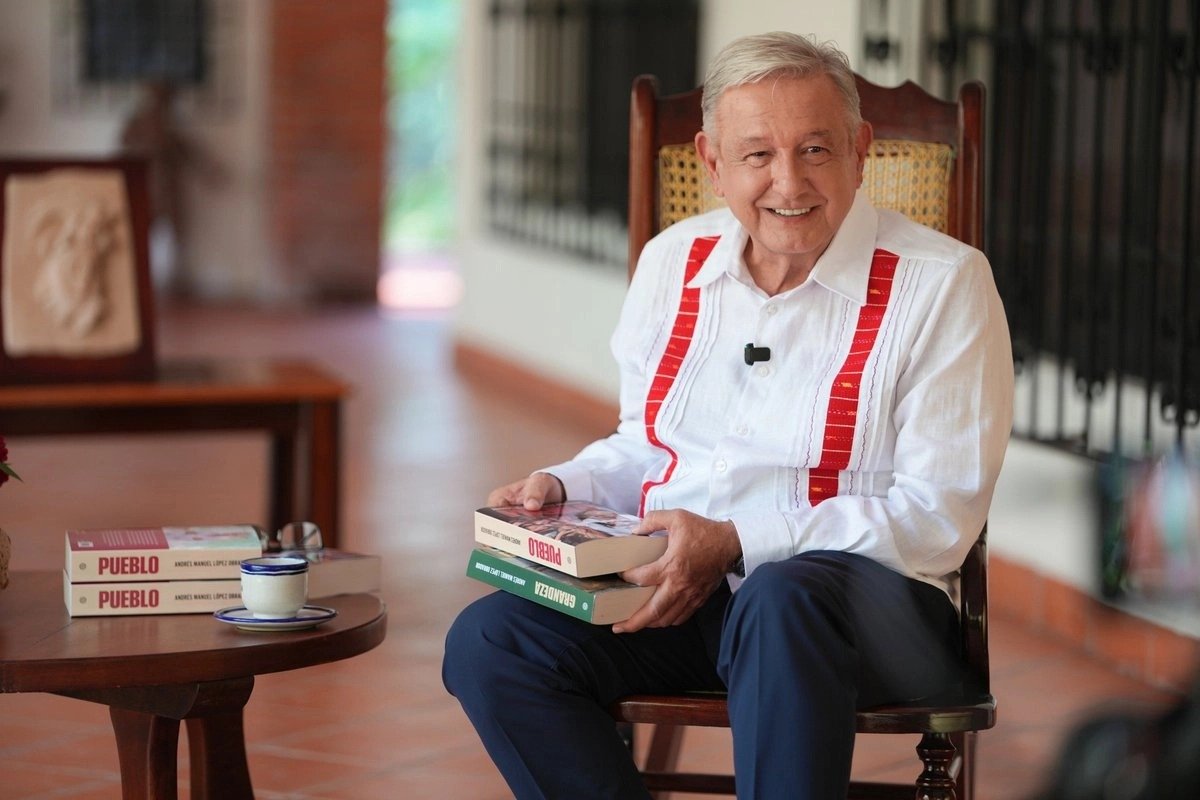
No longer bound by the responsibility of the presidential office, in his book Pueblo, former President Andrés Manuel López Obrador questions the terms of the bilateral relationship that the United States has sought to impose on Mexico over these two years. Particularly harsh in his assessment of the performance of the new ambassador, Ronald Johnson, in this first stage of the government of Claudia Sheinbaum Pardo, he states that this official:
is neither a diplomat nor a politician; rather, he acts like an excited and meddling policeman. He should be more even-tempered and less overbearing, seek to resemble Josephus Daniels more and the sinister Henry Lane Wilson less. In foreign policy one should not pontificate on someone else’s territory.
Andrés Manuel López Obrador, Pueblo
The former president accuses Johnson that when the illegal participation of the CIA in Chihuahua was discovered, which contravenes any relationship of bilateral respect, he reacted in a “defiant tone, neither diplomatic nor much less political.” The diplomat even threatened that the United States government would proceed to file complaints in the courts of his country against alleged Mexican money launderers or corrupt politicians linked to drug trafficking.
Withdrawal of His Son’s Visa, “Dogmatic and Villainous”
In the chapter “Foreign Policy and Defense of Sovereignty,” López Obrador also condemns the conduct of the Secretary of State, Marco Rubio, considering that the decision to withdraw the visa –the only mention of the subject– “from my son Andrés Manuel without any motive or reason” was made in a “dogmatic and villainous” tenor.
López Obrador writes that neither Ambassador Johnson nor his superiors would like Mexico to act in the same terms in which they have, that is, that any Mexican citizen “file complaints in our country with great fanfare against high-level United States officials who receive money for their electoral campaigns from arms manufacturers that take the lives of our fellow citizens.”
The former president launches in Pueblo a set of questions about U.S. conduct. He asks whether that country’s rulers would agree to trials being initiated in Mexico against personnel of their agencies linked to drug traffickers or for carrying out espionage in our country.
He also asks whether it would agree to allow smuggled weapons to enter to murder Mexicans and Americans, as happened in Operation Fast and Furious. And whether the United States would endorse Mexicans bringing in people kidnapped on its territory accused of drug distribution. Or whether they would like U.S. businessmen to be detained here who have paid bribes to Mexican officials or are owners or executives of companies that evade taxes.
Unlike the diplomatic terms with which he referred to the Donald Trump government during his administration, in Pueblo, López Obrador reproaches that the interference of the United States embassy and the agencies (CIA, DEA and FBI) has become much more evident and illegal under the excuse of combating drug trafficking, when in reality it is a political matter. In the book he reproduces the letter he wrote at his ranch La Chingada, in which he warned of “Trump’s surprising change”; he mentioned that “his false friends and internal advisers” have been dragging him “into vile and sinister adventures.”
The former president attributes these actions to the annoyance that Mexico has a popular and progressive government, because they prefer an authoritarian, disorderly and corrupt one that is vulnerable and docile before their aim of dominating the country, he says, or perhaps it is influenced by the fact that certain politicians are bound together by conservative ideology and are bent on creating a right-wing international association.
“Dirty Conduct”
For López Obrador, this “dirty conduct” of the U.S. government originates in a political or electioneering matter, to impress or continue manipulating its citizens with the accusation that Mexico is the cause of drug addiction in the neighboring country. And that they, those of the ruling party, are putting an end to the migration of bad people and drug traffickers who poison their young people.
He mentioned the “fabrication of case files with phony evidence” in their effort to accuse the governor on leave of Sinaloa, Rubén Rocha Moya, Senator Enrique Inzunza and eight other officials of links to drug trafficking.
In that context, he vindicates the response of Sheinbaum, who warned that if the corresponding evidence were presented, there would be no impunity, but if it were a complaint of a propagandistic nature, “the blackmail, the reprisal and the interference of the United States government” would be denounced.
After mentioning the U.S. actions against the governor of Sinaloa, in April, López Obrador discredits the conduct of the United States government: they have applied “the almost usual modus operandi, that is, the use of protected witnesses, their publicity handling, leaks and slander, as well as the use of tailor-made scripts that their lawyers hand to the accused, that is, the fabrication of case files with phony evidence, reward or punishment or many other old tricks.”
Unlike his past allusions to “licenciado Peña Nieto” when he was president, López Obrador states that he “did nothing to change neoliberal policy or stop corruption, on the contrary, he deepened it. With him, the decline accelerated because instead of rectifying, he deepened the neoliberal model. In just two years, Peña Nieto managed to crudely impose servile compliance with the agenda dictated from abroad in collusion with the power groups in Mexico –the so-called labor, education, fiscal and energy reforms–.”
And although he grants that corruption in his government was less than under Carlos Salinas, in Peña Nieto’s six-year term it was “more ostentatious and uncontrolled.” López Obrador considers that the “failure of Peña’s government” favored his broad chances of winning in 2018, although the journey was not easy because the oligarchs maintained their determination not to let him through.
In Pueblo, with more than 700 pages distributed in 10 chapters, he makes a tight summary of the conditions in which his movement was consolidated, based on his opposition to the neoliberal policies that prevailed from Miguel de la Madrid to Peña Nieto. To each of them he dedicated the chapter “PRIAN Neo-Porfirism,” with specific sections for each of them.
He places particular emphasis on the “spurious government of Felipe Calderón,” whose administration meant more of the same, with the aggravating factor that the war on drug trafficking was unleashed, which increased violence and homicides during what he calls the funeral six-year term.
About Salinas, the Tabasco native recounts that in a conversation with a multimillionaire he asked him who was the richest former president: “he didn’t even blink and answered me immediately: Salinas.”
-
73,000 Doctors Have Applied for Mexico’s Primary Health Care Clinics Initiative
The clinics will offer free care and 60 basic medicines starting in January, while home visits have already detected more than 568,000 hypertension patients.
-
Ambassador of Palestine Asks Mexico to Review Companies Linked to Israeli Settlements
The UN has identified 214 companies tied to Israel’s settlements in Palestinian territory, among them the Mexican conglomerate Orbia.
-
Provoke AMLO
“That old man they give up for dead will return to the plazas if necessary. Get ready, because he has the strength to travel the country once more,” warns Páez Varela.