Mexican Book Fairs
This article by Elena Poniatowska originally appeared in the October 11, 2026 edition of La Jornada, Mexico’s premier left wing daily newspaper.
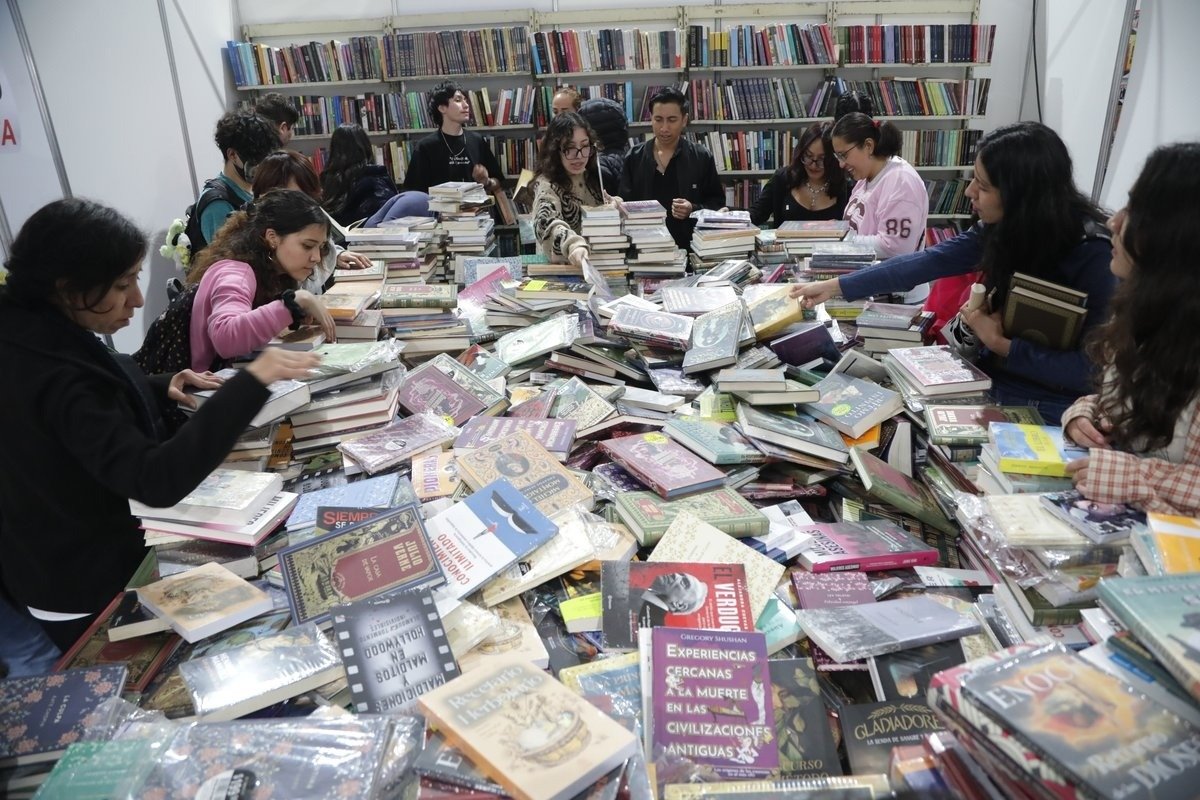
On October 9, the 26th edition of the Zócalo International Book Fair (FIL del Zócalo) opened, coordinated by Paloma Saiz Tejero, a tireless cultural promoter and lover of reading. For two weeks, the Zócalo of Mexico City is the meeting point for children, young people, and grandparents who pack the wide aisles where books are lined up as in a market of lettuces, strawberries, and limes, because, after all, there are books we devour and others we have no appetite for, like spinach. The famous publishing houses and the writers who travel from Spain are offered like fabada and paella next to beans and brain tacos, pancita, and the black mole of Oaxaca. They display their temptations because Paloma Saiz and Paco Ignacio Taibo II make books accessible to every wallet, and many students leave happy because they managed to buy some coveted volume. A book is not a luxury, and more than 350 publishing imprints display on their tables the works of much-loved authors, such as Juan Rulfo or Rosario Castellanos, who this year put all of Chiapas in the spotlight.
In its beginnings, the FIL del Zócalo faced the doubts of the publishing industry. Since 2000, this celebration has been the meeting point of readers with authors who smile kindly as they autograph their work and tell of their long journey to Mexico. To this day, the Zócalo is the starting point for other fairs that seek to win over young readers.
The first book fair in history was Frankfurt’s, in 1949, a reference point for publishers and booksellers, and a showcase for authors who seek to sail on the Seine or the Thames.
In Mexico, the Guadalajara International Book Fair (FIL) turns 40 this 2026, thanks to the remarkable work of Raúl Padilla –to whom Carlos Monsiváis and I will always be grateful for his attentions when we fell ill from so many letters–, begun in October 1987 and considered as preposterous as setting up a travel agency in the Lecumberri prison.
Thinking of international pretensions was as illusory as throwing oneself into the ocean without a life preserver. At most, two or three absent-minded booksellers and a handful of homegrown writers hungry for the spotlight would attend.
Today, the fair receives more than 900,000 visitors, and the publishers’ pavilions are sailing ships that row from the Old Continent to Mexico.
I remember with emotion that during the 2014 FIL Guadalajara, every hour one could hear in the aisles of the immense facilities and book stands: “one, two, three, four, five…” up to 43, to remember the 43 students of the Ayotzinapa teachers’ college disappeared on September 26, 2014. It was also moving to hear the poem by David Huerta that was repeated like a gospel among the visitors.
The 2026 Guadalajara gathering has Italy as its guest, in addition to awarding the FIL Prize for Literature in Romance Languages to Gioconda Belli, the lovely Nicaraguan, and my admired José Luis Martínez receives the Fernando Benítez National Homage to Cultural Journalism.
Just like the Guadalajara FIL, the one held in the Zócalo is an open space for denunciation, criticism, and protest. Starting with the names of its forums dedicated to persecuted writers: Federico García Lorca, Spanish poet shot by firing squad in August 1936; Alaíde Foppa, disappeared by the Guatemalan government in 1980; Rodolfo Walsh, the Argentine disappeared in 1977, and José Revueltas, a political persecutee, imprisoned four times because of his activism, who in the Lecumberri prison wrote El apando, adapted for film in 1976 by Felipe Cazals.
In this edition, speakers and authors from Brazil, Colombia, Spain, Argentina, Chile, and Guatemala are taking part. The FIL will have more than 250 activities, including lectures, book presentations, and concerts.
Within Mexico City, a cosmopolitan capital, several boroughs seek to strengthen their identity and have set out to promote their own book fairs. Coyoacán’s, with its four editions, has grown remarkably, led by its director, the young Gerardo Valenzuela. Tláhuac and Azcapotzalco are making their way with lectures and presentations. The International Children’s and Youth Book Fair, at the National Center for the Arts, unique of its kind, is the most eagerly awaited by children and young people, from November 12 to 22.
The Monterrey FIL was born thanks to a student initiative, in 1989, with a single tent in the parking lot of the Tec de Monterrey; it too has established itself in the publishing world. This year it will feature the participation of Nobel Prize in Literature laureate Jean-Marie Gustave Le Clézio and Emmanuel Carrère. El Colegio Nacional is the guest of honor, as is Juan Villoro, recently awarded the 2026 Carlos Fuentes International Prize for Literary Creation in the Spanish Language. From October 10 to 18, authors, scientists, artists, journalists, researchers, teachers, and readers will walk its aisles.
In Mexico, the Oaxaca Book Fair stands out, from October 12 to 20. Next year we eagerly await the FIL of the Palacio de Minería in the Historic Center of Mexico City, next to the Sanborns de los Azulejos, from February 26 to March 7, 2027, as well as the Yucatán International Reading Fair, from March 13 to 21, in which the Yucatecan researcher and writer Sara Poot-Herrera takes part; she directs the UC-Mexicanistas association, which has a strong presence in cultural activities.
Although the most recognized international book fairs in Mexico are practically 10, it is a fact that around 137 are held in our country, among state, municipal, and university fairs, such as those organized by the National Autonomous University of Mexico (UNAM), the Book and Rose Fair (April 23), which bursts with literary flowers at the University Cultural Center, neighbor to the Juan Ruiz de Alarcón theater and the Nezahualcóyotl hall, where lectures, concerts, and dramatized readings are held.
At the National Library of Mexico, another of the spaces of Ciudad Universitaria, the second Book and Publishers Fair in Indigenous Languages was recently organized, which represents a triumph that makes known the literature of our authors who speak one of the 63 original languages of the national territory.
The UNAM Institute of Bibliographic Research reported on its social media that activities were held in the central courtyard of the venue and lectures in the José María Vigil auditorium to discuss the linguistic and cultural diversity of Mexico. The purpose of the fair is to disseminate “projects linked to the production, circulation, and promotion of books in Indigenous languages.”
The publications presented are a beautiful mosaic of covers designed with images of textiles and embroidery, pre-Hispanic ceramics, photographs of women weaving on backstrap looms, illustrations with children’s drawings, and other graphic expressions of popular art.
Another fair worth mentioning is the International Jewish Book Fair, organized by the Jewish Documentation and Research Center of Mexico in Mexico City, which is supported by the Fondo de Cultura Económica, mainly through its Rosario Castellanos bookstore, in the Condesa neighborhood.
In each edition, the Jewish community shares with us, through book presentations, lectures, round tables, workshops, and concerts, its memory and the works of Jewish writers who have dedicated part of their writing to Mexico, such as Rosa Nissán, author of the novel Novia que te vea, brought to film by director Guita Shifter in 1991.
Book fairs in Mexico are among the great gatherings that speak of how a people nourishes itself on books, and they show the joint effort of cultural institutions, universities, publishers, bookstores, and cultural centers that each year receive thousands of readers, writers, students, tourists, academics, researchers, translators, teachers, and boys and girls in search of the book that will nourish and make happier the hours of their lives.
-
The Morena, PT, and PVEM Coalition Is Necessary to Stop the Right, Anaya Says
PT leader Alberto Anaya says there has never been a problem with Sheinbaum, while PAN’s Jorge Romero confirms an alliance with the PRI in Chihuahua.
-
“Washington Stole the Election from Me. It Happened in Honduras and It Can Happen in Mexico”
In an interview with Sin Embargo, the Honduran ex-candidate says Trump’s attacks and the Juan Orlando Hernández pardon were a planned operation, and urges the left to organize.
-
Defense of Sovereignty “Is Not Rhetoric, It’s Principles,” Sheinbaum Says
Sheinbaum recalled foreign pressure on Mexico in the 19th and 20th centuries and blamed the neoliberal governments and Calderón for opening the door to U.S. influence.