
Mexico Can Tax the Super-Rich & Combat Inequality, Argues Jayati Ghosh
This article by Dora Villanueva originally appeared in the May 7, 2026 edition of La Jornada, Mexico’s premier left wing daily newspaper.
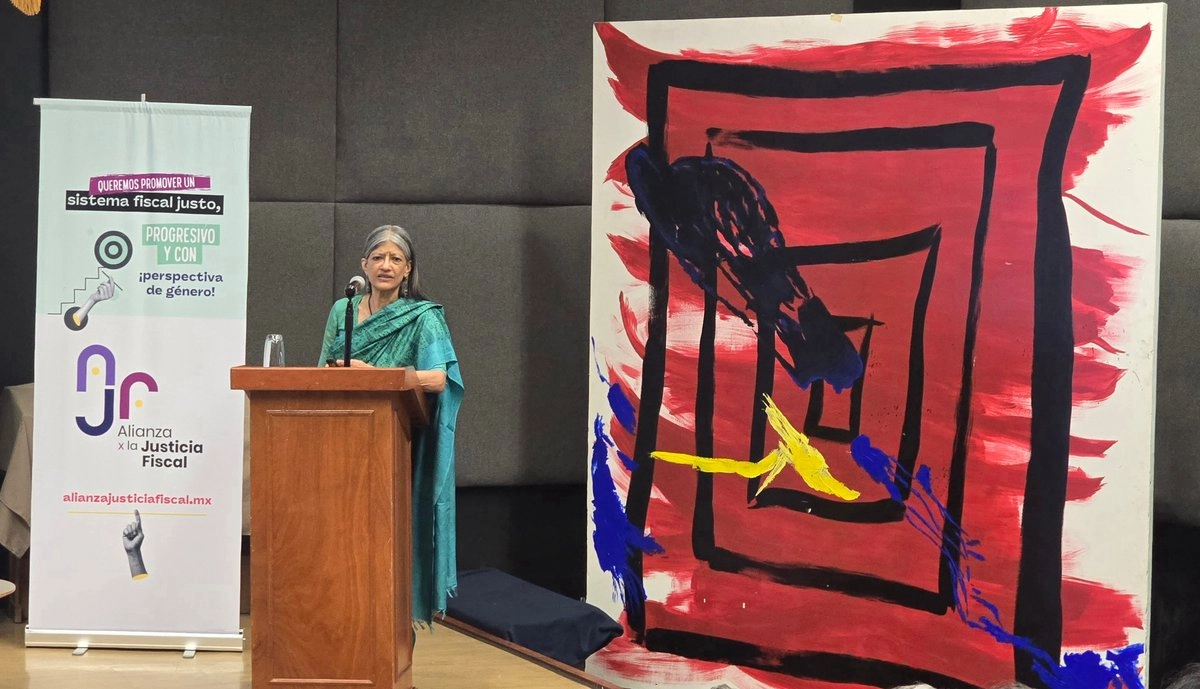
In Mexico there is a significant number of super-rich individuals and taxing their wealth would generate significant revenue for the country, stressed economist Jayati Ghosh, co-chair of the Independent Commission for the Reform of International Corporate Taxation (ICRICT), while warning that the world is experiencing an “inequality emergency”.
So far this century, four out of every ten dollars of wealth generated globally has gone to swell the fortunes of the richest 1 percent, while the poorest half of the population has received barely 1 percent of those resources. Even among the wealthiest, there is such a degree of concentration that “a handful of people, fewer than 3,000, control 16 percent of the world’s wealth,” noted the economist who shares the presidency of ICRICT with her colleague Joseph E. Stiglitz.
This concentration is due to the fact that the wealthiest 1 percent has seen its average wealth increase by $1.3 million since 2000, while the poorest half saw its wealth increase by only $585 during the same period. “In other words, wealth inequality has increased enormously,” the economist emphasized during a conference at the Faculty of Economics of the National Autonomous University of Mexico (UNAM).
In the discussion organized by the “Date cuenta” initiative, equivalent to the “Tax the rich” movement, Ghosh stressed that this inequality is largely due to the trend of recent decades, known as the neoliberal period, in which governments have opted for attracting private capital to finance themselves, instead of doing so through taxation, which has resulted in minimal public benefits and a stagnation in public wealth while private wealth has increased fivefold.
“Relying on private financial markets has been unreliable, too costly, and increases vulnerability without providing any net benefits (…) Low- and middle-income countries can no longer expect external aid. Let’s forget about that. We must not depend on private financial markets,” the economist emphasized at the event convened by UNAM, the Alliance for Tax Justice, the Independent Commission for Equality with Tax Justice, and Oxfam Mexico.
Hence, Ghosh reiterated the need to seek revenue through a progressive tax system – one that charges more to those who have more – and to form coalitions of countries to close the loopholes for tax evasion by large multinational corporations.
The expert believes there are “reasons for people in Mexico to be even more ambitious” regarding progressive agendas such as tax justice. She cited as an example the increase in real wages, which is “the most significant in the world in the last six or seven years,” and asserted that the Mexican government stands out internationally for the way it has responded to the pressure from the United States government, led by Donald Trump.
Transnational Corporations Evade $100 Million of Tax Every Day
The demand that the wealthiest pay their fair share stems from the fact that they currently aren’t, Ghosh argued. On one hand, there are the wealthiest individuals who pay very little income tax; on the other, there are large multinational corporations, which, by transferring income and registering assets in tax havens rather than where they were actually earned, are estimated to evade $100 million per day.
These revenues are not reaching the public coffers where they should, given the current international financial and fiscal architecture, as tax systems are very outdated, Ghosh explained. “There is a dramatic inequality in the way our tax systems are structured, and we need to change that,” she emphasized.
The economist emphasized that extreme wealth “undermines democracy and corrupts politics,” given that it comes with “excessive power to influence laws, regulations, and public policies in ways that favor the interests of the rich.” Examples include lower income taxes, more subsidies, monopoly rights through patents, and less protection for workers.
According to estimates from tax justice organizations, “around one-third of the wealth of billionaires worldwide comes solely from government connections.”
In his presentation, Ghosh recalled the case of Latin America, where there has been a transfer of wealth from the public to the private sector, largely due to the privatization of existing public assets; but also at a global level, every crisis benefits capital because the public sector subsidizes and helps the private sector to recover, hence the banks expand and ordinary people see their assets threatened or lost.
These decisions are made by governments and influenced by lobbying from the private sector. The point, the economist emphasized, is that just as there is pressure from large corporations, there can also be pressure from the public. She urged: “Governments face pressure from wealthy interest groups; they should also face pressure from the people.”
-
Jáuregui’s Defense Demands That Mexico’s Attorney General Summon Governor Maru Campos to Say What She Knows About the CIA
His lawyer says all the evidence points to the late state investigations chief, and that Campos changed her version of what she knew on Latinus.
-
People’s Mañanera October 21
President Sheinbaum’s daily press conference, with comments on Pemex, fuel theft, Jalisco’s water crisis, missing persons, and the lie detector.
-
Jáuregui’s Arrest Does Not Close the CIA Case in Chihuahua; Morena Demands Broader Investigations
Morena leader Ariadna Montiel holds Governor Maru Campos politically responsible and says ex-prosecutor Guillermo Zuany must also face justice.