
Mining Company in Zacatecas Used Drug Traffickers Against Workers, Mineros Union
This article by Jared Laureles originally appeared in the April 9, 2026 edition of La Jornada, Mexico’s premier left wing daily newspaper.
The Camino Rojo mining company, located in Zacatecas, used organized crime to threaten its workers, affiliated with section 335 of the National Mining Union, and violate their labor rights, in addition to seeking to make them desert this union, warns the unprecedented investigation by the panel of the Rapid Response Mechanism (RRM) of the USMCA, which determined that the company is “directly responsible for employer interference” in union activities.
According to the preliminary resolution, the expert panelists documented evidence of acts of violence and death threats, in union assemblies and at their homes, against the workers of the union organization headed by Napoleón Gómez Urrutia, holder of the collective agreement, to force them to join a union of employer “protection” of the National Federation of Independent Unions.
“The panel’s findings corroborated that the mine hired a drug trafficker to disrupt union meetings with armed individuals, issue death threats, and force workers to accept the company’s preferred union,” the U.S. Department of Labor said of the ruling.
Canada’s Orla Mining: Silence & Tolerance
Faced with this situation, the panel points out that the Canadian company Orla Mining, owner of the gold and silver mine located in the municipality of Mazapil, “remained silent and showed tolerance”; it also did not act on the complaints of violations of freedom of association nor investigate them.
Therefore, the panel concluded that the intimidation came not only from a contractor, but also from company personnel.
Mexican Agencies Reject Ruling
In its defense, Mexico rejected the panel’s decision, arguing that the mechanism exceeded its scope, claiming that it sought to analyze conduct of a criminal nature and that the acts of “coercion” cannot be attributed to the mining company.
Through the Secretariats of Labour and Social Welfare and Economy, it also gathered evidence and testimonies from workers about the threats they were victims of; but the agencies considered that they were not sufficient to link the company to said conduct.
“Mexico requires that there must be a link between the perpetrator of the act and the person held responsible, and that the damage occurred while performing duties or services,” the document states.
In its arguments, the Mexican government sought to set a “very high threshold” to determine whether a violation should be considered a denial of rights, due to the “seriousness of an accusation that condemns the system… of a State.”
However, the panel clarified that this is not “a case in which charges are brought against a State,” but against the company under the MRR.
The document states that Chapter 31-A.2 defines “denial” as a restriction or impediment to exercising the right to freedom of association. However, the agencies considered that “a simple act violating the Federal Labour Law is not enough; rather, the violation must be of such a degree that it completely and absolutely prevents workers from exercising these rights.”
It will influence similar refereeing decisions: Nahir Velasco
Nahir Velasco, legal coordinator of the Mineros Union, stressed that this case sets a precedent within the MRR, by analyzing fundamental aspects, such as demonstrating that acts of violence do impact the denial of rights to freedom of association and collective bargaining.
In an interview, he noted that the case could influence other similar arbitrations and will be taken into account in the review of the USMCA.
“Clearly, there was an issue that went beyond union matters, and when you don’t have human rights or security, how can you carry out your union duties? This case sets a very strong precedent against Orla Mining,” he emphasized.
The main objective of the labor panel is to redress the violation of workers’ labor rights. This dispute resolution mechanism called for the reinstatement of those who were dismissed, the payment of compensation, and guaranteed access to the unit for the miners of section 335.
However, the parties must work on a remediation plan; in case of recidivism, the Canadian company would be subject to the application of tariffs.
The Camino Rojo case prompted a labor complaint in August 2024; subsequently, because the reparation measures were insufficient, the situation escalated to a panel, which is the third to be resolved under the USMCA.
-
Mexico City Begins Construction of Housing in Guerrero & Historic Center
Five properties will house 250 homes; city authorities assure that the properties will be delivered by the end of this year.
-
Mexican National Farmers Strike for Food Sovereignty
Progress toward food sovereignty requires policies that protect, regulate, and promote the responsibility of the State. Maintaining the mistaken notion that these are goodwill aid packages given to farmers and agricultural producers only when budgetary resources are available will deepen the agricultural crisis and increase food dependency.
-
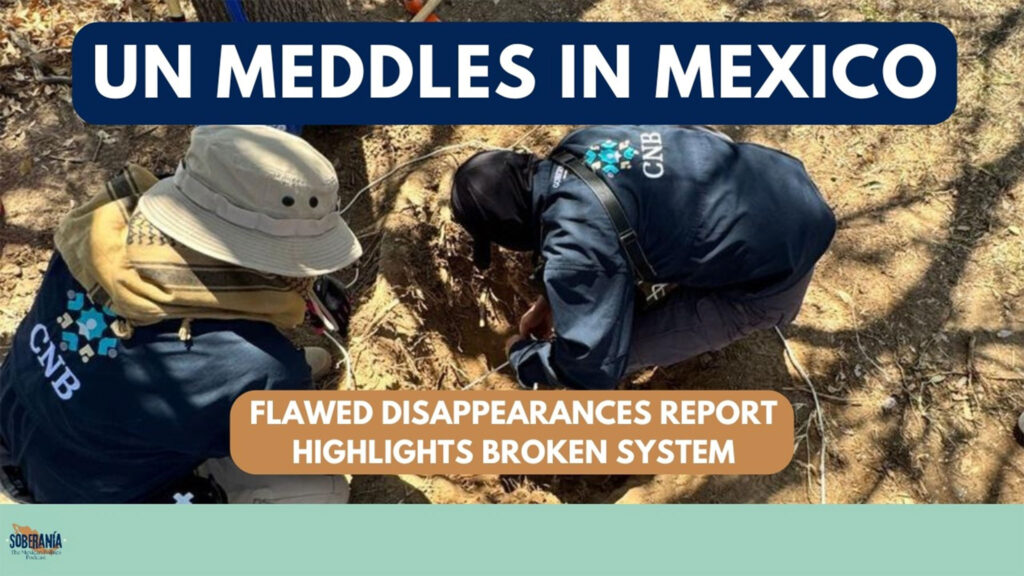
UN Meddles in Mexico: Flawed Disappearances Report Highlights Broken System – Soberanía 102
UN Committee on Enforced Disappearances, migrant deaths in the US, Mexico’s new Foreign Secretary Roberto Velasco, and deterrence in Mexico.