PRI Members, Businessmen and Bankers, the Biggest Beneficiaries of Fobaproa
This article by Óscar David Rojas Silva originally appeared in the October 10, 2026 edition of Contralínea, an investigative Mexican news outlet.
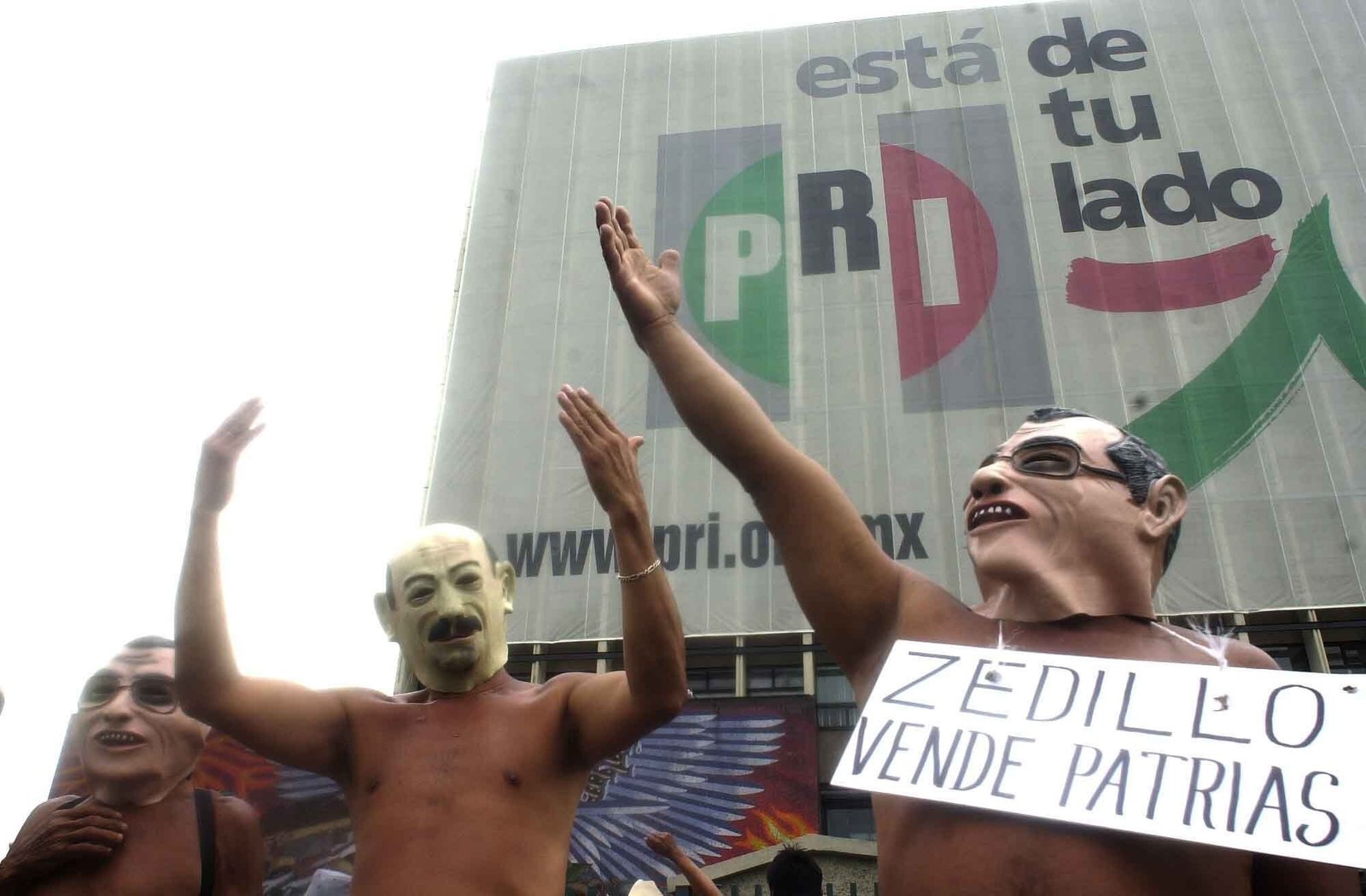
The bank bailout that PRI member Ernesto Zedillo paid for with the people’s money did not favor savers, but millionaires: among the beneficiaries were Claudio X González Laporte, Agustín F Legorreta, Carlos Cabal Peniche, Carlos Sánchez de la Peña, Salvador Martínez Garza, Jorge Lankenau, Ángel Isidoro Rodríguez, and even the Institutional Revolutionary Party, which prior to the “December 1994 error” set up four trusts at Banco Unión and Banca Cremi. Each year, the current spending on servicing that debt (48 billion pesos) is equivalent, approximately, to twice the entire budget of the Jóvenes Construyendo el Futuro program, or almost the entire budget of Sembrando Vida. According to the Secretariat of Finance, 1.6 trillion pesos have been paid in interest alone, which is why the debt would be unpayable
On September 7, 2026, at her morning press conference, President Claudia Sheinbaum denounced that Fobaproa is unpayable; and then a recent study by the Secretariat of Finance confirmed it, since for 30 years the Mexican government has not paid principal (only a part of the interest, and the rest it covers with more debt). According to the Secretary of Finance, Édgar Amador Zamora, 552 billion pesos recognized in 1998 have turned into 1.6 trillion pesos, three times the original nominal value, paid solely in interest. The principal, meanwhile, has not gone down. On the contrary: it has grown. In 2027 alone, 48 billion pesos will be allocated, an amount that could well be directed to social or productive purposes.
Translated into today’s economy, the original magnitude of that bailout is even more difficult to assimilate. The cost of Fobaproa was equivalent, in June 1999, to 19.3 percent of the country’s Gross Domestic Product. Applied to the current size of the Mexican economy (36 trillion 125.5 billion pesos, according to the 2026 General Economic Policy Criteria), that same percentage would today represent almost 7 trillion pesos: as if the government announced tomorrow that it will assume, charged to the public budget, a private debt equivalent to seven years of well-being programs.
All of this derived from an essential characteristic of the neoliberal governments: the full and determined decision to rescue large companies and banks that suffered the ravages of international competition or any other contingency, in this case the one derived from the great crisis of ’94, which caused a 6.2 percent drop in GDP, the soaring of interest rates and inflation, and a swollen portfolio of non-performing loans where real and fictitious loans coexisted, mixed together. The government let the ordinary citizen and small and medium-sized businesses founder, but devoted itself to building a rescue mechanism for the large financial-business consortiums, the Mexican elite, especially benefited by the Salinas bank privatization.
It must not be forgotten that this issue meant a great popular and partisan mobilization against the evident robbery of the public budget, especially because of the fact that marks the illegitimacy of this debt: the Fobaproa trust operated, de facto, in violation of the Constitution, specifically Article 73, which states that the issuance of any debt in the name of the Nation can only be authorized by the Congress of the Union. Each promissory note, signed by the Undersecretary of Finance, Martín Werner, meant an act in violation of the Magna Carta from its very origin. The technical committee dedicated to receiving the non-performing loan portfolio in exchange for Fobaproa promissory notes was able to act in a totally discretionary manner. As Andrés Manuel López Obrador pointed out in his 1999 book Fobaproa: expediente abierto, the mechanism was a “technocratic parastatal” with super powers to impose debt on future generations without respecting the minimum rules of oversight of public matters.
The specific trick used by the government of Ernesto Zedillo was to take cover under the opacity allowed by the figure of the trust (whose constituent parts are analyzed further on) and by the decision to impose, in practice, bank secrecy above the Constitution. In 1999, with the institutional conversion of this debt into a decentralized agency of the federal government, the IPAB (Institute for the Protection of Bank Savings) was created, which finished building the financial architecture that made it possible to convert the old promissory notes, non-negotiable, with first and last names, into modern financial bonds issued on the open market, highly tradable and generic: the Savings Protection Bonds (BPAG28, BPAG91 and BPA182). This qualitative leap is what causes us, after three decades, to remain tied to this illegitimate debt.
This essay, in addition to reviewing the historical reconstruction of the events, seeks to explain the mechanism that allows this debt to be kept open indefinitely; as well as to understand its context within the process of subordinate financialization into which Mexico was induced within the framework of the signing of NAFTA, whose indiscriminate opening secured not only the flow of trade in goods and services, but especially that of speculative financial flows that enter and leave the economy without control and without social scruple about the consequences of that high mobility. The objective, in the end, is to explore specific proposals to extinguish this illegitimate or odious debt (as the academic Alexander Sack would say) that weighs like a ghost on the public budget.
A Fund Without Capital and the Construction of the Legal Shield
To understand why the debt does not close, one must first understand how it was opened. Fobaproa was created in 1990, under the Presidency of Carlos Salinas de Gortari, just after the reprivatization of the banks was concluded. On paper it was a prudential mechanism: a trust fed by fees from the banks themselves, intended to assist an institution with liquidity problems. It did not have, in practice, significant capital of its own. Furthermore, it was not the first time that neoliberal governments used a trust to rush to the aid of the business sector. In 1983, during the presidency of Miguel de la Madrid Hurtado, FICORCA (Trust for Exchange Risk Coverage) had been created, with which the government guaranteed (also with public money) the payments of Mexican companies in dollars abroad. The operator of that mechanism was Ernesto Zedillo himself, who, as a result of those selective rescues, became known in the press as Dr. Ficorca.
The new rescue operation that Zedillo would push as president had another dimension: it was about rescuing the entire banking system and the related companies. That is, while FICORCA was dedicated to guaranteeing interest payments in dollars abroad, Fobaproa was dedicated to cleaning up the entire accumulated non-performing portfolio of a recently reprivatized banking system. Between 1991 and 1992, the government sold the 18 banks it had nationalized in 1982, and it was not necessarily bankers who bought them: they were, to a large extent, industrial groups with no previous banking experience other than speculative experience with brokerage houses. Thus, Valores Monterrey-Visa acquired Bancomer; Grupo Industrial Maseca, of Roberto González Barrera, acquired Banorte; businessmen from the southeast led by Carlos Cabal Peniche acquired BCH, which would later become Banco Unión. The private sector merged its industrial activities with the new financial activities, which led to a series of cross and fraudulent loans to use the banking system for the benefit of the leverage of those companies.
More interested in maximizing the sale price than in the soundness of the system, the government itself allowed many of these purchases to be financed with credit (often from the same bank that was being acquired), so that the new owners risked little capital of their own. Owners without banking know-how, highly leveraged, managing institutions without effective supervision: a breeding ground that would increase the severity of the 1994 crisis. Let us remember that this crisis was detonated thanks to the neoliberal dogma that called for ignoring the current account deficit (derived from the liberalization of finance) as long as there was no fiscal deficit. In reality, that liberalization showed a clear tendency toward capital flight when conditions are not optimal for speculation. To retain capital, Salinas offered the so-called tesobonos, instruments that made it possible to shield investors from exchange rate risk by transferring it to the State. They were sold in pesos, but paid their equivalent in dollars, and were agreed to be settled in the short term. By December 1994 there were almost 30 billion dollars in tesobonos coming due; while the Bank of Mexico’s reserves were barely enough to cover some 6 billion.
The situation could not have been more critical and sensitive to the explosiveness of an event. On the night of December 19, before the government publicly announced the devaluation the next morning, a group of businessmen close to the new government had advance information about the measure. Carlos Salinas de Gortari himself would later accuse the Secretary of Finance, Jaime Serra Puche, of having leaked it that early morning. In less than 72 hours, 4.633 billion dollars of international reserves left the country, headed to those who knew to buy dollars in time, while the rest of the population woke up, days later, with loans they suddenly could not pay. When the holders of tesobonos stopped renewing them and the government had to devalue and raise interest rates to try to stop the flight, that same rise in rates (designed to save the public debt in dollars) was what broke, in a chain, the recently privatized and over-leveraged banks.
The vast majority fell into generalized insolvency, not a simple lack of liquidity. The distinction matters: the classic doctrine of central banking, formulated in the 19th century by Walter Bagehot, holds that a central bank should only act as lender of last resort in the face of liquidity problems, never to plug solvency holes, because doing so is precisely transferring private losses to the treasury. The economist Charles Goodhart later warned that, in practice, that border is almost impossible to draw (and that any bank that comes to ask for that help is already, almost by definition, suspected of being broken inside). The Mexican technocrats decided to ignore these principles and found the way to use the central bank to operate the bank bailout: installing a mechanism for transferring private debt into a debt recognized in the public budget.
The Zedillo government, with its experience in bailouts, resolved to use Fobaproa, institutionally housed in the Bank of Mexico. Acting as trustee of the trust (not as direct lender), Banxico administered the purchase of the banks’ non-performing portfolio in exchange for promissory notes backed by the federal government. That double role is the hinge of the entire mechanism: as trustee, it gave the operation the infrastructure and technical legitimacy of the central bank; and precisely because it was not the direct lender, it allowed it to get around its own doctrinal mandate, the one that prohibits it from acting as lender of last resort in the face of solvency problems. It was, in practice, the vehicle that allowed the central bank to do, sideways, what its own doctrine prohibited it from doing head-on.
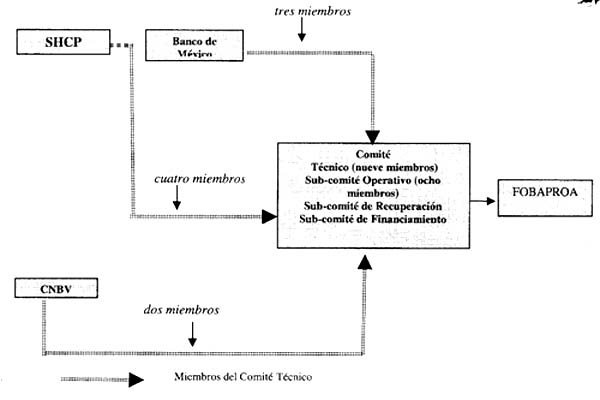
There is, in addition, a legal mechanism more forceful than is usually told, and it does not depend on any disguised identity: it is an exemption written, bluntly, into the law itself. The trust was constituted in 1990 with the Bank of Mexico as trustee and the Secretariat of Finance (an agency of the federal government) as settlor: from the beginning it was clear, on paper, that the fund belonged to the government. The trick consisted of using Article 122 of the Credit Institutions Law to establish that the creation of the fund by the federal government “will not give it the authority of an entity within the federal public administration” and, consequently, “it will not be subject to the provisions applicable” to those entities. The law recognized unambiguously that the fund was governmental, and in the same sentence exempted it from counting as government for control purposes. That statutory exemption, written since 1990, is what kept the operation off the radar of constitutional Article 73. The first violation of the law, and the most difficult to see precisely because it was never hidden: it was openly drafted in the legal text itself. This ruse allowed the installation of a committee in which representatives of the country’s economic authorities sat and in whose sessions, without any type of oversight, they operated the purchase of the non-performing portfolio in exchange for the illegal promissory notes.
When Zedillo finally sent to Congress, in 1998, the conversion of that debt into recognized public liability, the amount had already grown from 180 billion to 552.3 billion pesos in just two years, without any legislative supervision. Congress did not decide whether to authorize the operation: it decided whether to regularize an accomplished fact. In fact, there is already a precedent in the Supreme Court: in constitutional controversy 26/99 it was argued that this public debt was “null and void,” for having been contracted without the prior authorization required by section VIII of Article 73. The litigation did not succeed in annulling the debt, but the argument was documented as a reference. The legal shield continued to be strengthened over time. On May 3, 1996, the then governor of the Bank of Mexico, Miguel Mancera Aguayo, and the Secretary of Finance, Guillermo Ortiz Martínez, signed an additional instrument (the “Agreement of Parties”) that expanded, again in secret, the powers of the Fobaproa Technical Committee. An investigation by the magazine Proceso, which revealed the document only in 2005 and described it as “unconstitutional,” found that this agreement empowered the fund to act “above the Constitution,” and laid the foundations for the Committee itself, in July 1997, to “relax” the criteria for evaluating the portfolio that the banks sold to the government and to accept what are called “junk loans,” many of them without collateral, with only a signature (unsecured). The fourth clause of the agreement itself established that Technical Committee with nine members, chaired by Ortiz with a casting vote. Among those who made it up, documented in more than one source, are Martín Werner, Undersecretary of Finance; Eduardo Fernández, president of the CNBV; Francisco Gil Díaz, later Secretary of Finance under Vicente Fox; and Javier Arrigunaga, first director general of Fobaproa itself (who years later was sued, along with another official, for improperly authorizing the fund to subscribe public debt securities, encroaching on a power exclusive to Congress).
Of the 64 minutes of that Committee’s sessions between 1994 and 1998, none has been made public through official channels; only fragments are known (minutes 42, 54, 31, 32 and 36) because Proceso obtained them on its own and published them, revealing that the Committee members themselves acknowledged, in private, how costly the fund was. A report by the Superior Audit Office of the Federation, displayed by Sheinbaum in May 2025, later confirmed that the Committee “acted without rules or general policies” and that the bank reports on which it relied did not even comply with the auditing standards of the Mexican Institute of Public Accountants. Even so, those fraudulent loans were let through.
Here it is worth recalling the specific functioning of a trust in order to size up the technocratic strategy to evade the law. The trust is a figure imported from the Anglo-American tradition, which in Mexico was adopted specifically for financial and banking operations starting in the 1920s. Its mechanism consists of three pieces: a settlor, who contributes the assets and defines what they will be used for; a trustee, who receives those assets and administers them (only authorized institutions, such as banks or brokerage houses, can be trustees); and a beneficiary, who receives the benefit of the operation. What is distinctive about the figure is that, when the assets are contributed, they cease to belong to the settlor but neither do they become property of the trustee: an autonomous estate is formed, which legally belongs to no one in the ordinary sense of property; it exists only for the purpose agreed in the contract, in an indeterminate dimension that made it possible to justify the bailout.
In the case of Fobaproa, that triad operated like this: the settlor was the Secretariat of Finance itself (not the banks, as is usually assumed); the trustee was the Bank of Mexico; and the beneficiaries, the multiple banking institutions that received the support. The critical point rests on the fact that the substance of the trust should not have been considered private in nature at the moment when public resources flooded its operation through promissory notes charged to the budget. It was not only about private operational problems, but about the systemic bankruptcy of the Mexican banking system. A public matter.
The Beneficiaries: Banks and Businessmen
The most common mistake when talking about Fobaproa is to reduce it to the “bailout of the banks.” It was that, but it was more: the complete register of beneficiaries (people and companies whose private debts ended up dissolved in the portfolio that the fund bought) amounts to around 745 individuals and legal entities, not all of them banking institutions. The columnist Roberto Fuentes Vivar has documented names such as Claudio X González Laporte and Agustín F Legorreta within “an enormous list,” in his own words, impossible to exhaust in a single text. Among the most documented cases of open bank fraud are Jorge Lankenau, of Banca Confía, and Ángel Isidoro Rodríguez, el Divino, of BanPaís.
According to the Superior Audit Office of the Federation, other cases are those of Arrendadora Atlas, SA; Aseguradora Hidalgo, SA; and Grupo Del Monte. In addition, it lists as companies responsible for some of the losses: Adcoef, SA de CV; Alfil y Asociados, SA de CV; Cofinter Operación y Sistemas, SA de CV; Comercializadora Cerfa, SA de CV; Consorcio Mexicano de Comercio e Industria, SA de CV; Corporación de Comercio Exterior, SA de CV; Formadora de Equipos, SA de CV; Grupo Comercial Alvi, SA de CV; Grupo Corporativo en Comercio Exterior, SA de CV; Imes Mexicana, SA de CV; Oasis Nautics, SA de CV; Operadora Coba, SA de CV; Operadora Enlace, SA de CV; Operadora Virsa, SA de CV; Organización de Ingeniería Empresarial, SA de CV; Pico de México, SA de CV; Proinverfin, SA de CV.
But it was not only companies: the most illustrative case of this abuse is documented firsthand by the Mackey report, and it is that of Carlos Cabal Peniche, owner of Banca Cremi and Banco Unión. Mackey wrote that he was aware of statements attributed to Cabal Peniche himself in the press, according to which 25 million dollars were made available to the Institutional Revolutionary Party between 1992 and 1994 through trust accounts at Banco Unión, and that the bank had indirectly financed those amounts through loans that were later canceled. When Mackey’s team requested access to the records of the trust related to those payments, it was denied, on the argument that the transactions were already under criminal investigation.
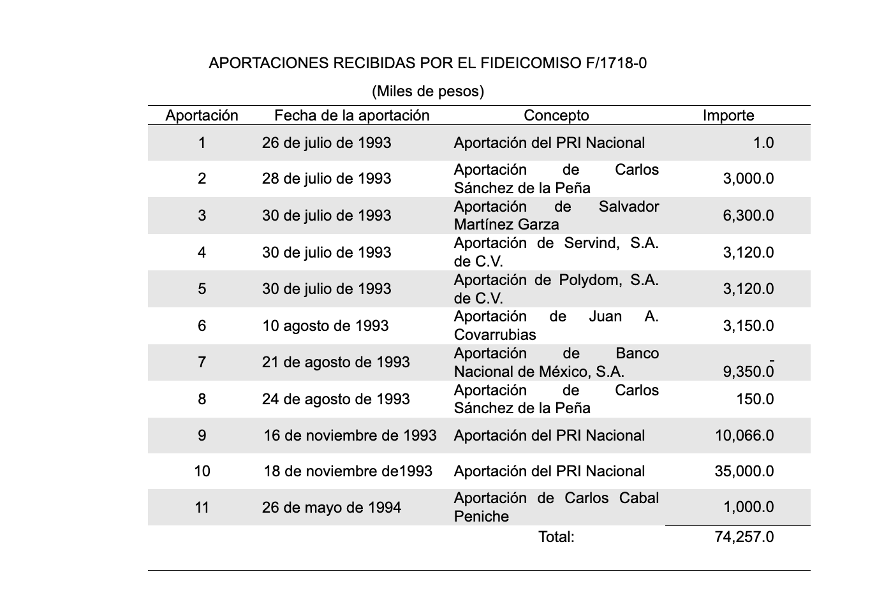
In this regard, the ASF details that this political party became involved with businessmen and bankers in trusts F/2739-9, F/2929-4, F/2939-1, F/3110-8 and F/1718-0, operated by Banco Unión and Banca Cremi.
Of these, F/1718-0 stands out, created at Banca Cremi directly by the National PRI (then led by the politician Fernando Ortiz Arana) on July 26, 1993. It received direct contributions from Carlos Cabal Peniche, and from businessmen such as Carlos Sánchez de la Peña, Salvador Martínez Garza (now deceased and former owner of Chivas) and Juan A Covarrubias; as well as from the companies Servind, SA de CV; Polydom, SA de CV; and Banamex (Banco Nacional de México, SA). Among the objectives of the trust was to support the National Executive Committee of the PRI, and to support with economic resources the PRI’s own functions and programs.
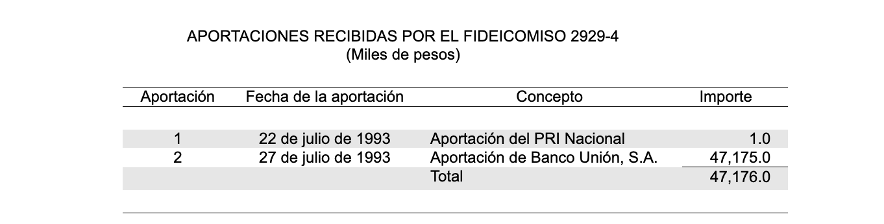
Regarding trust F/2739-9, the ASF notes that it was constituted on July 31, 1992 at Banco Unión by the PRI of Chiapas, with financial support from the National PRI. At that same bank, trusts F/2939-1 were created, on August 5, 1993, by the PRI of Tabasco; and F/2929-4, on July 22, 1993, by the National PRI. In the latter, the money came from the bank itself and not from the party.
All of that Banco Unión portfolio ended up, without distinction, in Fobaproa. The Superior Audit Office of the Federation itself acknowledged that Banca Cremi and Banco Unión were the first institutions intervened, in 1994, “as a consequence of the mismanagement of their administrators.” Around 55 percent of the debt absorbed by the fund went, according to journalistic estimates, to prominent businessmen and bankers who came out of the crisis with their fortunes intact or even increased. A lesser-known vehicle, the Coordinating Unit for the Bank-Business Agreement, created in 1996 with fiscal resources, served as guarantor to restructure the debt of 54 companies (not banks, companies from productive sectors) for 9.7 billion dollars.
Read as a whole, this register does not describe an abstract list of isolated names: it describes a dominant fraction of Mexican private capital (the fusion between industrial capital and financial capital) acting as a bloc against the State at the moment of the crisis. It was not just a few isolated cases, but the Mexican upper bourgeoisie as a privileged group within the economy, as opposed to thousands of small and medium-sized business owners who, without that political access or that place at the table where the bailout was designed, went bankrupt in those same years because of the same interest rates that, for the big ones, were in practice forgiven. Suffice it to point out that, according to an investigation by Juan Auping Birch, by October 1996 82 percent of the irregular loans were concentrated in a small group of 9.1 percent of debtors, with giant loans of more than 50 million pesos. It was not a bailout of ordinary savers, but of millionaires.
The obligatory question is: why did the bankers themselves accelerate the fraud precisely when the government had already decided, de facto, to back the solvency of the entire system? Economics has, for more than three decades, had a formal answer. In 1993, the economists George Akerlof (Nobel laureate) and Paul Romer published the article “Looting: The Economic Underworld of Bankruptcy for Profit,” in which they demonstrated that when a bank’s managers know that the government will absorb the losses if the institution fails, the rational strategy ceases to be managing it soundly: it becomes extracting the maximum possible value from it before the collapse. Bankruptcy, in that scheme, is not an accident that fraud takes advantage of afterwards: it is the very means of extraction. The article itself uses, as one of its founding cases, an almost identical Latin American episode: “in Chile, the financial sector collapsed, leaving the government responsible for massive foreign debts.” That is, there could be no surprise or error: the theory and the historical precedents of the fraudulent behavior of a privatized banking system with speculative activities existed. It was a premeditated operation.
Michael Mackey’s Truncated Audit
In 1998 (after the crisis caused the PRI to lose legislative control), Congress hired the Canadian auditor Michael Mackey to thoroughly review Fobaproa’s operations. His report contains a sentence that official Mexican history has preferred not to repeat: the procedures carried out, Mackey wrote, “are not sufficient to be considered a financial audit of Fobaproa,” so his firm could not “express any opinion on the financial statements.” It is a relevant clarification, especially because in May 2025 Ernesto Zedillo himself publicly stated that the bailout had indeed been the subject of “an audit by an independent international auditor,” a claim that the original text of the report directly contradicts.
Despite its limitations (deliberate obstacles, restricted access, delays of months invoking bank secrecy), Mackey did find loans granted to shareholders of the rescued banks themselves, and transactions that the National Banking and Securities Commission had already classified as illegal before he arrived. Not a single criminal consequence ever came out of those irregularities. The CNBV issued, over the years, 62 crime opinions that gave rise to 65 preliminary investigations. To date, there is not a single accusation against federal officials for criminal conduct linked to Fobaproa. There is, in addition, a discrepancy in figures that is rarely mentioned. Fobaproa’s total liabilities, according to its own estimate as of February 28, 1998, were 552.3 billion pesos (the same figure that Congress would recognize as public debt in December of that year). But by June 30, 1998, that figure had already risen: Fobaproa itself updated it to 576.6 billion, and Mackey’s team, independently, calculated 633.3 billion (56.7 billion more than the fund’s own figure, and with liabilities that Mackey found undervalued by 70.2 billion pesos, above all at Serfín, Bancrecer, Atlántico and Promex). In other words: while the discussion to approve the legalization of the debt was being carried out, the amount kept rising rapidly.
The results of Mackey’s investigation had a dismal ending. The most revealing episode of this story came to light only last year, and from the mouth of an official of the current government itself. On May 1, 2025, Pablo Gómez, head of the Financial Intelligence Unit, recounted at the mañanera how Zedillo delivered to Congress, along with the Mackey report, a disk encrypted with five different passwords (one for each party with representation in the Chamber), designed in such a way that all five were needed simultaneously to open it. The document itself, according to Gómez, included a warning that disclosing its contents would cause “irreparable damage.” The disk was decrypted years later: it revealed 73.775 billion pesos in irregular operations. When that figure was made public, someone hid it again: a new president of the Chamber ordered it deleted from the official site.
In his book on the subject, López Obrador described Fobaproa as a “technocratic parastatal”: an entity that operated with the discretion of public power but without any of its controls. Behind that phrase there is an older theoretical framework that supports it: what political denunciation describes as the patrimonial use of public power coincides with what classical sociology calls patrimonialism. Max Weber used that term, more than a century ago, to describe the exercise of authority when the one who holds it administers it as an extension of his personal patrimony, not under the impersonal rules of a rational-legal authority.
Read through that lens, Fobaproa was not the isolated failure of a corrupt official: it was, during the years in which it operated outside the control of Congress, a public institution exercised with patrimonial logic, at the service of those who had access to it, not of the population that in theory it was supposed to protect. It was the capture of the State itself by private interests. In May 2025, amid the public confrontation between Sheinbaum and Zedillo, there was an attempt to reopen the file: Morena senator Guadalupe Chavira proposed a Senate commission to investigate “hidden operations” of the bailout; in the Chamber of Deputies, Morena and the PT proposed creating a “truth commission” to publish the names of the beneficiaries and, if it had not prescribed, to establish criminal liability. Deputy Alfonso Ramírez Cuéllar, a former official of IPAB itself, summed it up directly:
The fundamental feature was opacity and impunity, because there was no punishment whatsoever.
Alfonso Ramírez Cuéllar
A year and a half later, there is no evidence that this commission was formally constituted. No one, to this day, has demanded it again.
From Promissory Note to Bond: How the Eternity of the Debt Was Manufactured
Fobaproa operated with promissory notes: bilateral instruments, delivered to each bank directly, with a fixed and known holder. In 1999, the Bank Savings Protection Law replaced Fobaproa with IPAB and took a technical step that would prove decisive: it exchanged the promissory notes for bonds tradable on the open market (the Savings Protection Bonds: BPAG28, BPAG91 and BPA182), auctioned weekly through the Bank of Mexico. The difference seems administrative, but it is the piece that produces the perpetuity. A promissory note matures and demands an explicit decision: pay or renegotiate with that specific counterparty. A market bond is resolved automatically: when it matures, IPAB does pay the principal (one must be precise here, it is not that money never circulates), but it pays it with the money it raises by placing, that same week, new bonds for an equivalent amount.
The net result is identical to having paid nothing: IPAB continues to owe exactly the same, only now to another set of creditors, with a new maturity. The first auction was held on March 1, 2000, still with Zedillo in the presidency; but it was under Vicente Fox, starting in December 2000, that Congress ratified IPAB’s power to issue these securities “with the sole purpose of refinancing its obligations”: the first time that indefinite refinancing was written down as the very purpose of the instrument. This is the origin of the perpetuity of the debt.
IPAB itself certifies today the magnitude of that transition. In its 2026 Annual Financing Plan, the Institute acknowledges that as of December 1999, 100 percent of its obligations were concentrated in bilateral loans with credit institutions, while as of October 2025 the totality of its liabilities corresponds to the bonds that it itself issues. The metamorphosis was total: from debt with first and last names to anonymous market debt, in a little over two decades. Seen carefully, that leap (from non-negotiable promissory notes to revolving bonds on the open market) was not just a technical solution to a problem of administrative rigidity. It was the design of a mechanism of permanent transfer. The relevant question is not only whether the debt “will be paid some day”: it is that the model itself, as it was built starting in 2001, constitutes a constant and structural flow of public resources to private banks, financed out of the federal budget and, ultimately, at the expense of the social well-being that that same budget could finance instead.
That design was not born in a vacuum: it coincided with the decade of greatest “financial creativity” of recent capitalism, the same one that, on the private side, produced the securitization of mortgages that would lead to the subprime crisis of 2008. As a La Jornada column would later summarize in 2020, the institute ended up assuming “the totality of the non-performing portfolio that the banks could not collect, without distinguishing between legitimate or illegitimate loans, guaranteed or not, authentic or false.” It is, in essence, the same operation that would collapse global banking 13 years later. The Mexican case is, if anything, cruder: in 2008 there was at least the fiction of a rating agency evaluating the risk before the product went to market; in Mexico, it was the State itself that did the packaging (good or bad, without distinction) and put it up for sale.
Who Collects Today
By becoming a market instrument, the holder of the IPAB bond ceased to be fixed: today anyone can buy it at the weekly auction (banks, insurers, retirement fund administrators, and since 2022 also small savers through Cetesdirecto). According to an investigation by La Jornada on May 8, 2025, one of every five pesos that the systemically important banks in Mexico (BBVA, Santander, Banorte, Banamex, Scotiabank, HSBC) received last year in interest from their investments in government debt came, specifically, from the bonds of their own bank bailout of three decades ago. In other words: the same banks that were saved in 1995 are, today, in their ordinary role as investors, collectors of the servicing of that same debt. It is a mechanism we could call reflexive rentierism: the agent rescued by the State repositions itself, through the very instrument created for its rescue, as a perpetual creditor of that same rescue. It is not a special privilege or a hidden deal: it is what happens when a low-risk sovereign debt instrument circulates freely in a market where those same banks are dominant actors.
Today, about 70 percent of the assets of the Mexican banking system are in the hands of the foreign entities to which Mexican banking was handed over. The reprivatization begun in 1990 sold the banks, for the most part, to Mexican groups, with foreign ownership limited by law to a minor fraction of the capital. But the North American Free Trade Agreement, signed just a year later, already came with a negotiated schedule for the gradual opening of the financial sector to U.S. and Canadian capital: foreignization was not a spontaneous consequence of the crisis, but an already agreed path that the crisis simply accelerated. In February 1995, the government expanded those limits ahead of schedule (which allowed the immediate entry of foreign capital into Bancomer, Serfín and Bancrecer), and by 1998 the Bank Savings Protection Law eliminated any restriction for the three largest banking groups in the country; the cost of the bailout itself that this model made necessary was so onerous that, in the following decade, it forced the massive sale to international capital. The mechanism that privatized profits and nationalized losses in 1995 ended up, by that same route, handing control of the national banking system to foreign financial capital.
The thread can be followed bank by bank. Bancomer, bought in 1991 by the Monterrey group Valores Monterrey-Visa, is today BBVA México, owned by the Spanish group BBVA, and the bank with the highest profits in the entire system. Banorte, acquired back then by Roberto González Barrera, owner of Grupo Maseca/Gruma, remains Mexican to this day: one of the few cases of continuity of national ownership since the origin. And Banamex, the bank of the largest bailout of 1995, completed its own journey just this year: after two decades in the hands of Citigroup, in December 2025 it sold a quarter to a Mexican businessman, Fernando Chico Pardo, and agreed to sell another 24 percent to a group of international funds that includes the sovereign wealth fund of Qatar. Three decades after the bailout, the bank that cost the most keeps changing owners (between a national multimillionaire and foreign capital) without anyone questioning the origin of that wealth.
The Confession That Was in the Budget All Along
The Bank Savings Protection Law assigns IPAB three sources of income to service its debt: the fees from multiple banking, the transfers from Branch 34 of the federal budget, and the income from the sale of the assets it inherited from the original bailout (the latter increasingly exhausted 30 years later). With those three sources, IPAB calculates how much it needs each year, and that’s it: whatever is not enough to cover is refinanced with more bonds. What is revealing is not the formula. It is the objective that the Mexican government itself has declared, in writing, in the Programmatic Strategy of Branch 34 of its federal budgets. In 2014: “the strategy adopted by the Institute for the Protection of Bank Savings for the management of its debt has as its central objective to maintain the balance of its liabilities constant in real terms.” Not to reduce it. To keep it constant. By 2018, the objective was reformulated again, now under the strategy that achieves that “its liabilities as a proportion of GDP decrease”: that is, it no longer even aspires for the balance to go down; it is enough for the economy to grow faster than the debt for the latter, arithmetically, to weigh less and less. That is the unrevealed strategy: planning the extinction of the debt over the longest possible term, accumulating along the way a burden that passes from one generation to the next without either of them having decided it democratically. In terms of proportion of GDP, the original debt went from representing 19.3 percent to currently representing about 2.7 percent.
IPAB itself confirms it, in its own words, in its 2026 Annual Financing Plan: its strategy consists of “avoiding the growth of the Institute’s debt in real terms” (not reducing it), allocating each year the budgetary resources necessary to cover only the real component of the financial cost. It is not the Finance Secretariat speaking for the Institute: it is the Institute itself confessing, in its annual constitutive document, that amortizing has never been the objective. Neither of the two phrases is hidden. They are printed, in aseptic budgetary language, in documents that the Secretariat of Finance publishes every year and that Congress approves when voting on the Federal Expenditure Budget.
And here is the difference that this essay wants to underline compared to the usual reading (that of calling all of this, simply, “systemic corruption”). The original corruption, that of 1995-1998, did need to hide: promissory notes issued without a law to back them, information restricted from Congress, a disk encrypted with five keys. But what sustains the debt today, 30 years later, no longer needs to hide at all. It became so normal that it stopped having to hide: it is, literally, the programmatic strategy of a budget branch, approved year after year, without almost anyone noticing what those two phrases (“keep constant,” “decrease as a proportion of GDP”) really mean. We are not facing an exceptional case of systemic corruption. We are facing something more disturbing: an original corruption that managed to institutionalize itself as ordinary public policy. Administering, in the most extended way possible over time, accepting the absorption of the illegitimate debt.
What It Costs to Keep Paying
The Mexican banking system closed 2025 with historic profits of 304.4 billion pesos, the highest figure ever recorded, with real growth of 1.10 percent (higher than the 0.7 percent the Mexican economy grew in the same period). BBVA México alone concentrated 98.946 billion pesos of that profit: almost double what the treasury allocates each year to servicing the debt of the bank bailout that made possible, among other things, the consolidation of that same bank. Against this, the State’s annual spending on servicing that debt (48 billion pesos allocated to IPAB for 2027, the most recent figure) is equivalent, approximately, to twice the entire budget of the Jóvenes Construyendo el Futuro program, or almost the entire budget of Sembrando Vida. And the 546 billion accumulated between 1999 and 2022 represent more than half a year of the entire budget of the 2026 Well-Being Programs, the most ambitious social package of the current government. They are, year after year, resources that could have been schools, clinics or scholarships, and that instead were allocated to sustaining a debt that no one, 30 years later, can fully explain.
Last September, the Secretary of Finance announced a corrective measure: starting in 2027, the fees that banks pay to IPAB will no longer be tax-deductible. The revenue estimated by the SAT: some 10 billion pesos annually. It is, at best, a start in the recovery of resources for the Nation: a fraction of what the country pays each year, and even smaller compared to the trillion pesos in liabilities that remain standing. It does not touch the objective of “keeping constant.” It does not even graze it.
A Rent That Never Stops Flowing
There is, in economics, a name for financial structures that are dedicated only to covering interest (never net principal) and that depend, to survive, on refinancing themselves indefinitely. The economist Hyman Minsky called them “speculative” financing, one step away from the most serious category, “Ponzi-type” financing. IPAB fits that description precisely. And yet, the economist Olivier Blanchard (former chief economist of the International Monetary Fund) has built, from the opposite stage of technocracy, the contrary argument: when the interest rate is lower than the growth rate of the economy, refinancing debt indefinitely “may have no fiscal cost.” It is a principle that, incidentally, the Mexican economy does not meet by a long shot: the real interest rates that the country has paid for much of these three decades have exceeded economic growth. Minsky warned, moreover, that the prolonged stability of a speculative financial structure is not proof of soundness: it is precisely what makes it invisible as a risk, until it stops being so.
But meanwhile, reality marks a resounding fact. With data from Manuel Aguilera Gómez in his book La banca en México, orígen, evolución y perspectivas, a distinction is drawn between the economic policies of the stabilizing development period and those of neoliberal financial liberalization: while during the period 1934-1982 Mexico increased its size 18 times, during 30 years of neoliberalism the country has barely increased twice. A period we can call “stabilizing stagnation.” That stagnation is no coincidence: it is, to a large extent, the price of sustaining for 30 years a financial structure that never stopped extracting rent from the country that rescued it.
Odious Debt? Toward the Way Out
There exists, in international law, a precise category for a debt like this one: the doctrine of “odious debt,” formulated in 1927 by the jurist Alexander Sack, which applies when a debt is contracted without benefit for the population and the creditor knows, or can know, of that illegitimate character. It is not a label improvised for this text: the Committee for the Abolition of Illegitimate Debts applied it explicitly to the Mexican case in May 2025, and an initiative presented by the Labor Party in the Chamber of Deputies, in November 2024, invokes the same doctrine as grounds for ceasing to pay the Fobaproa debt.
The impact is not a one-time cost: it is permanent, and it runs to the detriment of the same budget that could be financing development. The origin fits. The 2026 security, not entirely. A promissory note from 1996 had a name, a bank and a Committee. A BPA auctioned this week can be held by an Afore, a fund or an individual on Cetesdirecto, who paid market price and did not grant the junk loan. Sack’s doctrine looks at the creditor who knew. The open market diluted that creditor. Repudiating the circulating bond as if it were the original promissory note is, in practice, a domestic default: it hits current holders, makes the rest of the domestic debt more expensive and socializes the cost again by another route. That is why the way out is not a Tinoco-style award (the 1923 arbitration in which Costa Rica freed itself from a debt that the creditor bank itself knew was financing the flight of a deposed dictator, not the country). It is a decision about an instrument that the State itself has been selling as good.
An audit would have to separate, even if by tranches, the original principal, the capitalized interest, the subsequent refinancings and today’s holdings. Without that snapshot, any cut can be read as arbitrary. The second thing is to stop writing “constant balance in real terms” as the objective of a budget branch: amortize principal, with higher bank fees (the 2027 non-deductibility is barely the floor), with whatever remains of assets and, if necessary, with an explicit and finite transfer, not with an eternal roll over. The third, if the market price falls, is to buy back or swap with a haircut. The fourth, to cut by law the power to refinance without limit: that is indeed a selective default of IPAB, and its cost must be stated in litigation, in pensions and in the deposit insurance that lives in the same institute. Unilateral repudiation of the historical balance remains the clearest and most expensive route. The precedents that worked had a defeated creditor, a regime rupture or an arbitrator looking at the original lender. Mexico is not at that point.
That leap from promissory notes to bonds was not an isolated technical accident: it coincided with the same decade in which Mexico anchored its financial modernization to the logic of the emerging international financial system (the same one that, on the private side, would produce the subprime crisis 13 years later). The foreignization that we document (70 percent of the banking system in foreign hands) is not an outcome subsequent to that decision: it is its logical continuation.
In the face of this, justice cannot be measured only in the audit of the past. It must also be measured in the credit of the present. The same banks (BBVA, Banorte, and now also the new owners of Banamex) that today collect, as investors, the interest on their own bailout, are the same ones that in March 2026 committed to the government to raise bank credit from 38 percent to 45 percent of GDP, within the framework of Plan México, and to channel it especially toward small and medium-sized businesses (the other group, along with ordinary savers, that the 1994 crisis left out of the bailout). The result, a year later, has been modest: barely 5.8 percent more SMEs with access to credit. As the Cancún Chamber of Commerce warned in May 2026, “as long as there is no kind of pressure on the banks… they are not going to do it.”
There, with complete clarity, is the path of restorative justice that this text proposes: it is not enough to audit by tranches the origin of the debt (separating legitimate from fraudulent principal, the refinancings, the current holdings) to decide what part of the liability can reasonably continue to be paid and which should be renegotiated or canceled. Alongside that audit, an explicit political banner is needed: that credit to SMEs stop being a voluntary goal of banking convention and become the enforceable counterpart of 30 years of perpetual rent (with verifiable targets, not just commitments among the elite), and that the excessive charging of fees, which today continues to hit the same sector that was never rescued, be reduced immediately. A financial system that extracted from the country for three decades cannot continue to treat as generosity what is, in reality, barely the first installment of a much older debt.
The same logic should extend to the business groups that benefited from the bailout through the fusion of industrial and financial capital that we have already documented (from Grupo Maseca to the survivors of the portfolio absorbed by UCABE). If the argument holds that banks must repay with credit to the SMEs that were never rescued, the same argument demands that the industrial conglomerates that benefited in 1995 (many of them today central actors in the supply chains that Plan México itself seeks to strengthen) assume verifiable commitments of national productive investment and formal job creation, instead of limiting themselves to the calls for “coordination with the private sector” that have so far characterized that strategy. It is not a matter of retroactive expropriation: it is a matter of those who received, de facto, an unconditional rescue three decades ago, accepting today concrete conditions in exchange for participating in the reindustrialization that the country needs.
What Fobaproa Really Closed
I have argued at another time that the 1994 crisis was not an accident of technical expertise, but the result of the Salinas modernization that subjected Mexico to a subordinate financialization: the premature opening of the capital account, financial liberalization without controls, an unsustainable exchange rate defended down to the last dollar of reserves. Fobaproa was the logical, almost geometric, closing of that circle: the same State that was prevented from planning and directing credit in the name of the “efficient market” was forced, afterwards, to become the absolute guarantor of the losses that that market generated. Put in comparative perspective, the Mexican case turns out to be more extreme than domestic indignation usually recognizes. In 2008, Lehman Brothers collapsed through the same logic we have already described in this text (packaging heterogeneous mortgage assets, with toxic components, into instruments that the market treated as clean), with executives who collected million-dollar bonuses weeks before the collapse. But Lehman was not rescued: the U.S. government let it fall into ordinary bankruptcy, while it did aid other institutions under the doctrine of “too big to fail.”
In 2021, the Chinese real estate giant Evergrande accumulated more than 300 billion dollars in debt through a leveraged expansion that also recalls the industrial groups that bought Mexican banks in the nineties; when the firm collapsed, the Chinese government refused to rescue it, declared that “the rights and interests of creditors and shareholders would be respected according to their legal seniority,” and prioritized only homebuyers and workers. Evergrande ended up in liquidation in Hong Kong. And its main architect, Xu Jiayin, once on the list of the richest men in China, was sentenced to life in prison. Neither U.S. financial capitalism at its worst moment, nor the Chinese State with all its capacity for intervention, came to socialize a private loss with the indiscriminate generosity with which Mexico did it in 1995.
Getting out of that circle is not just an accounting exercise or a technical negotiation with bondholders: it is a decision about what kind of financial system this country wants to have. In another space I have proposed thinking of that way out as a Model of Reindustrialization with Social Sovereignty: a financial system oriented toward producing, not speculating, with development banking, credit cooperatives and financial sovereignty as its axes, instead of the logic that Fobaproa personifies better than any other case: the one that subordinates public credit to the perpetual rescue of private capital. As long as that alternative is not built, the country will continue to administer, year after year, the inheritance of a model that decided, 30 years ago, to skip over the constitution to preserve financial speculation.
What this week’s revelations show, and what this text has tried to point out, is that this story did not end in 1998, nor in 1999, nor with any of the times this pending matter has been publicly stated again. The trust that evaded Congress without changing a single word of its contract, the looting that the implicit guarantee made rational, the market bond that turned all of that into a rent with no closing date, and finally the budget strategy itself that renounced, in writing, the idea of amortizing: they are not loose episodes of an old story. They are the links, still functioning, of the same operation through which a corruption that in 1995 had to hide ended up, 30 years later, turned into the most boring and least questioned form of the entire public administration: one more line in the Programmatic Strategy of a budget branch, voted on without discussion, every September, by a Congress that long ago stopped asking why. The country keeps paying, every year, the rent of that regime. Not as a debt that will some day be settled. As the recurring cost of a corruption that no longer needs to hide, because it learned to present itself as the most normal thing in the world, and as a reminder that, until Mexico decides to build a new financial system, it will continue to pay, each time with less scandal, the rent of the one it never finished rescuing.
References:
- Bank Savings Protection Law, Diario Oficial de la Federación, January 19, 1999.
- Constitutional Controversy 26/99, Supreme Court of Justice of the Nation.
- Institute for the Protection of Bank Savings, 2026 Annual Financing Plan, gob.mx.
- Michael W. Mackey, Report of Michael W. Mackey on the Comprehensive Evaluation of the Operations and Functions of the Bank Savings Protection Fund, Fobaproa, and the Quality of Supervision of the Fobaproa Programs from 1995 to 1998 (July 1999), commissioned by the Contracting Committee of the Subcommissions for the Study of Fobaproa of the Congress of the Union; published in full in Gaceta Parlamentaria, year II, no. 352-I, September 23, 1999: gaceta.diputados.gob.mx/Gaceta/57/1999/sep/19990923-I.html.
- Federal Expenditure Budget, Branch 34, Programmatic Strategy, fiscal years 2014 and 2018, Secretariat of Finance and Public Credit.
- Financial Intelligence Unit, statement and remarks by Pablo Gómez, gob.mx, May 1, 2025.
- La Jornada, coverage of the special mañanera on Fobaproa, September 7 and 10, 2026.
- La Jornada, investigation on bank holdings of Savings Protection Bonds, May 8, 2025.
- George A. Akerlof and Paul M. Romer, “Looting: The Economic Underworld of Bankruptcy for Profit,” Brookings Papers on Economic Activity, 1993.
- Olivier Blanchard, “Public Debt and Low Interest Rates,” American Economic Review, 2019.
- Committee for the Abolition of Illegitimate Debts (CADTM), “La Deuda del Fobaproa debe cancelarse,” May 17, 2025.
- Labor Party initiative before the Chamber of Deputies on the Fobaproa debt, November 2024.
- Andrés Manuel López Obrador, Fobaproa: expediente abierto, Grijalbo, 1999.
- Secretariat of Finance and Public Credit, 2026 General Economic Policy Criteria.
- Tinoco Claims Arbitration (Great Britain v. Costa Rica), William H. Taft, sole arbitrator, 1 U.N. Rep. Int’l Arb. Awards 369 (1923).
-
People’s Mañanera October 13
President Sheinbaum’s daily press conference, with comments on security, new prisons, healthcare, Jalisco, and popular support.
-
Constitutional Reforms Strengthen the Defense of Mexican Sovereignty, Sheinbaum Says
Elections swayed by foreign interference can now be annulled, and Sheinbaum likened those seeking outside backing to the conservatives who brought Maximilian.
-
At the End of the Six-Year Term There Will Be 350,000 New Places for Undergraduate Studies, Sheinbaum Says
The plan includes new high schools and technological institutes, converting middle schools without afternoon shifts, and more Rosario Castellanos campuses.