Archives of the PRI’s ‘Political Police’ Reveal Its ‘Tradition’ of Spying
This article by Nancy Flores originally appeared in the August 8, 2026 edition of Contralínea, an independent Mexican investigative-journalism magazine.
PRI rule signified not only repression and censorship—particularly during the Dirty War—but also a long-standing "tradition" of espionage directed at political opponents and party members alike. The "political police"—embodied by the now-defunct DFS and its predecessor, the DGIPS—systematically surveilled members of the PRI (including former presidents), the PAN, and leftist groups; writers from Mexico and abroad; business leaders, artists, diplomats, and foreign agents; far-right radical groups, guerrillas, and drug traffickers; as well as media owners, broadcasters, and journalists. Files held in the General Archive of the Nation reveal the oppressive regime's modus operandi; the archive itself is recognized as a site of memory "dedicated to commemorating and raising awareness of grave human rights violations—such as torture, enforced disappearance, and extrajudicial executions—perpetrated by the State amidst systematic political persecution and repression." With this installment, which examines the surveillance of President Sheinbaum and her family, Contralínea begins a series of reports on the files documenting the shameful legacy of the PRI era.
Part One. In the cells of the Palacio de Lecumberri there are no longer political prisoners; what there is are historical archives that narrate the darkest passages of an oppressive regime headed by the Institutional Revolutionary Party. The files under the custody of the National Archive (AGN) reveal repression, anti-democracy, censorship, and a long “tradition” of spying, which extended into the period of PAN rule, and intensified with the PRI’s return to the Presidency, hand in hand with Enrique Peña Nieto.
Generally based on the false premise of facing “risks” to national security, political espionage —including surveillance of the press— represents a grave human rights violation, and is an anti-democratic practice that impedes the full exercise of citizens’ rights. In the Mexican case, this deepened with the evolution of the General Directorate of Political and Social Investigations (DGIPS, which emerged after the Mexican Revolution) into the Federal Security Directorate (DFS, created by the government of Miguel Alemán Valdés in March 1947, a year after the Party of the Mexican Revolution became the PRI).
From its origin, the DFS had the mandate to “put an end” to seditious and subversive activities. According to the AGN itself, the Federal Security Directorate dedicated itself, from its creation, to surveilling, controlling, detaining, and exterminating dissident groups and movements, with actions that violated not only the privacy of communications, freedom of assembly, and free association, but also the lives of the regime’s supposed “enemies.”
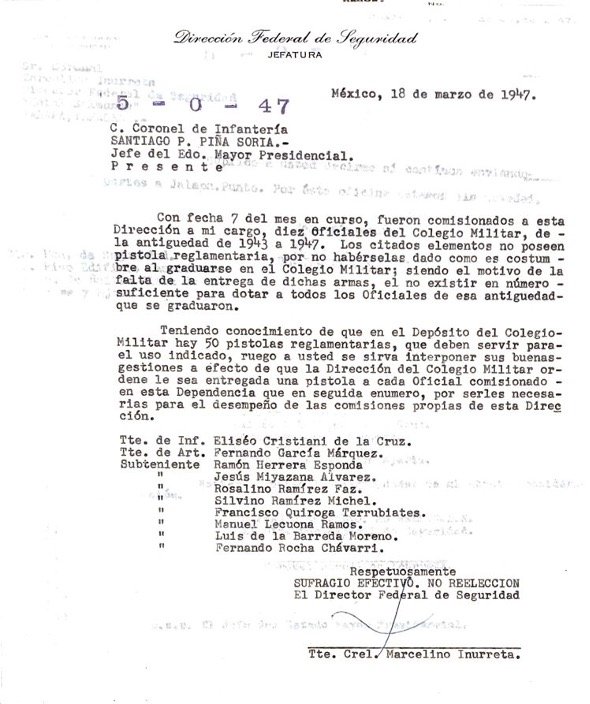
The long list of targets of the so-called political police includes members of the PRI itself; among them, the former presidents of the Republic: José López Portillo, Adolfo Ruiz Cortines, Miguel Alemán Valdez, Gustavo Díaz Ordaz, Miguel de la Madrid, Carlos Salinas de Gortari, and Ernesto Zedillo Ponce de León. As well as still-active members, such as Roberto Madrazo Pintado and Manlio Fabio Beltrones.
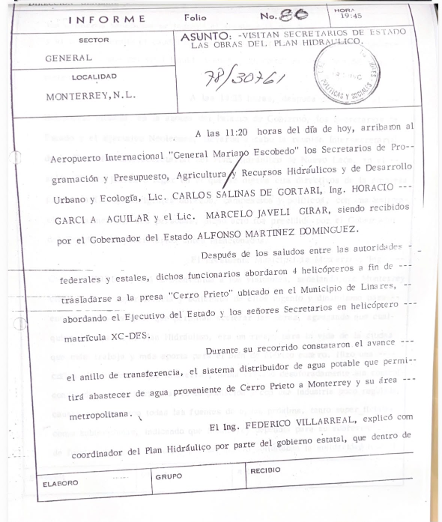
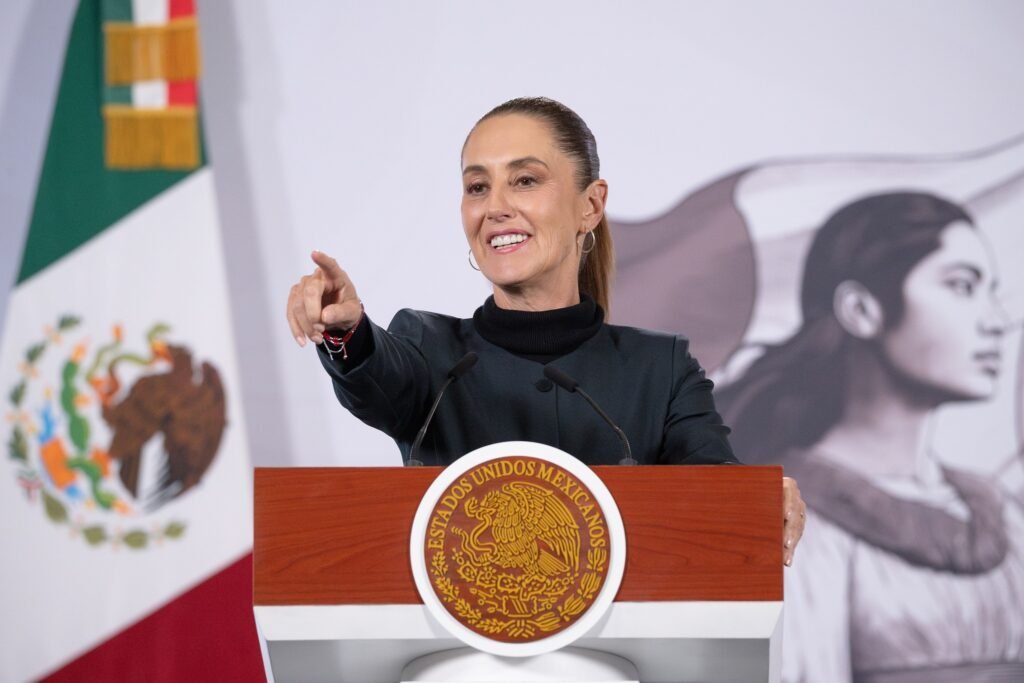
As well as members of the political left, among whom stand out President Claudia Sheinbaum Pardo, who was subjected to surveillance from her childhood; and former President Andrés Manuel López Obrador, spied on since his beginnings in politics.
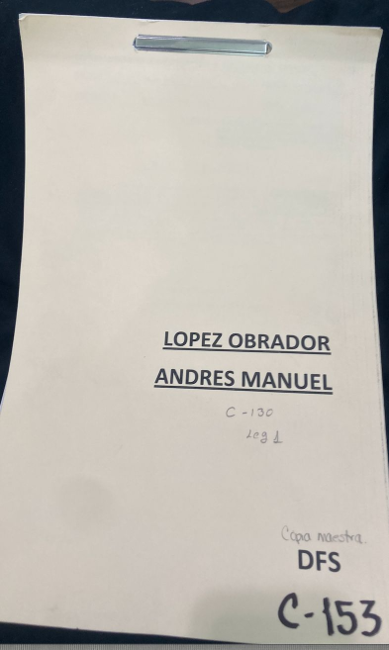
Members of the National Action Party were also subject to monitoring. Among these, figures such as former President Vicente Fox Quesada, the founder Juan Manuel Gómez Morín, or Manuel Jesús Clouthier del Rincón, and his children Manuel Jesús, Rebeca, and Tatiana Clouthier Carrillo (the latter, a Morena member) stand out.
To that list are added presidents of other countries —such as Chile’s Salvador Allende Gossens—; Mexican writers and those of other nationalities —among them, the Colombian Gabriel García Márquez, and the American Albert Maltz—; artists —David Alfaro Siqueiros, Vicente Rojo, Rufino Tamayo—; diplomats —including Gilberto Bosques—; foreign agents —among whom stand out: Phillip Agee, a CIA member who carried out espionage work in Mexico, Ecuador, and Uruguay, and who wrote the book Inside the Company: CIA Diary; and Michael Townley, an American double agent who, in addition to working for the Central Intelligence Agency, also operated for Chile’s National Intelligence Directorate (secret police), during the military dictatorship of Augusto Pinochet.
Likewise, the DFS kept under surveillance radical right-wing groups —such as MURO, el Yunque, and the Anti-Communist Popular Front of Mexico—; guerrilla groups —among them, the Peasant Justice Brigade, the armed wing of the Party of the Poor; as well as its chief, Lucio Cabañas Barrientos; and likewise the Revolutionary Armed Forces of the People.
Others who remained in the sights of the political police were the most prominent drug traffickers of the era: the leader of the Guadalajara Cartel, Miguel Ángel Félix Gallardo, who carried identification as an agent of the DFS itself; Rafael Caro Quintero; and Juan José Esparragoza Moreno, alias el Azul.
Even high-ranking military officers were spied on, such as the secretaries of National Defense during the term of José López Portillo —Félix Galván López—, and in the government of Gustavo Díaz Ordaz —Marcelino García Barragán—. On that list of military figures also appear Mario Arturo Acosta Chaparro, implicated in the Dirty War; and Francisco Quiroz Hermosillo, accused of having allied himself with drug trafficking.
In the archives that portray the PRI’s ignominy there is evidence of the monitoring that State agents carried out against victims of the Dirty War. For example, there are the surveillance files on the forcibly disappeared Rosendo Radilla Pacheco and Jesús Piedra Ibarra, son of the late Rosario Ibarra de Piedra. The files account for the activities of the whole family: in addition to doña Rosario and her son, her husband Jesús Piedra Rosales was spied on, as were her other children: María del Rosario —current president of the National Human Rights Commission—, Carlos, and Claudia Isabel Piedra Ibarra.
Another sector that was systematically spied on is that of businessmen; that was the case of the brothers Bernardo and Eugenio Garza Sada, and of the owner of Kimberly Clark, Claudio X. González Laporte. Also, the owners of media outlets —Emilio Azcárraga Milmo (Televisa), Juan Francisco Ealy Ortiz (El Universal).
Even right-wing intellectuals and communicators have a DFS file: Joaquín López Dóriga, Enrique Krauze, Carlos Loret de Mola Mediz —grandfather of Carlos Loret, of the LatinUs portal—, Leo Zuckerman, and Héctor Manuel Aguilar Camín.
Journalists were not left out of these espionage efforts: Julio Scherer García, Manuel Becerra Acosta, and Miguel Ángel Granados Chapa, among many others, were subject to monitoring. And even religious leaders, such as the priest who founded the Legionaries of Christ, Marcial Maciel, later accused of pedophilia.
Thus, the Federal Security Directorate portrays in full what the PRI in government meant: repression —with the darkest period known as the Dirty War—, anti-democracy, censorship, and a long “tradition” of spying that, over time, evolved alongside the now-defunct Cisen (Center for Investigation and National Security). This more recent period includes the use of mass surveillance platforms, such as Pegasus, whose scandals span both the government of the PAN’s Felipe Calderón and that of the PRI’s Enrique Peña Nieto.
The File on President Sheinbaum
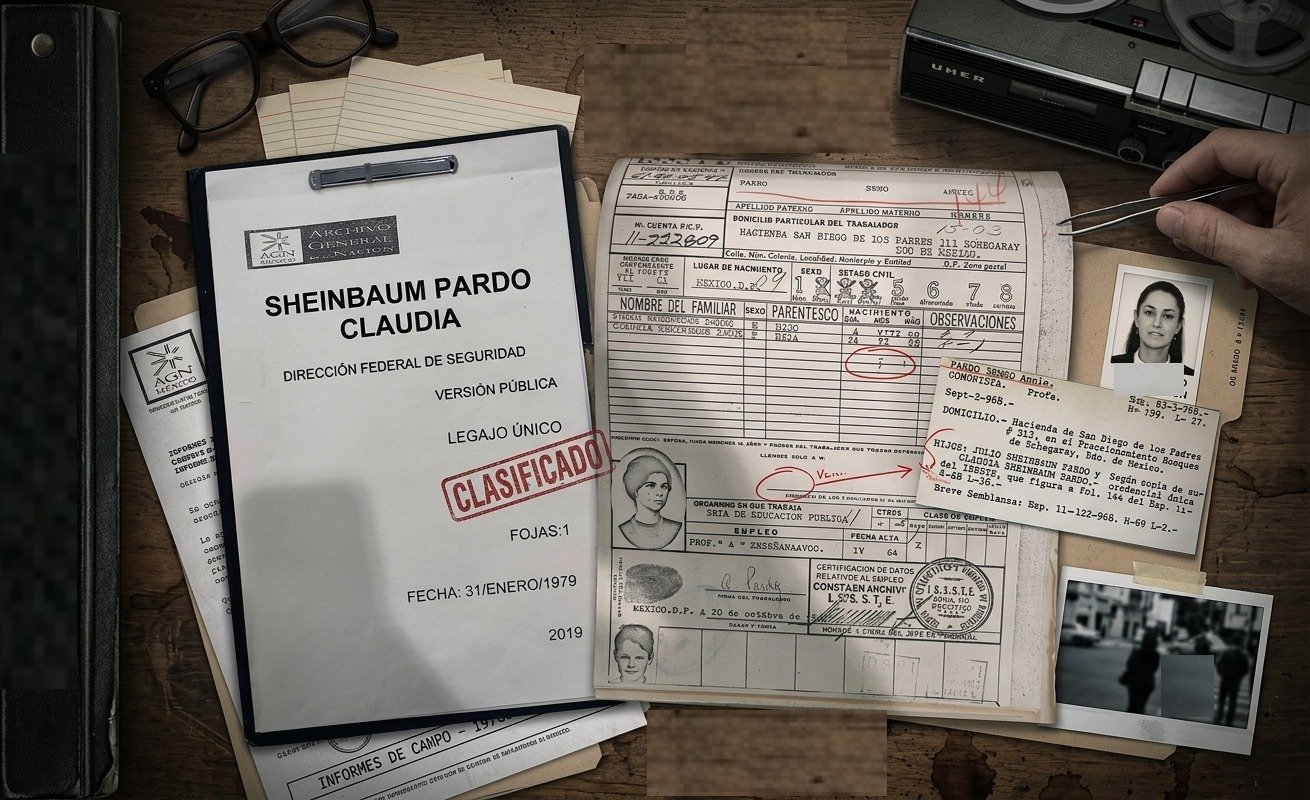
The Palacio Negro, as Lecumberri is also known due to its penitentiary history, houses files linked to the espionage that President Claudia Sheinbaum Pardo suffered from her childhood. The National Archive itself refers to one of them to illustrate the correct way to request master copies and public versions when one physically visits the site for research purposes.
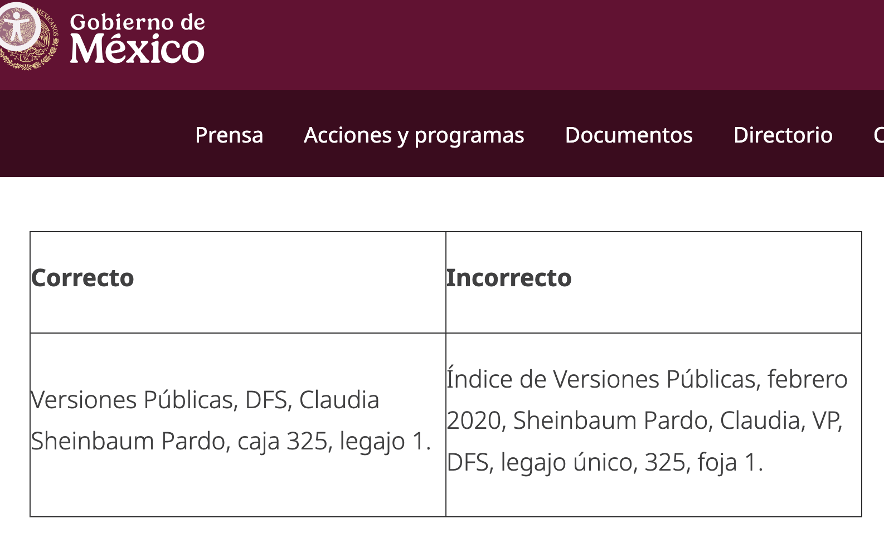
The document located in box 325, file 1 of the public versions of the DFS, titled Claudia Sheinbaum Pardo, is made up of three pages, of which only one is related to the surveillance work of the DFS, and it is dated January 31, 1979. That page accounts for a series of trips abroad and back, especially to Cuba, Spain, and the United States. From the information, it is noted that only one of those flights —from Mexico to Cuba— is attributed to the now head of state. From this, the date also stands out, since in that year Sheinbaum Pardo was a minor: she was 16 years old, as her date of birth is June 24, 1962.
Contralínea consulted the Presidency of the Republic as to whether it acknowledged that the rest of the trips were related to Dr. Sheinbaum Pardo. The answer was no, and it clarified that the president did not travel to those countries referred to in the rest of the page.
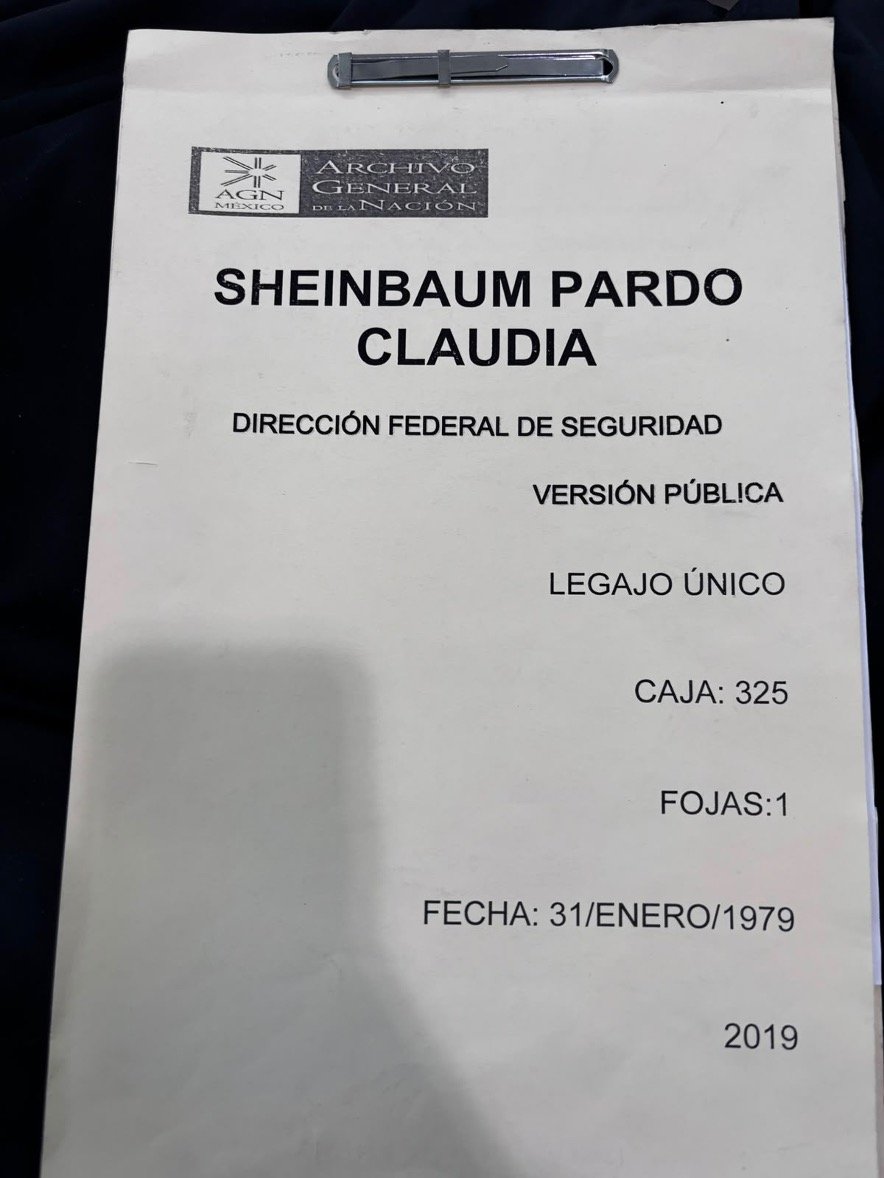
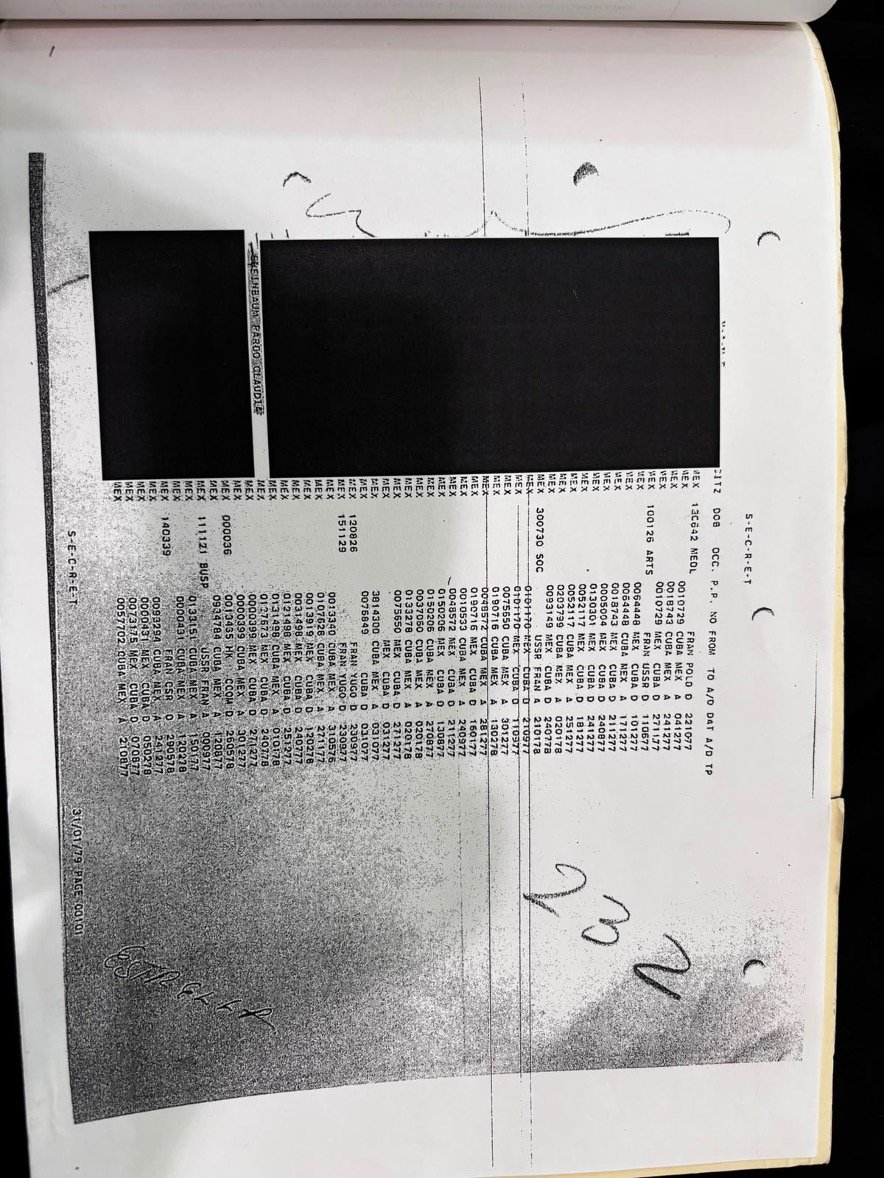
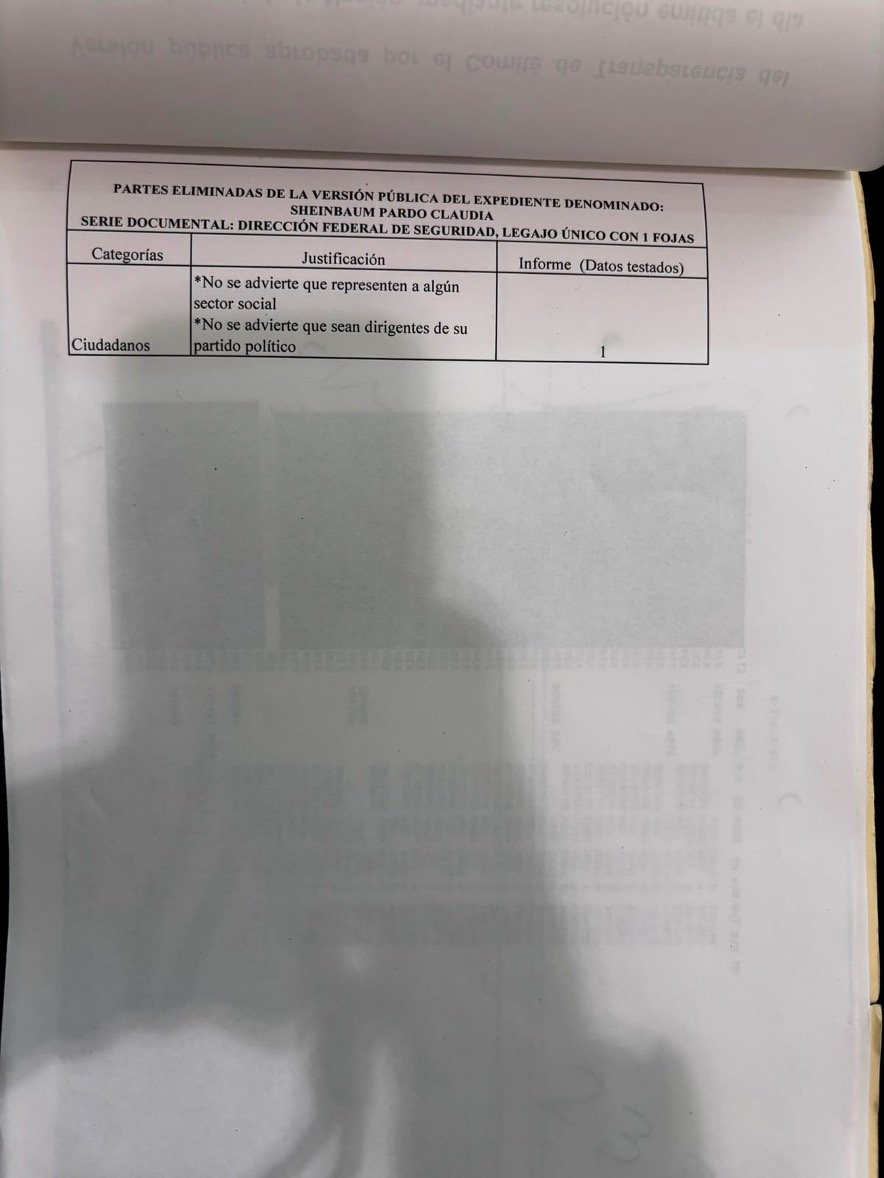
The document that bears the name of the first woman to preside over Mexico is not the only one that refers to her. Four other files are related to her family, particularly to her mother, the scientist Annie Pardo Cemo, who was the target of espionage for her work in academia and was even identified as a “communist.”
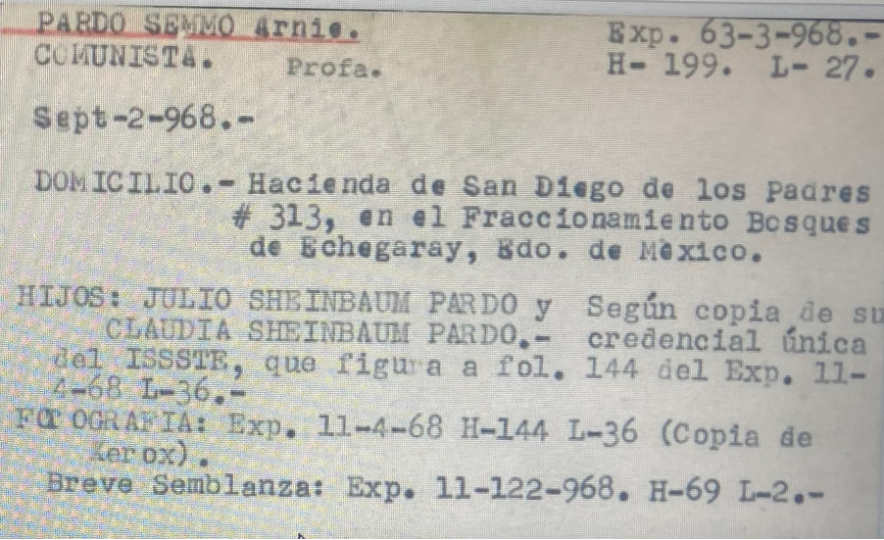
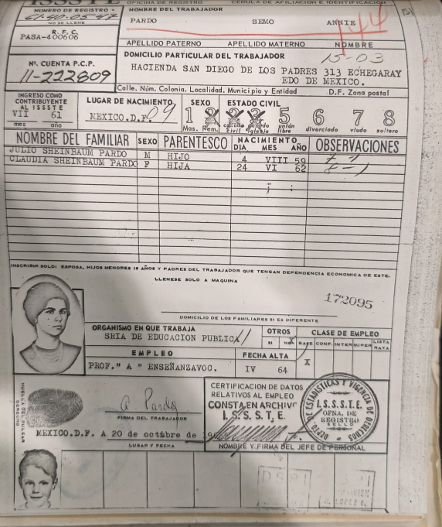
Once again, the references to the president and her brother Julio occurred in a context in which both were minors. One of the documents includes personal data in addition to their names, such as their ISSSTE social security number, photographs, and fingerprint.
In addition, other documents are presented that account for the activities of the scientist Annie Pardo, in the context of the student repression of 1968 and 1971, considering them subversive. Regarding those files, on November 12, 2024, President Sheinbaum revealed that, when she was still head of government of Mexico City, she asked the AGN to find out whether they held the archives of her parents and of herself.
There in the National Archive there is an investigation from when I was six years old because —I have talked about it here and I even talked about it on October 2— when the 1968 student movement happened —it is no secret, on the contrary— my mother proudly acknowledges it: she participated in that movement; she was a professor at the Politécnico and a student at the Politécnico, she was also studying her postgraduate degree. And after the movement they expelled her from the National Polytechnic Institute for having participated in it; they expelled her as a teacher and they expelled her as a student. She had to go to the UNAM —the UNAM, if you recall, the rector, the engineer Javier Barros Sierra, played a completely different role— and there she was able to return to continue her studies.
In her morning press conference on that November 12, Sheinbaum Pardo added that, later, her mother “was able to obtain, through academic competitions, a position at the UNAM School of Sciences; today she is an emeritus researcher at the UNAM and one of the most recognized researchers in her field. And it was hard for her, because of two things: for being a woman and also for participating in social movements, because she was always very active at the University.”
About the espionage of which she herself was a target, she said: “and when we were little she would take us some weekends to Lecumberri to visit the political prisoners of ’68. So, my name was recorded there since I was a girl, I don’t know if six or eight years [old], that I had entered Lecumberri to see the political prisoners. For me, it is a source of pride to be the daughter of Annie Pardo.”
The president of the Republic also reflected on the abuse of power and the human rights violations of that regime, warning that that espionage:
..speaks to what the governments of the past were. Because now, look, and it is worth it because now people speak of “authoritarianism, of anti-democracy”; participating in those times was not easy, that is, it was prohibited, there were political prisoners for participating. The students of ’68 were imprisoned and, as Pablo Gómez rightly said here, their sentence was never lifted; later there was an amnesty, but those were indeed repressive regimes.
If any journalist dared to speak against a president, well, he was immediately removed from television […]; it was repression from the Mexican State. That does not exist now; of course, there are insecurity problems in the country that we are addressing, but there is no repression by the Mexican State, that is another thing.
-
Sheinbaum Calls “Absurd” the PT’s Claim of U.S. Pressure in Morena
Labor Party leader Alberto Anaya suggested Washington shaped Morena’s picks for 2027; Sheinbaum said the polls decided, and disappointment fuels such theories.
-
People’s Mañanera October 8
President Sheinbaum’s daily press conference, with comments on public companies, railways, Morena’s 15 years, and US security cooperation.
-
Confidence in Mexico Secures US Investment, Sheinbaum Says After Meeting With Business Leaders and Ambassador Johnson
The executives, who came with Ambassador Ronald Johnson, pressed for a quick USMCA deal, while new pharma, energy and farm investments are on the way.