International Right-Wing Network Behind Documentary Attacking Mexico’s Judicial Reform
This article by Aníbal García Fernández originally appeared in the November 10, 2026 edition of Contralínea, a Mexican investigative journalism magazine.
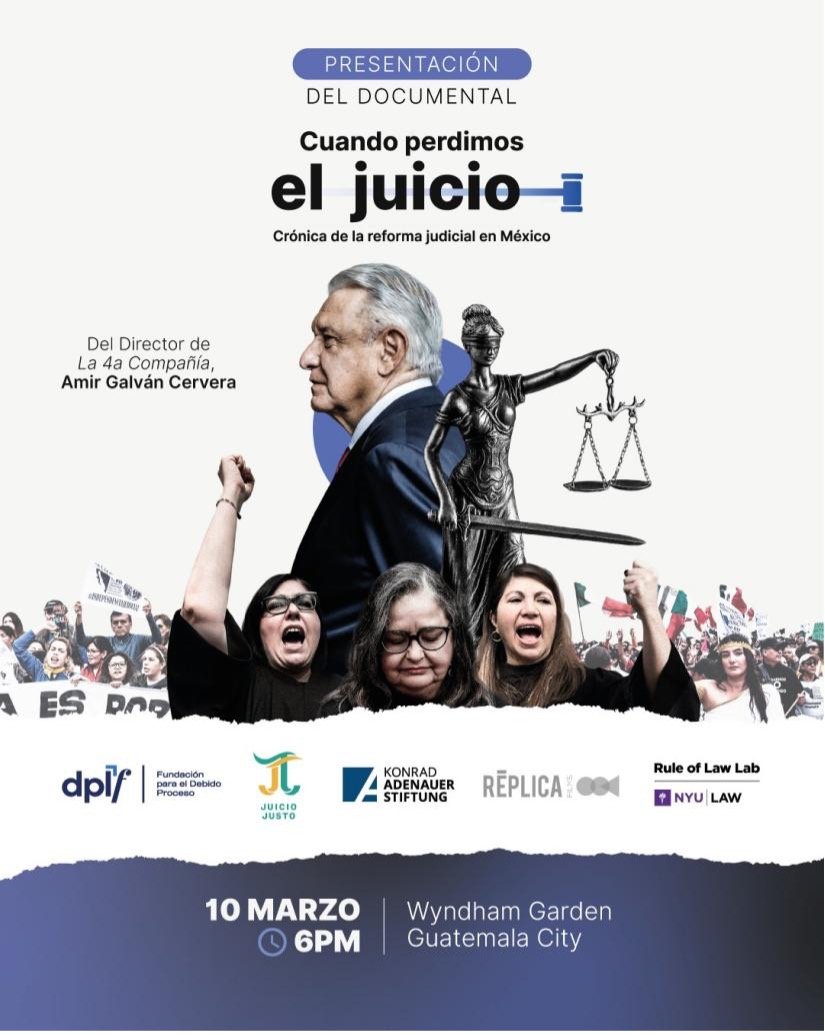
Although the documentary titled “When We Lost Our Judgment” (“Cuando perdimos el juicio”) was presented as a journalistic product, it is part of a series of inputs generated by a network of the Mexican and international right that seeks to plant the idea that Mexico is advancing toward authoritarianism, without supposed institutional “checks and balances.” That is why its main purpose is to question the judicial reform. Behind that product are several organizations, some of them even allies of the NED; among them: Konrad Adenauer Stiftung, Juicio Justo, the Due Process of Law Foundation, Réplica, New York University’s Rule of Law.
The documentary titled “When We Lost Our Judgment,” which questions the judicial reform in Mexico, was recently released. Behind it are several non-governmental organizations that are part of the large network of the Mexican and international right, among them: Juicio Justo, the Due Process of Law Foundation, Réplica, New York University’s Rule of Law and the Konrad Adenauer Stiftung.
As on other occasions, those who attack the transformation in Mexico see in the judicial reform one of the most questionable and critical processes. Even opponents, national and foreign, have said that with this reform –and others– democracy in Mexico is being eroded.
Nothing could be more false. On the contrary, it was the previous Supreme Court of Justice of the Nation (SCJN) that was antidemocratic, the one chosen by the “dedazo” of Ernesto Zedillo Ponce de León, the author of Fobaproa, of the structural reforms, the privatizations, the highway bailout and the indebtedness. The same president who did not know how to deal with the situation in Chiapas and ended up violating human rights with the massacre in Acteal. The same one of the massacres of El Charco and El Bosque.
That SCJN was the one that opposed relevant transformations that benefited the people of Mexico during the term of former President López Obrador, such as the Electricity Industry Law and the Hydrocarbons Law, and that, together with former judge Juan Pablo Gómez Fierro –the one who granted amparos to companies such as Ingemar–, judicialized reforms.
Norma Piña, who presided over the SCJN at the end of the previous stage, voted for the unconstitutionality of the Federal Law of Republican Austerity, the National Law of Asset Forfeiture and the Law of the National Public Security System, and invalidated the electoral Plan B. In other words, she systematically opposed democratization.
That previous Judicial Branch was the one that constantly released generators of violence. A few examples are enough for the people of Mexico to remember what kind of relationships it had: the Fifth Collegiate Court in Administrative Matters gave Luis Cárdenas Palomino “the protection and shelter of the justice of the Union” to unblock one of his accounts; the Seventeenth Collegiate Court in Administrative Matters of the First Circuit of Mexico City revoked the ruling of the Twelfth Court with which the amparo requested by the wife of Genaro García Luna against her inclusion in the List of Blocked Persons of December 9, 2019, had been denied; the Criminal Court of First Instance of Hidalgo, in Guerrero, ordered on Wednesday, May 18, the immediate release of Héctor Luis Palma Salazar, better known as el Güero.
Right-Wing Network Behind the Documentary
Who are the organizations behind the documentary and why is it important for the people of Mexico to know where they come from?
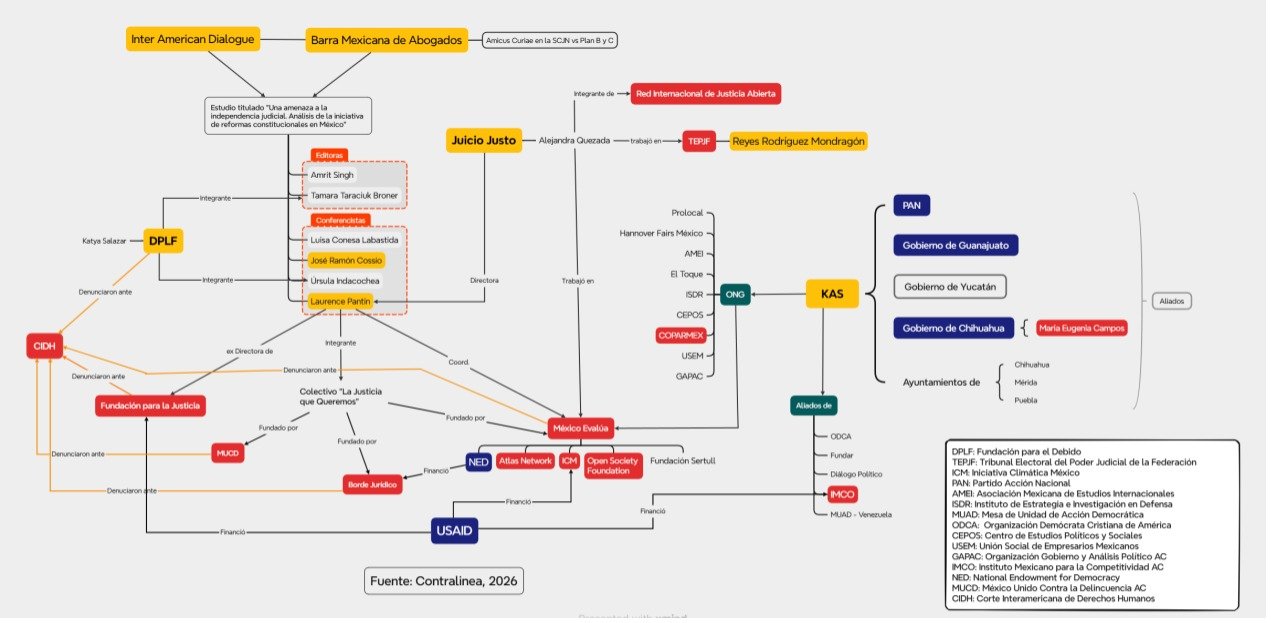
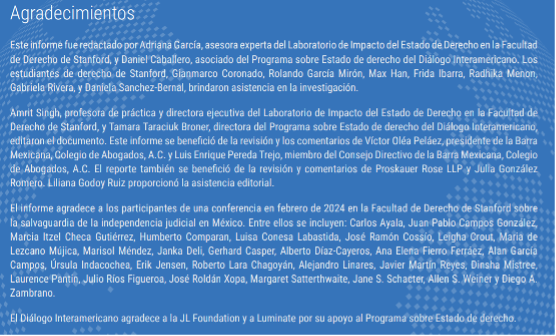
The Due Process of Law Foundation (DPLF) has been directed by Katya Salazar since 2009. This foundation, the think tank The Inter American Dialogue –the same one that, during the term of Felipe Calderón, promoted the plan “Vision 2030: The Mexico We Want”– and the Mexican Bar Association carried out in 2024 the research “A Threat to Judicial Independence. Analysis of the Initiative of Constitutional Reforms in Mexico.” Its authors were Adriana García, expert adviser at the Rule of Law Impact Lab at Stanford Law School, and Daniel Caballero, associate of the Rule of Law Program at the Inter-American Dialogue. It was edited by Amrit Singh, professor of practice and executive director of the Rule of Law Impact Lab at Stanford Law School, and Tamara Taraciuk Broner, director of the Rule of Law Program at the Inter-American Dialogue.
To present that document, a conference was held in February 2024 in which Luisa Conesa Labastida, José Ramón Cossío, Úrsula Indacochea (of DPLF) and Laurence Pantin (director of Juicio Justo), among others, participated.
The organization Juicio Justo has as its director Laurence Pantin, a member of the collective “Justicia que Queremos” –which also opposed the judicial reform–, who was general director of the Fundación para la Justicia and coordinator of the Transparency in Justice program at México Evalúa, an organization that opposed the judicial reform and the government of López Obrador, and that receives resources from the United States government, via the coup-plotting National Endowment for Democracy (NED).
Alejandra Quezada also coincides at Juicio Justo as research coordinator. She is a member of the International Open Justice Network and worked at the Electoral Tribunal of the Federal Judicial Branch with former magistrate Reyes Rodríguez Mondragón, an opponent of the Morena governments, protector of opposition parties such as the PAN and the PRI. Like Pantin, she worked at México Evalúa and collaborated with opposition media such as Nexos, Proceso and Animal Político.
Lastly, the Konrad Adenauer Stiftung (KAS) is an organization that held training courses with the previous SCJN, headed by Norma Piña, and also with the National Action Party. It is a German right-wing organization that has extensive contacts with the international and Latin American right.
In Mexico, the KAS has as allies the SCJN, the National Electoral Institute (INE), the PAN, the Government of Guanajuato (which is governed by Acción Nacional), the Government of Yucatán, that of Chihuahua, governed by María Eugenia Campos, who opened the door to the CIA, and the city councils of Chihuahua, Mérida and Puebla.
Among its partners it counts the NGO Prolocal, Hannover Fairs México, the Mexican Association of International Studies (AMEI), El Toque, a multimedia platform opposed to the government of Cuba, México Evalúa (which in turn receives funding from the NED, the Atlas Network, Iniciativa Climática México, Fundación Sertull, the Open Society Foundation, among others), the Institute for Strategy and Research in Defense (ISDR), the Center for Political and Social Studies (CEPOS), the Mexican Business Council for Foreign Trade, Investment and Technology, the Employers’ Confederation of the Mexican Republic (COPARMEX) and the Social Union of Mexican Entrepreneurs (USEM). And in Venezuela, it also supports the opposition and coup-plotting Mesa de Unidad de Acción Democrática (MUAD).
Locating the institutions behind the hoax and the propaganda that the documentary “When We Lost Our Judgment” entails means knowing that it is a right-wing power network that systematically opposed the delivery of social justice. The people did not lose their judgment; what they won was justice.
-
People’s Mañanera November 11
President Sheinbaum’s daily press conference, with comments on free health care, housing, the 2006 election, the 2027 budget, and misinformation.
-
Sighting of Wood Storks Recorded for the First Time at Mexico’s Lake Texcoco
Habitat restoration is bringing birds back to the lake where Mexico’s government once planned a new international airport, a project canceled in 2018.
-
Nadia Beller, Ex-Partner of Cerimedo, Leaves Bolivia Bound for Mexico. She Is Granted Safe Conduct
Mexico granted her asylum after she reported police harassment, months after surviving a shooting allegedly ordered by the Argentine consultant.