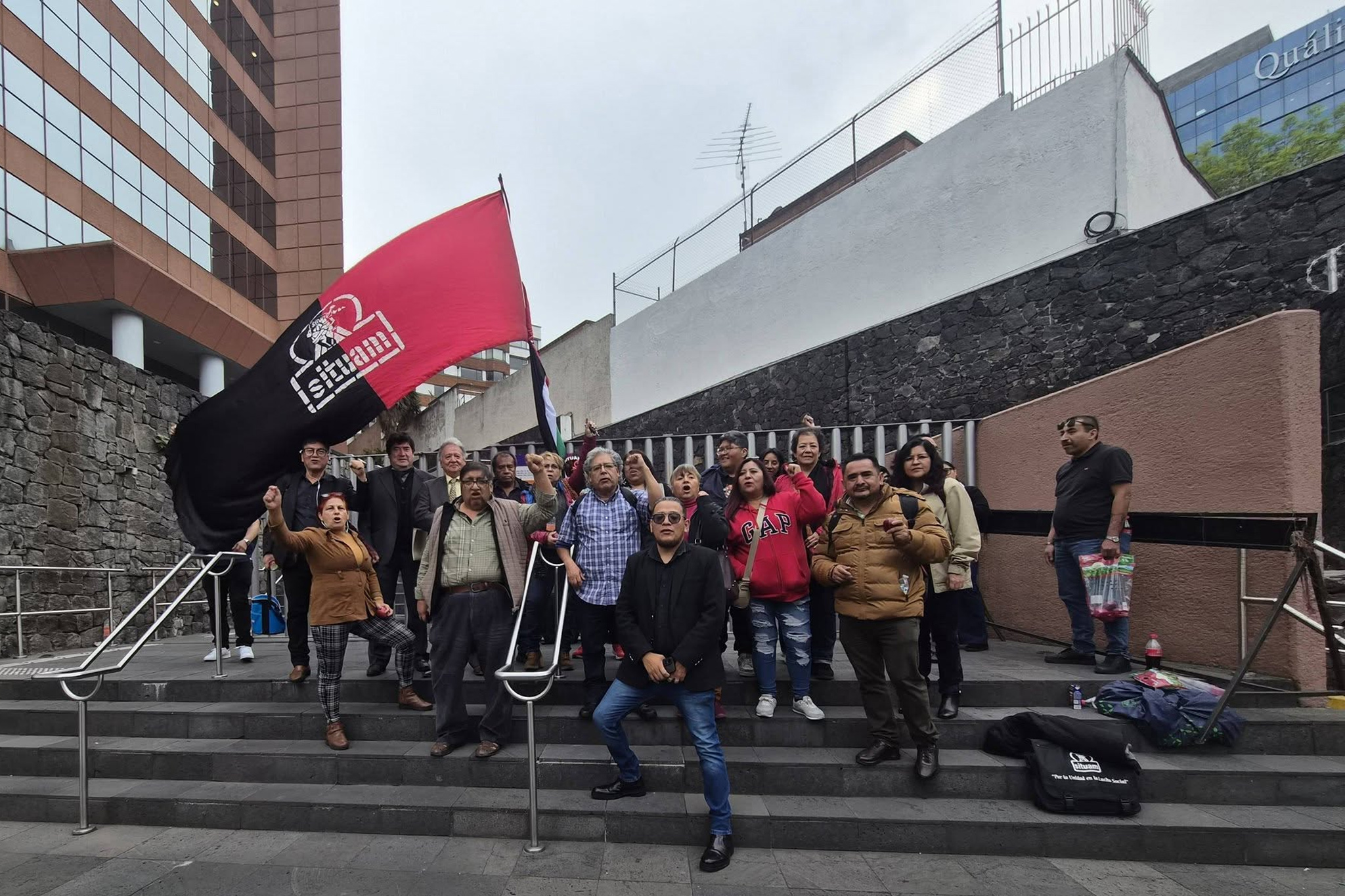
SITUAM, A Renewed Actor in the University
This editorial by Hugo Aboites originally appeared in the March 14, 2026 edition of La Jornada, Mexico’s premier left wing daily newspaper. The views expressed in this article are the authors’ own and do not necessarily reflect those of Mexico Solidarity Media or the Mexico Solidarity Project.
The faculty and staff of the Universidad Autónoma Metropolitana (UAM) have a very generous collective bargaining agreement that supports their teaching and research activities. It includes freedom of research, sabbatical leave, other leaves of absence, a balance between teaching and research, and more. Furthermore, the UAM administration has committed to providing the SITUAM union, through the collective bargaining agreement, with information on the institution’s academic activities. This allows the union to intervene with more information to defend the academic workers and enables them to contribute to the direction and progress of this important work.
The outdated prejudice persists that a union in a university is only useful for negotiating salaries and benefits. Everything else, it is said, is academic and not relevant to the discussion. But if the union includes administrative and academic staff (more than a thousand), then it is clearly relevant. Furthermore, when academic matters are prominently featured in the bilaterally signed contract, then of course it is appropriate to discuss, and even expand upon, what has been agreed upon.
And in that sense, it’s good that the clauses dealing with academic matters are very precise, as this facilitates discussion. For example, clause 215 states that UAM administration is obligated to “inform the union annually of the research projects approved by the divisional councils, as well as their names” and, among other things, “the resources” allocated to them (Section XXV).
The teaching schedule must also be made public. (Section XXIV) Furthermore, the Rector’s Office must provide detailed information on agreements with public or private institutions and companies (Section XXVI). Clearly, the union does not decide on the approval of projects or teaching loads, but since it is informed, it can freely analyze and express its opinion regarding a given project. Nothing prevents an academic discussion on a topic or project, especially since UAM is legally obligated to ensure that “the training of professionals corresponds to the needs of society” and “to develop research activities… primarily addressing national problems…” (Organic Law, Art. 2).
Some examples clarify the type of problems that can arise at this point: UAM has entered into agreements with transnational companies to conduct research on a technology that, among other uses, improves the performance of tanks, aircraft, and combat helicopters for the U.S. armed forces. In cases like this, UAM provides facilities, researchers, and other resources from public funding to the institution free of charge. This is highly questionable for UAM. Another example: the design and manufacture of machinery for a company seeking to make its toilet bowl deodorant tablets more compact and longer-lasting.
Another example: the development of products and adhesives for application, for instance, on shoe soles. Yet another: offering a master’s degree program at a large company’s facilities to train its technical staff. And more: countless courses on dog training, bonsai care, theater, and so on, with fees reaching thousands of pesos. It’s so important to know and analyze what’s being done, but equally, or perhaps even more, important to examine what aspects of Mexico are not being addressed at UAM.
Many activities could be discussed by panels of academic experts convened by SITUAM to critically examine the implications of these projects. Furthermore, on the 51st anniversary of its founding (March 4th), SITUAM can join as a key player in this important endeavor to support a UAM that addresses the broad challenges facing the Mexican people and contributes to resolving them.
The fact that, with the new labour law (despite our initial suspicion), all workers of the institution, unionized or not, can decide whether to approve the progress in the negotiation carried out by SITUAM, has served to increase the discussion and participation of non-unionized workers in union issues.
This fosters greater union membership and strengthens both the union and democracy at UAM. With votes for or against what SITUAM obtained in the negotiations, we broaden the base of democratic decision-making in an institution where unilateral decisions abound. And that strengthens the union’s contribution to UAM.
A country of organizations and, hopefully, of democratic universities, ultimately has a better chance of facing the hostile climate that prevails today due to the decision of the United States and israeli governments to bet on war in the Middle East, and due to the threats against the Cuban people and nation.
-
Mexico National Farmers Strike, Day 1
Driven by concerns over US crop dumping, monopoly profiteering, the decline of food sovereignty & insufficient state support, farmers have struck for the third in six months. Now transporters have joined.
-
People’s Mañanera April 6
President Sheinbaum’s daily press conference, witch comments on public education investment, AIFA, Committee on Enforced Disappearances report, and the Gulf of Mexico oil spill.
-
Ultra-right “Masculinity” Congress in Guadalajara
Promoted by government agencies in Jalisco, Guadalajara, and Zapopan and featuring a morbid roster of misogynists, reactionaries & former boy band singer; the expensive two day event has drawn criticism.