If USMCA Disappears in the Next Decade, It Would Be the End of Economic Liberalization
This article by Carolina Hernández Calvario, an economist and academic at UAM Iztapalapa specializing in political economy, originally appeared in the July 16, 2026 edition of Contralínea, an independent Mexican investigative magazine.
In the current context of multipolarity and the consolidation of economic blocs worldwide, it is imperative to reflect on the concept of North America. This reflection is no trivial matter if one considers the complex history between Mexico and the United States, as well as the fact that the free trade agreement negotiated between 1990 and 1993 not only reconfigured the productive logic of these countries, but fundamentally reconfigured the region.
For this purpose, the exercise of historical memory is always instructive, as it allows us to structure the perceptions and political calculations among nations. That is why I consider it necessary to recall that, before we conceived of the United States as a reliable trading partner, this country was the object of many reservations, and even distrust, on the part of our people. Those reservations were founded on the United States’ invasion of our territory, between 1846 and 1848, when it seized more than half of the national territory. This aggression is acknowledged even by U.S. military leaders of the time such as Ulysses Grant, who would later become president of the United States, who described this conflict as “one of the most unjust wars ever waged by a powerful nation against a weaker one.”
This background explains, in part, Sebastián Lerdo de Tejada’s refusal to build a railroad connecting the Mexican capital with the northern border, when he expressed his preference that “between the United States and Mexico, better the desert.” Or, for that matter, Porfirio Díaz’s maxim, “Poor Mexico, so far from God and so close to the United States,” which captured this same reality of involuntary proximity and inherent risk. And what to say of this country’s multiple interventions in Mexican internal affairs throughout the 20th century, such as its active participation in the coup d’état against President Francisco I. Madero, at a time when our country was undergoing a social revolution?
This brief account, aimed at keeping in mind the geopolitical rationality of the United States since its rise as a power, allows us to refute the narrative that Mexico is condemned to integration with the United States or to economic collapse. Although commercial integration with this country is an important element of the economic growth strategy driven since the 1990s, it does not constitute the only variable that can boost the Mexican economy. Hence the importance of not confusing a free trade agreement with a national development plan.
In other words, if the USMCA were to disappear in the next 10 years, it would mark the end of the economic liberalization project, but not necessarily that of the Mexican national development project. Especially since our history has shown us that the country’s highest records of economic growth have been achieved at times when a selective trade policy has been combined with the protection of strategic sectors and the active promotion of industrialization based on the domestic market.
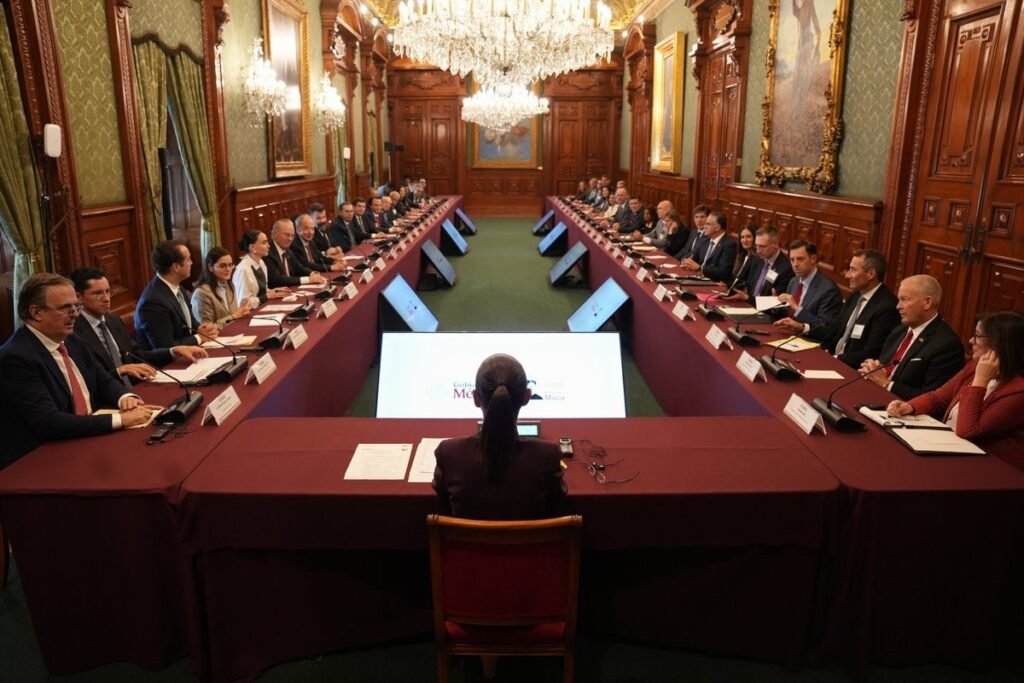
That is why, regardless of the results of the first working session on the formal review of the treaty between Mexico, the United States, and Canada, which will take place this coming July 20, the Mexican negotiating delegation must arrive with a clear strategy to protect national interests, based on the National Development Plan (2025-2030) and the Plan México. And this strategy must operate under the principle of what we might call “strategic anticipation,” understood as the capacity to prepare for multiple possible futures without passively waiting for others to make decisions.
And for our part, as the Mexican people, we must keep in mind the historical lessons about how the United States has conducted trade negotiations at other moments in history. This means being alert to leaks, which have been a favorite resource of the Americans for weakening the positions of their counterparts in negotiations, since with this practice they create the media and political pressure that frequently favors them. Hence the importance of being shielded against what we might call “weapons of mass distraction,” which tend to be fired in media campaigns.
Another point of attention detected through the lens of history is the problematic performance record of U.S. agencies in bilateral negotiations with Mexico, for there are testimonies published by former presidents that attest to pressures derived from accusations against public officials in the 1980s over links to drug trafficking, as part of extra-institutional pressure tactics that demonstrate that sometimes what happens outside the negotiating table is as important as what happens within it. Another revealing precedent is documented in Canada, with the exponential growth of U.S. pressures during the negotiation of the trade agreement between Canada and the United States, prior to NAFTA, in which capital flight was reached as a pressure mechanism aimed at forcing the opening of its financial sector to North American capital.
In sum, this scenario of USMCA renegotiation offers us a historic opportunity for our country to redefine its relationship with the North American region, on the basis of strengthening a national development project that has been under construction since 2018, and that today has allowed us to recover the capacity to be architects of our own future.
Carolina Hernández Calvario is an academic at UAM Iztapalapa. Holds a bachelor’s degree and a doctorate in Economics (Faculty of Economics, UNAM) and a master’s degree in Latin American Studies (Faculty of Philosophy and Letters, UNAM). Her area of specialization is political economy.
-
Sheinbaum Calls “Absurd” the PT’s Claim of U.S. Pressure in Morena
Labor Party leader Alberto Anaya suggested Washington shaped Morena’s picks for 2027; Sheinbaum said the polls decided, and disappointment fuels such theories.
-
People’s Mañanera October 8
President Sheinbaum’s daily press conference, with comments on public companies, railways, Morena’s 15 years, and US security cooperation.
-
Confidence in Mexico Secures US Investment, Sheinbaum Says After Meeting With Business Leaders and Ambassador Johnson
The executives, who came with Ambassador Ronald Johnson, pressed for a quick USMCA deal, while new pharma, energy and farm investments are on the way.