
The American Dream Is Not Dead
This editorial by Diego Torres appears as the introduction to the November 2026 issue of Let’s Talk About Migration (Hablemos de Migración), a magazine on migration issues published by the Frente Amplio de Mexicanos y Migrantes. Read and download the full November issue.

Talking about migration also means addressing the topic of the “American Dream.” Some say the American Dream is dead, that it disappeared many years ago, or that it has become the American nightmare. However, these assertions stem from forgetting the underlying causes that continue to force many people to emigrate in search of a better life.
Many of the first European settlers who arrived in what is now the United States were seeking better living conditions or fleeing religious persecution. The Library of Congress itself documents that several of the British colonies in North America were established by people escaping religious persecution in Europe, while others came seeking economic opportunities. This is not unlike what currently motivates people to continue coming to the United States, however dangerous the journey may be.
Migration has been a part of U.S. history since the early settlers, beginning with Asians (primarily Chinese), Europeans, and Mexicans, all present during the expansion of the American empire. Later came the influx of Cubans and a significant increase in Mexicans, and continuing to this day with Africans, Venezuelans, Haitians, Cubans, Chinese, and a long list of other nationalities. While their circumstances differ, the reasons for their migration are similar. Over time, many of these migrants forget what they fled and settle for the precarious life offered by the United States, especially for undocumented immigrants; precarious, but better than what they had in their home communities.
And worse still, forgetting these causes means not only assimilating xenophobic rhetoric, but also putting it into practice. Today, we see not only migrants in uniform as ICE agents, but also pro-Trump activists who violently attack their own people—those they themselves once were and now refuse to acknowledge.
This passivity on the part of the majority of migrants, both documented and undocumented, who are being harassed, persecuted, detained, and deported, coupled with the support of a few forgetful migrants, has been exploited by the Trump administration to fuel its hate campaign against those whom he and many others consider inferior. This is not merely a perception. In March 2016, the United Nations Committee on the Elimination of Racial Discrimination expressed its concern about the language used by Donald Trump to refer to migrants. The body warned that portraying them as criminals or as a burden on society can incite racial discrimination and hate crimes.
Migrants are becoming victims of their own making. Their failure to organize and demand their rights has made them easy targets for the orange-clad dictator’s attempts. Meanwhile, the consequences of this immigration policy are visible on the streets. Reuters documented in October 2026 that, since January 2025, at least 21 people had been shot by ICE agents and 7 had died. One of the most recent cases occurred in New York, where a man was wounded during an operation while his five- year-old son was inside the vehicle.
The American Dream isn’t dead, it’s just transformed. Governments that send migrants away repeat it in speeches full of rhetoric but lacking substance. In Mexico, the discourse tells migrants, “Mexico embraces you,” but it fails to acknowledge the reality that continues to drive them away. And “Mexico Embraces You” isn’t just a phrase: it’s the name of the National Repatriation Strategy, created by the Mexican government to receive Mexican nationals returning from the United States. The Ministry of the Interior itself states that the program offers lodging, food, medical care, and other services to repatriated individuals. In March 2026, the government reported 189,830 returns of Mexican nationals since January 20, 2025. But it fails to mention that a dignified and permanent return can’t even be considered a dream; at best, it’s an illusion that vanishes just days after the migrant returns to the same community that initially expelled them.
But therein lies the contradiction: Mexicans are welcomed and embraced upon their return, but the reality that initially drove them out is rarely acknowledged. Similarly, we can find similar narratives in many parts of the world.
Scholars and advocates for migrants claim that the American Dream is disappearing, but the truth is quite the opposite. It hasn’t disappeared at all; people not only continue to leave, but they also don’t return of their own free will. Because they know that if life in the United States is bad for them, in Mexico or in the countries they come from, there is neither a present nor a future. And as soon as the conditions arise that allow them to try to cross the border again, they won’t hesitate, and they will attempt the leap once more.
-
Nadia Beller, Ex-Partner of Cerimedo, Leaves Bolivia Bound for Mexico. She Is Granted Safe Conduct
Mexico granted her asylum after she reported police harassment, months after surviving a shooting allegedly ordered by the Argentine consultant.
-
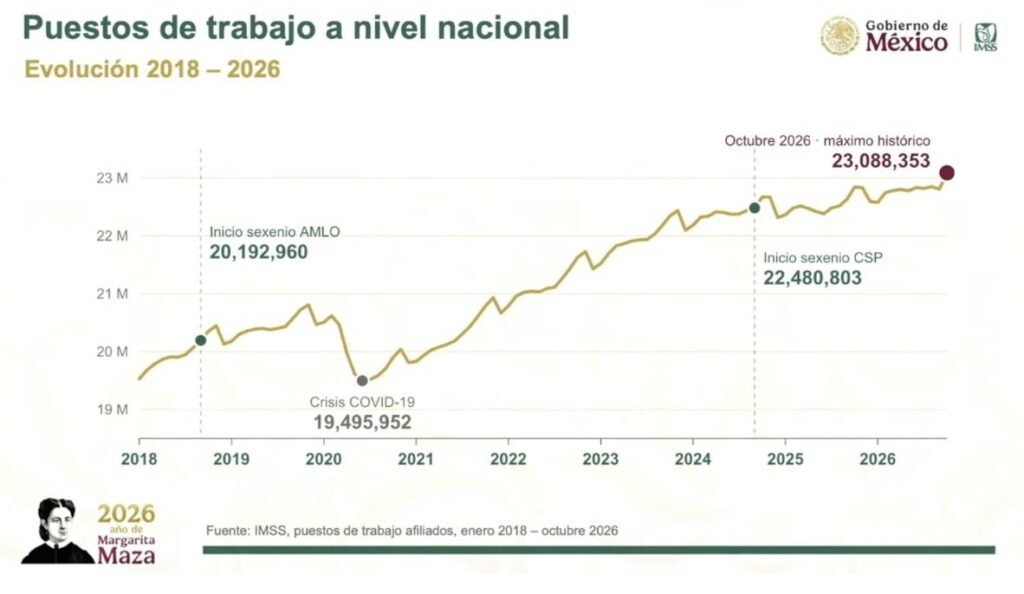
Mexico’s Formal Employment Reaches Historic High of 23.08 Million Jobs
Platform workers covered by the new labor reform now top 1.7 million, while the average daily wage hit 664.7 pesos, a record for October.
-
People’s Mañanera November 10
President Sheinbaum’s daily press conference, with comments on homicides, Michoacán, García Luna funds, and approval ratings.