Workers Purchasing Power Decreases
This article by Ricardo Torres originally appeared in the March 18, 2026 edition of Rebelión. The views expressed in this article are the authors’ own and do not necessarily reflect those of Mexico Solidarity Media or the Mexico Solidarity Project.
The minimum wage increased from 278.80 pesos per day in 2025 to 315.04 pesos per day in 2026 (an increase of 36.24 pesos), meaning that this year a salaried worker receives 2,205 pesos per week and, consequently, 8,821 pesos per month. It’s worth noting that the current Mexican government has long touted these nominal increases to the minimum wage, implemented since Morena came to power, as a source of pride. And it’s true, in nominal terms , we must acknowledge that these increases are higher than those implemented during the PRI or PAN administrations.
However, this partial view is intentionally misleading because increases to the minimum wage are compared with increases from previous governments or with the minimum wage increase of the immediately preceding year; but a more complete and rigorous view would also require contrasting the nominal amount of the minimum wage with the prices of products in the market, that is, in real terms. This occurs when the worker goes to the market to acquire the products to satisfy their most basic needs for themself and their family: when they verify in fact -in the market- the purchasing power of their salary.
We workers must therefore understand the difference between nominal wages and real wages. The former is defined by the amount of money we receive as wages in exchange for our labor; the latter is defined by the purchasing power of those wages when acquiring the goods and services that satisfy our needs.
A family of four requires an income of almost 10,000 pesos just to eat: therefore, a head of household earning the current minimum wage does not have enough income to even feed their family properly.
Now, this point is relevant because the National Institute of Statistics and Geography (INEGI), in its February report of this year, on the National Consumer Price Index (INPC), – a measure that records the average change in the prices of the products that make up a basket of goods and services consumed by households in the country – announced that on average inflation in the months of January and February 2026 was 3.79 and 4.02 percent, respectively.
On the other hand, INEGI itself, in its February report of this year concerning the Basic Food Basket and the Extreme Poverty Lines by Income, whose calculations are based on the National Consumer Price Index (INPC), highlights that the cost of the food basket in urban areas reached 2,486.40 pesos per month per person, and the combined food and non-food basket reached 4,843.11 pesos per month per person, representing an average increase of 5.1 percent compared to the same month last year. Thus, the food basket (5.1%) increased more than inflation (4.02%).
Thus, a family of four would require an income of almost 10,000 pesos just to eat. Therefore, a head of household earning the current minimum wage does not have enough income to even feed their family properly. And that’s not even considering the expenses of the non-food basket, which includes education, health, culture, and transportation, among other things, and which could only be covered with a monthly income exceeding 20,000 pesos. In this context of hardship and need, does anyone truly believe that the 36-peso daily increase by 2026 will alleviate the agonizing misery in which millions of Mexicans live? Not at all; it’s just another mirage.
Inflation and the reduction in workers’ purchasing power might seem like mere cold economic indicators, but when viewed more closely, they allow us to understand them as benchmarks that show us the degree of poverty that the population suffers and will suffer; for example, the inability to acquire the basic food basket clearly indicates poor nutrition for our children, which, among many other things, will cause anemia, malnutrition, weakness, and poor school performance.
In other words, these changes in the prices of goods mean a decrease in the purchasing power of workers and, therefore, a negative impact on the well-being of Mexican families.
Conversely, also in February of this year, Oxfam Mexico published a report titled Oligarchy or Democracy which states that “ Today, Mexico is one of the most unequal countries in the world. The richest 1% of the population—just 1.3 million people—receives 35% of total income, owns 40% of the nation’s private wealth, and is responsible for 23% of polluting emissions. This extreme concentration of wealth coexists with 18.8 million people without access to nutritious, quality food, and 38.5 million with social deprivations or incomes below the poverty line […] Over the last 30 years, the extreme concentration of wealth has become entrenched in Mexico. The ultra-wealthy in Mexico have never been so numerous or as wealthy as they are today […] Carlos Slim, the richest man in Mexico and in Latin America and the Caribbean, has never amassed such a fortune. In the same period, Mexican billionaires doubled their combined wealth in just five years […] This concentration is not the product of individual merit, but of a system An unjust economic system that depends on the labor of millions of people and the resources of the entire nation, but distributes its benefits among very few. Billionaires enrich themselves at the expense of the time, precariousness, and uncertainty of millions of people.”

As we can see, the loss of workers’ purchasing power is explained by the extreme and growing concentration of social wealth, which is appropriated by a handful of the ultra-rich in our country. Therefore, over the years, we workers must understand that the problem of poverty and inequality in Mexico is not explained by government “corruption,” as we have been told ad nauseam, but rather by the unjust capitalist economic model, which is designed precisely to maximize profits for capital at the expense of the exploitation of labor and the impoverishment of millions of workers.
In 2025, the Mexican economy grew by 0.7 percent, its fourth consecutive year of slowdown; and for 2026, projections from some international organizations, such as the Organization for Economic Cooperation and Development and the International Monetary Fund, anticipate economic growth below 1 percent. In short, the national economy faces minuscule economic growth, a greater concentration of wealth in the hands of a few billionaires, a gradual increase in inflation, and consequently, greater poverty and inequality for the working class. A bleak outlook.
Despite all this, there must be no room for resignation. Faced with this adverse reality, we workers must prepare ourselves to confront the onslaught of the savage capitalism we live under; therefore, the task at hand for workers can be none other than to promote organization and combative struggle in defense of our class interests. There is no other way.
-
UN Meddles in Mexico: Flawed Disappearances Report Highlights Broken System – Soberanía 102
UN Committee on Enforced Disappearances, migrant deaths in the US, Mexico’s new Foreign Secretary Roberto Velasco, and deterrence in Mexico.
-
People’s Mañanera April 8
President Sheinbaum’s daily press conference, with comments on Chiapas housing, Mexico’s energy system, US and Iran ceasefire, and BlackRock public-private partnerships.
-
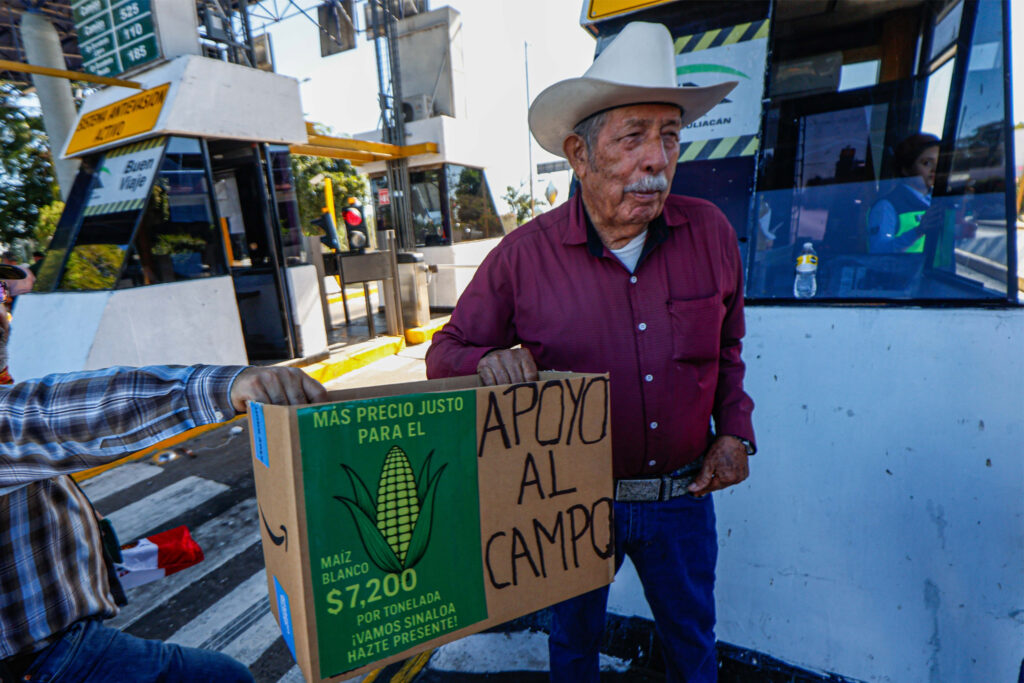
The USMCA is Causing a Decline in Mexican Agriculture
What can the phrase “Without corn, there is no country” mean when domestic corn production is on its last legs in the face of US dumping and the state’s inability to fight neoliberal free trade?