
Mexico’s Misguided Monetary & Trade Policies
This editorial by Arturo Huerta González originally appeared in the April 28, 2026 issue of La Jornada de Oriente, the Puebla edition of La Jornada, Mexico’s premier left wing daily newspaper. The views expressed in this article are the authors’ own and do not necessarily reflect those of Mexico Solidarity Media or the Mexico Solidarity Project.
Editor’s note: Arturo writes that several Canadian cities have removed US alcoholic beverages from their stores but the move has been far more significant: all Canadian provinces with the exception of Alberta and Saskatchewan (which only represent about 14% of Canada’s population) have banned US alcoholic beverages. This includes Ontario’s LCBO, which is publicly-owned and operated by the provincial government and one of the largest buyers of alcohol in the world.
On April 21, 2026, Omar Mejía, Deputy Governor of the Bank of Mexico (Banxico), stated that “the effects of inflation in Mexico are concentrated in the non-core basket of goods and services—agricultural products, energy, and government-regulated tariffs—which is characterized by its high volatility and sensitivity to supply shocks. Monetary policy, specifically the interest rate, has limited influence over this basket… and therefore has little impact on reversing the rise in agricultural prices.” He is mistaken in this assertion. If the national economy faces significant production shortfalls in basic grains, as well as in fertilizers, gas, and gasoline (which are the products of non-core inflation), putting pressure on prices and leading us to depend on imports to meet domestic consumption, it is due to the prevailing high interest rates that make credit and investment more expensive, thus hindering national production. Added to this is the fact that high interest rates encourage capital inflows, which appreciate the national currency, make the dollar cheaper, and increase imports. These imports displace domestic producers, threatening food sovereignty and self-sufficiency in basic grains and energy products. The rise in international prices for gasoline, gas, fertilizers, and food, among many other products, will affect us due to the already present international inflation. Mexico depends on imports of these products as a consequence of the prevailing high interest rates, which, along with the cheap dollar and budget cuts and reduced private investment (resulting from the high cost of debt servicing due to high interest rates), undermine national self-sufficiency in these products. Therefore, the national economy will face inflationary pressures that will not be temporary, as the Deputy Governor of the Bank of Mexico stated.
For his part, the country’s Secretary of Economy [Marcelo Ebrard] acknowledged on April 23, 2026, that it is unlikely the United States will eliminate the tariffs it has imposed on the automotive sector and the steel and aluminum industries. He stated that “the new U.S. trade approach moves away from free trade and favors a system of selective tariffs and stricter rules that require a greater proportion of products to be manufactured in North America.” He reiterated that “the ideal world is to have virtually no tariffs or as few as possible, and to maintain an open flow of trade,” which reflects his neoliberal stance in favor of free trade, as if Mexico were doing well. He completely disregards the fact that this has led us to import more and export less, to have less manufacturing, less production of basic grains, lower economic growth, less formal employment, lower wages, high levels of foreign ownership of the economy, high levels of indebtedness, and dependence on capital inflows, for which economic policy is geared toward promoting capital inflows at the expense of economic policies that favor productive growth and employment.
The Secretary of Economy stated that “we see ourselves as a highly integrated region. The United States wants to reduce its dependence on Asia. Mexico can be the United States’ great ally in producing all of that.” This reflects wishful thinking, given that the national economy lacks the technological, productive, and financial capacity to domestically produce the goods that transnational corporations have been importing from Asia. There is no monetary, exchange rate, credit, fiscal, or trade policy to promote import substitution, so the U.S. will force Mexico to import goods from the U.S. that previously came from Asia in order to comply with the region’s rules of origin. This will not result in any growth for national industry or the country as a whole.
The Secretary of Economy said that “we have to get used to a new reality; we’re going to have tariffs, there’s no more free trade.” If this is already a reality, it means that Mexico must not only establish tariffs on products from China and the rest of Asia, but also on those from the US, and safeguard the nation’s production of staple grains and other strategic products that have a high domestic multiplier effect. Industrial and agricultural policies must be implemented, which requires low interest rates, subsidies, increased public spending and investment, tariffs, and a competitive exchange rate.
Mexico should follow Canada’s example. Its Prime Minister has stated that if the US imposes tariffs, they will do the same, and other Canadian officials have indicated they will not allow US companies to participate in public procurement bids. Furthermore, several cities have already removed American alcoholic beverages from their stores in response to the tariffs imposed by Donald Trump.
The US isn’t just coming to Mexico in the USMCA negotiations to buy more and sell less; it’s coming for energy, especially now because of the war in the Middle East. The president of the American Society of Mexico (AmSoc) said on April 22, 2026, that “energy integration between Mexico and the United States is structural and strategic.” He stated that “Mexico cannot develop its energy fields alone; it absolutely needs to partner with US companies if it wants to make progress in the energy sector.” He is mistaken. Our country can perfectly well develop the energy sector by financing it with its own currency. It’s simply a matter of Banxico (the Bank of Mexico) buying direct government debt so that the government can spend sufficiently on energy development. This wouldn’t be inflationary, nor would it put pressure on the external sector or the exchange rate, since it’s a sector that saves and generates foreign currency. And this official added that “the review and renegotiation of the United States-Mexico-Canada Agreement (USMCA) is a priority for the thousands of companies participating in AmSoc; maintaining it is and will be a priority.” This demonstrates that the companies that have benefited from the USMCA have been transnational corporations, not domestic ones. Domestic producers have been displaced by imports, and those who remain are junior partners of transnational corporations, without this translating into greater growth for the national economy.
-
Defense of Sovereignty “Is Not Rhetoric, It’s Principles,” Sheinbaum Says
Sheinbaum recalled foreign pressure on Mexico in the 19th and 20th centuries and blamed the neoliberal governments and Calderón for opening the door to U.S. influence.
-
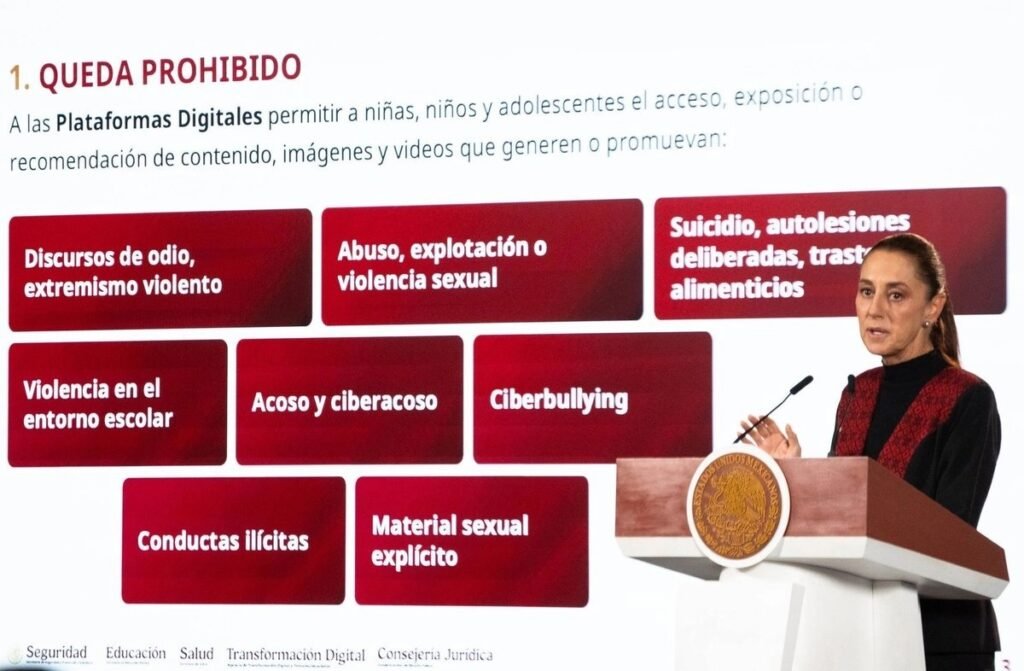
Sheinbaum Presents Draft Decree to Force Digital Platforms to Take Down Content That Incites Violence and Hate
No fines for now: the government will talk with tech companies before publishing the decree next week, a promise made after the Coahuila school attack.
-
People’s Mañanera October 9
President Sheinbaum’s daily press conference, with comments on digital safety, IMSS-Bienestar, sovereignty, and the opposition.