Mexican Government Will Allocate More Than 58 Billion Pesos to Educational Infrastructure in 2026
This article by Fernanda Monroy originally appeared in the July 13, 2026 edition of Contralínea, a Mexican investigative journalism magazine.
The government of Mexico will invest 58.415 billion pesos in educational infrastructure during 2026, the highest amount allocated by the federation to improve schools in the country, reported President Claudia Sheinbaum Pardo, who emphasized that the funds will be spent without counting the additional contributions of the state governments.
During her morning press conference, the president explained that the investment will be channeled through programs such as La Escuela es Nuestra (LEEN) and the Multiple Contributions Fund (FAM), with the purpose of rehabilitating and strengthening basic, upper-secondary, and higher education campuses.
It is a historic investment of 58 billion pesos for the country’s schools, without counting what the states invest directly; this is only what we invest from the government of Mexico.
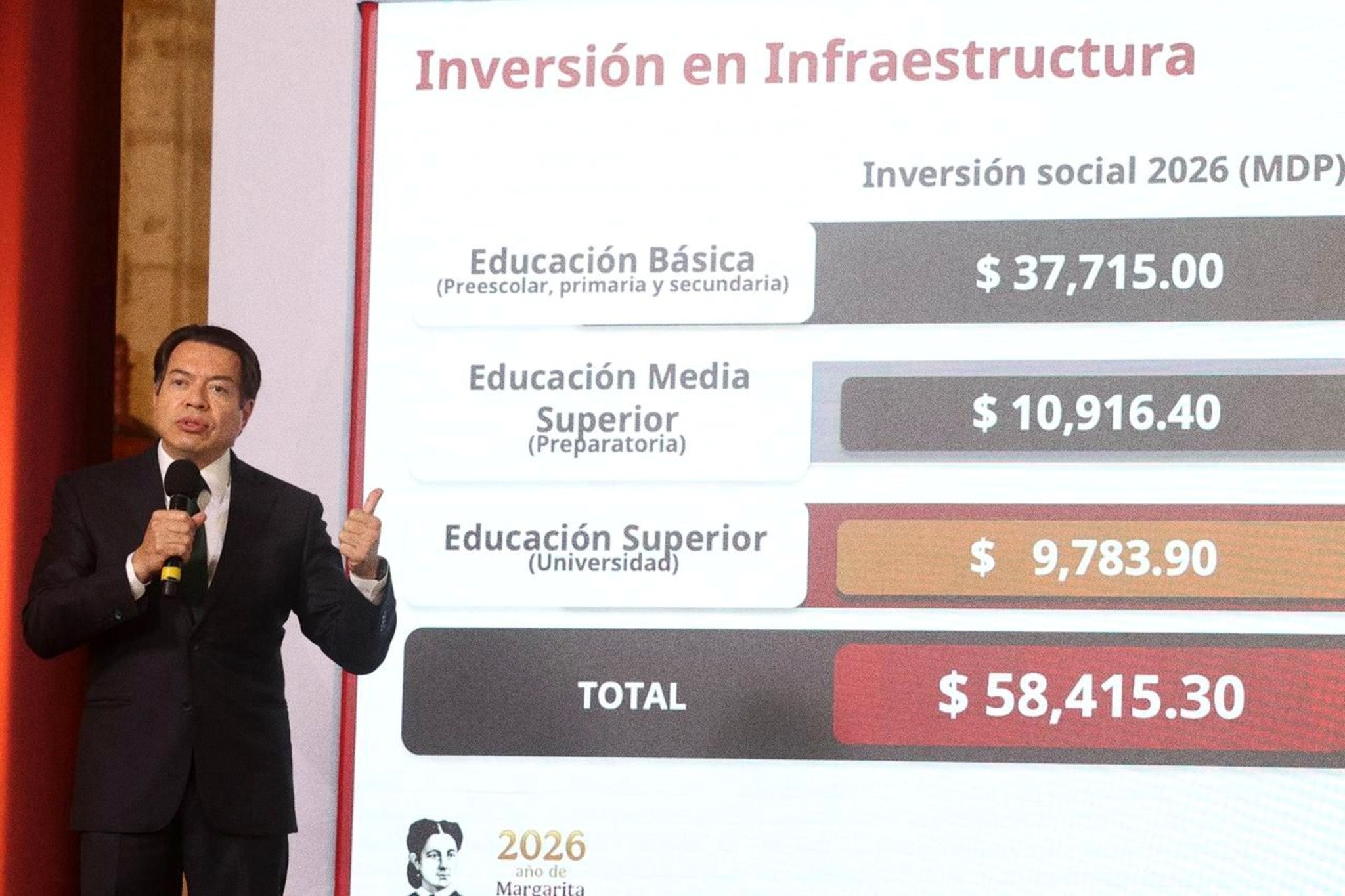
For his part, the Secretary of Public Education (SEP), Mario Delgado Carrillo, detailed that, of the total resources, 37.715 billion pesos will go to basic education, of which 22.694 billion correspond to the LEEN program and 15.021 billion to the FAM.
He specified that 10.9164 billion pesos will be invested in upper-secondary education, funds that will make it possible to build 31 new National Baccalaureates, carry out 80 expansions, four reconversions, and set up 370 campuses of the Margarita Maza National Baccalaureate, creating 156,240 new spaces for students.
In higher education, he added, 9.7839 billion pesos will be spent to strengthen the infrastructure of institutions such as the Rosario Castellanos National University, the National Technological Institute of Mexico, the system of Technological and Polytechnic Universities, the Normal Schools, the Benito Juárez García Universities for Well-Being, as well as intercultural and state universities and other classroom expansion projects.
In turn, the director general of La Escuela es Nuestra, Pamela López Ruiz, reported that during this year the program has benefited 71,482 schools through a social investment of 22.694 billion pesos, distributed with priority to campuses located in areas of greatest marginalization, vulnerability, and social lag.
She explained that the program serves everything from Multiple Attention Centers, initial education, preschool, primary, and secondary, to upper-secondary education campuses, with 100 percent coverage in public secondary schools and high schools incorporated into the scheme.
Sheinbaum Pardo noted that this investment adds to other actions promoted by her administration to strengthen the education system, among them the Well-Being Scholarships, salary increases for teachers, the Well-Being Pension Fund, and the school-by-school consultations to improve the teacher mobility system.
“There are many actions and programs to improve the education of the girls, boys, and young people of our country and to guarantee access to education as a right,” she affirmed.
Likewise, the head of the SEP reported that, together with the educational support programs, the federal government expects to close 2026 with 22 million students benefiting from the Well-Being Scholarships at all educational levels.
-
“They Want to Erase Us From the Digital Cloud”: Mixtec Engineer Asks Mexican Deputies to Use AI to Preserve Indigenous Languages
Speaking in tu’un savi from the Congress tribune, Moisés Hilario López proposed living digital archives of native tongues and AI trained on elders’ voices.
-
Mexico’s September 16 Military Parade Will Incorporate Tactical Drones and Nationally Made Armored Vehicles
First-ever 99-aircraft flyover, 45 debuting tactical drones, and DN11 vehicles with 100%-national remote weapons systems; 15,458 troops will march.
-
Sheinbaum Foresees 12 Million Families Benefited by the Housing Program by the End of Her Government
“The most important thing is having access to what we consider a right, which is decent housing,” Sheinbaum said.