Somos MX and the Media: Does Mexico’s New Party Revolve Around Salinas Pliego?
This article by José Shaddai Olvera Torres originally appeared in the July 13, 2026 edition of El Chamuco y los Hijos del Averno, a Mexican political satire magazine.
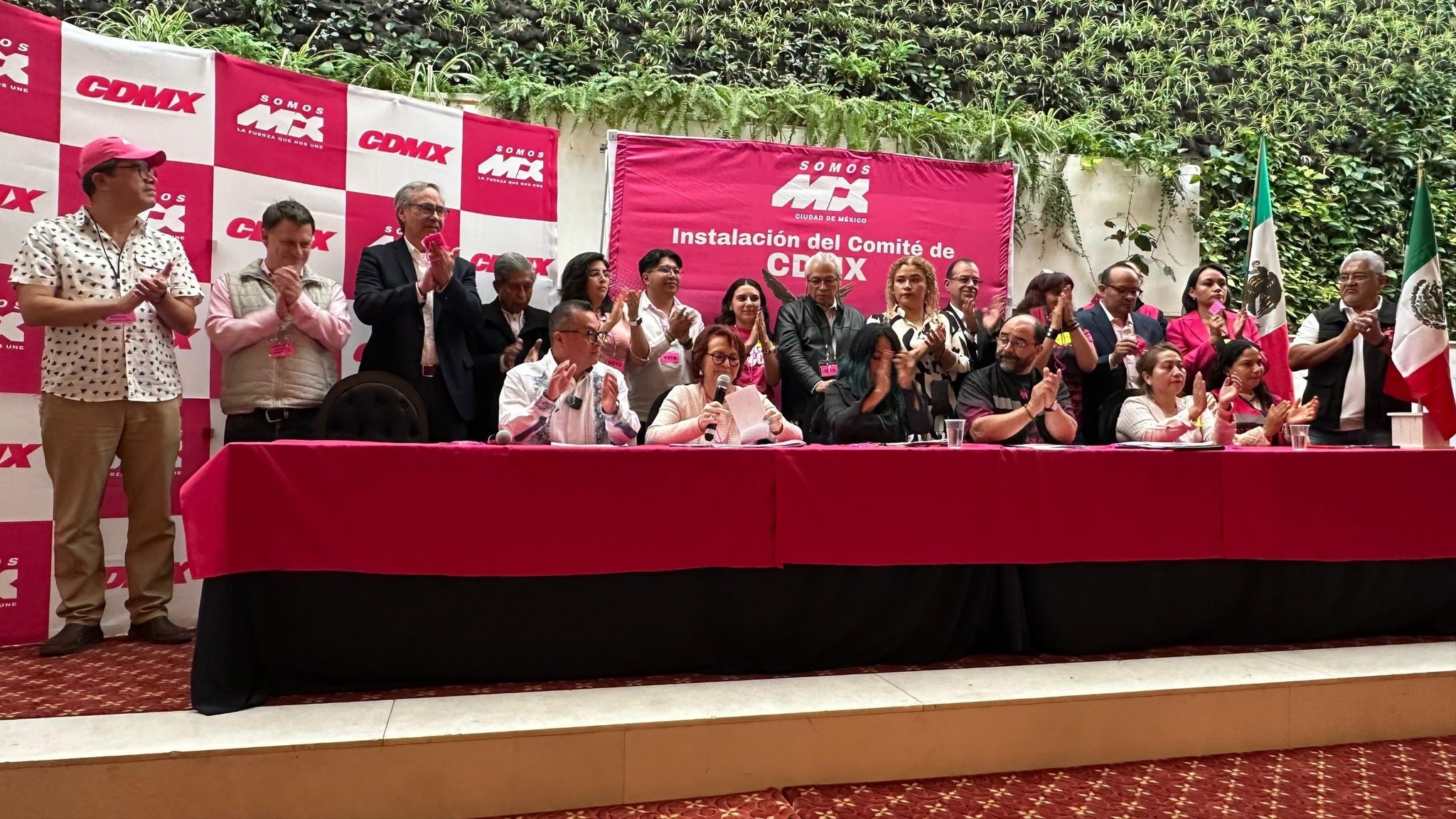
(July 13, 2026).- An analysis of the leadership of Somos MX argues that the new party lacks territorial bases and concentrates profiles drawn from the media, former officials, and commentators, which opens the debate on the growing mediatization of Mexican politics.
Is Somos MX a Media Party? An Analysis of Its Political Structure
The recent registration of Somos MX as a national political party has opened a debate about the nature of its internal structure. Beyond its declaration of principles, a review of its leadership makes it possible to propose a hypothesis: the party seems to be organized more around the media capital of its members than around social organizations or territorial leaderships.
The analysis proposes looking at the party through the theory of political communication and asking whether, instead of representing traditional social sectors, it functions as a network of figures linked to the media.
From Mass Parties to Media Politics
For decades, Mexican parties were structured through social organizations, unions, internal currents, or regional leaderships.
The PRI was organized by sectors; the PAN through internal processes and political groups; the PRD around currents; Morena, to a large extent, through electoral and territorial leaderships.
The text argues that Somos MX breaks with that model.
Instead of building a territorial base, it brings together profiles drawn mainly from three groups:
- former members of the Judiciary;
- former INE officials;
- former PRD leaders.
To them are added journalists, analysts, academics, and commentators with a constant presence in the media.
The Theory of “Political Parallelism”
To explain this phenomenon, the analysis draws on the proposals of Daniel Hallin and Paolo Mancini on media systems.
Their concept of political parallelism holds that the media reflect the political divisions of a society and can become actors that directly influence political competition.
The author argues that this evolution has deepened in recent decades, to the point that media capital can replace territorial leadership as the main resource for party building.
Which Media Appear in the Leadership?
The exercise identifies collaborators or participants from various media within the party structure.
Among them, it mentions:
- El Universal
- Este País
- Aristegui Noticias
- Nexos
- TV Azteca
- Siempre
- Animal Político
- Aurora
- El Economista
- El Heraldo
- El País México
- Proceso
- LatinUS
- Radio Fórmula
- Reforma
- Letras Libres
The text clarifies that this does not necessarily imply that those media institutionally represent the party, but rather that there is a coincidence between media careers and political participation.
The Case of TV Azteca and Grupo Salinas
One of the sections focuses attention on profiles directly linked to the companies of Ricardo Salinas Pliego.
The analysis notes that members connected to TV Azteca, the Universidad de la Libertad, and Kybernus hold positions within the party structure.
On that basis, it poses as a hypothesis that there could be a different kind of relationship compared to other media collaborators, since some of those profiles depend on the business group for their employment and not only for their public presence.
The text emphasizes that this is an interpretation by the author and not a proven fact.
Could It Become a Presidential Platform?
The final part develops an additional hypothesis.
Taking as a reference international cases such as that of Silvio Berlusconi in Italy, the author raises the possibility that a media businessman could use a party structure as a political platform.
He does not maintain that this will happen, but rather considers that this possibility deserves to be watched as the party’s consolidation advances and the 2027 and 2030 electoral processes approach.
An Increasingly Media-Driven Politics
The analysis concludes that Somos MX represents a phenomenon different from that of traditional parties.
Its main strength would be the media presence of its members rather than the existence of social organizations or territorial structures.
In the author’s judgment, this raises questions about the future of political representation in Mexico and about the weight that the media can have in the formation of new party projects.
-
“They Want to Erase Us From the Digital Cloud”: Mixtec Engineer Asks Mexican Deputies to Use AI to Preserve Indigenous Languages
Speaking in tu’un savi from the Congress tribune, Moisés Hilario López proposed living digital archives of native tongues and AI trained on elders’ voices.
-
Mexico’s September 16 Military Parade Will Incorporate Tactical Drones and Nationally Made Armored Vehicles
First-ever 99-aircraft flyover, 45 debuting tactical drones, and DN11 vehicles with 100%-national remote weapons systems; 15,458 troops will march.
-
Sheinbaum Foresees 12 Million Families Benefited by the Housing Program by the End of Her Government
“The most important thing is having access to what we consider a right, which is decent housing,” Sheinbaum said.