Guadalajara’s Water at Risk of Privatization
This column by Pedro Mellado originally appeared in the July 31, 2026 edition of SinEmbargo, one of Mexico’s leading independent digital news outlets.
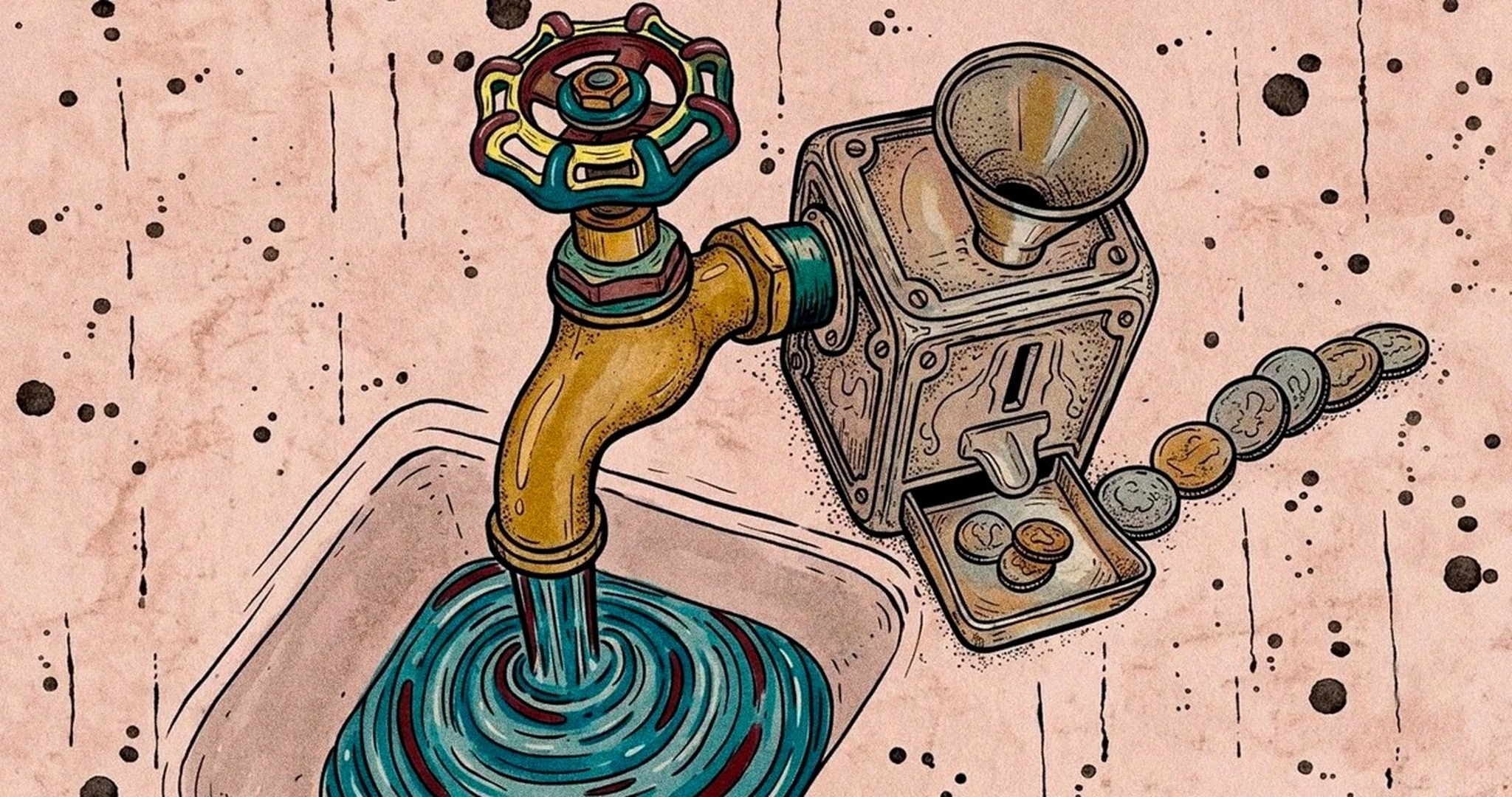
“Business cannot be placed above social need and the State’s obligation to guarantee the human right to water.”
In the Guadalajara metropolitan area live 5,110,000 people, and at least 1,200,000 subscribers are users of the Intermunicipal System of Potable Water and Sewerage (SIAPA). After the conurbations of Mexico City and Monterrey, Guadalajara’s is the third most populated metropolitan area in the country. And the Governor of Jalisco, Jesús Pablo Lemus Navarro, is seen to be very eager to close deals with private companies that, he assures, are willing to invest in some SIAPA projects to resolve the serious health crisis represented, for several months now, by the supply of dirty, unsanitary, and foul-smelling water that millions of people in the Guadalajara conurbation suffer.
The governor has shown no interest whatsoever in establishing a broad, open technical roundtable, with experts and representatives of society and of users, to lay out a route that would allow the problem to be resolved, and he deepens the distrust of those who oppose any threat of water privatization in the Guadalajara metropolitan area. In Jalisco the water utility is administered by the state government and has on its board of directors representatives of the municipalities of Guadalajara, Zapopan, Tlaquepaque, and Tonalá, who are practically never taken into account.
The nauseating stench of distrust framed the words of the businessman Lemus Navarro, turned into Governor of Jalisco by a stroke of fortune and with the support of Movimiento Ciudadano, when he announced this past Wednesday, July 28, 2026, that he already has four investors, four offers already submitted, from those who are set to participate in public-private partnership schemes, and he asked the National Water Commission to move quickly on the technical validation of projects, which would allow his Administration to carry out the financial analysis. The presumption is that those investors would finance a new Chapala-Guadalajara aqueduct and the renovation of the main water treatment plant in the Guadalajara metropolitan area.
In announcing that there are already four investors interested in doing business with water, the government of Pablo Lemus gets far ahead of itself, because if the projects have not been defined and approved by the National Water Commission or by an independent, top-level technical committee, if potential investment amounts have not been quantified and there are no executive projects, and if criteria have not been defined to tender those potential projects, it is inexplicable that negotiation or participation of four companies or businessmen interested in investing is already being anticipated.
All of this is contradictory with what is established on page 8 of the so-called “Technical Bases for the Prioritization of Strategic Interventions for the Water Security of the Guadalajara Metropolitan Area,” delivered by the Government of Jalisco to the state Congress on Tuesday, July 14, 2026.
That document warns: “These Technical Bases do not constitute the instruments of strategic planning, nor do they determine in advance the specific solutions that must be adopted. Nor do they represent, in themselves, decisions of programming, financing, authorization, or execution.”
The “Technical Bases” booklet further adds: “These determinations will correspond to later stages of planning, in which the various alternatives must be evaluated according to their technical, economic, financial, environmental, social, legal, and institutional feasibility.”
The very preliminary character of those “Technical Bases” is clarified on page 11: “The present document constitutes the technical foundation for the formulation of an action plan that contributes to addressing the identified problem. Its function consists of integrating the available evidence, identifying the structural constraints of the system, determining the capacities that require strengthening, and establishing criteria for the subsequent evaluation and prioritization of alternatives.”
The aforementioned document is very emphatic: “By their nature, these Technical Bases do not imply, in themselves, the authorization, programming, financing, or execution of specific actions. These determinations will correspond to the later stages of planning and must be based on the applicable studies and procedures.”
So then, on the basis of what criteria has the Government of Jalisco established dialogue and begun negotiations with four potential investors to finance projects of the Intermunicipal System of Potable Water and Sewerage of Guadalajara?
Is private investment, the business of water, the panacea for resolving the problems of the supply of dirty and foul-smelling water that the users of the Guadalajara metropolitan area suffer?
Sergio E. Gómez Partida, a consultant in evaluation, results-based management, and planning in the public, private, and social sectors, who in 2012 audited the privatized potable water system of the City of Aguascalientes, makes some important observations.
“In my experience in Aguascalientes (2012), where I was tasked with auditing the concession (company, contract, and compliance performance) from a technical analysis of processes-products-results, I can assure you that the private sector is more ‘ingenious’ at pulling off shady tricks than the public sector. There the French company (Veolia), tied to a Mexican corporate group, set about extracting significant flows of profit, many of them through breaches of the contractual commitment and others through simple imagination to raise dividends.”
That company, Gómez Partida points out, even engaged in “manipulation at the level of the user registry and the commercial system. [Private companies] have more imagination for corruption than any public entity. The key is to consolidate the State’s stewardship and regulation, from the perspective of a complex system, because part of the ‘trap’ is to make the water utilities appear as ‘technical entities,’ that is to say, institutions dedicated [only] to the ‘physical-chemical’ issue of water.”
Consultant Gómez Partida explains that granting a concession or involving the private sector in water operations is a complex matter, one that includes the environmental, the economic, the social, the institutional, and also the physical-chemical; for that reason, what he calls the “engineering kidnapping” I describe as a deceitful measure. He considers that in any public-private agreement there are risks if there is a lack of public stewardship over the private, which must translate into a broad and solid system of regulation.
For his part, Arturo Gleason Espíndola, a doctor in urban planning and an expert in the management of water resources, stated that the problem of the infected and foul-smelling water supplied to users in Guadalajara is not resolved by privatizing SIAPA nor by requesting more federal resources without first presenting a precise, up-to-date, and independent technical diagnosis that identifies the real causes of the crisis.
“It is worrying,” warns Dr. Gleason Espíndola, “that the plan presented [by the Government of Lemus Navarro] is disjointed and shows evident signs of having been produced almost entirely with Artificial Intelligence, without the technical support that a problem of this magnitude demands. Jalisco needs decisions based on evidence, transparency, and long-term planning, not improvisation.”
Water cannot be privatized nor can it be subject to commercial criteria of profitability or profit, because the General Water Law is very clear in establishing in its article six that, as the General Constitution of the Republic establishes, “every person and community must enjoy the human right to water, without any distinction and without exclusions, distinctions, or restrictions by the authorities or by private parties that undermine human dignity.”
The General Water Law further adds: “Priority attention must be given to the sectors in a situation of greater vulnerability, marginalization, and lack of protection of the population.” For these reasons, the potable water for human consumption that the State is obligated to supply cannot be a business.
Article 9 of the General Water Law is categorical: “The water utilities may not totally suspend the supply of potable water and the sanitation service for lack of payment; in any case, they must supply the minimum quantity for basic human consumption.”
In addition, the General Water Law clarifies in its article 28 that it falls to municipal governments to “guarantee the provision of the public services of potable water, drainage, sewerage, treatment, and disposal of their wastewater, considering them a human right of priority attention.”
And it empowers them to “coordinate and, where appropriate, associate with other municipalities and with the competent state authorities for the establishment of intermunicipal water and sanitation systems, with the aim of guaranteeing the adequate provision of the public services of potable water, drainage, sewerage, treatment, and disposal of wastewater, under the terms provided by the applicable regulations.”
Any initiative by the government of the Movimiento Ciudadano member Jesús Pablo Lemus Navarro to accept investments in the Potable Water System of the Guadalajara metropolitan area would have to be the object of a detailed technical analysis, with the participation of independent specialists, experts from public and private higher-education institutions, and observers from society at large representing the users, and after a broad discussion in the Congress of Jalisco. And of course, with the endorsement of the federal government, which exercises its stewardship through the National Water Commission.
The privatizing temptations are latent, and the deepening of the problem of the infected and foul-smelling water feeds the urgency of the population, an argument that could be used by the Government of Jalisco to pressure and justify turning the operation of the Intermunicipal System of Potable Water and Sewerage of the Guadalajara Metropolitan Area into a private business. Business cannot be placed above social need and the State’s obligation to guarantee people their human right to clean, clear, and potable water.
Pedro Mellado Rodríguez
A journalist who, for five decades, has been a keen and critical observer of public life in Mexico. He has covered all news beats and held every possible position in the media. He has worked in print, radio, television, and digital media. His column, "Puntos y Contrapuntos" (Points and Counterpoints), has been published for four decades in newspapers such as El Occidental, Siglo 21, and Mural in Guadalajara, Jalisco. He studied law at the University of Guadalajara and for a decade was a journalism professor at ITESO, the Jesuit University of Guadalajara. He is the author of the book "Las Naves Nodrizas de la Comunicación y el Periodismo" (The Motherships of Communication and Journalism) (Taller Editorial La Casa del Mago, Guadalajara, 2022).-
73,000 Doctors Have Applied for Mexico’s Primary Health Care Clinics Initiative
The clinics will offer free care and 60 basic medicines starting in January, while home visits have already detected more than 568,000 hypertension patients.
-
US Ambassador Johnson Acts Like a Meddling Policeman, AMLO Says
In his new book Pueblo, López Obrador calls the revoking of his son’s visa “villainous” and accuses U.S. agencies of fabricating cases with phony evidence.
-
Ambassador of Palestine Asks Mexico to Review Companies Linked to Israeli Settlements
The UN has identified 214 companies tied to Israel’s settlements in Palestinian territory, among them the Mexican conglomerate Orbia.