
New Poll Says Morena Has 35% Support for 2027. PAN, 11; PRI, 9; MC, 9
This article by the editorial staff of SinEmbargo originally appeared in the September 7, 2026 edition of SinEmbargo, a Mexican digital news outlet.
Mexico City, September 7 (SinEmbargo).— Just days before the start of the 2026-2027 electoral process, Morena maintains a wide lead heading into the federal deputies election, while the opposition does not have a defined second place, reveals the recent national in-home survey by Buendía & Márquez, exclusively for El Universal.
The consulting firm details that, if the elections were held today, Morena would concentrate 35 percent of electoral preference, followed by the National Action Party (PAN) with 11 percent. Meanwhile, the Institutional Revolutionary Party (PRI) and Movimiento Ciudadano (MC) would each obtain nine percent. The Ecologist Green Party of Mexico (PVEM) would reach five percent and the Labor Party (PT), two percent.
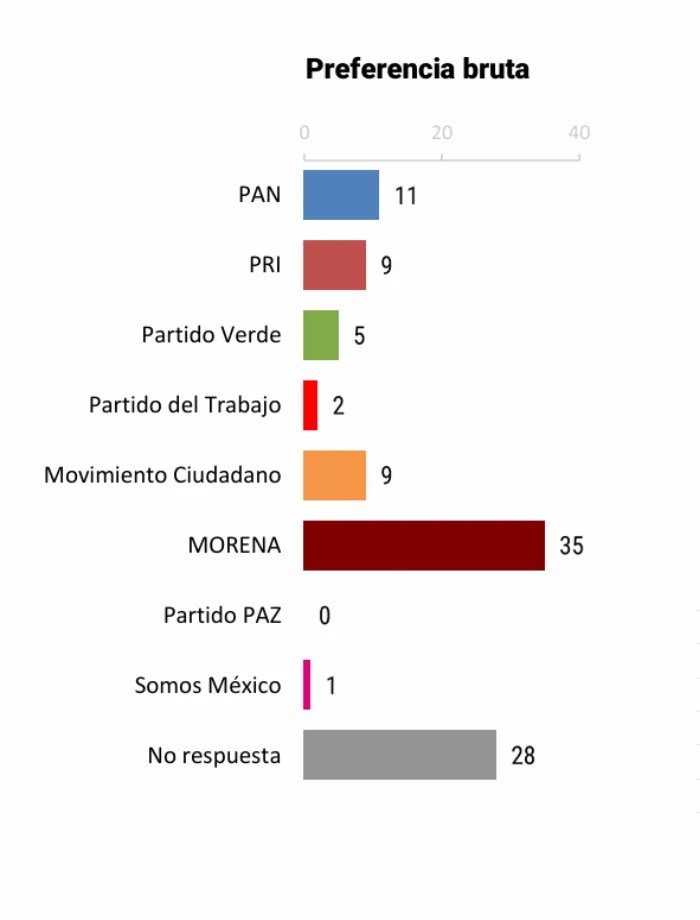
The Buendía & Márquez survey notes that 28 percent of those consulted did not state an electoral preference, so that, removing that proportion, the guinda bench reaches 48 percent of the effective preference. The PAN stands at 15 percent; the PRI, at 13 percent; and MC, at 12 percent.
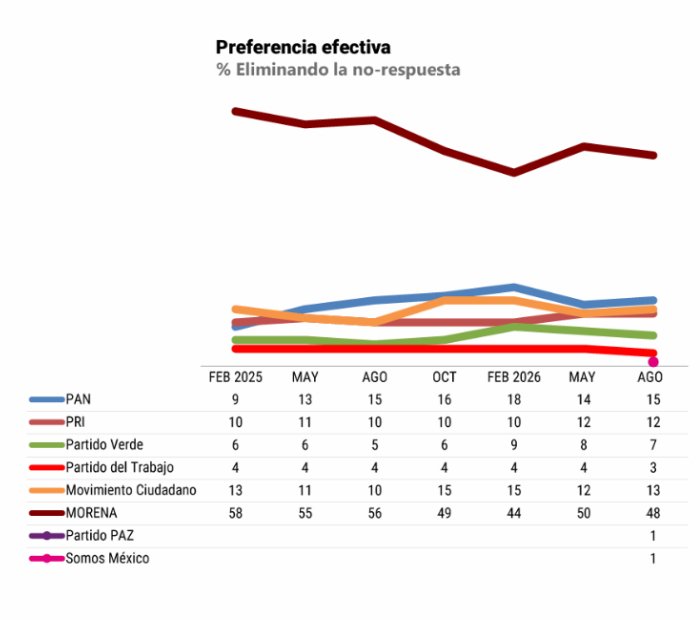
It is important to note that, although the PAN has the highest estimate among the opposition, the Mexican consultancy warns that its lead over the PRI and MC is not wide enough to determine with statistical certainty which party occupies second place. Nonetheless, it appears recurrently in the Buendía & Márquez series of measurements, which points to a small but consistent advantage over its competitors.
On the other hand, the newly created parties still show an incipient electoral presence. According to the firm’s figures, PAZ registered no mentions in the sample; while Somos had just one percent.
According to Buendía & Márquez, the electorate is divided regarding the country’s direction, since 41 percent of those consulted consider that Mexico is on a good or very good path, while 43 percent think it is on a bad or very bad path.
However, that discontent has not so far concentrated on a single opposition alternative. Thus, according to the figures recorded by the consultancy, the PAN obtains 27 percent of the effective preference among those who consider that Mexico is on the wrong path, followed by the PRI and MC, which capture 19 percent each. Morena, for its part, retains 22 percent of the effective preference among those who have a negative perception of the country’s direction.
Despite this, the guinda party continues as the best-rated political force, with 56 percent positive opinions and 29 percent negative opinions, representing a favorable balance of 27 points.
Movimiento Ciudadano registers a positive balance of six points and the PVEM of three, while the PT is practically in neutral territory, at minus one. In contrast, the PAN and PRI hold the largest negative balances, at minus 27 and minus 39 points, respectively, Buendía & Márquez explains.
The pollster also asked those consulted about some of the issues that have occupied the recent public agenda. On that front, 78 percent said they had heard news related to gasoline smuggling, or “fiscal huachicol,” making this the topic with the highest level of awareness among those included in the measurement.
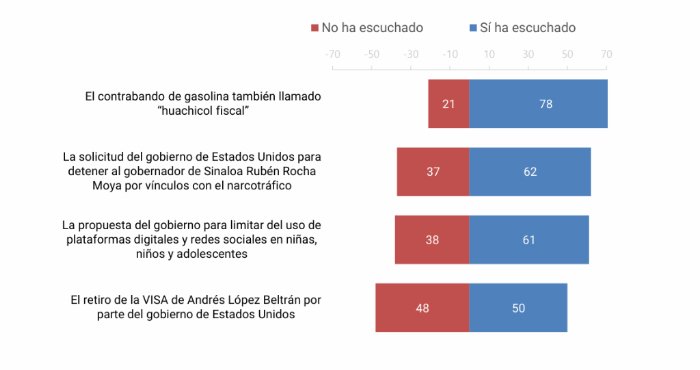
In addition, 62 percent are aware of the request by the Southern District of New York Prosecutor’s Office to detain the governor of Sinaloa on leave, Rubén Rocha Moya. Meanwhile, 61 percent have heard about the proposal to limit the use of digital platforms and social media among children and adolescents; and 50 percent are aware of the withdrawal of the visa of Andrés López Beltrán, son of former president Andrés Manuel López Obrador (AMLO), by the US government.
However, Buendía & Márquez warns that awareness of these events does not necessarily imply a change in electoral preferences. One example is the perception of the withdrawal of visas from Mexican politicians, on which public opinion is practically divided.
According to the figures gathered by the consultancy, 46 percent of those surveyed believe that withdrawing a visa is a decision by the United States (US) to determine who enters its territory, while 45 percent interpret it as a form of political intervention in Mexico.
The different stances do show variations in electoral preferences, although they do not substantially change the parties’ positions. Thus, among those who consider that the withdrawal of visas is a US decision, Morena obtains 41 percent of the effective preference, against 16 percent for the PAN, 16 percent for MC, and 13 percent for the PRI.
In contrast, among those who interpret the withdrawal of visas as a form of political intervention, Morena reaches 53 percent; the PAN obtains 15 percent; the PRI, 12 percent; and MC, 11 percent, says Buendía & Márquez.
With these results, the survey outlines a competition in which Morena retains a wide advantage for the upcoming elections, while the opposition faces the fragmentation of its preferences as one of its main challenges.
-
Mexico Meets Minimum Annual Water Delivery to the US Despite Extreme Drought
Washington’s Agriculture Secretary confirmed the 350,000 acre-feet, but pressed Mexico to keep delivering and repay the “water debt owed to Texas farmers”.
-
Reading AMLO
“That is hegemony: being able to offer a direction for society as a whole, governed from a social class that has conquered political power,” writes Mejía Madrid.
-
Maru Campos Betrays Everyone, Even the President, Morena Leader Says
Ariadna Montiel said Campos broke Sheinbaum’s trust by airing a private talk, and should face treason charges for letting CIA agents into Chihuahua.