Afro-Descendants in the Independence
This article by Felipe Ávila originally appeared in the September 27, 2026 edition of La Jornada, Mexico’s premier left wing daily newspaper.
It has often been said that the War of Independence was a movement led by the criollos, who culminated and capitalized on that process. It has been claimed that the popular sectors were not clear about why they were fighting and only followed their leaders, or chiefs, who came from the elites of New Spain.
However, it is necessary to stress that the Independence of Mexico was a great popular revolution that was made possible by the participation of tens of thousands of men and women from the poorest and most marginalized popular sectors; who rose up in arms to fight not only for the Independence of Mexico, but to build a more just and egalitarian society, putting an end to slavery, to tribute and to the division into castes by social origin and skin color. That is why they followed and fought alongside Hidalgo, Morelos, Guerrero and many other insurgent leaders, because these leaders knew how to understand their feelings and aspirations.
The poor people identified with them and formed a community that made possible the triumph after 11 years of war that destroyed the foundations of the colonial regime.
Those who swelled the insurgent ranks were above all Indigenous people and Afro-descendants, called negros or mulatos. The massive participation of entire peoples and communities was a cry of freedom and rebellion to put an end to an oppressive social system that was imposed on them by force, that destroyed a good part of their culture, that murdered many of their warriors and priests, that raped their women, that prohibited their religious practices, took away their lands and imposed on them a new political order, as well as new laws, institutions, tributes, language and religion.
Those who suffered most from those abuses and humiliations were the Indigenous and Afro-descendant communities, who managed to survive through constant everyday resistance, many times hidden and other times open, with rebellions that sought to improve their living conditions and defend their culture, their traditions, their communal organization of labor, their traditional authorities, their lands, forests and waters.
The Independence of Mexico would not have been possible if the Indigenous and Afro-descendant communities of the south of New Spain had not kept the libertarian flame burning after the execution of Morelos in December 1815. In the most difficult years of the insurgent war, when its main leaders had been killed, the resistance of the Indigenous people and Afro-descendants of Tierra Caliente, of La Montaña and of the Costa Chica and Costa Grande of what is today the state of Guerrero, as well as of the sierras of Puebla and Oaxaca, kept up the struggle and could not be defeated by the royalist armies, whose number reached 40,000 soldiers in those years.
In that southern region, the Indigenous and Afro-descendant communities had supported Morelos in his military campaigns and had swelled the ranks of the Galeana brothers and of Vicente Guerrero. They were communities and peoples with a great identity and collective cohesion. The young men joined the insurgent armies, while their fathers, mothers, grandparents, uncles and siblings helped and committed themselves to the insurgent cause in different ways.
The whole people was with them. That is why the royalist troops could not put an end to that resistance. For that reason, they often burned villages, executed their inhabitants en masse, imprisoned the women and deported the men who were not in a condition to fight.
Vicente Guerrero was the most important insurgent leader of that period. He had stood out for his bravery and military and organizational ability, and for the backing he had from the Indigenous, Black and mulato communities of the south of New Spain. African blood ran through his veins. He had made the ideals of Hidalgo and Morelos his own.
He was a firm supporter of Independence, but also of establishing equality among all, without distinction of ethnicity, wealth or skin color. The abolition of slavery and of the division into castes, together with absolute independence from Spain, were his main banners, and he had the unconditional support of the Indigenous and Afro-descendant communities, who saw in him one of their own.
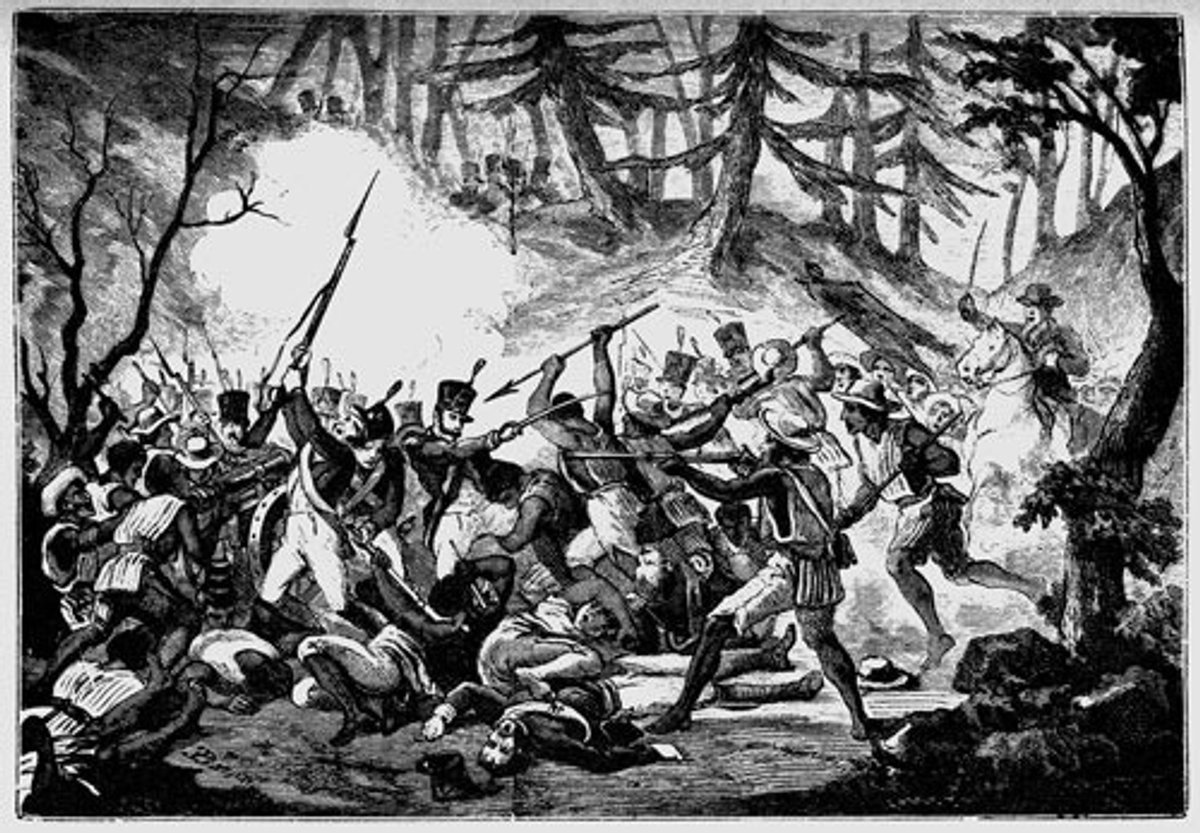
Guerrero’s army was made up mostly of Black and mulato men who made possible the triumph of the insurgent cause. Among them was Juan del Carmen, a mulato from Tlacoachistlahuaca, born in 1790, who joined Guerrero in 1811; he reached the rank of colonel and took part in several of the main military operations in La Montaña and the Costa Chica between 1812 and 1817. Guerrero held him in esteem and made him his lieutenant.
The troops of Guerrero and Juan del Carmen had a broad knowledge of the terrain: rugged sierras, deep ravines and the bravery of the guerrillas made them unbeatable. One tactic that worked for them was to establish fortifications in towns or villages high in the sierra. Mothers, wives, children and relatives of the combatants took refuge there. They set up small factories for munitions and cannons; they had blacksmith shops, carpentry shops; the civilian population helped with different tasks.
The royalist armies, which outnumbered them in soldiers and weaponry, could not defeat them. Thus the resistance was sustained between 1815 and 1821. One of the main forts was on the hill of Xonacatlán, where Juan del Carmen had 300 combatants. In March 1817, the viceroy sent a strong military contingent against that small fort. It took them a month to defeat the rebels. Juan del Carmen died on March 3.
It was a great loss for the insurgent cause. Guerrero stated that it was not for lack of courage, but for lack of food and water, that they had been defeated, and he erected a memorial in the church of San Pedro in Xonacatlán, in honor of Juan del Carmen, where he is still remembered today.
Felipe Ávila
Director of the National Institute of Historical Studies of the Revolutions of Mexico (INEHRM).
-
Hurricane ‘Polo’: Mexican Navy Deploys Nearly 3,000 Personnel in Support of Baja California Sur
Now a Category 3 and expected to make landfall Monday as a Category 2, the storm has prompted 111 temporary shelters and port closures from Nayarit to Los Cabos.
-
PT Rejects Rupture With Morena; “We Will Always Go With the President,” Alberto Anaya Says
Despite threats from some PT leaders to drop the alliance over Morena’s choice of state coordinators, the party says the 2027 negotiating table is going well.
-
Sheinbaum: No Elite Determines the Destiny of the Homeland
Before 20,000 people in Hermosillo, days ahead of a Senate debate, the president defended requiring sole Mexican nationality to run for president or governor.