Mexico City Government Delivers 106 New Apartments in Gustavo A. Madero
This article by Darylh Rodríguez originally appeared in the July 10, 2026 edition of Contralínea, a Mexican investigative journalism magazine.
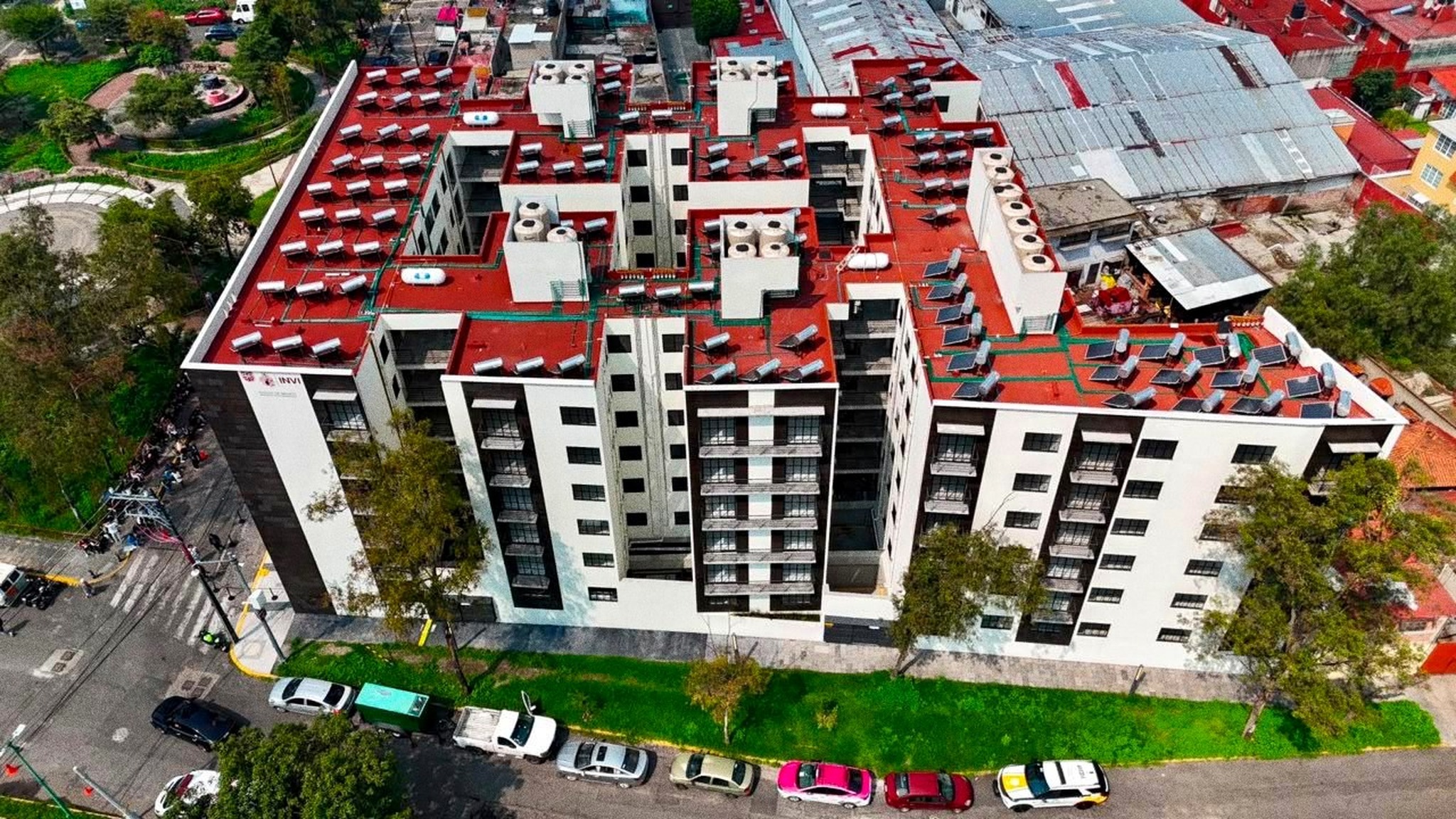
As part of the strategy to expand access to affordable housing in the capital, the Mexico City government delivered 106 social-interest apartments to families in the Santa Isabel Tola neighborhood, in the Gustavo A. Madero borough. The development, built with an investment of nearly 100 million pesos, consists of homes between 60 and 65 square meters.
On this matter, the capital’s head of government, Clara Brugada Molina, reported that the housing complex will benefit 106 families; that is, the equivalent of 424 people, who will access their homes through zero-interest public credits, granted according to their ability to pay. The head of government affirmed that the delivery of a home represents “restarting a life,” considering that these properties are the result of years of effort, work, organization, and management by the benefiting families.
“Today 106 completely new homes are being delivered that benefit 424 people. Here an investment of almost 100 million pesos was made to build more than 8,400 square meters. Each apartment has almost 60 square meters and meets all the international habitability criteria such as security of tenure, basic services, adequate materials, sufficient space, accessibility and, of course, a very affordable price,” the Mexico City leader maintained.
Regarding the costs, Brugada specified that each apartment had an approximate value of 928,000 pesos, a figure that, she affirmed, is below the average price of the real estate market in Mexico City, where a home of similar dimensions can reach between 2 and 4 million pesos. In that sense, she assured that the delivered homes represent a cost between three and five times lower than that of the real estate market.
Likewise, she noted that the housing complex incorporates eco-technologies and systems for water use, as well as energy transition mechanisms. With this, she explained that its location, which is about 10 minutes from the Indios Verdes station on Line 3 of the Metro Collective Transport System, seeks to facilitate families’ access to services and workplaces, because, she said, her administration’s housing policy has shown that it is possible to build accessible and cheap housing, and that it is an example of co-production between social organizations and her government, which put the families who have the least at the center.
“It is a model in which people organize themselves and the government promotes housing as a powerful mechanism for the decommodification of land, which we have to protect for the coming generations,” she stated.
Meanwhile, Mexico City’s Housing Secretary, Inti Muñoz Santini, noted that the housing development located at Huitzilihuitl 194, in the Santa Isabel Tola neighborhood, is the result of joint work between neighborhood organizations and the capital’s government. He added that 40 of the 106 apartments were assigned to people registered on the applicant list of the Housing Institute (Invi), with the purpose of expanding access to this program.
He also reported that with this delivery the Mexico City government is approaching 2,000 homes delivered so far in 2026, and maintains around 9,000 more under construction. He added that the goal is to surpass 30,000 housing actions this year and reach 200,000 during the six-year term, backed by an annual investment of 9 billion pesos in this area.
-
People’s Mañanera October 21
President Sheinbaum’s daily press conference, with comments on Pemex, fuel theft, Jalisco’s water crisis, missing persons, and the lie detector.
-
Jáuregui’s Arrest Does Not Close the CIA Case in Chihuahua; Morena Demands Broader Investigations
Morena leader Ariadna Montiel holds Governor Maru Campos politically responsible and says ex-prosecutor Guillermo Zuany must also face justice.
-
Morena Accuses Violation of the Secular State Over Award Ceremony for Evangelicals in the Chamber of Deputies
A representative of Israel’s embassy attended the PRI-hosted event, and the group’s founder was arrested in the U.S. for drug trafficking in 2007, Morena deputies said.