Sheinbaum Announces Historic Electricity Expansion Plan of 32,000 Megawatts; 70% of Them from Renewable Sources
This article by Arturo Sánchez and Alma E. Muñoz originally appeared in the June 24, 2026 edition of La Jornada, Mexico’s premier left wing daily newspaper.
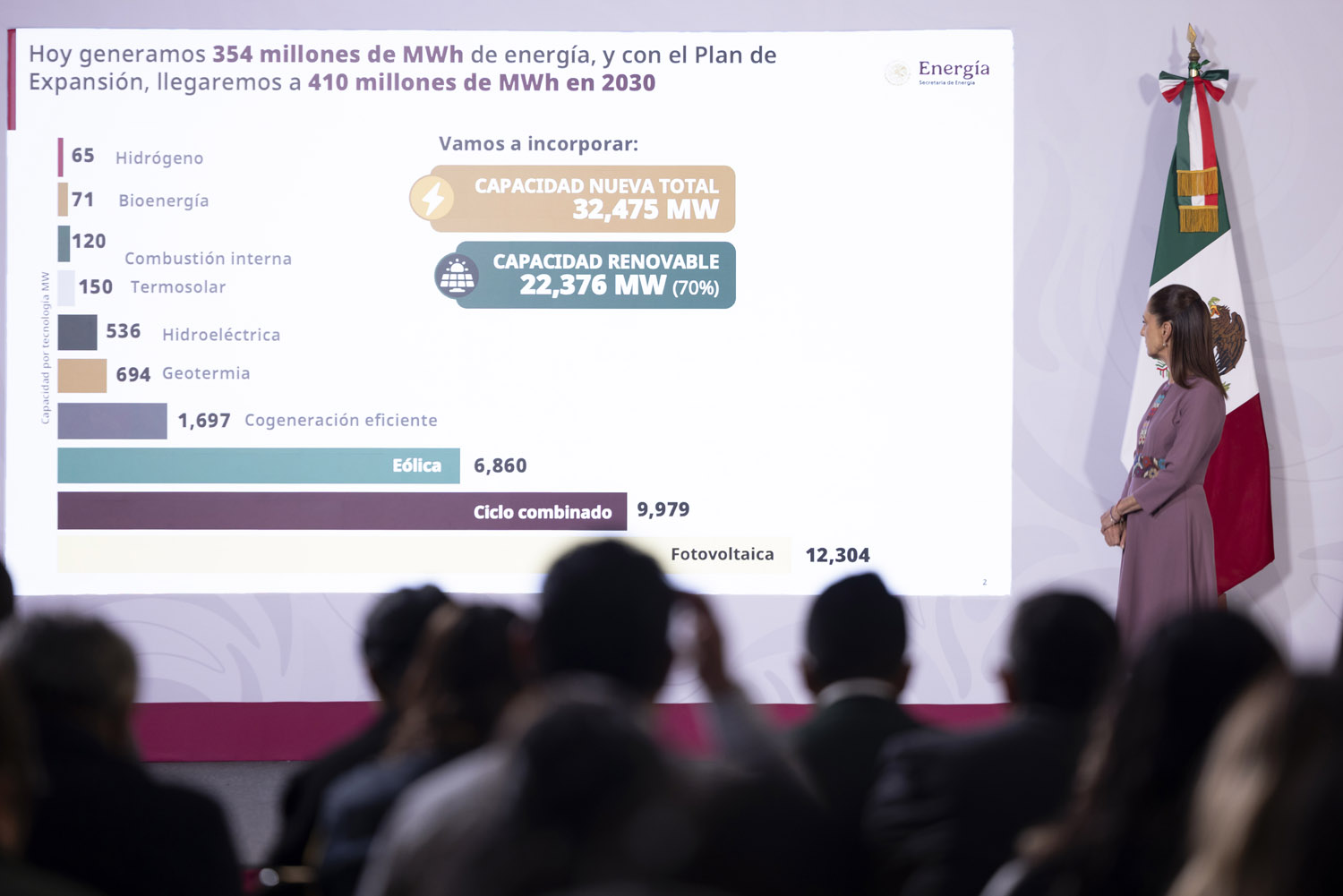
Mexico City. The federal government announced this Wednesday an electricity expansion plan that will allocate 739 billion pesos to add 32,000 megawatts (MW) of generation capacity to the national electrical system before the six-year term ends in 2030, of which 22,376 MW —70 percent— will come from renewable sources: photovoltaic solar, wind, concentrated solar power, geothermal, and hydroelectric.
“For the first time in history we have projects of 32,000 MW; something historic in six years, and 70 percent of them are renewable,” President Claudia Sheinbaum Pardo declared at her morning press conference at the National Palace.
With this plan, the country will go from generating 354 million megawatt-hours (MWh) of electricity per year to 410 million MWh in 2030, and will raise the share of renewable sources in its energy mix from the current 23-24 percent to 38 percent, an increase of 15 percentage points in five years.
The president described the announcement as “historic, unique, and an enormous effort for the benefit of the people of Mexico and of energy sovereignty.”
The Secretary of Energy, Luz Elena González Escobar, specified that by the end of the six-year term the public sector will inject 61 percent of the national electricity —compared to the 43 percent recorded in 2023—, which will reverse the decline registered since the 2013 energy reforms, when state participation came to fall below private generation.
The Federal Electricity Commission (CFE) will contribute 79 percent of the new installed capacity, whether with its own resources or through mixed schemes in which the generation assets will remain the property of the State.
González Escobar stressed that the plan envisions 12,300 MW of photovoltaic energy and 6,800 MW of wind energy as the main growth technologies. In percentage terms, that will represent a 140 percent increase in photovoltaic solar generation compared to 2024, 90 percent in geothermal, 70 percent in wind, and 18 percent in hydroelectric.
To back up these variable sources, the CFE will build five new combined-cycle plants that will provide an additional 9,900 MW of firm capacity.
One of the direct effects of the plan, the head of Energy emphasized, will be the reduction of the consumption of and dependence on natural gas in the electricity sector. Currently 79 percent of generation depends on fossil sources; by 2030 that proportion will drop to 62 percent.
González Escobar indicated that the decision to direct the new capacity toward renewables is equivalent to avoiding the construction of 55 combined-cycle plants and will eliminate 69 million tons of CO2-equivalent emissions compared to the projected trajectory.
“In such a way that when we leave the government, the consumption of natural gas will even go down and the energy generated by renewables will increase,” Sheinbaum Pardo affirmed.
The president noted that this implies importing less natural gas than is currently acquired on international markets, which reinforces the country’s energy sovereignty.
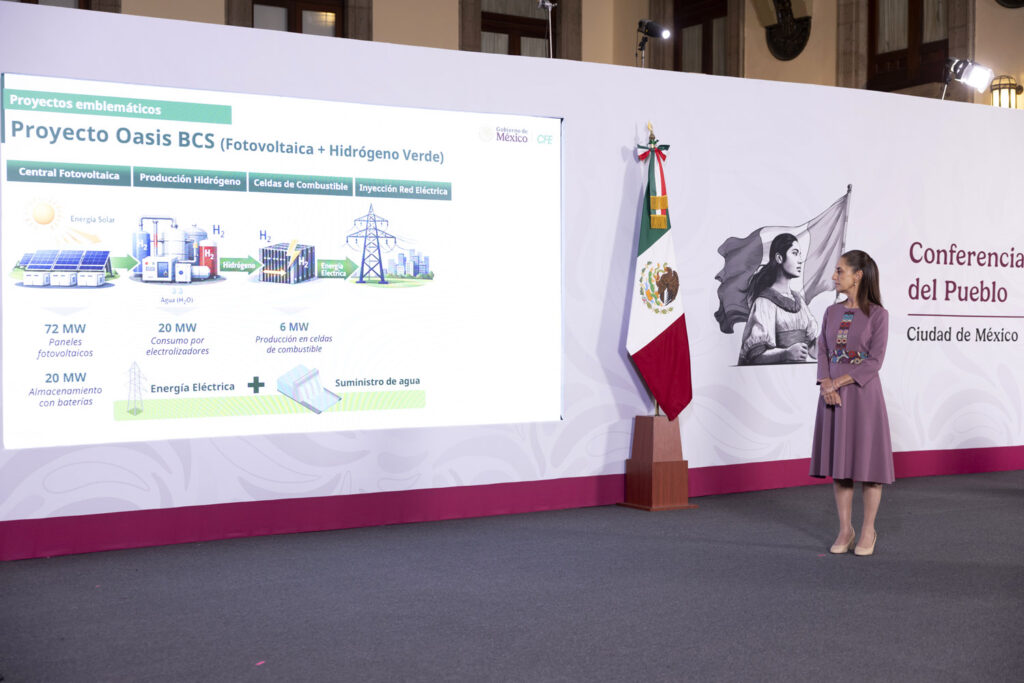
The general director of the CFE, Emilia Esther Calleja Alor, presented two projects of the plan. The first, called the Oasis Project, will be developed in the isolated electrical system of Mulegé, Baja California Sur, and will combine a 72 MW photovoltaic plant, 20 MW of battery storage, and green hydrogen production to guarantee continuous zero-emission supply, even during nighttime hours.
The second is the Rafael Galván photovoltaic plant, in Puerto Peñasco, Sonora, which upon completing its four stages will reach 1,000 MW of capacity and 246 MW of storage, making it the largest solar plant in the Americas, with a total investment of more than 1.4 billion dollars.
-
Defense of Sovereignty “Is Not Rhetoric, It’s Principles,” Sheinbaum Says
Sheinbaum recalled foreign pressure on Mexico in the 19th and 20th centuries and blamed the neoliberal governments and Calderón for opening the door to U.S. influence.
-
Sheinbaum Presents Draft Decree to Force Digital Platforms to Take Down Content That Incites Violence and Hate
No fines for now: the government will talk with tech companies before publishing the decree next week, a promise made after the Coahuila school attack.
-
People’s Mañanera October 9
President Sheinbaum’s daily press conference, with comments on digital safety, IMSS-Bienestar, sovereignty, and the opposition.