Mexico’s Filthy Rich
This editorial by Fabrizio Mejía Madrid originally appeared in the February 27, 2026 edition of Sin Embargo. The views expressed in this article are the authors’ own and do not necessarily reflect those of Mexico Solidarity Media or the Mexico Solidarity Project.
When I was a child in the 1970s, it was said that Mexico was a country of “contrasts.” The PRI assumed that inequality in the country was almost a folkloric image, worthy of being sold to the National Fund for the Promotion of Arts (FONART) or for a photojournalism prize. Then, when neoliberalism began under Miguel de la Madrid, the idea took hold that the wealth of the rich would, sooner or later, trickle down to those at the bottom because, if there are millionaires, they’re bound to invest, right? Later, during the PRIAN era, with Vicente Fox, Calderón, and Peña Nieto, the idea they tried to sell us was that there were two Mexicos: one developed and globalized, and the other backward and struggling to survive. None of this is true. In reality, there aren’t parallel Mexicos, but rather one—the Mexico of all of us—that feeds, sustains, and even flatters the other, the Mexico of the billionaires, like Slim, Larrea, and Aramburuzabala.
An Oxfam report released just a few days ago provides terrifying data about Mexico’s disgustingly rich. One of the most shocking findings is that the private sector invests less than 8 pesos out of every 100 it owns back into the Mexican economy. The idea that having many billionaires is good because they reinvest is a complete lie. They invest nothing. They hoard, spend abroad, and sail yachts flying the Cayman Islands flag. I repeat: less than eight pesos out of every 100 that the rich earn thanks to our collective effort returns to the economy in the form of investment. They are rentiers, clinging to their inherited fortunes, their connections to political and academic power, and they extort the State when it threatens even the crumbs they refuse to give us.
Carlos Slim and Germán Larrea’s wealth is supported by 18.8 million working Mexicans who lack access to nutritious, quality food, 38.5 million with social deprivations or incomes below the poverty line, two million people who work without pay, and 21 million women who dedicate at least eight hours a day to unpaid care work.
The Oxfam report states: “The wealth of Mexican billionaires stems primarily from business activities in poorly regulated or under-regulated sectors, poor working conditions for most workers, women’s double or triple shifts due to unpaid care work, environmental degradation caused by their large corporations, and the fiscal irresponsibility of the wealthiest.” It points to a global phenomenon of wealth concentration, but in the Mexican case, this is largely explained by the cronyism and nepotism practiced by Salinas de Gortari, Zedillo, Fox, Calderón, and Peña Nieto.
“Mexican fortunes are closely tied to the privatizations of the 1980s and 1990s, as well as to concessions, licenses, and permits to exploit public assets in strategic, often poorly regulated, sectors. As concession holders, contractors, or owners, they control key infrastructure, granting them veto power over the national development model.” Another falsehood is that they are billionaires because they are more adept at exploiting the market. That’s a lie. The wealthiest people in Mexico have grown faster than the economy. While the country grows at one percent, their fortunes grow at almost nine percent annually. This means they are responsible for the country’s one percent annual growth rate, while their wealth grows at seven percent each year. They are the ones hindering the country’s growth. Inequality is what prevents our development, and if you invest less than eight pesos out of every 100 you earn, things aren’t going to improve. That’s why it’s outrageous that the PRIAN (PRI and PAN parties) criticize the one percent growth rate, attributing it, as it suits them, to the cancellation of the airport at Lake Texcoco or to the failure of the economic strategy, and never to the appalling inequality the country experiences with voracious billionaires, more concerned with amassing fortunes than with innovating, taking risks, or transforming, as they claim to do from their business chambers and their Communication Councils, the Voice of Business.
Let’s talk about our billionaires. In the last three decades, their number has increased from 15 to 22 individuals between 1996 and 2025. During that same period, their combined fortunes grew from $52.3 billion to $219 billion. This means that, in three decades—those of neoliberalism and the PRIAN (PRI and PAN alliance)—their fortunes grew by almost nine percent each year, quadrupling their wealth simply because they hardly invest, because their taxes were forgiven, and because they were given incentives to establish companies that don’t regulate labor or environmental conditions, like Larrea in Sonora. I repeat the chilling statistic: the wealth in the hands of Mexican billionaires multiplied 4.2 times in just three decades, with an average real annual growth rate of 8.8 percent. Meanwhile, the country only grew at one percent when things were going well.
Mexico’s wealthy pay no taxes on their inheritances or estates. Mexico’s wealthy pay no taxes on stock market transactions.
Thus, Oxfam explains, between 1996 and 2025, Carlos Slim’s wealth increased more than eightfold, and that of billionaires multiplied 4.2 times, while the Mexican economy didn’t even double in size during those same years. Therein lies the double harmful effect of neoliberalism: it doesn’t serve to create growth, only to concentrate wealth. It extracts wealth, it doesn’t generate it. The wealthiest one percent of the Mexican population—a mere 1.3 million people, not counting your PAN-supporting aunts on WhatsApp—receives 35 percent of the total income of the economy, owns 40 percent of the nation’s private wealth, and is responsible for 23 percent of the country’s polluting emissions. Slim and Larrea’s wealth is supported by 18.8 million working Mexicans who lack access to nutritious, quality food, 38.5 million with social deprivations or incomes below the poverty line, two million people who work without pay, and 21 million women who dedicate at least eight hours a day to unpaid care work. And speaking of pollution, the wealthiest one percent of Mexico pollutes as much as the poorest 74 percent of the population.
Let’s talk about our billionaires. In the last three decades, their number has increased from 15 to 22 individuals between 1996 and 2025. During that same period, their combined fortunes grew from $52.3 billion to $219 billion. This means that, in three decades—those of neoliberalism and the PRIAN (PRI and PAN alliance)—their fortunes grew by almost nine percent each year, quadrupling their wealth simply because they hardly invest, because their taxes were forgiven, and because they were given incentives to establish companies that don’t regulate labor or environmental conditions, like Larrea in Sonora. I repeat the chilling statistic: the wealth in the hands of Mexican billionaires multiplied 4.2 times in just three decades, with an average real annual growth rate of 8.8 percent. Meanwhile, the country only grew at one percent when things were going well.

Carlos Slim, the richest man in Mexico and Latin America and the Caribbean, has never been wealthier than he is today. Slim’s fortune totaled $107.1 billion as of November 2025, the largest amount in his history of political connections. Since 2020, with the pandemic, his wealth has increased by an average of $23.65 million per day, equivalent to $273 per second. A person with an average salary, like you or me, would need to work a week to earn what he earns in one second. Someone earning minimum wage would need 20 days to earn what he earns in one second. We know Slim as the one who was able to buy Telmex because he contributed money to Carlos Salinas de Gortari’s campaign. But lately, Slim has been a key partner of Petróleos Mexicanos (PEMEX) with large investments in oil and gas projects.
The pandemic was a boon for these disgustingly rich individuals. Their wealth grew by 101 percent in real terms, that is, after adjusting for inflation. During the pandemic, Carlos Slim increased his fortune by 66 percent, while Germán Larrea’s multiplied 2.4 times. To try and avoid getting lost in this nauseating array of numbers, Oxfam offers an example. Let’s say these Mexican billionaires are told they can keep their fortunes as they were before the pandemic, but that they have to invest the rest in hiring workers at the 2025 minimum wage. How many jobs do you think they could have created? 21 million for an entire year—that’s almost two out of every three people in the informal labor market in Mexico. That’s the magnitude of the obstacle preventing Mexico from achieving greater growth.

Now let’s look at this. Between 1981 and now, the country’s annual growth rate has averaged two percent. That is, during the neoliberal era and despite the adjustments made by the current administration. In 35 years, per capita income has only increased by 16 percent compared to 1981, even without adjusting for inflation. In Brazil, it grew by 58 percent, in Spain by 98 percent, and in China by 2,796 percent.
The Oxfam report states: “For every peso the Mexican economy as a whole had in 1996, it had 1.76 pesos in 2025, adjusted for inflation. Meanwhile, the richest 10 percent had 2.14 pesos; the richest one percent, 2.38 pesos; and the wealthiest 0.0001 percent—that is, the 22 billionaires—4.20 pesos. 4.20 pesos in an economy of a mere 1.76 pesos. For every peso they had in 1996, they now have 4.20 pesos. Their wealth grew twice as fast as the Mexican economy. That wealth, produced by all of us who work, was siphoned off by the yachts and mansions of our beloved magnates.”
In 35 years, Mexico’s per capita income has only increased by 16 percent compared to 1981, even without adjusting for inflation. In Brazil, it grew by 58 percent, in Spain by 98 percent, and in China by 2,796 percent.
But the picture one can draw from the Oxfam report is equally devastating, beyond the numbers. It turns out that we have an elite that originates when the State transfers public assets—the wealth generated by everyone—to a few elderly men (there’s only one woman) who have close ties to the neoliberal PRI and the PAN. Then, they are granted concessions for national resources, such as mines, oil, electricity, water, and natural gas. They also control education, healthcare, and even prisons. Already flush with money, they begin to exert a dominant influence on political decisions because they wield the power of extortion. They own telecommunications, investments in banks, mining, healthcare, and infrastructure such as highways, ports, airports, and water concessions. I’ll focus on just one point: the healthcare data is terrifying. In 2024, the majority of patients, 58 percent, received care in private medical services, not public ones. In other words, those who fall ill have to resort to private healthcare because the public system is insufficient or provides inadequate care. This amounts to extortion in a country with chronic diseases, a reality brought to the forefront by the pandemic: obesity, diabetes, and hypertension.
The wealthy pay no taxes on their inheritances or estates, and increasingly powerful hereditary dynasties have been established. Oxfam proposes that inheritances, gifts, and estates exceeding one million dollars be taxed. Furthermore, they propose a two percent tax on those with more than one billion dollars; a minimum tax of two percent on fortunes exceeding one billion dollars. The wealthy pay no taxes on their stock market transactions. Last year, the stock market gained 30 percent, yet no taxes are paid on this, which is not productive but rather vile speculation.
Although AMLO and the President have made them pay what they owe by law, the truth is that the wealthy don’t pay their fair share. In 2025, people with annual incomes exceeding 500 million pesos contributed only 21 cents out of every 100 pesos collected in federal taxes, that is, 0.21 percent. There is an abysmal disparity between them and us when it comes to paying taxes. They pay 10 percent on dividends, while we pay 35 percent in Income Tax. This injustice must be addressed. Another point: Of all the properties that are not primary residences—that is, apartments held solely for renting to tenants or tourists, vacation homes, and resorts—half are registered in the names of the wealthiest five percent. So they should pay more property taxes than those of us who live where we contribute, because they are nothing more than land speculators. And they should pay more for polluting more. It would take an average Mexican two centuries to pollute what a billionaire pollutes with his private planes, helicopters, and yachts.
What I’m saying is that, up to now, the 4T (Fourth Transformation) has acted to try to mitigate the effects of neoliberalism, but it should emphasize a project that prevents them. Reclaiming the State’s role in the economy means that the decision about how money is invested rests with the State, which should ensure that this investment benefits people, provides good working conditions, doesn’t pollute, and creates more wealth where it’s located. We’ve celebrated the fact that taxes are being collected, that more foreign direct investment is arriving, and that more jobs are being created, but it’s not enough. The inequality is that of a country that, to this day, supports 21 men and one woman who contribute almost nothing to improving the country. It’s time to reclaim the power that was lost when Miguel de la Madrid came to power in 1982 and began to transfer away everything that many generations of Mexicans had helped to build.
-
UN Meddles in Mexico: Flawed Disappearances Report Highlights Broken System – Soberanía 102
UN Committee on Enforced Disappearances, migrant deaths in the US, Mexico’s new Foreign Secretary Roberto Velasco, and deterrence in Mexico.
-
People’s Mañanera April 8
President Sheinbaum’s daily press conference, with comments on Chiapas housing, Mexico’s energy system, US and Iran ceasefire, and BlackRock public-private partnerships.
-
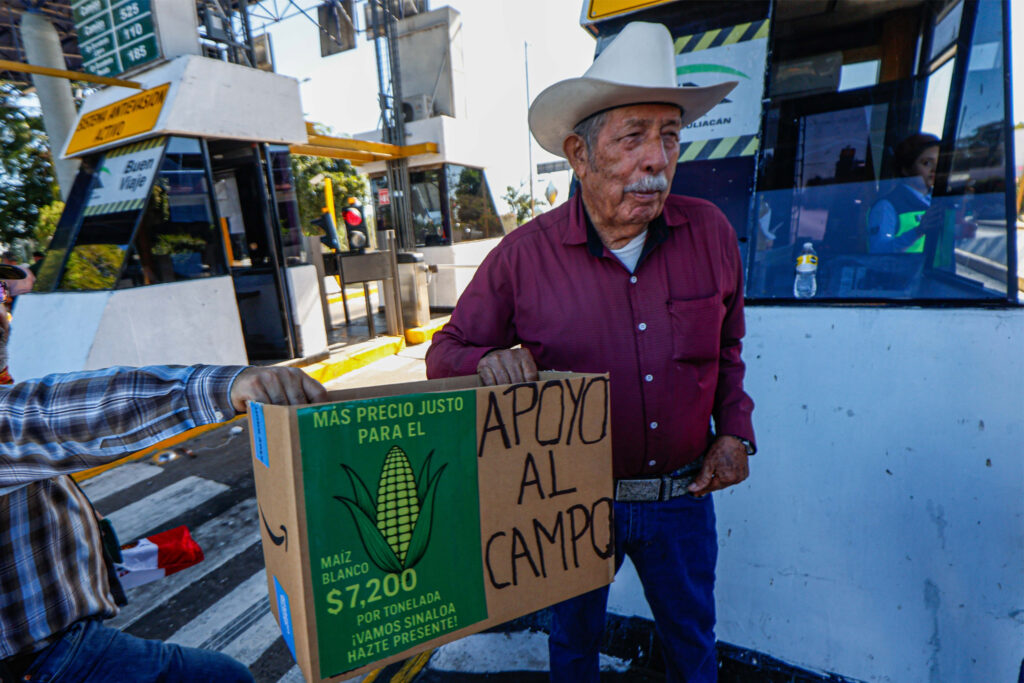
The USMCA is Causing a Decline in Mexican Agriculture
What can the phrase “Without corn, there is no country” mean when domestic corn production is on its last legs in the face of US dumping and the state’s inability to fight neoliberal free trade?