Pasta de Conchos: Industrial Homicide
This editorial by Napoleón Gómez Urrutia originally appeared in the February 19, 2026 edition of La Jornada, Mexico’s premier left wing daily newspaper.
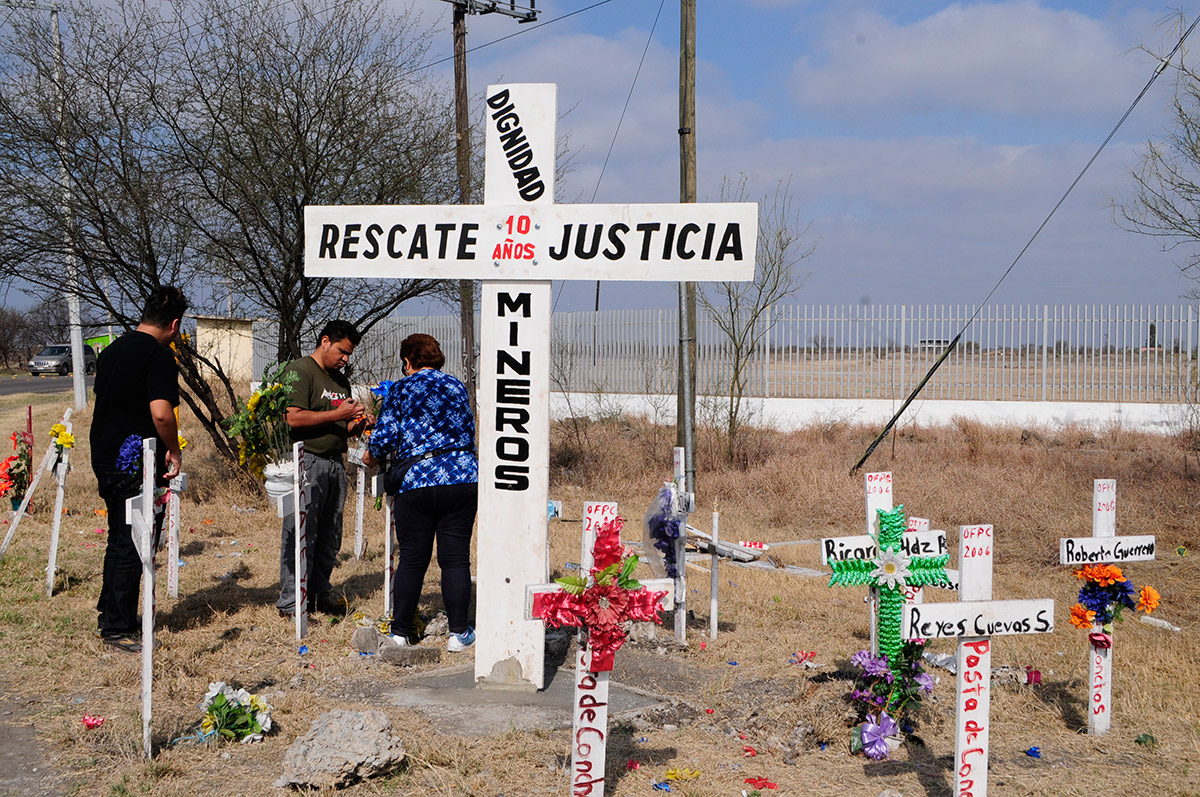
Today marks 20 years since one of the most unfortunate and tragic events in modern Mexican history: the Pasta de Conchos mine disaster. A fatal accident at this mine claimed the lives of 65 miners. But the disaster didn’t end there: two decades later, the families continue to demand justice, as not all the bodies have been recovered, nor has the company been fully held accountable, still enjoying complete impunity. From the outset, the company refused to accept responsibility, suspending rescue efforts just five days later with the help of the then-PAN government. Even more tragically, the rescue efforts remained suspended for years, leaving 63 fellow miners trapped underground, as only two bodies were recovered in the initial months.
Thus, Pasta de Conchos has become a lamentable case of corruption, impunity, and the treacherous pact that previous governments forged with a corrupt and vile business elite. What happened in San Juan Sabinas, Coahuila, reminds us that neither the then-president, Vicente Fox, nor Grupo México, nor its owner, Germán Feliciano Larrea Mota Velasco, went to the mine to offer comfort or answers to the families, nor to assist in the search efforts. Instead, they did everything possible to cover up the tragedy with a veil of indifference and oblivion, just 120 meters underground. This act of impunity must never be forgotten; we cannot allow it to happen again, neither in Mexico nor anywhere else in the world. The Pasta de Conchos catastrophe is a clear example of the overbearing, arrogant, and utterly criminally negligent attitude with which the company acted. This complicity, this collusion between governments and corporations, between political and economic power, normalized appalling working conditions. The authorities were tolerant of the company, and today, 20 years later, the bailout has not been completed, nor has full justice been served.

From the outset, workers had reported serious safety deficiencies at the mine: inadequate ventilation, methane gas buildup, and a lack of essential equipment to protect miners’ lives. Although the company maintained that the mine was safe, subsequent investigations and testimonies indicated that conditions were precarious and dangerous. A few days after the disaster, the mine was closed with the support of federal and state forces, halting the search efforts. For nearly five years, the rescue plan proposed by Grupo México has been pursued without success and at an exorbitant cost. Every advance spearheaded by the National Union of Miners, supported by a group of serious, responsible, and prestigious rescuers and engineers, was arbitrarily suspended, demonstrating the indifference of the Mexican business class.
It is unacceptable and profoundly detrimental to workplace culture that companies protect their interests at the expense of workers’ lives. The responsibility for ensuring workplace safety lies with companies, as established by the Federal Labor Law and the Constitution. It turns out that during two PAN administrations and one PRI administration, a company the size of Grupo México enjoyed absolute impunity and state tolerance, to the detriment of the miners who lost their lives and their families. Clearly, if the law were upheld, those responsible for tragedies like this would be held accountable and face legal and criminal consequences.
The tragedy disrupted labor relations and unleashed a conflict that included the political persecution I suffered, along with my family, which led to my exile. It is unacceptable that the country’s leading mining group, headed by one of Mexico’s wealthiest businessmen, chose to abandon the workers instead of redoubling efforts to rescue them. The lack of ethics and cowardice of the owners, shareholders, and board members has been evident throughout these years; they have preferred to bury the tragedy quickly. But from the Mining Union, we stand with the widows, families, and victims of this company: we resist and continue to raise our voices, denouncing the irregularities in this process, so much so that the new rescue efforts have recovered some bodies, whose forensic analysis contradicts the initial accounts.
While it was reported that there had been a devastating explosion and uncontrollable fires, several of the recovered bodies were found intact, with their work gear, boots, and headlamp belts. This reinforces the conviction that there were collapses, but also that the company fabricated a narrative to justify suspending operations. The difference with what happened in 2010 at the San José mine near Copiapó, Chile, where 33 miners were rescued alive after 69 days trapped 750 meters underground, demonstrates that when there is political and corporate will, it is possible to act responsibly and with solidarity. But when that will is lacking, lives are lost, as in Pasta de Conchos.
Faced with this unfortunate situation, I made three fundamental proposals: the immediate rescue of the workers; an objective, independent, and impartial investigation to determine the causes and punish those responsible to the full extent of the law; and, in the event of death, fair and dignified compensation for the families. Furthermore, I championed a bill that would include industrial homicide as a criminal offense, so that corporate responsibility would not be diluted by administrative procedures.
Today, after a long and painful history, this latest initiative continues its progress in the Chamber of Deputies. The aim is to strengthen the legal framework so that companies’ obligation to guarantee safety is not merely a dead letter and that, when negligence results in death, there are clear criminal consequences. It is about transforming the world of work into a fairer and more dignified one, where the lives of workers are valued more than any profit, gain, or financial balance sheet.
Although in recent years the Mexican State has resumed the search for the remains and several bodies have been recovered—some identified and returned to their families—the process is not yet complete. Each discovery confirms that reparations have been late and partial, and that the families’ grief has been unnecessarily prolonged. Pasta de Conchos is a testament to how corruption and impunity can prevail over human dignity when political and economic power act in collusion. It is also an affirmation of a profound principle of mining ethics: one miner never abandons another. As long as there is a body to be recovered and a responsibility to be established, this demand will remain.
Pasta de Conchos is not forgotten and cannot be abandoned. Because there can be no justice if it is not for everyone, and because only when the law reaches those who, through action or omission, endangered the lives of 65 workers, can it be said that Mexico has begun to settle this historical debt with its working class.
-
Struggles of the Women’s Secretariat: From Combating Femicide to Political Violence
An interview with Mexico’s Secretary for Women, Citlalli Hernández Mora.
-
Mexico’s National Farmers Strike Begins Today in 20 States
Organizers considered the government’s has no interest in resolving the agricultural crisis, and balked at the demand that they not hold any demonstrations during this year’s World Cup.
-
Mexico’s Unpaid & Exploited Gas Station Attendants
Slave-like working conditions and numerous abuses persist; while the majority of workers lack employment contracts, wages, social security, and benefits.