
No to Fracking
This editorial by Ariana Escalante Kantún originally appeared in the April 14, 2026 edition of Sin Embargo. The views expressed in this article are the authors’ own and do not necessarily reflect those of Mexico Solidarity Media or the Mexico Solidarity Project.
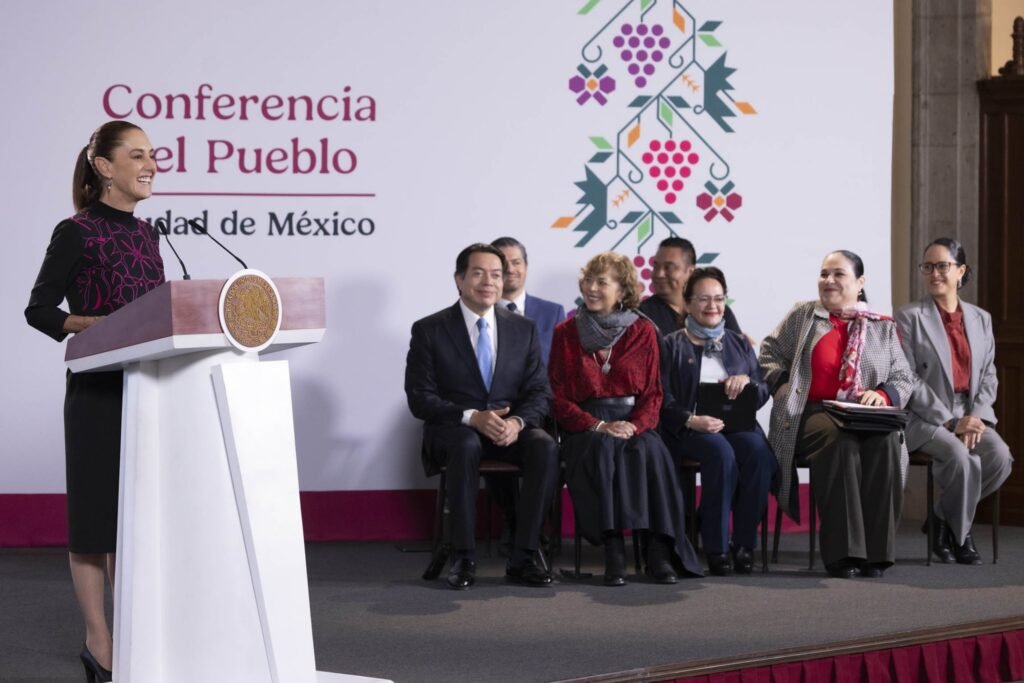
On April 8th, President Claudia Sheinbaum presented a report titled “Natural Gas: A Strategy to Strengthen Energy Sovereignty” during a daily press conference. The first slide stated that fossil gas, often incorrectly called natural gas, is a gaseous fuel used in industrial processes requiring heat, as well as in electricity generation and domestic use. She added that it is a less polluting fuel than coal, fuel oil, and other petroleum products. Interestingly, what she omitted was that methane is the main component of “natural gas,” and despite having up to 30 times the global warming potential of CO2, its use in the global energy mix has increased by 67 percent in the last two decades.
We agree with the diagnosis that Mexico has a high dependence on natural gas since it imports more than 70 percent from the United States, which has implications that the presentation indicates: sensitivity to international variations, vulnerability to climatic events, vulnerability to international conflicts, limitations in regional development, uncertainty in the guarantee of supply and dependence on foreign decisions.
To avoid all of the above, the administration proposes increasing fossil gas production through fracking. Paradoxically, gas production in Mexico has been declining for 17 years. Production is currently at 3.6 billion cubic feet per day (MMcf/d), 35 percent less than the peak in 2009. This is also evident in the information presented at the morning press conference, where a graph projects that by 2030 production will reach 2.192 billion cubic feet per day, and that the country as a whole will produce 5.871 billion cubic feet per day. However, Mexico currently demands 9 billion cubic feet per day, and this figure does not include the 30 percent increase in demand projected by the Ministry of Energy itself. In other words, even with increased fossil gas production, we would not be able to meet half of our energy consumption.
Mexico currently demands 9 billion cubic feet [of gas] per day, and this figure does not include the 30 percent increase in demand projected by the Ministry of Energy itself: even with increased fossil gas production, we would not be able to meet half of our energy consumption.
What venturing into the highly polluting technology of fracking would cause is serious environmental damage. It is a hydrocarbon extraction technique that involves injecting large volumes of fluids under pressure to fracture rocks containing trapped gas and oil. In this technique, a single well can consume between 9,000 and 29,000 cubic meters of water, equivalent to between 2.4 and 7.7 Olympic-sized swimming pools. In a typical field where six wells are drilled to extract all the gas from the reservoir, between 54,000 and 174,000 cubic meters of water would be used. This poses a significant risk, as several regions of the country are experiencing water stress. Furthermore, liquefaction plants and the transport of gas by LNG carriers involve significant methane emissions, risks of spills, disruption of local productive activities, and irreversible transformation of marine ecosystems due to increased maritime traffic.
Despite claims that fracking is more environmentally friendly, this is false. After two decades of fracking in the United States, there is extensive scientific literature documenting the environmental and social impacts of this technique in the regions where it has been practiced, including air, groundwater, and surface water pollution from leaks or spills of fracturing fluids.
Techniques like fracking are part of the idea that technology can solve everything, reflecting a blind faith in science that assumes that by producing major technological advancements we can solve any problem, such as the depletion of gas and oil reserves. However, this is inherently contradictory, as it ignores and defies fundamental laws of physics, such as thermodynamics, which establish limits on the energy and work that can be performed in a given system. In other words, it acknowledges the impossibility of infinite growth on a finite planet with limits that restrict our growth and the use of energy and common resources.
The use of fracking in Mexico will not guarantee energy sovereignty and will not lead to a just energy transition. Dependence on fossil fuels also presents significant challenges, especially during times of high geopolitical tension, where we have seen that rising prices compromise, for example, food security.
Mexico is missing a crucial opportunity to lead regional change to reverse its fossil fuel dependency, combat energy poverty inequalities, and guarantee socio-environmental justice for all its people and their territories. Mexico must develop a clear roadmap, tailored to the country’s specific challenges, for the orderly phase-out of fossil fuels. This roadmap should include sectoral diversification of energy sources, an analysis of high consumption patterns, and prioritizing the most stable energy sources for hospitals, schools, health centers, and other essential services. Fossil fuel dependency is causing more problems than it solves and seriously jeopardizes our right to a healthy environment. Therefore, we reaffirm our opposition to fracking—not here, not there, not today, not ever.
-
People’s Mañanera October 16
President Sheinbaum’s daily press conference, with comments on recovered assets, public education, security, and exports.
-
Mexico Does Not Have the Capacity to Confront the Cartels, Trump Says
Speaking at the White House, Trump claimed without evidence that cartels control Mexico and warned they have a deadline to “basically surrender.”
-
Mexico’s Secretary of Governance Announces Group of Experts Will Analyze National Registry of the Disappeared
Backed by the UN human rights office, Mexican and U.S. scientists will audit the registry, while 16,003 people reported missing have been located.