Beyond the Rubble
This article by Teri Mattson originally appeared in the July 30, 2026 edition of LA Progressive.
After a pair of powerful earthquakes struck northern Venezuela last month, images of collapsed buildings, rescue crews, and devastated neighborhoods quickly spread around the world. Headlines tracked the mounting toll of deaths, injuries, and displacement.
But beyond the rubble, another story was unfolding—one that received far less attention. Across the affected communities, an extensive network of communes, community councils, and neighborhood organizations mobilized alongside emergency responders, revealing a grassroots infrastructure years in the making.
Returning from Venezuela with an international solidarity delegation organized through ALBA Movimientos, Tim Biondo traveled through communities in La Guaira where entire neighborhoods had been reduced to rubble.
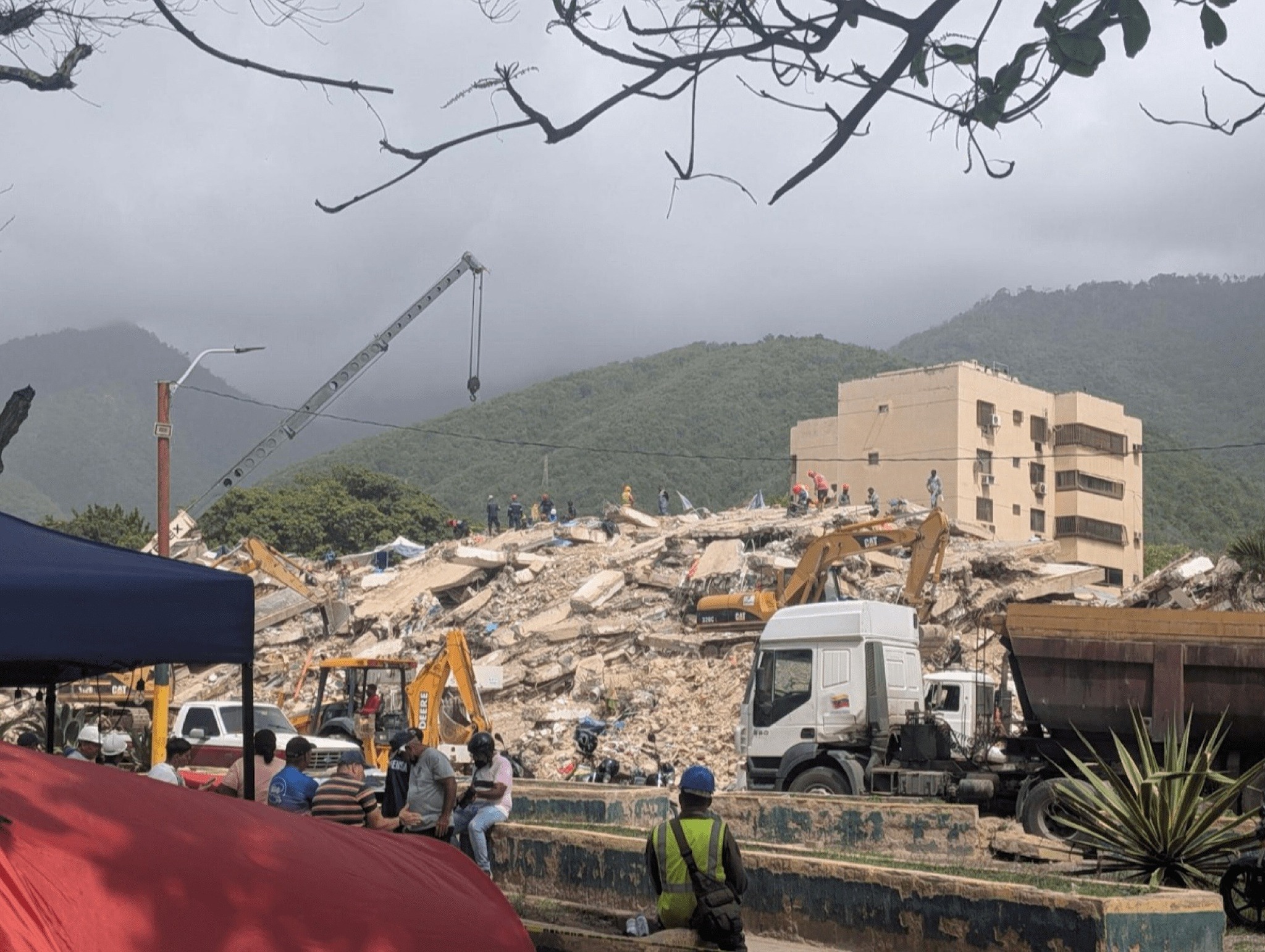
“The only comparison I can make is that it looked like a war zone. Entire communities had been reduced to rubble. Some buildings stood like skeletons. You could see a child’s bedroom exposed to the open air, closets with clothes still hanging inside—the intimate details of people’s lives suddenly laid bare.”
Search-and-rescue teams worked around the clock in suffocating heat, carefully clearing debris by hand before heavy machinery could safely move in. Apartment buildings stood open to the sky, exposing family photographs, furniture, and the ordinary objects of everyday life that remained even after the walls surrounding them had disappeared.
Yet what remained with Biondo after returning home was not simply the destruction.
It was how quickly communities organized themselves to respond.
For years, much of the Western coverage of Venezuela has focused on political polarization, sanctions, economic hardship, and institutional crisis. In the aftermath of one of the country’s worst natural disasters, however, Biondo encountered another story—one rarely reported outside Venezuela. Community councils, communes, healthcare workers, neighborhood organizations, and thousands of volunteers mobilized almost immediately, creating an extensive relief network while search-and-rescue operations were still underway.
“It wasn’t chaos,” Biondo recalled. “People knew what they needed to do.”
Institutions Before Disaster
Understanding that response requires looking back more than two decades.
The community councils and communes that became indispensable after the earthquakes were not created as emergency institutions. They emerged from Hugo Chávez’s vision of participatory democracy—an effort to shift decision-making from centralized bureaucracies into organized neighborhoods where residents could identify local needs, elect community leadership, and work collectively to solve common problems.
Over more than twenty years, Venezuela built a nationwide network of community councils and later expanded that work through the creation of communes—institutions responsible for identifying local priorities, coordinating public resources, and strengthening civic participation.
Supporters viewed the projects as an effort to deepen democracy at the grassroots level. Critics questioned both their political objectives and their effectiveness.
The earthquakes offered something different from either argument. They offered an opportunity to observe these institutions under extraordinary circumstances.
As part of Hugo Chávez’s political legacy, the neighborhood institutions he envisioned more than two decades ago were no longer simply an ambitious political project. They had become an operational reality when Venezuela faced one of the greatest disasters in its modern history.
Biondo witnessed that operational capacity almost immediately.
“A lot of the work of the communes was surveying their own communities and working together with the government,” he explained. “They were identifying which buildings had been impacted, who needed relocation, where it was safe, and what additional capacity existed. The government, in coordination with the Union of Communes, asked communes across the country to identify how many displaced families they could take in.”
In one commune, leaders walked Tim through a detailed survey of its neighborhood. Maps covered with notes identified damaged buildings, unsafe areas, families requiring relocation, and structures that could safely receive displaced residents.
Rather than waiting for outside direction, neighborhoods already possessed the leadership, relationships, and communication networks needed to respond immediately in coordination with municipal, regional, and national institutions.
Thousands of national communes, cooperative stores and collective enterprises were transformed almost overnight into collection and distribution centers for food, water, and emergency supplies.
Rebuilding More Than Buildings
The response Biondo witnessed extended far beyond emergency relief.
More than one hundred temporary shelters had been established in schools, cultural centers, community buildings, and tent communities, many operating in coordination with nearby communes.
“Every place we went had what we would call wraparound services,” Biondo said. “There were fully staffed kitchens preparing three hot meals a day. Everywhere we went, they offered us food too. That really astounded me. It’s such a Venezuelan expression of hospitality.”
Medical care accompanied nearly every shelter, but what surprised them most was the attention given to emotional recovery.
“It didn’t even occur to me how traumatic an event like this is. Even if you didn’t lose anybody, you’ve lost your routines, your sense of safety—your whole life has been turned upside down. Everywhere I went there were psychologists and mental health workers supporting people around the clock.”
Children played basketball while volunteers organized games, art activities, and performances to restore a sense of normalcy. Doctors, nurses, and mental health professionals volunteered long hours because they considered it both a responsibility and an honor to serve communities facing profound loss.
These details rarely dominate international headlines, yet they reveal something fundamental about disaster recovery. Communities are rebuilt not only by removing rubble, but by restoring the rhythms of everyday life.
Order Amid Devastation
Biondo also spent time observing active search-and-rescue operations.
Online commentary suggested heavy machinery often sat idle while little work was taking place.
That was not what they found.
Buildings had been marked according to internationally recognized rescue protocols indicating where survivors might still be located, where remains were believed to be, which structures had already been searched, and which had become too unstable to enter safely.
“People see a bulldozer standing idle and assume nothing is happening. In reality, that often means crews are still searching with small power tools and by gloved or bare hand.”
Far from inactivity, rescue workers continued painstaking searches while civil protection units from across Venezuela reinforced local responders—many of whom had themselves suffered personal loss during the earthquake.
The methodical pace reflected not delay, but the difficult reality of disaster response, where preserving the possibility of finding survivors takes precedence over clearing debris quickly.
Recovery Within a Hemisphere in Transition
What emerged from the rubble was not only an effective response to catastrophe, but evidence of a nation navigating a profound period of regional change.
Over the past several years, conservative governments have regained political ground while progressive governments and social movements have confronted renewed political and economic pressures. Those competing visions shape debates over democracy, sovereignty, development, and regional integration throughout the hemisphere.
Biondo observed that the earthquake quickly became part of that larger political struggle.
“One thing I hadn’t heard before going was how quickly the Salvadoran government responded. People I spoke with viewed that response as highly political—as an opportunity to showcase the supposed effectiveness and necessity of Bukele’s right-wing model. Of course, people in El Salvador genuinely wanted to help the Venezuelan people, but humanitarian aid was being filtered through a much larger political narrative.”
Their observation illustrates how rapidly a humanitarian catastrophe became another arena in which competing political visions for Latin America were advanced.
Supporters of Venezuela’s Bolivarian process continue to express concern that expanding U.S. military engagement in the Caribbean and northern South America reflects broader efforts to strongarm governments throughout the region to align more closely with Washington’s strategic priorities. This reality forms an important part of the political context through which many Venezuelans understand both the recovery effort and their country’s future.
The earthquakes did not suspend politics.
They became another chapter in the broader struggle over Latin America’s direction.
Beyond the Headlines
Near the end of our conversation, I asked Biondo what had surprised him most after spending a week documenting the recovery.
Their answer had little to do with politics.
Despite the grief, life continued.
Children played basketball outside temporary shelters. Families gathered together after long days of uncertainty. Neighbors prepared meals, cared for one another, and slowly rebuilt routines amid extraordinary loss.
Reflecting on what they had witnessed, Biondo paused before offering an observation that stayed with me long after our interview ended.
“That is just so Bolivarian. It’s such a transformed sense of humanity. It really made me emotional—especially when I think about our response to catastrophe and crisis in the United States.”
No one who visited La Guaira would minimize the scale of the catastrophe. Recovery will take years, and thousands of families continue to navigate profound loss.
But natural disasters expose the strengths and weaknesses of every society.
In Venezuela, the earthquakes exposed terrible destruction.
They also revealed something less visible.
After more than two decades of building community institutions, Venezuelans proved that they had become far more than an ambitious political vision. They had become the social infrastructure through which ordinary people responded when disaster struck.
For many outside the country, that may be the most important story they have yet to hear.
Teri Mattson currently works with the Venezuela Solidarity Network. She is an activist with the SanctionsKill coalition and CODEPINK's Latin America team. Her writing can be found at Anti-War.com, CommonDreams, Jacobin, and LA Progressive. Additionally, Teri hosts and produces the YouTube program and podcast WTF is Going on in Latin America & the Caribbean.-
People’s Mañanera October 21
President Sheinbaum’s daily press conference, with comments on Pemex, fuel theft, Jalisco’s water crisis, missing persons, and the lie detector.
-
Jáuregui’s Arrest Does Not Close the CIA Case in Chihuahua; Morena Demands Broader Investigations
Morena leader Ariadna Montiel holds Governor Maru Campos politically responsible and says ex-prosecutor Guillermo Zuany must also face justice.
-
Morena Accuses Violation of the Secular State Over Award Ceremony for Evangelicals in the Chamber of Deputies
A representative of Israel’s embassy attended the PRI-hosted event, and the group’s founder was arrested in the U.S. for drug trafficking in 2007, Morena deputies said.